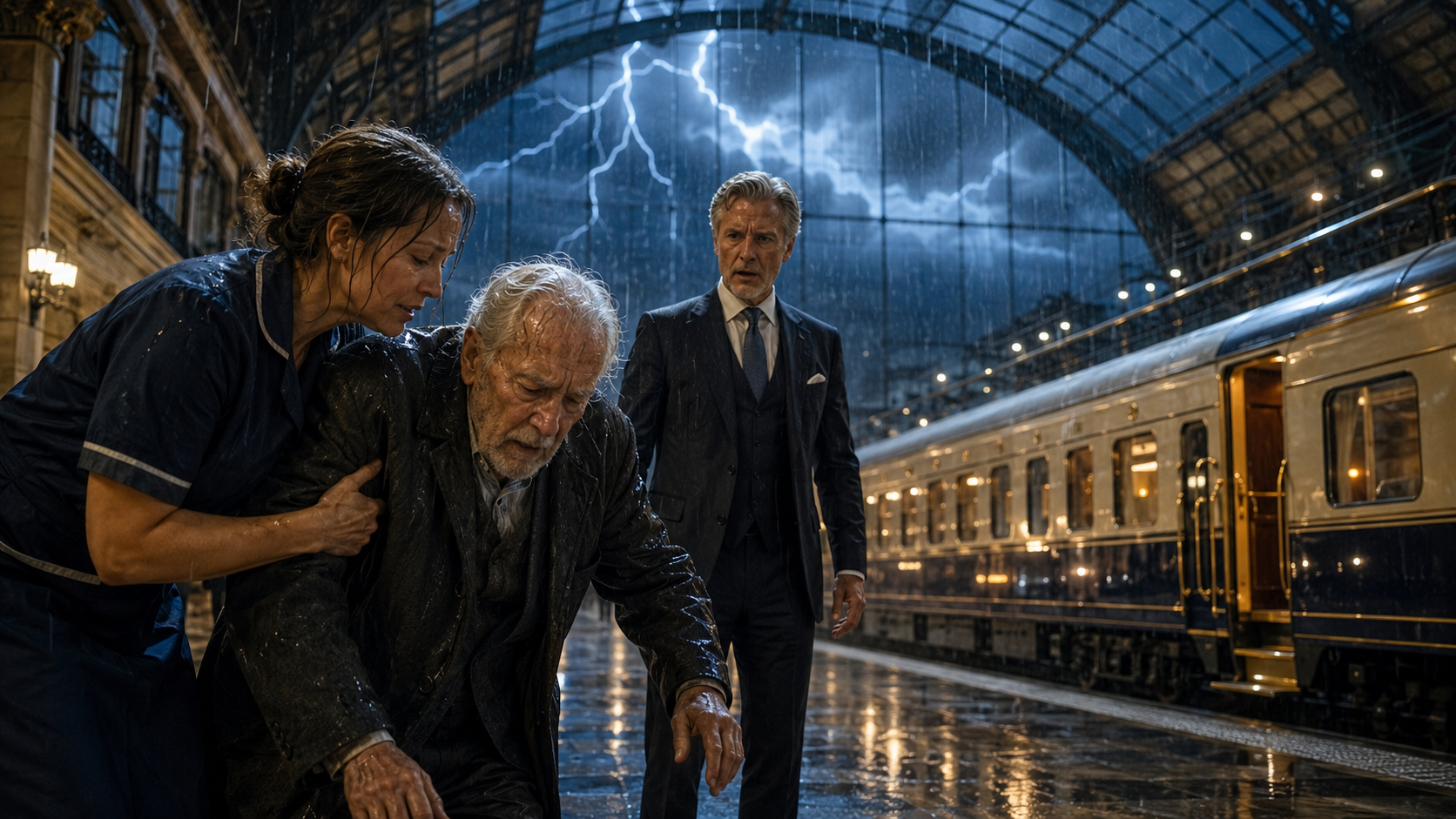
“She listened when everyone with authority refused.”
“She gambled with your reputation.”
“She gambled her job and her daughter’s medication to help a man she believed was nobody.”
Victor’s mouth twisted.
“No one believes another person is nobody. They simply fail to recognize the price.”
Bennett stared at him.
“That sentence explains everything wrong with you.”
“It explains business.”
“No. It explains why you should never again be responsible for human beings.”
Victor’s eyes turned cold.
“You remove me today, and I will tell every investor that an unstable old man now influences company decisions. I will tell them the emergency stop was reckless. I will show them how your employee violated protocol.”
Bennett collected the letters.
“Do it.”
“You will lose the Harrington agreement.”
“Then I will lose it.”
“The board will remove you.”
“Then they will remove me.”
Victor laughed in disbelief.
“You spent your entire life building this.”
Bennett looked at his father’s handwriting.
“That is why I finally understand what it is worth.”
5. THE PRICE OF ONE NIGHT
Elena found Sophie asleep in a chair beside Gideon’s hospital bed.
Mrs. Alvarez had brought the child to the hospital after the pharmacy visit because the terminal district remained closed by flooding.
Sophie was eight years old, small for her age, and incapable of entering a room quietly. Yet she slept with surprising seriousness, one arm wrapped around a purple backpack containing her emergency medication.
Gideon was awake.
He looked at the child.
“She snores like a locomotive.”
“She does not.”
Sophie made a soft rumbling sound.
Gideon raised his eyebrows.
Elena smiled.
“Maybe a small locomotive.”
He had been cleaned, warmed, and dressed in hospital clothing. Without the mud and rain, he appeared less like a vagrant and more like an exhausted professor who had wandered away from his lecture.
“How are you feeling?” Elena asked.
“Like a bridge fell on me.”
“You were not on the bridge.”
“Then I have no excuse.”
She placed a cup of tea near him.
“Do you remember last night?”
“Pieces.”
“You stopped a train.”
“You pulled the lever.”
“You showed us which one.”
“Then we both behaved irresponsibly.”
“I have been told that.”
Gideon looked toward Sophie.
“You spent her medicine money on me.”
“I got it back.”
“You were not certain you would.”
“No.”
“Why?”
Elena considered the question.
“Years ago, my mother collapsed at a bus station. People walked around her because they thought she was drunk.”
Gideon watched her.
“She had suffered a brain hemorrhage. A teenage boy finally called for help, but too much time had passed.”
“I’m sorry.”
“I remember standing in the hospital afterward and thinking how strange it was that a person could spend her whole life being someone’s mother, sister, neighbor, and friend, then become an obstacle on the floor because strangers did not know her story.”
She adjusted Sophie’s blanket.
“I promised myself I would never need a person’s history before deciding they mattered.”
Gideon’s eyes glistened.
“Your daughter will learn that from you.”
“I hope she learns to be kinder and less impulsive.”
“Kindness without impulse is often only an intention.”
The door opened.
Bennett entered carrying a wooden box.
Sophie woke immediately.
“You’re the train man,” she said.
Bennett stopped.
“I suppose I am.”
“My mom says you own the terminal.”
“Yes.”
“Does that mean you own all the clocks?”
“No.”
“Then why do they all have your name under them?”
Bennett looked at Elena.
“She has had a long night.”
“She gets more direct when she’s tired.”
Sophie examined him.
“Did you fire my mom?”
“No.”
“Are you going to?”
“No.”
“Did she break a rule?”
“Several.”
“Then why aren’t you firing her?”
Bennett glanced at Gideon.
“Because some rules protect people, and some protect powerful people from embarrassment. Your mother understood the difference before I did.”
Sophie considered that.
“Good answer.”
Elena hid a smile.
Bennett approached the bed and placed the wooden box on Gideon’s lap.
“I kept this in storage.”
Gideon opened it.
Inside lay a model locomotive painted green, a signalman’s red flag, several black-and-white photographs, and a small notebook with a cracked leather cover.
Gideon touched the locomotive.
“You broke the front wheel.”
“I repaired it.”
“Badly.”
“I was nine.”
“You used kitchen glue.”
“It was available.”
Gideon opened the notebook.
The first pages contained diagrams of tracks, bridges, and warning systems. Later pages were filled with Bennett’s childhood drawings.
One showed a bird flying above a railway.
Beneath it, in a child’s handwriting, were the words:
THE FALCON LINE — FASTEST TRAIN IN THE WORLD.
Gideon looked at Bennett.