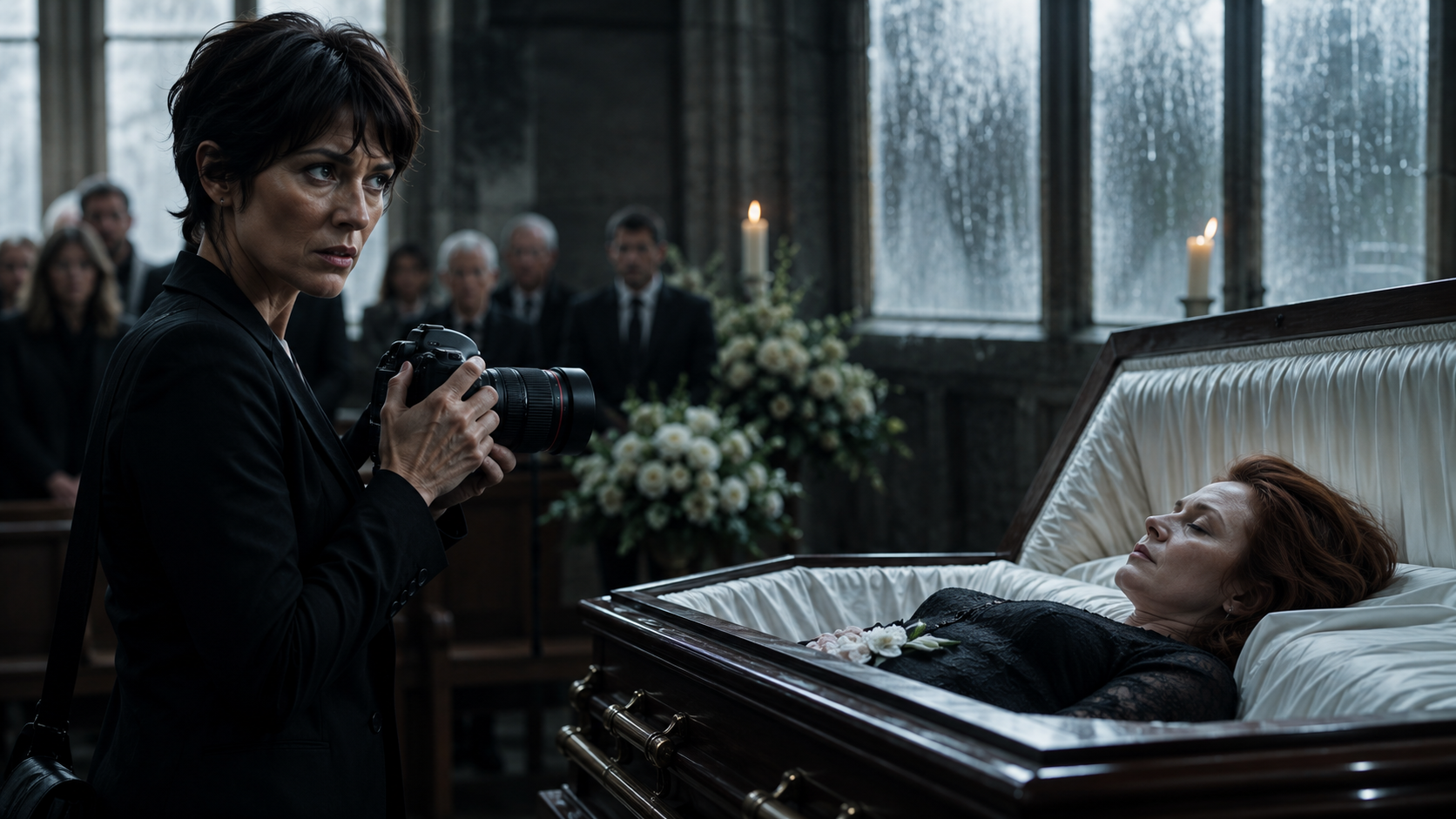
Then Tessa found a message from twelve days earlier.
It contained only one sentence.
If anything ever happens to me, remember the blue envelope.
Tessa stared at the screen.
She had no idea what it meant.
Then she remembered Adrienne visiting her studio two weeks earlier.
Tessa had been developing a large exhibition print when Adrienne appeared unexpectedly.
She stayed only ten minutes.
Before leaving, she had placed something inside the old metal filing cabinet beside Tessa’s desk.
Tessa hadn’t asked about it.
She drove to the studio immediately.
The blue envelope was still there.
Inside were twelve pages.
The first was a patient consent form from Meridian NeuroRest Institute.
The second was a confidential description of an experimental sleep protocol called Project Lumen.
The next several pages contained dosage records.
Then came an internal safety report.
Tessa didn’t understand most of the medical terminology.
But she understood the sentence Adrienne had circled in red ink.
Three patients had experienced episodes of profound metabolic suppression in which vital signs became extremely difficult to detect using standard portable equipment.
Tessa read it twice.
Then a third time.
There was another document.
An email printed on Meridian letterhead.
Dr. Adrian Kessler, the director of the clinic, had ordered staff not to discuss the incidents outside the research team.
At the bottom, Adrienne had written three words by hand.
They know already.
Tessa called Marcus.
He answered on the first ring.
“She’s awake.”
Tessa almost dropped the phone.
“What?”
“She opened her eyes ten minutes ago.”
“I’m coming.”
“Tessa.”
Something in his voice stopped her.
“What?”
“She keeps asking for you.”
Adrienne looked impossibly small in the hospital bed.
Machines surrounded her.
An oxygen line rested beneath her nose. Her hair had been pulled away from her face.
But when Tessa entered the room, Adrienne’s eyes moved toward her.
“Tess.”
Her voice was almost inaudible.
Tessa sat beside the bed.
“I’m here.”
Adrienne stared at her for several seconds.
Then she whispered, “Did they burn me?”
Tessa felt every hair on her arms rise.
“No.”
Adrienne closed her eyes.
A tear slipped down her cheek.
“I thought they would.”
“What happened?”
Adrienne’s lips trembled.
“Meridian.”
“I found the envelope.”
Her eyes opened again.
“You found it?”
“Yes.”
Adrienne looked toward the door.
“Lock it.”
Tessa did.
Then she returned to the bed.
Adrienne spoke slowly, stopping often to breathe.
Project Lumen had not begun as anything sinister.
It was supposed to be a revolutionary treatment for chronic insomnia, using a new compound that could push the brain into a deep restorative state without traditional sedation.
Adrienne had joined the program because she had spent years sleeping only three or four hours a night.
For the first month, the treatment seemed miraculous.
Then she accidentally received a file that Meridian had meant to send to one of its legal advisers.
The file showed that several patients had suffered frightening complications.
One had been unconscious for seventeen hours.
Another had displayed almost no measurable pulse for more than twenty minutes.
Instead of stopping the study, Meridian had quietly changed the reporting language.
“They were afraid investors would leave,” Adrienne whispered.
Tessa stared at her.
“You threatened to expose them.”
Adrienne nodded.
“Dr. Kessler asked me to come in and discuss it.”
“When?”
“The night I supposedly died.”
Tessa felt cold.
Adrienne remembered drinking tea in Kessler’s office.
She remembered feeling dizzy.
She remembered trying to stand.
Then darkness.
But the darkness had not lasted.
At some point, Adrienne had become aware again.
She could hear voices.
She could feel pressure.
She could sense movement.
But she could not open her eyes.
She could not speak.
She could not lift a finger.
“I heard someone say I had no pulse.”
Tessa leaned closer.
Adrienne continued.
“I heard Kessler.”
“What did he say?”
“He said there was nothing more to do.”
The hospital monitor continued its steady rhythm.
Beep.
Beep.
Beep.
“I tried to scream,” Adrienne whispered. “I couldn’t.”
Tessa swallowed.
“Do you remember the funeral?”
Adrienne looked directly at her.
“All of it.”
Tessa’s mouth went dry.
“The chapel?”
“The minister. Marcus crying. Owen talking to me.”
She paused.
“And your camera.”
Tessa stopped.
“My camera?”
Adrienne gave the smallest possible smile.
“I knew that sound.”
Tears filled Tessa’s eyes.
“I kept thinking… if you were taking pictures, you were close enough to see me.”
Tessa reached for her hand.
“I almost didn’t.”
“But you did.”