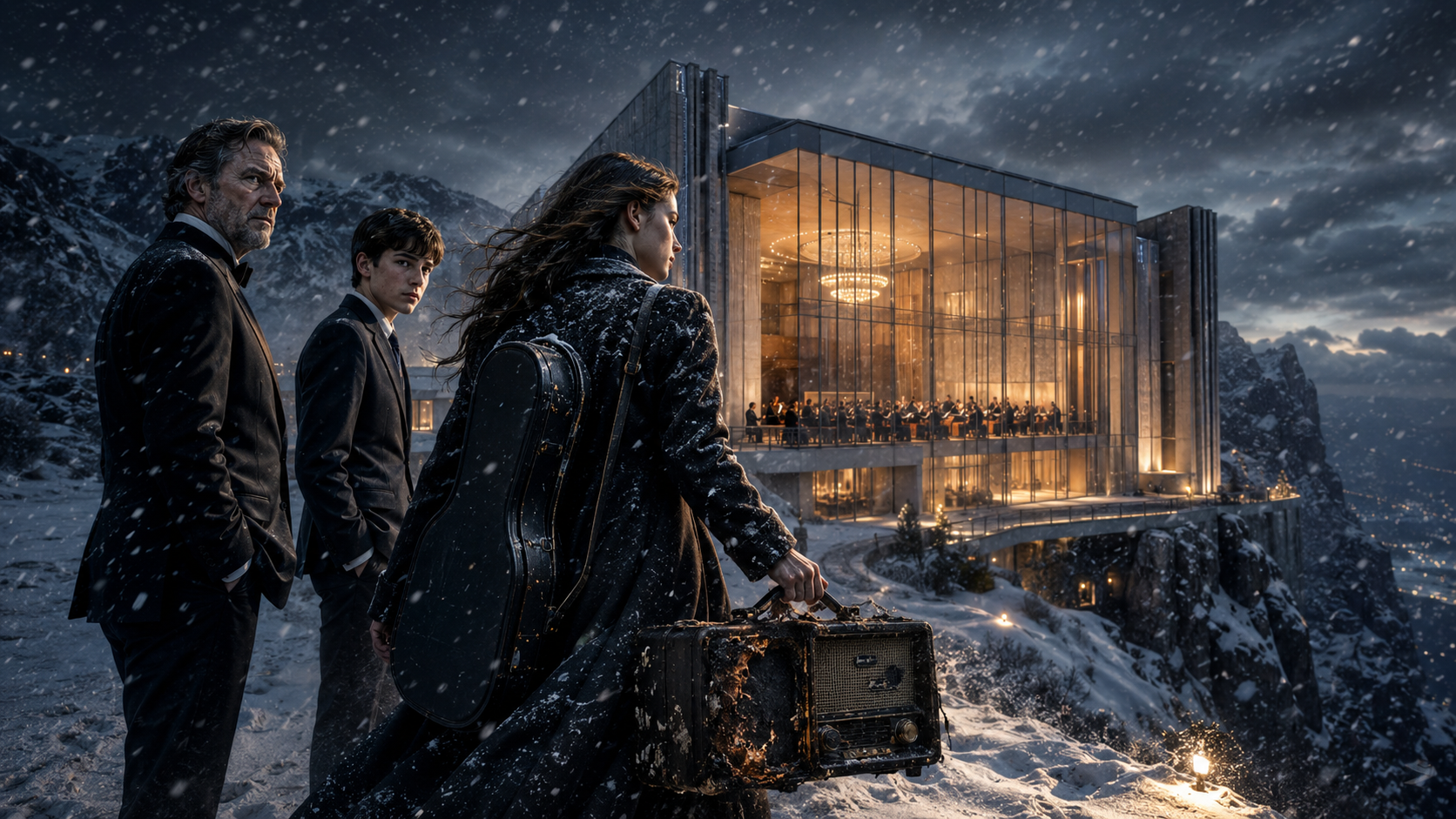
Winter Hall had been built where no concert hall should have survived.
It stood high above the northern valley, balanced against the black shoulder of Mount Varin. Its walls were made of pale stone and enormous sheets of glass that reflected the surrounding peaks. During daylight, the building seemed to float among the clouds. At night, when hundreds of lamps glowed behind its windows, it looked like a lantern suspended over the frozen wilderness.
For decades, the world’s greatest musicians had traveled there to perform.
Then came the avalanche.
The eastern wing was destroyed. Seven people died. The concert season ended overnight, and Winter Hall remained silent for four years.
Tonight, at last, its doors were open again.
Luxury cars climbed the narrow mountain road through falling snow. Politicians, actors, industrialists, conductors, and patrons of the arts entered beneath the newly restored stone archway. Inside, waiters carried crystal glasses between marble columns while a chamber orchestra performed beneath a ceiling painted with silver stars.
Reporters gathered near the main staircase.
Television cameras faced the stage.
The reopening concert was being broadcast to millions of viewers.
Yet the audience had not come only to see the building.
They had come for Julian Crowe.
Julian was the most celebrated composer of his generation. His symphonies had filled opera houses from Vienna to New York. He had conducted for kings, presidents, and audiences who waited years to hear him perform.
But four years earlier, Winter Hall had taken something from him that no success could replace.
His wife, Celeste Crowe, had died during the avalanche.
Their eleven-year-old son, Theo, had survived.
Theo had not spoken since.
He was fifteen now.
He stood beside his father near the edge of the stage, dressed in a dark formal suit. He was tall for his age, with Celeste’s gray eyes and Julian’s serious expression. His hands remained folded behind his back while hundreds of guests watched him with careful, uncomfortable sympathy.
Some people smiled at him.
Others quickly looked away.
Theo noticed every one of them.
He always noticed.
He simply never responded.
Doctors had called his condition traumatic mutism. Specialists had explained that his voice was physically unharmed. There was no injury to his throat, his lungs, or his brain. According to every medical examination, Theo was capable of speaking.
He had only chosen not to.
Julian had spent four years trying to understand why.
He had taken his son to private clinics, quiet coastal towns, mountain retreats, and therapists whose names appeared in international journals. He had tried patience, music, silence, routine, and travel.
Nothing had brought Theo’s voice back.
Tonight was not supposed to be another attempt.
Julian had promised him that.
The reopening concert was intended to honor Celeste, restore Winter Hall, and introduce Julian’s unfinished symphony—the final work he and his wife had written together.
At least, that was what the official program claimed.
Shortly before nine o’clock, Marcus Vane stepped onto the stage.
Marcus was the director of the Winter Arts Foundation and the man who had supervised the restoration. His silver hair was perfectly arranged, his tuxedo immaculate, his smile measured for the cameras.
“Ladies and gentlemen,” he began, “four years ago, this mountain answered music with silence.”
The orchestra stopped playing.
The guests turned toward him.
“Tonight,” Marcus continued, “we answer that silence with music.”
Applause filled the hall.
Julian placed one hand on Theo’s shoulder. The boy did not move.
Marcus spoke about courage, memory, and renewal. He praised the architects, rescue workers, donors, and musicians who had made the evening possible.
He spoke Celeste’s name with solemn affection.
Julian lowered his eyes.
Theo stared directly at Marcus.
When the speech ended, Marcus invited Julian to the conductor’s platform.
The applause grew louder.
Julian walked toward the center of the stage, but before he reached the podium, a disturbance broke out near the rear entrance.
A woman was arguing with security.
She appeared to be in her early thirties. Snow covered the shoulders of her long brown coat, and strands of dark hair had escaped from a loose knot behind her head. She carried a narrow violin case in one hand and an old metal box in the other.
The box looked badly damaged.
One side was blackened by fire. Several wires protruded through a crack in its casing.
“You cannot bring that inside,” a security officer told her.
“I was invited by the restoration committee.”
“Your invitation was withdrawn.”
“By whom?”
The officer did not answer.
Marcus heard the exchange from the stage.
For the first time that evening, his confident expression disappeared.
“Remove her,” he said.
The woman looked toward him.
“I only need three minutes.”
Marcus stepped away from the microphone, but his reply still carried through the silent hall.
“You were told not to come.”
A murmur passed through the audience.
Reporters raised their cameras.
Julian studied the woman.
There was something familiar about her, although he could not remember where he had seen her.
“Who are you?” he asked.
She looked at him with an expression that contained neither admiration nor fear.
“My name is Ana Wren. I worked at North Valley Emergency Communications on the night of the avalanche.”
Theo’s right hand tightened around his left wrist.
Julian felt the movement.
Marcus quickly approached the front of the stage.
“Miss Wren was a junior radio operator,” he explained. “She was dismissed after repeatedly making unsupported accusations about the rescue operation.”
“I resigned,” Ana said.
“After you violated procedure.”
“After someone erased a recording.”
The atmosphere inside Winter Hall changed.
The guests stopped whispering.
Julian stepped down from the platform.
“What recording?”
Marcus moved between him and the audience.
“This is neither the time nor the place.”
Ana lifted the damaged metal box.
“This receiver was recovered from the old communication room beneath the eastern wing. The restoration crew found it sealed behind a collapsed wall six months ago.”
Marcus stared at the box.
His face remained composed, but one of his hands slowly closed into a fist.
Ana continued.
“The main system was destroyed, but this unit contained an independent magnetic recorder. Most of the audio was badly damaged. I spent five months rebuilding it.”
Julian looked at the burned casing.
“Audio from the avalanche?”
“Yes.”
“Why wasn’t I told?”
Ana’s gaze shifted toward Marcus.
“Because the foundation obtained the receiver before the police could examine it.”
Marcus gave a sharp laugh.
“That machine is a piece of wreckage. Any recording it contained would be meaningless.”
Theo suddenly moved.
He raised one hand and tapped his fingers against the wooden railing beside the stage.
Four slow taps.
A pause.
One tap.
Another pause.
Four more.
Ana turned toward him.
Theo repeated the pattern.
Four.
One.
Four.
Ana’s expression changed.
She set the metal receiver on the floor and opened her violin case.
The security officers stepped forward.
Julian raised his hand.
“Let her continue.”
Ana removed a dark wooden violin. Its surface was scratched, and one edge had been repaired with a thin strip of lighter wood.
She placed it beneath her chin.
Then she played three quiet notes.
The first was low.
The second rose sharply.
The third seemed to hang in the air without resolving.
Theo stopped tapping.
Ana played the notes again.
Theo’s breathing became faster.
Julian watched him closely.
“Theo?”
His son stared at the violin.
Ana added a fourth note.
A deep, trembling sound escaped Theo’s throat.
It was not yet a word, but it was the first sound Julian had heard him make in four years.
Several guests gasped.
Julian forgot the cameras, the concert, and the hundreds of people surrounding them.
He stepped toward his son.
“Theo, what is it?”
Theo’s lips moved.
Nothing came out.
Ana lowered the violin.
“Celeste used those four notes as a tuning signal,” she said. “Whenever she tested the emergency radio, she played them into the microphone.”
Julian looked at her.
“My wife was a pianist.”
“She also helped design Winter Hall’s acoustic warning system. She tested it personally.”
Marcus moved toward the receiver.
“That is enough.”
Ana stood between him and the device.
“Why are you afraid of a broken radio?”
“I am protecting this family from a cruel performance.”
“No,” Ana replied. “You are protecting yourself from a voice you thought had disappeared.”
Marcus’s expression hardened.
He signaled to security.
Julian stepped into their path.
“No one touches that receiver.”
“Julian, listen to me.”
“I have listened to you for four years.”
Marcus glanced toward the television cameras.
“This recording has not been authenticated.”
“Then let everyone hear it,” Julian said. “Let them decide whether it deserves an investigation.”
Ana carried the receiver onto the stage.
A technician examined the cables and connected the old machine to the hall’s sound system. Static burst from the speakers.
The audience flinched.
The sound faded into a low electrical hum.
Ana adjusted a dial.
For several seconds, there was only broken noise.
Then a woman’s voice appeared beneath the static.
Faint.
Distant.
Terrified.
“North Station… this is Winter Relay…”
Julian stopped breathing.
Even through the distortion, he recognized Celeste.
The voice he had heard in dreams.
The voice he had tried to remember without allowing memory to change it.
“The eastern access corridor is blocked,” the recording continued. “Emergency power is failing. There are people inside the lower rehearsal rooms.”
A man’s voice responded, but the words were buried beneath interference.
Celeste spoke again.
“The red beacon is active. Do you see it?”
Ana leaned toward the receiver.
“The rescue team reported that no beacon was operating that night.”
The recording cracked.
Celeste’s voice returned.
“The generator batteries have been removed. Someone took them before the impact.”
The audience began whispering.
Marcus walked toward the technician.
“Disconnect it.”
The technician hesitated.
“I said disconnect it.”
Theo struck the railing with his palm.
Everyone turned toward him.
His face had lost all color.
He pointed at the receiver.
His mouth opened.
“Seven.”
The word was rough and barely louder than a breath.
Julian stared at him.
“Theo?”
The boy swallowed painfully.
“Channel seven.”
Julian’s eyes filled with tears.
He reached for his son, but Theo stepped past him and moved toward the receiver.
Ana adjusted the frequency.
A new layer of static filled the hall.
Then came the sound of heavy breathing.
Celeste’s voice returned, clearer than before.
“Theo is with me. He saw the man in the relay room.”
The boy closed his eyes.
The stage disappeared from his mind.
He was eleven years old again.
He remembered the building shaking.
He remembered emergency lights flashing red across the corridor.
Celeste had been holding his hand as they ran toward the lower exit. Snow and stone crashed against the roof. Somewhere in the darkness, people screamed.
They had reached the relay room before the second impact.
The door was open.
A man stood inside.
He was removing two emergency batteries from beneath the communication desk.
Theo had recognized him.
The man who attended every family dinner.
The man who called himself Julian’s oldest friend.
Marcus Vane.
Celeste had demanded an explanation.
Marcus told her there was no time.
She had tried to take the batteries from him.
He pushed her against the desk.
Then he saw Theo standing in the doorway.
Marcus had knelt in front of the boy and placed both hands on his shoulders.
He had spoken very calmly.
If Theo told anyone what he had seen, Julian would be blamed for everything.
The foundation would collapse.
His father would lose his music, his home, and his freedom.
People would say Celeste had caused the disaster by interfering with the emergency system.
Theo had believed him.
For four years, he had carried Marcus’s warning inside him.
He had believed that every word might destroy his father.
On the stage, Julian watched memory return to his son’s face.
“Theo,” he said gently. “You are safe.”
Theo looked at Marcus.
His next words came slowly, but each one was clear.
“You took the batteries.”
The hall became completely still.
Marcus shook his head.
“You were a frightened child.”
“You locked the relay door.”
“That is not true.”
“Mom tried to stop you.”
Marcus looked toward the exits.
Two security officers moved closer, but it was no longer clear whether they were protecting him or preventing him from leaving.
Ana restarted the recording.
Celeste’s voice filled the hall.
“Marcus removed the emergency batteries. He is trying to destroy the financial records stored in the lower archive.”
A loud metallic crash followed.
Then Marcus’s recorded voice could be heard in the background.
“You don’t understand what is at stake.”
Celeste answered.
“I understand perfectly. You stole from the foundation, and now you are willing to let people die to hide it.”
The recording ended in a blast of static.
Marcus stood beneath the lights with hundreds of faces turned toward him.
His public smile was gone.
Julian approached him.
“The missing foundation money.”
Marcus said nothing.
“You told us the accounts were destroyed in the avalanche.”
“They were destroyed.”
“Because you made certain the archive lost power.”
Marcus lowered his voice.
“I protected Winter Hall.”
“You protected yourself.”
“You think donors would have returned if they knew the truth? You think this building would be standing tonight?”
“Seven people died.”
“The avalanche killed them.”
“The emergency system might have saved them.”
Marcus’s eyes flashed with anger.
“You built your career in this hall, Julian. Do not pretend you are innocent. You accepted the official report because it allowed you to survive.”
Julian recoiled as though he had been struck.
Marcus was right about one thing.
Julian had accepted the report.
He had been drowning in grief. When Marcus told him that the investigation had found no human wrongdoing, Julian had wanted to believe him. Believing in an unavoidable disaster was easier than imagining that someone they trusted had abandoned Celeste.
Theo stepped between them.
“My mother was alive.”
Julian looked at him.
Theo’s voice trembled, but he continued.
“She was calling for help after the first rescue team left.”
Ana turned another dial.
“There are eleven more minutes of recording.”
She pressed the playback switch.
Celeste’s voice emerged again.
She was weaker now.
“Theo, listen to me. None of this is your fault.”
On the stage, Theo covered his mouth.
The message had not been addressed to a rescue station.
Celeste had been speaking directly to her son.
“If you are hearing this,” the recording continued, “you survived. Your father loves you. Do not let fear teach you to disappear.”
Julian placed a hand over his eyes.
Throughout the hall, guests wept openly.
Theo moved toward the speaker as if he could somehow cross the distance between the present and the night his mother died.
Celeste took a slow, painful breath.
“Your voice belongs to you. No one has the right to take it.”
The recording faded.
This time, no one applauded.
The silence was too honest for applause.
Marcus suddenly pushed past one of the security officers and ran toward the backstage corridor.
He reached the door before the officer caught his arm.
Marcus struggled.
“You cannot arrest me because of a damaged recording!”
“No,” Ana said. “But the original financial archive might be more useful.”
Marcus stopped fighting.
Ana looked toward the eastern wall.
“The receiver contained a final location code. Celeste moved copies of the foundation accounts into the old organ chamber before the power failed.”
Julian understood.
The organ chamber had survived the avalanche.
It had remained sealed throughout the restoration because the entrance was considered structurally unsafe.
Marcus’s face revealed the truth before he could deny it.
Police officers entered Winter Hall less than ten minutes later. Several had been stationed outside to manage security for the broadcast. Others arrived from the valley as the snowstorm intensified.
Marcus was led from the stage past donors, musicians, journalists, and former friends.
He did not look at Theo.
The television cameras followed him until the doors closed.
For a long moment, Julian and his son stood alone beneath the stage lights.
The unfinished symphony waited on the music stands.
The audience waited in silence.
Julian reached for Theo’s hand.
“I should have questioned the report.”
Theo looked down.
“I was afraid you would hate me.”
Julian’s voice broke.
“For surviving?”
“For not saving her.”
Julian pulled his son into his arms.
“You were eleven years old. You did save her.”
Theo began to cry.
Julian held him more tightly.
“You carried her truth until someone was ready to hear it.”
Behind them, Ana placed her violin back in its case.
She tried to leave without being noticed.
Theo saw her.
“Wait.”
Ana turned around.
The strength of his own voice seemed to surprise him.
He walked toward her.
“Where did you get the violin?”
“It belonged to your mother. She left it in the emergency communication room after one of the system tests.”
“She never told me she played.”
Ana smiled.
“She didn’t play well.”
A small sound escaped Theo.
It took Julian a moment to recognize it.
His son was laughing.
The sound was uncertain and mixed with tears, but it was real.
Ana handed him the violin.
“She said the instrument only behaved when you threatened to throw it into the snow.”
Theo examined the scratched wood.
“Did she really say that?”
“Several times.”
Outside, the storm began to weaken.
Snow still moved past the glass walls, but the valley lights were becoming visible below the mountain.
Julian looked toward the orchestra.
The musicians had remained in their seats.
Some held their instruments. Others were wiping their eyes.
The conductor’s platform stood empty.
Julian turned to Theo.
“We do not have to perform tonight.”
Theo looked at the pages of the unfinished symphony.
Celeste’s handwritten notes remained visible in the margins. Corrections, questions, jokes, and musical instructions crossed the paper in blue ink.
For four years, Julian had been unable to complete the final movement.
He had believed the music ended with her death.
Theo walked to the piano.
He sat on the bench and placed his hands above the keys.
The audience remained completely silent.
Theo played the four-note tuning signal.
Low.
High.
Suspended.
Resolved.
Then he looked at his father.
“Start with the second movement.”
Julian stepped onto the conductor’s platform.
The musicians raised their instruments.
Ana remained near the side of the stage, holding Celeste’s violin.
Julian lifted his hands.
The orchestra began.
The music was not clean or perfect. Grief moved through every measure. Certain passages sounded unfinished because they were unfinished. Yet as the melody rose toward the glass ceiling, it no longer felt like a memorial.
It felt like a door opening.
Theo continued playing.
For the first time in four years, Winter Hall was no longer defined by the night it had fallen silent.
And neither was he.
SEEDANCE VIDEO TRAILER PROMPTS
1
Create a 15-second cinematic mystery trailer, realistic live-action, 16:9, set inside a luxurious glass concert hall during a mountain snowstorm. Begin with a wide aerial shot of Winter Hall glowing above the dark frozen valley. Cut to fifteen-year-old Theo standing silently beside his famous composer father as an orchestra waits. A snow-covered woman enters carrying a burned radio receiver and says in a calm urgent voice, “Your wife called for help after the rescue ended.” The father whispers, “That’s impossible.” End with static bursting from the speakers and a faint woman’s voice saying, “Theo… use your voice.” Dramatic orchestral tension, realistic English dialogue, natural lip synchronization, no subtitles, no captions, no logos, no signs, no written text on screen.
2
Create a 15-second emotional thriller trailer, photorealistic live-action, 16:9. Open on a close-up of a silent teenage boy tapping a mysterious four-one-four rhythm against a wooden railing. A female violinist answers the rhythm with four haunting notes while wealthy gala guests turn toward them. The boy’s father asks softly, “Theo, what do you remember?” Flash rapidly to a red emergency corridor, falling snow, a man stealing batteries, and a woman trapped behind a damaged door. Theo looks directly at the foundation director and says for the first time, “You locked her inside.” Finish on the director’s terrified face as the concert hall lights shut off. Spoken English dialogue only, strong cinematic sound design, no subtitles, no captions, no titles, no logos, no visible writing.
3
Create a 15-second high-intensity conspiracy trailer, cinematic photorealism, 16:9, fast suspenseful editing. Start with an elegant memorial concert and a conductor raising his hands. Suddenly an old burned receiver is connected to the sound system. A distorted female voice fills the hall: “Marcus removed the emergency batteries.” Cut to shocked guests, television cameras turning, police approaching through the snow, and Marcus running backstage. Julian grabs his arm and demands, “Seven people died. What did you hide?” Marcus replies angrily, “I saved this hall!” End with the silent boy stepping from the shadows and saying, “No. You saved yourself.” Realistic English conversation and lip sync, no narration, no subtitles, no text overlays, no signs, no credits, no logos.
4
Create a 15-second poetic emotional trailer, premium cinematic live-action, 16:9. Show snow drifting beyond the enormous windows of an empty concert hall. A grieving father stands on the conductor’s platform while his teenage son sits at a grand piano. Play a faint recording of the dead mother saying, “Your voice belongs to you.” The boy begins crying, presses one piano key, and whispers, “I thought speaking would destroy you.” His father kneels beside him and replies, “Silence was destroying us both.” The boy plays four gentle notes, the orchestra joins, and warm light fills the hall as dawn appears over the mountains. Natural spoken English dialogue, emotional orchestral music, realistic faces and lip synchronization, no subtitles, no captions, no written titles, no logos, no text anywhere in the video.

