She raised her hand, but not to hit him.
No.
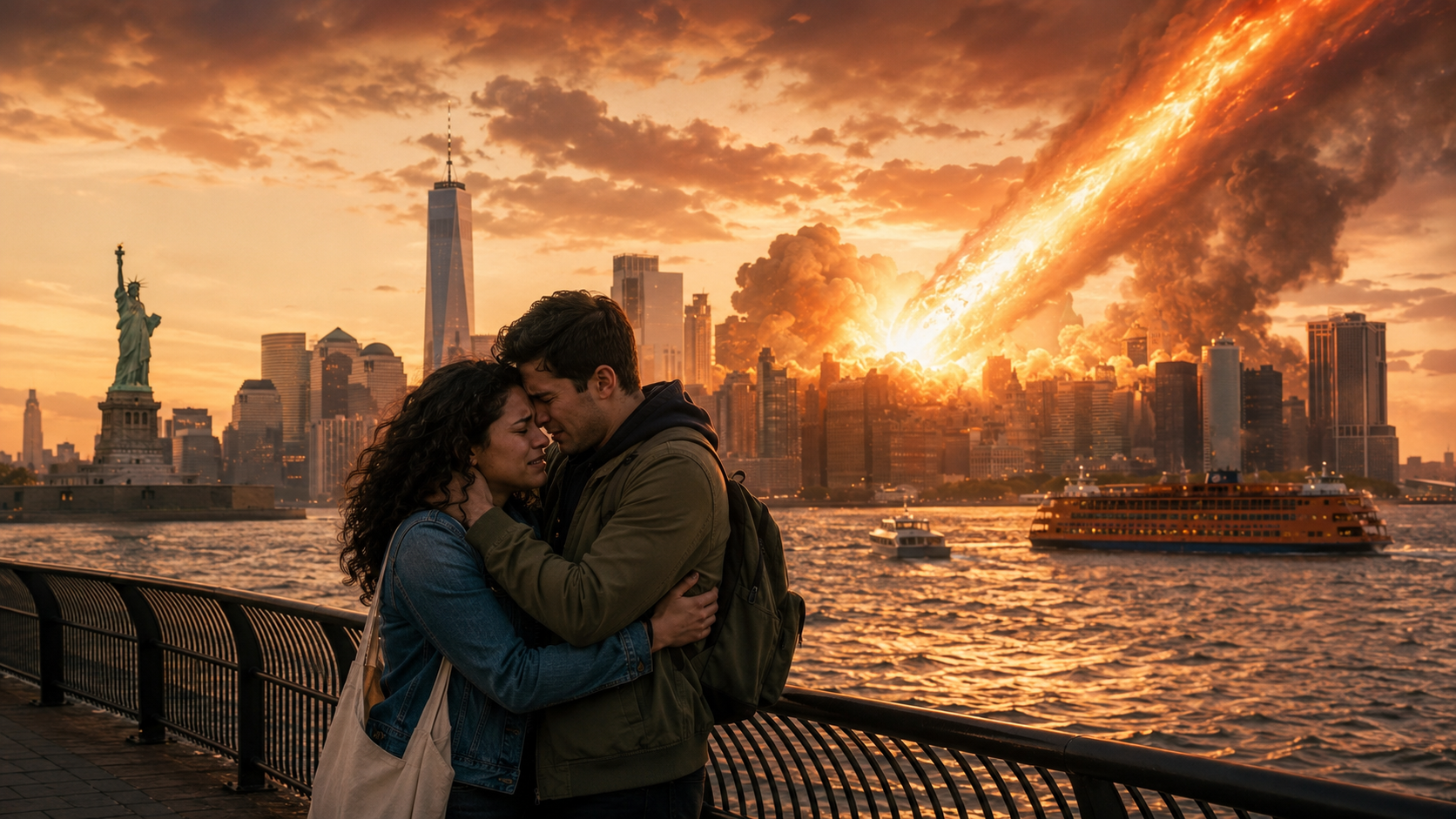
Elina would never hit Mark. Not even now, when everything inside her chest was boiling, as if her heart had turned into a burning stone. She raised her hand because she did not know what else to do with her anger. Her fingers trembled near her face, her voice broke, and behind her Manhattan glowed in the evening light — beautiful, calm, indifferent.
The water between them and the city shimmered with soft gold. A ferry moved slowly across the bay. Tourists took photos by the railing. Somewhere, children were laughing. Someone was selling coffee from a little cart.
And only the two of them stood in the middle of all that beauty as if the whole world had shrunk down to one old wound.
“You’re silent again,” Elina said. “That’s exactly who you are, Mark. When you need to speak, you stay silent. When you need to be there, you disappear. When you need to choose, you vanish.”
Mark stood by the metal railing, gripping the strap of his backpack. His face looked tired. Not angry. Not indifferent. Just exhausted.
“I don’t disappear,” he said quietly.
“Really?” She gave a bitter laugh. “Then where were you that day?”
He looked away.
Elina understood immediately. Again. Once again he would hide behind that look. Behind silence. Behind his eternal habit of not explaining, not defending himself, not apologizing in time.
“Where were you, Mark?” she repeated, quieter now. “When my father was dying and I called you seven times?”
He closed his eyes.
Seven times.
That number had lived between them for eight months.
Seven missed calls.
Seven small blows that destroyed everything they had built over five years.
Before that day, they had been almost happy. Not perfectly — no one is perfectly happy. They argued over small things: who forgot to buy milk, who set the alarm too loud, why Mark had left a cup on the windowsill again. But they laughed after fights. They made up in the kitchen. They fell asleep holding hands.
And then her father died.
And Mark was not there.
He appeared only in the evening, when everything was already over. He walked into the hospital hallway pale, with wet hair, holding some kind of bag in his hand, and said:
“Elina…”
She looked at him then as if she were looking at a stranger.
“Not now.”
And from that day on, “not now” became their life.
They tried to talk, but their conversations turned into accusations. They tried to stay silent, but the silence was even heavier. They tried to move on, but that hospital hallway always stood between them — those seven calls and the emptiness in her phone.
Today they were supposed to say goodbye for good.
Elina had asked to meet by the water because this was where Mark had once proposed to her.
It had been an evening just like this. The sky blushed pink over the city. Ferries passed by. He was nervous, stumbled over his words, then took out a ring and said:
“I can’t promise I’ll never make mistakes. But I promise I’ll come back. Always.”
Back then, she had cried from happiness.
Today, she was crying from anger.
“I came to give this back,” she said, pulling a small velvet box from her bag.
Mark looked at it, and something in his face broke.
“Elina…”
“Don’t,” she snapped. “Don’t say my name like it still changes anything.”
She held out the box.
He did not take it.
“Take it.”
“No.”
“Mark.”
“I said no.”
“You don’t have the right to refuse,” her voice trembled. “You don’t have the right to keep me suspended like this. I’m tired. I’m tired of hating you and missing you at the same time.”
He clenched his jaw.
“You think this is easy for me?”
“Was it hard for you then?” she shot back. “That day? When I was sitting beside my father, holding his hand? When he was trying to say something and I couldn’t understand him? When I needed you, the only person I wanted beside me?”
“I was on my way to you.”
“Don’t lie.”
“I was.”
“Seven calls, Mark! Seven! You didn’t even text!”
He turned sharply toward her.
“Because my phone was smashed!”
She froze.
The words hung in the air.
Mark instantly regretted shouting them like that. He dragged a hand over his face and turned back toward the water.
“What?” Elina asked quietly.
He said nothing.
“What did you say?”
“Nothing.”
“No. Now you speak.”
He let out a bitter laugh.
“Now?”
“Mark.”
He looked at her. For the first time in a long time, he truly looked at her.
“That day, when you were calling me, I was in Brooklyn. I was picking something up for your father.”
“For my father?”
“Yes.”
“What?”
Mark slipped the backpack off his shoulder, but he did not open it. He only held it in front of him, as if there were something dangerous inside.
“He called me a week before the hospital,” Mark said. “He asked me not to tell you. He said he wanted to give you a gift. Not for your birthday. Not for the wedding. Just… while he still could.”
Elina frowned.
“What gift?”
“His old letters to your mother. Photos. Recordings. He wanted me to help restore them. There was a tape, an old one, damaged. He recorded it when you were one year old. He wanted you to hear his voice if one day…”
Mark’s voice broke.
Elina stood motionless. The sound of the water suddenly became too loud.
“Why didn’t you tell me?”
“Because he asked me not to. He wanted to do it himself. That day, I picked up the restored recording. I was on my way to the hospital. Then, at an intersection, a truck ran a red light. The taxi was hit from the side. My phone shattered. I lost consciousness for about twenty minutes. When I woke up, the driver was screaming, blood was running down my face, and I was trying to get out because I knew you were waiting.”
Elina took a step back.
“No.”
“I got there on foot. Then I caught another car. Then there was traffic again. I arrived too late.”
She stared at him as if the ground under her feet had suddenly turned thin and glassy.
“Why did you stay silent for eight months?”
He smiled faintly, but there was nothing alive in that smile.
“Because when I walked into the hospital, you looked at me like I had killed him. And I thought… maybe you were right.”
“Mark…”
“I should have been there earlier. I should have charged an old phone. I should have asked someone to call you. I should have done a thousand things. But I didn’t. And when you said, ‘not now,’ I decided I deserved it.”
Elina covered her mouth with her hand.
At that moment, somewhere far above the city, a light flashed.
At first, no one understood.
An orange-white streak cut across the sky with such brightness that it looked as if the sun had mistaken the hour and decided to rise in the west. People on the waterfront froze. Someone raised a phone. Someone laughed, thinking it was fireworks or a rocket launch.
But the light grew.
It did not disappear.
It became wider, brighter, more terrifying.
The ferry in the bay sounded a long, warning horn.
Mark lifted his head.
“What is that?..”
Elina turned toward the city.
The sky above Manhattan split open.
A massive ball of fire tore through the clouds, leaving behind a tail of smoke, ash, and burning debris. For one second, everything became unbelievably beautiful — almost divine. The pink sky, the golden water, the Statue of Liberty, the skyscrapers, and above them a falling star far too large for a wish.
Then came the sound.
Not the explosion yet.
A roar.
Low, deep, the sound of the planet itself groaning.
People screamed.
The fireball struck somewhere beyond the line of skyscrapers.
The flash was so bright that Elina instinctively shut her eyes. For a moment, the world disappeared. Only white remained. White like hospital walls. White like the sheet over her father’s face. White like the emptiness between two people who had stayed silent for too long.
And then the city began to vanish.
First one skyscraper trembled. Then another. Behind them, a wall of dust and fire rose into the sky. It grew over Manhattan like a black wing. Glass sparkled in the air. A huge cloud unfolded, devouring streets, rooftops, towers.
“Oh my God,” Elina whispered.
Everyone’s phones vibrated at once.
Sirens.
Alerts.
Screams.
Mark pulled out his phone. The screen flashed red.
EMERGENCY ALERT. CELESTIAL BODY IMPACT. SEEK SHELTER IMMEDIATELY. SHOCKWAVE…
The message cut off.
The signal disappeared.
The water began to tremble strangely. The ferry tried to turn, but there was nowhere to go anymore. Birds burst from the trees all at once, a dark frightened cloud. People ran along the waterfront, shoving each other, falling, calling for children, parents, lovers.
Elina did not run.
She stared at the growing wall of dust.
Mark grabbed her hand.
“We have to go!”
She did not move.
“Where?”
He looked around. Behind them was an open walkway, a few trees, benches, tourists, concrete, water. No real shelter. No escape from what was already coming.
The shockwave was moving across the bay.
At first, it looked like fog.
Then like a storm.
Then it became clear: it was not a storm.
It was the end.
The water in front of Manhattan rose in a massive fold. The ferry rocked like a toy. A white line raced across the surface of the bay, wide and fast. The air ahead of it shimmered.
Mark slowly let go of Elina’s hand.
They both understood.
They had minutes.
Maybe less.
Elina turned to him. There was no anger in her eyes anymore. Only terror. And something else — realization, arriving too late.
“We…” she could not finish.
Mark nodded.
“Yes.”
A woman ran past them with a child in her arms. A man screamed into a phone with no signal: “Mom! Mom, answer me!” Someone fell to their knees. Someone prayed. Someone simply stood still, like them.
Elina suddenly laughed.
Quietly. Brokenly. Almost madly.
“We spent eight months fighting.”
Mark looked at her, tears running down his face.
“Elina…”
“Eight months, Mark. I woke up and planned what I would say if I saw you. I argued with you in my head. I hated the cup you forgot to take away. I hated your books. Your sweater. Your name in my phone.”
She swallowed.
“And now we have a few minutes left.”
He stepped toward her.
“I’m sorry.”
“No,” she shook her head. “I… I need to apologize too. I didn’t let you speak. I decided my pain gave me the right to be cruel.”
“You lost your father.”
“And you lost me,” she said. “And I never even asked how you survived that day.”
He closed his eyes as if those words hurt more than the explosion.
Behind them, people kept running. But fewer now. Many stopped. They understood. They hugged right there on the walkway. Someone kissed a child’s forehead. An old man held his wife’s hand and looked at the city that had been their life. A young woman typed a message that would never be sent.
Mark slowly opened his backpack.
“The recording,” he said. “I still have it.”
Elina looked at him.
“What?”
He took out a small digital recorder. Old. Scratched. He held it to his chest for a second, then handed it to her.
“I carried it with me all this time. I wanted to give it to you. Every time I thought: today. Then I got scared.”
Elina’s hands trembled as she took the recorder.
“His voice is on here?”
“Yes.”
She pressed the button.
At first there was static. Crackling. A distant breath.
Then a voice.
Weak, a little hoarse, but alive.
“Eli… if you’re listening to this, then I probably failed again to find a normal way to say something important in time.”
Elina cried out and pressed the recorder to her lips.
Her father’s voice continued:
“You were always angry that I stayed silent when I should have spoken. I suppose it runs in the family. Forgive me for that. But I want you to know this: life is too short to wait for the right moment to love someone. The right moment almost never comes.”
Elina closed her eyes. Tears ran down her cheeks.
“If there is someone beside you whom you love, don’t waste days on pride. Pride won’t hold you at night. Pride won’t bring you tea when you’re sick. Pride won’t remember how you laugh when you’re trying not to laugh.”
Mark turned away, but she saw him crying.
“And one more thing,” her father’s voice softened. “Mark is a good man. Stubborn, of course. Quiet. Takes too much on himself. But good. If he makes a mistake one day, don’t judge him only by that one day. We are all more than our worst day.”
The recorder hissed.
Elina pressed her hand to her mouth.
The shockwave was closer now. The air grew hot. The hair on their heads lifted with static electricity. The sky above the city darkened. Debris, foam, and smoke flew across the water.
“He knew,” she whispered.
“What?”
“He knew we would fight. He knew us.”
Mark tried to smile through his tears.
“He said we were both too proud for our own happiness.”
Elina looked at the ring box still clenched in her hand.
“I wanted to give it back to you so it would hurt less.”
“Did it?”
She shook her head.
“No.”
He came closer.
“I love you, Elina.”
She looked straight into his eyes. The world was collapsing around them, but for the first time in eight months there was no wall between them.
“Say it again.”
“I love you.”
“Again.”
“I love you. I loved you that day. I loved you through all these months. Even when you didn’t answer. Even when I hated myself. Even when I thought I no longer had the right to say your name.”
She cried as if everything she had been holding inside had finally broken.
“I love you too,” she said. “I’m so tired of pretending I don’t.”
He touched her face carefully.
“I would give anything to get our time back.”
Elina covered his hand with hers.
“We have this.”
“A few minutes.”
“No,” she looked at him through her tears. “We have now.”
He understood.
Their whole life suddenly collapsed into that one word.
Now.
Not yesterday, which could no longer be fixed.
Not tomorrow, which would never come.
Now.
His fingers on her cheek. Her breathing. The sound of the water. The roar of the approaching end. The warm little ring box in her palm. Her father’s voice still coming from the tiny recorder.
“Put it on me,” Elina said.
Mark froze.
“What?”
“The ring. Put it on.”
“Elina…”
“Please. I don’t want to leave as your former fiancée. I want to leave as someone who chose love. Even if only now.”
He took the box. Opened it.
It was the same ring. Small, delicate, with a tiny stone he had once spent three weeks choosing because he was afraid of making a mistake.
His hands shook so badly that he could barely pick it up.
Elina held out her hand.
He put it on her finger.
And in that second, she smiled.
Not widely. Not happily. But a real smile, one Mark remembered. The one from their kitchen, from their mornings, from their life before all the pain.
“Hi,” she said softly.
He did not understand.
“What?”
“I just thought… if we have so little time left, I want to start over.”
Mark sobbed and laughed at the same time.
“Hi, Elina.”
“I get angry when you leave cups on the windowsill.”
“I know.”
“And when you stay silent.”
“I’ll try to do it less.”
“A little late.”
“Yes,” he nodded. “A little.”
They both laughed through their tears.
Then the laughter stopped.
The wind hit first.
Hot, heavy, smelling of burning and metal. It tore a strand of hair across Elina’s face and threw ash into their eyes. People around them screamed louder. The metal railing groaned. Somewhere, glass shattered with a sharp crack.
Mark wrapped his arms tightly around Elina.
She clung to him with both hands.
“I’m scared,” she whispered.
“Me too.”
“Say something.”
He pressed his lips to her hair.
“Do you remember the first time we came here?”
“You bought terrible coffee.”
“You said it tasted like wet cardboard.”
“It did taste like wet cardboard.”
“And then you still drank half of mine.”
“Because I was cold.”
“And that was when I realized I wanted to spend my whole life giving you my bad coffee.”
She closed her eyes and smiled against his chest.
“A stupid confession.”
“But an honest one.”
The shockwave was coming closer. They could already see trees falling one after another along the water. People disappearing into gray dust. Benches overturning. The world being erased by a line racing toward them.
Elina lifted her head.
“Mark.”
“Yes?”
“Don’t look there.”
He looked at her.
“Okay.”
“Look at me.”
“I’m looking.”
She took his face in her hands.
“We lost so much because of words we said. And because of the ones we didn’t say.”
“I know.”
“If someone could hear us now… I would tell them: don’t wait for the end of the world to stop fighting.”
He nodded.
“Say it immediately.”
“Hug immediately.”
“Forgive immediately.”
“Love immediately,” she whispered.
Mark leaned down and kissed her.
Not like in movies, where the end of the world makes a kiss beautiful.
No.
It was a desperate kiss, salty with tears, between two people who finally understood the price of a second. A kiss for all the missed calls. For all the closed doors. For the nights spent on opposite sides of the bed. For the messages typed and deleted. For the pride that had seemed like strength but turned out to be an empty room.
They kissed until the air around them began to roar.
Then Elina pressed her forehead to his.
“I love you.”
“I love you.”
“I’m sorry we understood it so late.”
“No,” Mark said, holding her tighter. “We understood.”
She began to cry.
“What if this is it? Right now?”
He looked into her eyes.
“Then let the last thing not be a fight.”
She nodded.
The shockwave was almost there.
In the final seconds, Elina heard the recorder. It had fallen from her hand, but it was still playing somewhere near their feet. Her father’s voice barely pushed through the thunder:
“…every moment you spend beside the people you love seems ordinary only because you don’t know how many of them are left…”
Mark covered her with his body, even though they both knew it would change nothing.
But love rarely changes the physics of the world.
It only changes the meaning of the final moments.
And sometimes that is enough.
Elina held him so tightly, as if she could hold not his body, but their entire life. Their first meeting. Their first fight. Their first laughter. Their small kitchen. Rain at the window. His cups. Her books. The awkward proposal by the water. Seven missed calls. Eight months of pain. And these final minutes, in which they finally stopped trying to prove who was right.
Because before the end, it turned out not to matter who was right.
All that mattered was who was loved.
The wave swallowed the waterfront.
The light disappeared.
The sound disappeared.
The city disappeared.
But in the very last instant, when the world was already falling apart around them, Elina did not think about the meteor. She did not think about fear. She did not think about lost time.
She thought only that fighting always seems important until life reveals its true price.
And that every moment, even the simplest one, even the most ordinary one, even the one where someone left a cup on the windowsill, is priceless.
Because one day there may be only one moment left.
And it is good if, in that moment, you manage to say:
“I love you.”

