“What did he say?”
“That you always went first.”
Gideon gave a humorless smile.
“That sounds like him trying to make me seem brave.”
“He said you went first because you were afraid someone else would get hurt.”
Gideon’s smile disappeared.
“What else did he tell you?”
“That he was sorry.”
“For what?”
“He never said.”
The road ended at a locked steel barrier.
Mercer stopped the truck.
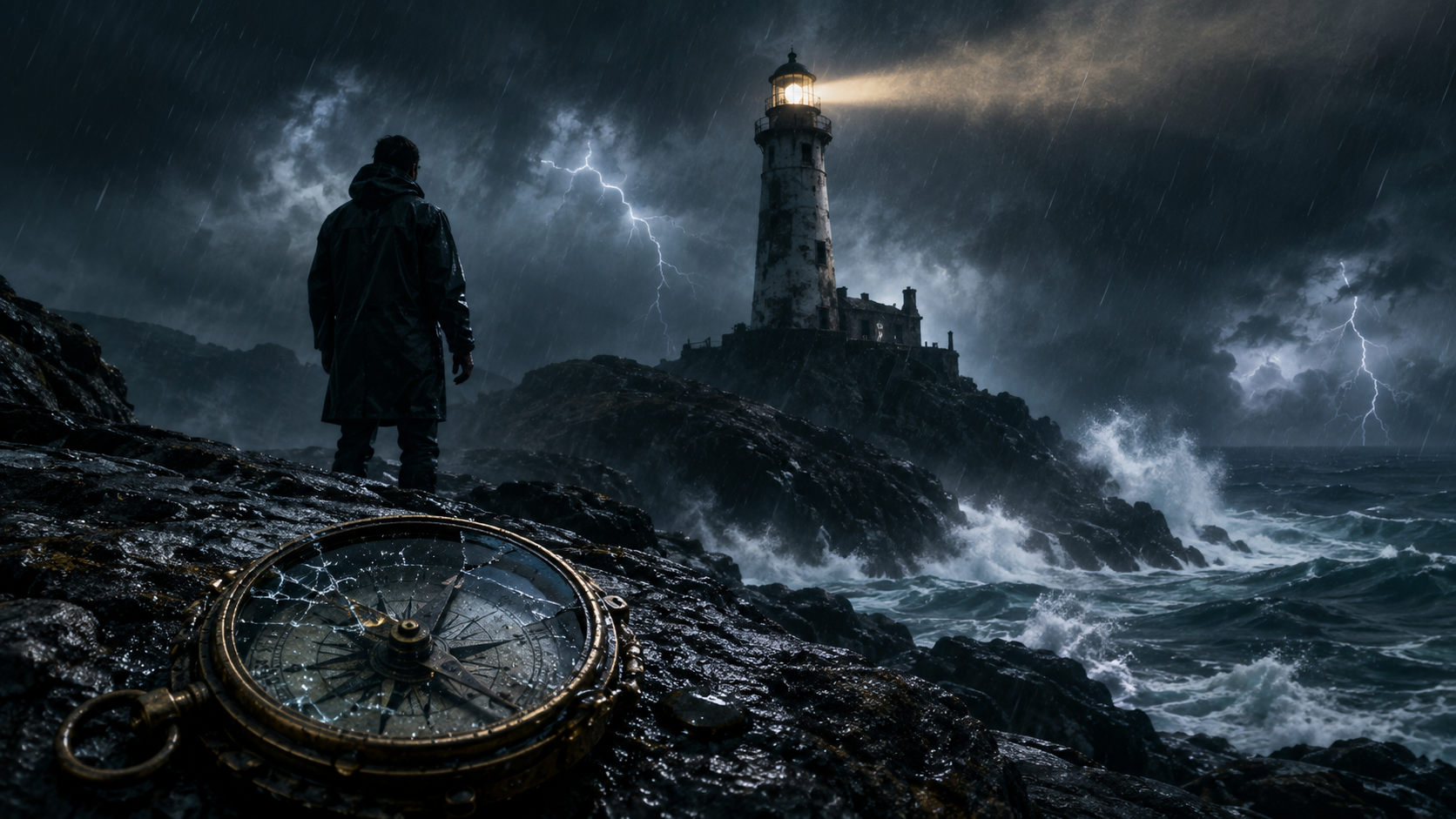
Beyond the barrier, a narrow path climbed along the cliff toward the lighthouse. Waves exploded against the rocks below, throwing white spray into the darkness.
The team continued on foot.
Mira led them past the lighthouse path and down a steep slope covered with wet grass. Gideon stayed close enough to catch her when she slipped.
At the base of the cliff, she pointed toward a wall of black stone.
“There.”
Gideon saw nothing.
Then lightning illuminated a narrow gap behind a fallen section of seawall.
The opening was barely wide enough for a person.
They entered one at a time.
Inside, the sound of the storm faded into a deep, continuous vibration. Their flashlights revealed a brick-lined passage descending beneath the lighthouse.
After fifty yards, the tunnel ended at a circular iron door.
There was no handle.
Mira removed the key from her neck and inserted it into a slot hidden beneath a layer of rust.
The lock turned.
Gideon pulled the door open.
Cold air rushed from the chamber beyond.
The room had once been a storage vault. Metal shelves covered the walls. Most were empty, but several held waterproof cases stamped with shipping numbers.
A worktable stood in the center.
On it lay dozens of photographs, tide charts, cargo records, and handwritten notes.
Isaac opened one of the cases.
Inside were sealed packages of currency.
Mercer opened another.
It contained passports bearing different names but identical photographs.
“This isn’t smuggling,” Isaac said. “It’s an entire relocation network.”
“For whom?” Mercer asked.
Gideon examined the photographs.
Politicians.
Corporate executives.
Foreign military officers.
Men who had supposedly died.
Witnesses who had disappeared before major trials.
The operation beneath Breakwater Nine had not simply moved illegal cargo. It had erased people, created new identities, and transported fugitives across the coast.
One photograph showed Elias standing in the lighthouse chamber.
He looked twenty years younger.
Beside him stood Silas Crowe.
Crowe was not yet the powerful harbormaster who controlled every commercial dock in Port Briar. He wore a junior officer’s uniform and held a folder stamped with the emblem of the harbor authority.
They were both smiling.
Gideon’s stomach tightened.
“This was taken before the Morning Star sank.”
Mira looked at the picture.
“My father knew him.”
“He knew him very well.”
A light flashed inside the tunnel.
Not lightning.
A flashlight.
Gideon switched off his own lamp and raised a hand for silence.
Footsteps approached the iron door.
Several people.
Mercer quietly drew a flare gun from his equipment bag.
A man’s voice echoed through the passage.
“Captain Rusk, you have entered restricted government property.”
Gideon recognized the voice.
Silas Crowe.
The harbormaster appeared in the doorway wearing a dark raincoat. Four armed security officers stood behind him.
Crowe was nearly seventy, but he held himself with the confidence of a man who had spent his life giving orders that no one dared question.
His silver hair remained perfectly combed despite the rain.
His gaze moved from Gideon to the open cases.
Then he noticed Mira.
For the first time, his confidence weakened.
“You brought the girl,” Crowe said.
“You knew about her,” Gideon replied.
“I knew Elias had made another mistake.”
Mira stepped behind Gideon.
Crowe sighed.
“Your father was always sentimental at the worst possible moment.”
“Where is he?” she demanded.
Crowe looked almost amused.
“You have his courage.”
“Where is my father?”
“Close enough to hear the answer, perhaps.”
Gideon moved forward.
The security officers raised their weapons.
Crowe lifted one hand.
“No shooting. Not in here.”
“Afraid of damaging your records?” Gideon asked.
“I’m afraid of damaging the explosives behind the western wall.”
Everyone froze.
Crowe smiled.
“This facility was designed to disappear if necessary.”
“You won’t destroy it while you’re standing inside.”
“No. But the tide will reach the lower detonator room in twelve minutes. Once the water closes the electrical circuit, none of us will need to make that decision.”
Mercer glanced toward the tunnel.
Crowe’s officers blocked the only visible exit.
Gideon said, “You came all this way to die with us?”
“I came to recover one item.”
Crowe pointed toward Mira’s backpack.
“The recorder.”