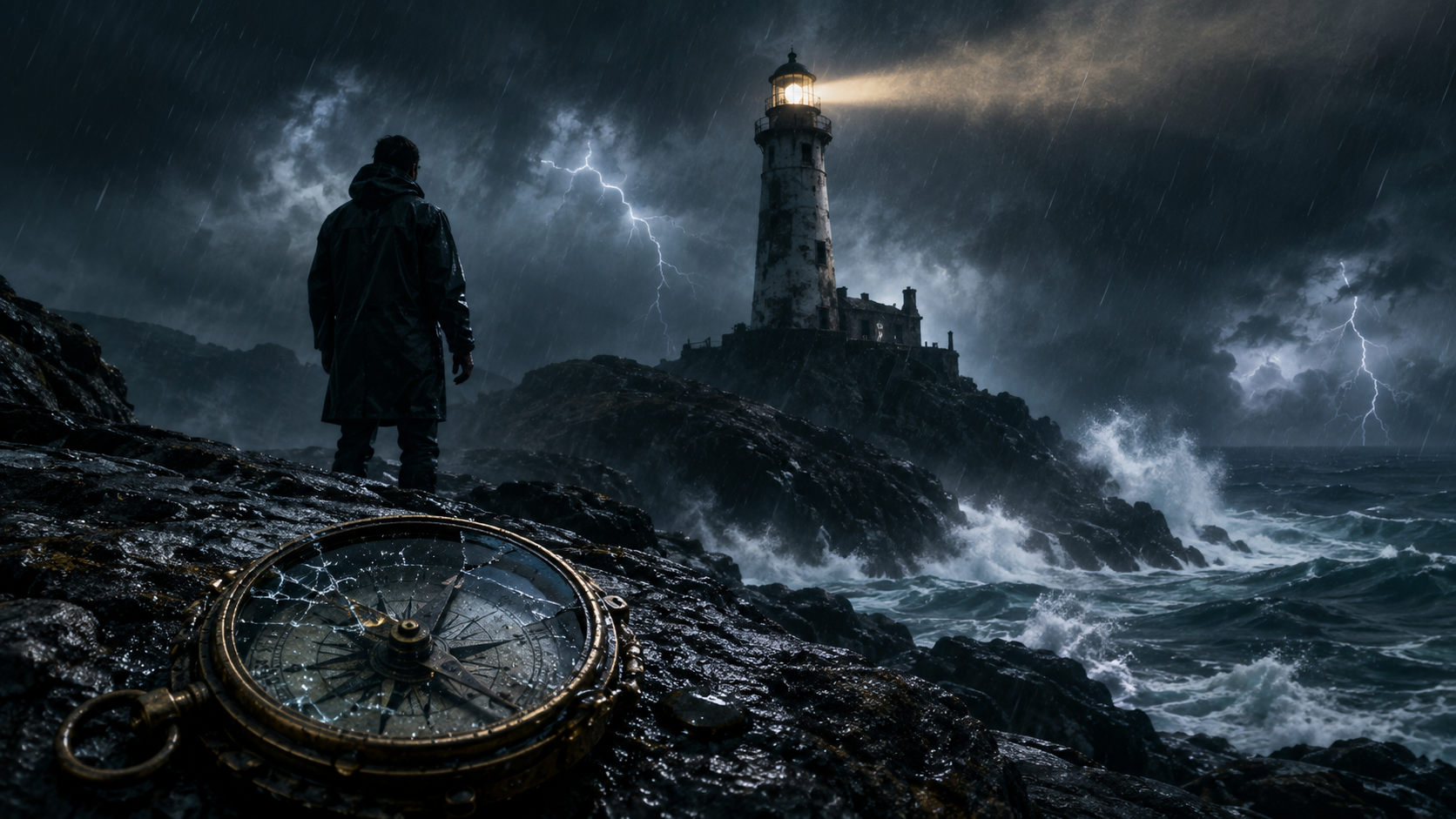
THE LAST LIGHT AT BREAKWATER NINE

The storm had cancelled every ferry out of Port Briar, but no one had gone home.

Passengers crowded beneath the iron roof of the terminal, listening to rain hammer the glass walls. Families guarded their luggage. Dockworkers drank bitter coffee from paper cups. A tired station clerk kept repeating that the sea was too dangerous and that no vessel would leave before morning.

Near the shuttered ticket counter sat six men who looked as though they belonged to the storm.

They wore dark waterproof jackets marked with a faded silver emblem: a diving helmet surrounded by seven waves. Years ago, the emblem had belonged to the most respected rescue team on the northern coast.

The Blackwater Seven.

They had pulled fishermen from burning boats, recovered children from flooded caves, and searched wrecks no sane diver would enter. Newspapers had once called them heroes.

Now only six remained.

Their former captain, Gideon Rusk, sat apart from the others. His broad shoulders were bent beneath an old navy coat. A white scar crossed his chin, and a broken-anchor tattoo disappeared beneath the sleeve of his left glove.

He was watching the black water beyond the terminal windows when a voice spoke beside him.

“Are you Captain Rusk?”

Gideon turned.

A girl stood there alone.

She could not have been older than ten. Her yellow raincoat was several sizes too large, and water dripped from the ends of her dark hair. A canvas backpack hung from one shoulder. Her hands were red from the cold, but she did not appear to notice.

Gideon glanced behind her.

“Where are your parents?”

The girl ignored the question.

“Are you the man with the broken anchor?”

The other divers looked over.

Gideon slowly removed his glove.

The tattoo on his wrist showed an anchor split through the middle by a jagged black line.

The girl released a breath she seemed to have been holding for hours.

“My father said you would show me that.”

Gideon’s expression hardened.

“What is your name?”

“Mira Vale.”

The coffee cup slipped from the hand of the man sitting beside Gideon.

It struck the floor and rolled beneath a bench.

No one moved to pick it up.

Gideon stared at the girl.

“What did you say?”

“Mira Vale.”

“I heard your first name.”

The girl hesitated.

“My father is Elias Vale.”

The six men became completely still.

Outside, lightning flashed over the harbor.

Thirteen years earlier, Elias Vale had been the seventh member of the Blackwater team.

He had also been Gideon’s closest friend.

Elias had disappeared during a rescue operation aboard the cargo vessel Morning Star. The ship had gone down five miles beyond the breakwater. Gideon and the others had searched for three days, but they had found only Elias’s torn diving harness and a bloodstained glove tangled in the wreckage.

The sea had never returned his body.

The Coast Guard declared him dead.

The town carved his name into a memorial wall.

Gideon had delivered the eulogy.

Now a ten-year-old girl stood in front of him and claimed Elias was her father.

“That isn’t possible,” one of the divers said.

His name was Mercer Flint, the youngest of the original team, though gray had begun to appear in his beard.

Mira faced him.

“He told me you would say that too.”

Mercer’s face lost its color.

Gideon leaned forward.

“Where is your mother?”

“She died two years ago.”

“I’m sorry.”

Mira gave a small nod, but her expression did not change. Grief had already become something familiar to her.

“Where is Elias?” Gideon asked.

“I don’t know.”

“Then how did you get here?”

“He put me on a bus in Stonehaven this morning. He bought the ticket with cash and told the driver my uncle would meet me in Port Briar.”

“You don’t have an uncle here.”

“No.”

“Did your father come with you?”

Mira shook her head.

“He said someone was following us. He stayed behind so they would follow him instead.”

A gust of wind rattled the terminal doors.

Gideon studied the child’s face. He searched for uncertainty, confusion, or some sign that she had been coached.

He found none.

Her eyes disturbed him most.

They were pale green, almost gray.

Elias had possessed exactly the same eyes.

Mira opened her backpack and removed a small object wrapped in a wool scarf.

It was a brass compass.

The glass was cracked. One side had been blackened by fire. Seven tiny waves were engraved into the lid.

Gideon reached for it but stopped before touching it.

He knew the compass.

The Blackwater team had given it to Elias on the night he became their captain.

Gideon had watched him carry it aboard the Morning Star.

“Where did you find this?” he whispered.

“My father gave it to me yesterday.”

Mercer stood.

Another diver, Isaac Rowe, approached the girl and examined the compass.

“It could be a copy.”

Gideon pressed his thumb against a hidden catch beneath the hinge.

The back of the compass opened, revealing seven initials scratched into the metal.

G.R.

E.V.

M.F.

I.R.

T.B.

S.K.

J.M.

The initials belonged to the original team.

No copy could have included them.

Mira reached into her backpack again.

“There’s something else.”

She produced an old handheld voice recorder sealed inside a plastic bag.

“My father told me to give this to you only after you opened the compass.”

Gideon took the recorder.

A strip of gray tape had been placed across the front. Four words were written on it in black ink.

PLAY IT SOMEWHERE SAFE.

Gideon looked around the crowded terminal.

“This isn’t safe.”

He rose from the bench and turned to the others.

“Equipment room. Now.”

The terminal manager tried to stop them from entering the restricted corridor, but one look at Gideon’s face changed his mind.

Minutes later, the six divers and Mira gathered inside a narrow room filled with emergency radios, ropes, life jackets, and tool cabinets.

Gideon locked the door.

Then he pressed play.

For several seconds, the recorder produced only static.

A man began to speak.

His voice was older and rougher than Gideon remembered, but there was no mistaking it.

“Gideon, if Mira reached you, then I failed to keep her out of this.”

Gideon gripped the recorder so tightly that the plastic creaked.

Elias continued.

“You have every reason to hate me. You buried an empty coffin because I asked men with badges to tell you I was dead. I let you mourn me. I let my own name become a lie.”

Mercer whispered a curse.

“But I did not disappear because of the Morning Star,” the recording said. “I disappeared because of what was inside it.”

The men exchanged uneasy glances.

According to the official investigation, the Morning Star had been carrying machine parts, canned food, and medical supplies.

Nothing worth killing for.

Nothing worth vanishing for.

Elias’s voice continued.

“The ship was transporting sealed military containers that were never listed on the manifest. After the wreck, those containers were moved through Port Briar under the protection of the harbor authority. The operation never stopped. It only became larger.”

A metallic crash sounded somewhere in the background of the recording.

Elias paused.

When he spoke again, his voice was quieter.

“The proof is beneath Breakwater Nine. Go at low tide. Enter through the eastern maintenance tunnel. Do not use the main road. Do not contact the local police. And whatever happens, do not trust Harbormaster Silas Crowe.”

The recording ended with the sound of a door being forced open.

Then a man shouted in the distance.

Elias whispered one final sentence.

“They found the house.”

A violent impact followed.

The recording stopped.

For a long moment, the equipment room was silent.

Mira stared at Gideon.

“Is my father alive?”

“He was alive when he made this.”

“That was yesterday.”

Gideon looked at the tide clock mounted above the radio equipment.

Low tide would arrive in ninety minutes.

Breakwater Nine was an abandoned lighthouse standing on a blade of rock north of the harbor. The main structure had been closed after a fire twenty years earlier. Officially, the tunnels beneath it had collapsed.

Gideon had never believed that story.

He placed the recorder inside his coat.

“Mercer, get the truck. Isaac, bring cutting tools, lights, climbing gear, and two diving sets.”

“What about the storm?” Isaac asked.

“The storm is why we have a chance.”

Mercer glanced at Mira.

“We can’t take a child out there.”

Mira stepped closer to Gideon.

“My father said I had to show you the second entrance.”

Gideon frowned.

“He said the eastern tunnel.”

“He lied on the recording.”

“Why?”

“He thought someone might force me to give them the recorder.”

She reached beneath her raincoat and pulled a thin chain from around her neck. A flat iron key hung from it.

“He said the real entrance opens only with this.”

Gideon looked at the other men.

Thirteen years of grief had suddenly become anger.

“Bring another life jacket,” he said.

They left the terminal through a service exit.

The Blackwater truck waited beside the docks, an aging red vehicle with a reinforced roof and emergency lights that had not worked in years. Mira sat between Gideon and Mercer in the front cabin while the other divers rode behind the equipment racks.

As they drove north, the streets of Port Briar emptied around them.

Rain flooded the gutters. Fishing boats strained against their ropes. The lighthouse at Breakwater Nine appeared and vanished through curtains of mist.

Mira watched Gideon from the corner of her eye.

“Were you really his friend?”

Gideon kept his attention on the road.

“I thought I was.”

“He talked about you.”

“What did he say?”

“That you always went first.”

Gideon gave a humorless smile.

“That sounds like him trying to make me seem brave.”

“He said you went first because you were afraid someone else would get hurt.”

Gideon’s smile disappeared.

“What else did he tell you?”

“That he was sorry.”

“For what?”

“He never said.”

The road ended at a locked steel barrier.

Mercer stopped the truck.

Beyond the barrier, a narrow path climbed along the cliff toward the lighthouse. Waves exploded against the rocks below, throwing white spray into the darkness.

The team continued on foot.

Mira led them past the lighthouse path and down a steep slope covered with wet grass. Gideon stayed close enough to catch her when she slipped.

At the base of the cliff, she pointed toward a wall of black stone.

“There.”

Gideon saw nothing.

Then lightning illuminated a narrow gap behind a fallen section of seawall.

The opening was barely wide enough for a person.

They entered one at a time.

Inside, the sound of the storm faded into a deep, continuous vibration. Their flashlights revealed a brick-lined passage descending beneath the lighthouse.

After fifty yards, the tunnel ended at a circular iron door.

There was no handle.

Mira removed the key from her neck and inserted it into a slot hidden beneath a layer of rust.

The lock turned.

Gideon pulled the door open.

Cold air rushed from the chamber beyond.

The room had once been a storage vault. Metal shelves covered the walls. Most were empty, but several held waterproof cases stamped with shipping numbers.

A worktable stood in the center.

On it lay dozens of photographs, tide charts, cargo records, and handwritten notes.

Isaac opened one of the cases.

Inside were sealed packages of currency.

Mercer opened another.

It contained passports bearing different names but identical photographs.

“This isn’t smuggling,” Isaac said. “It’s an entire relocation network.”

“For whom?” Mercer asked.

Gideon examined the photographs.

Politicians.

Corporate executives.

Foreign military officers.

Men who had supposedly died.

Witnesses who had disappeared before major trials.

The operation beneath Breakwater Nine had not simply moved illegal cargo. It had erased people, created new identities, and transported fugitives across the coast.

One photograph showed Elias standing in the lighthouse chamber.

He looked twenty years younger.

Beside him stood Silas Crowe.

Crowe was not yet the powerful harbormaster who controlled every commercial dock in Port Briar. He wore a junior officer’s uniform and held a folder stamped with the emblem of the harbor authority.

They were both smiling.

Gideon’s stomach tightened.

“This was taken before the Morning Star sank.”

Mira looked at the picture.

“My father knew him.”

“He knew him very well.”

A light flashed inside the tunnel.

Not lightning.

A flashlight.

Gideon switched off his own lamp and raised a hand for silence.

Footsteps approached the iron door.

Several people.

Mercer quietly drew a flare gun from his equipment bag.

A man’s voice echoed through the passage.

“Captain Rusk, you have entered restricted government property.”

Gideon recognized the voice.

Silas Crowe.

The harbormaster appeared in the doorway wearing a dark raincoat. Four armed security officers stood behind him.

Crowe was nearly seventy, but he held himself with the confidence of a man who had spent his life giving orders that no one dared question.

His silver hair remained perfectly combed despite the rain.

His gaze moved from Gideon to the open cases.

Then he noticed Mira.

For the first time, his confidence weakened.

“You brought the girl,” Crowe said.

“You knew about her,” Gideon replied.

“I knew Elias had made another mistake.”

Mira stepped behind Gideon.

Crowe sighed.

“Your father was always sentimental at the worst possible moment.”

“Where is he?” she demanded.

Crowe looked almost amused.

“You have his courage.”

“Where is my father?”

“Close enough to hear the answer, perhaps.”

Gideon moved forward.

The security officers raised their weapons.

Crowe lifted one hand.

“No shooting. Not in here.”

“Afraid of damaging your records?” Gideon asked.

“I’m afraid of damaging the explosives behind the western wall.”

Everyone froze.

Crowe smiled.

“This facility was designed to disappear if necessary.”

“You won’t destroy it while you’re standing inside.”

“No. But the tide will reach the lower detonator room in twelve minutes. Once the water closes the electrical circuit, none of us will need to make that decision.”

Mercer glanced toward the tunnel.

Crowe’s officers blocked the only visible exit.

Gideon said, “You came all this way to die with us?”

“I came to recover one item.”

Crowe pointed toward Mira’s backpack.

“The recorder.”

“It has nothing you don’t already know.”

“It contains Elias’s voice. Voices can be authenticated. Stories can become evidence.”

Gideon removed the recorder from his coat.

Crowe extended his hand.

“Give it to me, and the girl leaves with my men.”

Mira whispered, “He’s lying.”

Crowe smiled at her.

“Your father taught you suspicion. Unfortunately, he never taught you when suspicion becomes useless.”

Gideon studied the chamber.

The old lighthouse plans returned to him in fragments. During his rescue years, he had inspected the tunnels after a winter landslide. The vault should have contained a ventilation shaft leading to the lantern room.

The shaft had been sealed.

Or appeared to be sealed.

He looked at Isaac, then toward the rusted metal shelves against the northern wall.

Isaac understood.

Gideon tossed the recorder across the room.

Crowe’s eyes followed it.

At the same instant, Isaac drove his shoulder into the shelving.

The entire frame collapsed, revealing a narrow service hatch.

Mercer fired the flare gun at the ceiling.

Red fire exploded through the chamber.

The officers shouted and covered their faces.

Gideon grabbed Mira and pushed her through the hatch. The divers followed as smoke filled the room.

Behind them, Crowe roared, “Stop them!”

The shaft climbed almost vertically.

Iron rungs had rusted away in several places. Gideon lifted Mira from one foothold to the next while the others blocked the hatch below.

Gunshots thundered through the shaft.

A bullet struck the wall beside Gideon’s hand.

“Keep climbing!” Mercer shouted.

Mira reached a narrow platform near the top.

A second hatch blocked their escape.

She pushed against it.

“It won’t open!”

Gideon climbed beside her and struck the hatch with a cutting bar.

Once.

Twice.

The corroded lock broke.

Wind tore the hatch from his hands.

They emerged onto the exterior gallery beneath the lighthouse lantern.

The storm hit them with full force.

Rain moved sideways across the tower. The sea below had swallowed the rocks and was rising toward the tunnel entrances.

Mercer climbed out last.

“They’re coming up!”

Gideon searched the gallery.

The old emergency signal horn still hung beneath the railing. Its compressed-air tank had been removed years ago, but a manual crank remained attached to the housing.

He turned to Isaac.

“Can you make it work?”

“If the diaphragm isn’t split.”

“You have one minute.”

While Isaac opened the horn’s casing, Gideon examined the dark harbor.

The Blackwater truck was hidden beyond the cliff. Their radios had no signal inside the tower. Even if they escaped, Crowe’s men controlled the path.

Mira pointed toward the sea.

“There’s a boat.”

A small vessel moved without lights near the breakwater.

It was approaching the lighthouse.

Gideon watched its shape rise between the waves.

Not a rescue boat.

A harbor patrol craft.

Crowe’s men had sealed the coast.

Isaac connected a portable diving cylinder to the signal horn.

“Ready!”

The first officer emerged from the hatch.

Mercer struck him with the empty flare gun and pulled him onto the gallery.

A second officer fired upward.

The bullet shattered one of the lantern windows.

Gideon seized the signal crank and turned it.

The horn released a low mechanical scream that rolled across the sea.

One long blast.

Two short.

One long.

The old emergency code of the Blackwater team.

Every fisherman in Port Briar knew it.

DIVERS TRAPPED. ARMED THREAT. SEND ALL VESSELS.

Gideon repeated the signal.

The patrol craft increased its speed.

Then another horn answered from the harbor.

A fishing trawler.

A second answered farther south.

Then a third.

Lights appeared through the storm.

Dozens of fishing vessels were leaving Port Briar.

Crowe climbed onto the gallery with a pistol in his hand.

“You fool,” he said. “You think witnesses will save you?”

“No,” Gideon replied. “But they will make it harder to bury us.”

Crowe pointed the weapon at Mira.

Gideon stepped in front of her.

Before Crowe could fire, a voice came from the broken lantern room.

“Silas.”

Crowe turned.

A man stood behind the fractured glass.

He was thin, soaked, and bleeding from a wound above his right eye. A length of broken chain hung from one wrist.

Mira stopped breathing.

The man looked at her.

His pale green eyes filled with pain.

“Stay behind Gideon,” he said.

“Dad?”

Elias Vale stepped onto the gallery.

Crowe stared at him.

“You should be locked inside the patrol boat.”

“You taught your men how to guard prisoners,” Elias said. “You never taught them how to guard divers.”

Mira tried to run to him, but Gideon held her back.

Crowe’s pistol shifted toward Elias.

“You destroyed everything.”

“No,” Elias replied. “We built it together.”

The approaching fishermen could not hear the words over the storm, but Gideon heard them clearly.

So did the other divers.

Mira’s expression changed.

“What does he mean?” she asked.

Elias looked at his daughter.

Shame crossed his face.

“Mira, there are things I never told you.”

Crowe laughed.

“Tell her now. Tell her who designed the hidden routes. Tell her who chose the Morning Star. Tell her whose idea it was to fake the first death.”

Gideon turned toward Elias.

“You were part of this?”

Elias did not deny it.

“I thought we were moving witnesses away from dangerous people.”

Crowe shook his head.

“You knew exactly when that stopped being true.”

“I tried to end it.”

“After you had become rich.”

“After people started dying.”

“They had always been dying. You simply decided to notice.”

The patrol craft reached the base of the lighthouse.

Crowe raised the pistol.

Elias moved first.

He struck Crowe’s arm as the gun fired.

The bullet passed through the sleeve of Gideon’s coat.

Crowe and Elias crashed against the railing. The corroded metal bent beneath their weight.

Gideon pulled Mira back.

Elias twisted Crowe’s wrist until the pistol fell into the sea.

For a moment, the two men faced each other in the red glow of the emergency flare.

Then part of the railing broke.

Crowe slipped over the edge.

Elias caught his arm.

Crowe hung above the raging water.

“Pull me up!” he shouted.

Elias looked down at the man who had hunted him, imprisoned him, and threatened his child.

His fingers tightened around Crowe’s wrist.

Gideon stepped closer.

“Elias.”

Elias looked at him.

Thirteen years of secrets passed between them.

Then Elias reached down with his other hand.

Together, he and Gideon pulled Crowe back onto the gallery.

Crowe collapsed beneath them.

“Why?” he gasped.

Elias looked toward Mira.

“Because she’s watching.”

The first fishing vessel arrived seconds later.

By dawn, the cliff road was filled with Coast Guard vehicles, emergency crews, state investigators, and reporters. Crowe’s private officers surrendered after their escape route was blocked by local fishermen.

The explosives beneath the western wall were found and disconnected with less than four minutes remaining.

The evidence recovered from Breakwater Nine opened investigations in five countries.

Silas Crowe was charged with trafficking, conspiracy, kidnapping, bribery, falsifying government records, and multiple counts connected to deaths that had once been ruled accidental.

Three port officials disappeared before they could be arrested.

Two were captured.

One was never found.

Elias spent eleven days in the hospital.

Mira remained beside him for most of that time.

Gideon visited only once.

He entered the room after midnight and placed the brass compass on the table.

Elias looked older than his years. His hair was almost entirely gray, and dark bruises covered his arms.

“You kept it,” he said.

“No. Your daughter did.”

Gideon remained standing.

Elias waited for the question they both knew was coming.

“How much of what Crowe said was true?”

“Enough.”

“That isn’t an answer.”

“I helped create the routes. I modified the wreck reports. I found captains willing to move unregistered passengers.”

“For money?”

“At first, I told myself it was for the people we were saving.”

“And later?”

Elias looked toward the hospital window.

“Later, it was for money.”

Gideon lowered his voice.

“Did anyone die because of you?”

“Yes.”

The answer came without hesitation.

Gideon’s jaw tightened.

“Did you sink the Morning Star?”

“No. Crowe did that after I threatened to expose him.”

“But you put the hidden containers aboard.”

“Yes.”

“You let us enter a sinking ship without telling us what was inside.”

“Yes.”

“We nearly died looking for you.”

“I know.”

“We carried an empty coffin through this town.”

“I know.”

“I stood beside your mother while she cried.”

Elias closed his eyes.

“I know.”

Gideon wanted to strike him.

Instead, he looked at Mira sleeping in the chair beside the bed. Her head rested against a folded blanket. One hand still held the sleeve of her father’s hospital gown.

“She believes you’re a good man,” Gideon said.

Elias opened his eyes.

“She believes I can become one.”

“That’s not the same thing.”

“No.”

“What happens now?”

“When I’m released, I give a full statement.”

“You’ll go to prison.”

“Yes.”

“For how long?”

“I don’t know.”

“And Mira?”

“My sister in Stonehaven has agreed to care for her.”

Gideon picked up the compass.

“You sent your daughter into a storm carrying evidence that could get her killed.”

“I had no one else.”

“You had me thirteen years ago.”

Elias lowered his head.

“I was afraid you would stop me.”

“You were right.”

Gideon turned toward the door.

“Gideon.”

He stopped.

“I am sorry.”

Gideon did not look back.

“Be sorry in court.”

The trials continued for nearly two years.

Elias testified for seventeen days.

He revealed safe houses, hidden accounts, false identities, and burial sites. His evidence helped convict Crowe and fourteen others.

It also convicted him.

Elias Vale received a twenty-year sentence with the possibility of parole after twelve.

Some people in Port Briar called him a hero for ending the network.

Others called him a criminal who had confessed only after losing control of it.

Gideon called him neither.

Every month, Mira visited the prison with her aunt.

She told her father about school, the sea, and the lighthouse restoration project. She never asked him to pretend he was innocent.

That was the one promise she demanded from him.

No more pretending.

Three years after the storm, Breakwater Nine reopened as a maritime rescue station.

The hidden chamber became an evidence archive. The iron door remained in place, but the stolen money and false passports were replaced with photographs honoring the people whose identities had been erased.

Gideon returned to train a new generation of rescue divers.

He kept the old brass compass inside a glass cabinet in the station classroom.

One autumn morning, Mira visited with her school.

She was thirteen now, taller and more confident, though she still wore the oversized yellow raincoat when storms approached.

Her classmates gathered around the compass.

One boy read the seven engraved initials.

“Were they all heroes?” he asked.

Mira looked toward Gideon.

He let her answer.

“No,” she said. “They were people.”

The boy frowned.

“What’s the difference?”

“Heroes exist in stories. People have to decide what they are every day.”

Outside, the restored lighthouse lamp began to turn.

Its beam crossed the classroom window, passed over the compass, and moved out across the water.

For more than a decade, Breakwater Nine had hidden men who wanted the world to believe they were dead.

Now its light served the opposite purpose.

It warned sailors away from the rocks.

It guided lost boats toward the harbor.

And on the darkest nights, when the sea erased the horizon and every direction looked the same, it reminded Port Briar of a truth the town had learned at terrible cost:

A secret could survive beneath the water for years.

A lie could be sealed behind iron.

A guilty man could disappear and return wearing the face of a victim.

But sooner or later, someone had to carry the truth back into the light.