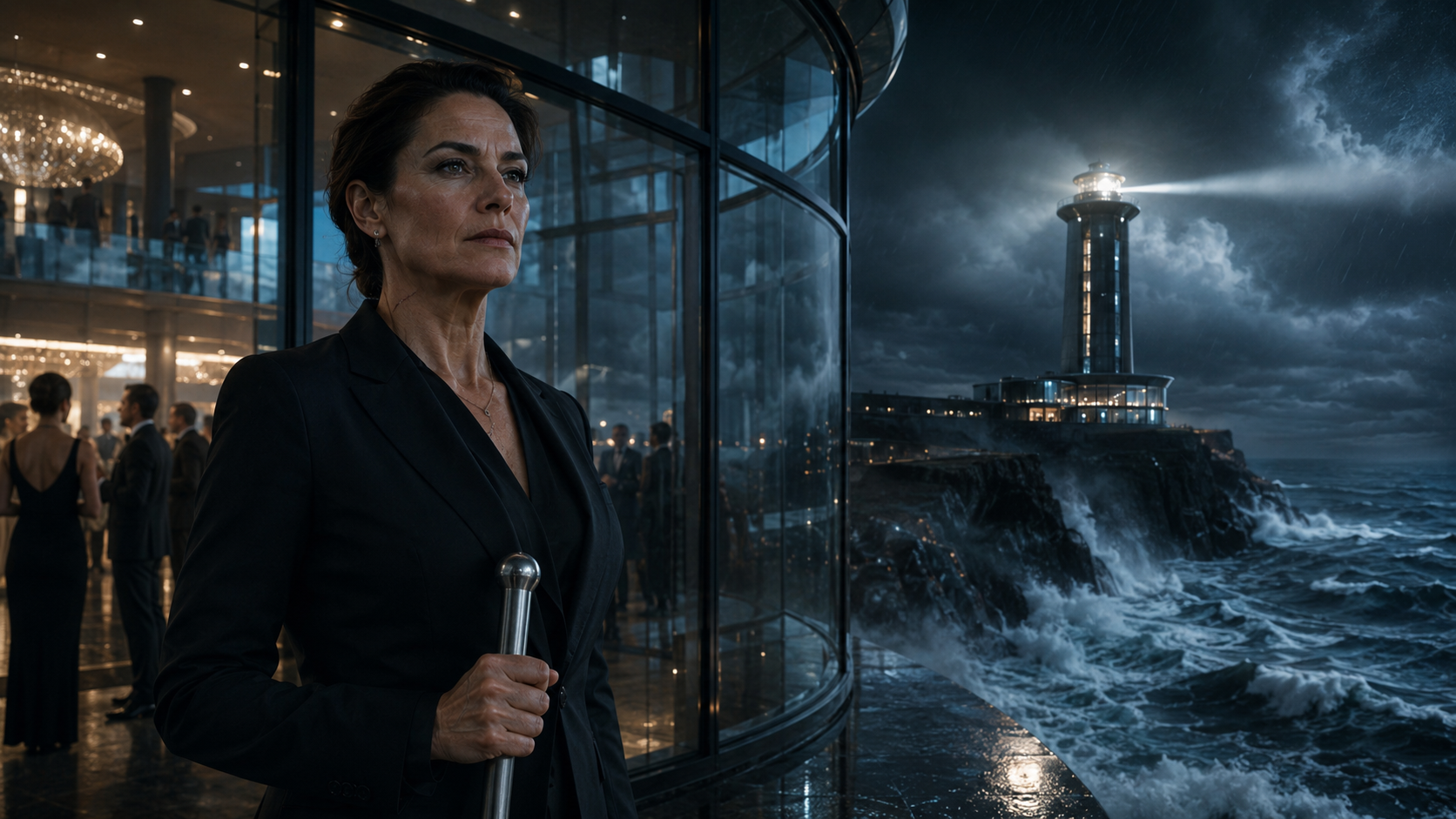
Everyone had been invited to witness Eleanor Vane surrender her life’s work.
The invitation described the evening as a celebration.
There would be champagne beneath the glass roof of Asterion Point, a chamber orchestra overlooking the black Atlantic, and a formal announcement concerning the future of Vane Maritime Technologies.
No one used the word retirement.
No one mentioned the explosion.
And no one dared say that the woman who had built the most powerful marine-engineering company in Europe was expected to sign away control before midnight.
But that was why they had come.
The guests crossed the illuminated bridge leading to Asterion Point in polished cars and private shuttles. Investors stepped out wearing tailored dinner jackets. Politicians arrived with discreet security teams. Technology executives smiled for photographers while pretending they had not already discussed how Eleanor’s patents would be divided after the sale.
Beyond them, waves struck the cliffs with enough force to shake the glass walls.
Asterion Point had been Eleanor’s masterpiece.
Part research laboratory, part lighthouse and part fortress, the structure rose from the rocks like a blade of silver driven into the coast. Deep beneath it, submerged turbines converted the violence of the ocean into clean energy.
For eighteen years, Eleanor had told anyone willing to listen that the sea did not need to be conquered.
It needed to be understood.
Then, seven months earlier, an explosion had torn through one of her experimental vessels.
Three engineers died.
Eleanor survived.
Barely.
The blast damaged the nerves along the right side of her body. It left a silver scar beneath her jaw and reduced her once-commanding voice to a strained whisper. For several weeks, she could not recognize written words. For two months, she could not hold a cup without assistance.
The newspapers called her survival miraculous.
Her younger brother called it tragic.
Malcolm Vane had spent most of his adult life standing several steps behind Eleanor.
He had inherited their father’s charm, their mother’s aristocratic features and none of Eleanor’s discipline. Where Eleanor studied tidal systems, Malcolm studied people. He remembered birthdays, marriages, rivalries and weaknesses. He could enter a room of strangers and leave with three invitations, two secrets and a promise of money.
For years, Eleanor had kept him close enough to protect the family name but far enough from the company’s engineering divisions to prevent disaster.
After the explosion, that distance disappeared.
Malcolm began attending board meetings on Eleanor’s behalf.
He assured investors that his sister needed peace.
He told senior engineers that difficult decisions could worsen her condition.
He informed journalists that Eleanor’s recovery remained uncertain.
Beside him stood Sabine Keller, Asterion’s chief operating officer.
Sabine had worked with Eleanor for twelve years. She understood the company’s contracts, patents and debts better than anyone except Eleanor herself.
During Eleanor’s recovery, Sabine became the calm voice of continuity.
She redirected projects.
Replaced department heads.
Restricted access to technical archives.
And negotiated a secret acquisition agreement with Northstar Global, Asterion’s largest competitor.
The agreement would make Malcolm wealthy.
It would make Sabine indispensable.
And it would end Eleanor’s control permanently.
Tonight, all Eleanor had to do was sign.
At eight fifteen, the orchestra began playing.
The guests gathered beneath suspended lights shaped like drops of water. Waiters carried trays between tables decorated with white orchids and polished fragments of sea glass.
At the northern end of the hall stood a raised platform.
A black folder rested on a narrow table at its center.
Inside were the transfer documents.
Malcolm stood near the platform, greeting investors with the confidence of a man already imagining his new office.
Sabine remained beside him.
She wore a dark silver gown and no jewelry except Eleanor’s old company pin.
It had been presented to her ten years earlier after she saved an important research program from bankruptcy.
Eleanor had trusted her then.
That memory no longer seemed to trouble Sabine.
“Has she arrived?” Malcolm asked quietly.
Sabine checked the time.
“Her driver crossed the bridge six minutes ago.”
“Is she bringing the nurse?”
“The rehabilitation specialist.”
Malcolm frowned.
“That was not the agreement.”
“She still needs assistance walking.”
“She needs assistance thinking.”
Sabine looked toward him.
“Do not underestimate her in public.”
Malcolm smiled.
“That warning is seven months too late.”
The orchestra changed tempo.
A murmur moved through the hall.
Eleanor Vane had entered.
She wore a simple black suit rather than a gown. A narrow support brace enclosed her right leg beneath the fabric, and a black glove covered her damaged hand. She walked with a metal cane, placing each step carefully.
Dr. Leah Arden, her rehabilitation specialist, remained several paces behind.
Eleanor had refused to take her arm.
The room watched her advance.
Some guests showed genuine concern.
Others examined her the way buyers inspect damaged machinery.
Malcolm approached with his arms open.
“Eleanor.”
She stopped before he could embrace her.
For a moment, brother and sister simply looked at each other.
Malcolm’s expression contained warmth, sorrow and patience.
It was a beautiful performance.
“You look stronger,” he said.
Eleanor’s answer was barely audible.
“I am.”
Malcolm leaned closer as though he had not heard.
“Are you comfortable speaking tonight?”
Eleanor looked past him at the platform.
“At the correct moment.”
Sabine joined them.
Her smile was more cautious.
“It is good to see you here.”
Eleanor’s gaze dropped to the company pin on Sabine’s dress.
“You kept it.”
Sabine touched the small silver emblem.
“Of course.”
“Why?”
The question appeared to surprise her.
“Because it means something to me.”
Eleanor studied her face for another second.
Then she continued toward her table.
Malcolm watched her go.
“What did she mean?” he whispered.
“Nothing,” Sabine replied.
But her hand remained over the pin.
Dinner was served.
Eleanor sat at the central table with Malcolm, Sabine, two government ministers and representatives from Northstar Global.
Conversation moved around her.
No one asked about the dead engineers.
No one mentioned the investigation into the vessel explosion.
Instead, they discussed stability, transition and the importance of protecting Eleanor’s legacy.
The words became more polished each time they were repeated.
A Northstar director named Conrad Hale raised his glass.
“What Eleanor created will survive for generations.”
Eleanor turned toward him.
“Under whose ownership?”
The director hesitated.
Malcolm answered for him.
“Ownership is a technical detail.”
“To a man buying something,” Eleanor said, “it is usually the only detail.”
The minister beside her looked down at his plate.
Sabine placed her napkin on the table.
“We agreed that tonight would not become adversarial.”
“I agreed to attend.”
“You agreed to consider the transition.”
“I have considered it.”
Malcolm smiled at the other guests.
“My sister has always enjoyed making negotiations dramatic.”
Eleanor looked at him.
“You have never seen me negotiate.”
His smile tightened.
At nine thirty, dessert plates were cleared away.
The lights above the platform brightened.
Malcolm stood.
The orchestra fell silent.
“Friends,” he began, “thank you for joining our family on such an important evening.”
Every face turned toward him.
“Seven months ago, we nearly lost a visionary, a leader and a beloved sister. Eleanor’s courage since that terrible accident has inspired all of us.”
Applause rose through the hall.
Eleanor did not react.
Malcolm continued.
“She built Asterion from a rented workshop into an institution capable of changing how humanity lives with the ocean. But even the strongest among us must sometimes allow others to carry their work forward.”
Sabine lowered her eyes with carefully measured humility.
The Northstar executives watched the black folder.
“Tonight,” Malcolm said, “we honor Eleanor by protecting everything she created.”
He extended his hand toward the platform.
A spotlight illuminated the table and the waiting documents.
“Eleanor, will you join me?”
The hall became silent.
Eleanor placed her left hand on the table.
Dr. Arden began to rise, but Eleanor stopped her with a glance.
Slowly, Eleanor stood.
She took her cane.
Each step toward the platform produced a faint metallic sound against the stone floor.
Malcolm waited with a compassionate smile.
When Eleanor reached him, he pulled out the chair beside the documents.
She did not sit.
Sabine stepped onto the platform.
“The agreement guarantees the survival of Asterion’s research divisions,” she said. “Northstar has committed substantial resources to continuing Eleanor’s projects.”
“Which projects?” Eleanor asked.
Sabine paused.
“All viable projects.”
“Name one.”
“This is not the time for technical discussion.”
“It is a technology company.”
A few people shifted uncomfortably.
Malcolm opened the folder.
“We have reviewed these matters for months. There is no reason to exhaust yourself.”
Eleanor turned toward the orchestra.
“Maestro, would you ask your musicians to leave the stage?”
The conductor looked at Malcolm.
Malcolm’s smile disappeared.
“Eleanor, what are you doing?”
She spoke more clearly this time.
“Making room.”
The musicians collected their instruments and moved away.
Behind them, the glass wall revealed the ocean and the rotating beam of the lighthouse.
Eleanor faced the guests.
“When the vessel Meridian Seven exploded, the official investigation concluded that a pressure valve failed during a routine descent.”
Sabine stepped forward.
“This is neither the place nor the occasion.”
Eleanor continued.
“The valve did not fail.”
No one moved.
Malcolm gave a quiet laugh.
“My sister has experienced memory complications since the accident.”
Eleanor looked toward the rear entrance.
A tall man in a weather-stained coat entered the hall carrying a sealed metal case.
Several engineers recognized him immediately.
Jonas Reed had designed the Meridian Seven’s navigation system.
He had disappeared from public view after the explosion.
Malcolm’s face changed.
Sabine whispered, “He was dismissed.”
“No,” Eleanor said. “He was hidden.”
Jonas reached the platform and placed the case on the table.
“The vessel transmitted a backup diagnostic packet eleven seconds before the explosion,” he said. “Someone erased it from Asterion’s main archive.”
Malcolm turned to the security team.
“Remove him.”
The guards did not move.
Jonas opened the case.
Inside was a compact black recording unit, its edges burned and distorted.
“The emergency beacon stored a physical copy,” he said. “A fishing crew recovered it three weeks ago.”
Sabine stared at the device.
“That data would be corrupted.”
“Most of it was,” Jonas replied. “Not all.”
The lights in the hall dimmed.
A deep mechanical sound passed through the building as the glass panels behind the platform turned opaque.
Malcolm looked around sharply.
“What is happening?”
Eleanor answered.
“My building is changing modes.”
“On whose authority?”
“Mine.”
A three-dimensional model of Meridian Seven appeared against the glass.
There were no decorative graphics, no company slogans and no presentation titles.
Only the vessel, its internal systems and a sequence of illuminated control paths.
Jonas pointed to a red line moving through the model.
“The main valve received an external command forty-three seconds before the blast. The command bypassed the vessel crew and originated from Asterion Point.”
Guests began whispering.
Conrad Hale from Northstar stood.
“I was told this was a retirement announcement.”
“It is,” Eleanor said. “Just not mine.”
Malcolm closed the folder.
“This proves nothing. Hundreds of employees had system access.”
“Thirty-two,” Jonas corrected. “Only four possessed authorization for a deep-system override.”
One name appeared beside the red command line.
MALCOLM VANE.
Malcolm stared at it.
“That can be fabricated.”
“It was,” Eleanor said.
Confusion moved across his face.
She continued before he could respond.
“The command was designed to appear under your authorization. Whoever sent it expected the investigation to find your name if the hidden packet survived.”
Malcolm turned toward Sabine.
She remained perfectly still.
Eleanor looked at her.
“You planned for every outcome, didn’t you?”
Sabine’s voice stayed calm.
“You are unwell.”
“You expected me to die in the explosion. If the evidence vanished, Northstar would acquire Asterion. If the evidence survived, Malcolm would be blamed and you would become the company’s only acceptable leader.”
Malcolm stepped away from her.
“You said the system was clean.”
Sabine did not look at him.
Eleanor’s scarred hand tightened inside the black glove.
“You changed the vessel’s route. You removed two engineers from the launch team. You delayed the rescue signal by six minutes.”
“That is an accusation,” Sabine said.
“No. An accusation comes before proof.”
Eleanor looked toward Dr. Arden.
The doctor removed a small silver pin from her coat.
It was identical to the one Sabine wore.
Sabine’s face lost its color.
Dr. Arden held the pin between two fingers.
“These were issued to twelve senior employees,” she said. “They contain proximity chips for restricted laboratories.”
She placed it beside the recording unit.
“After Eleanor began recovering, Sabine visited the rehabilitation wing six times under the pretext of checking her condition. During two of those visits, she entered Eleanor’s room while Eleanor was sedated.”
Malcolm stared at Sabine.
“What were you looking for?”
Eleanor answered.
“The trust documents.”
Sabine’s composure finally cracked.
“What trust?”
Eleanor turned toward the Northstar representatives.
“The patents Northstar intended to purchase do not belong to Asterion Maritime Technologies.”
Conrad Hale frowned.
“Our attorneys verified ownership.”
“They verified the company’s licenses. They did not verify the underlying patents.”
Eleanor faced the room.
“Five years ago, I transferred Asterion’s core tidal, desalination and deep-navigation patents into the Ocean Commons Foundation.”
The government ministers looked at each other.
“The foundation’s charter forbids their permanent sale to any private corporation. Asterion has permission to develop them only while it meets strict environmental and labor conditions.”
Sabine stepped toward Eleanor.
“You cannot do that.”
“I already did.”
“The board would have known.”
“The board approved a summary. None of you read the full charter.”
Several board members lowered their eyes.
Eleanor looked at Malcolm.
“You were right about one thing. Ownership is a technical detail.”
Malcolm’s face filled with a strange mixture of relief and rage.
“Then tonight’s agreement is worthless.”
“To Northstar, yes.”
Conrad Hale seized the black folder and began examining the papers.
Sabine moved toward the stairs.
The security team blocked her path.
She looked at Eleanor.
“You have no idea what you are destroying.”
“I know exactly what I am preventing.”
“I kept this company alive while you struggled to remember your own address.”
“You sold research data while three families were still arranging funerals.”
“You were weak.”
Eleanor absorbed the words without flinching.
“Yes.”
The admission silenced the hall.
“I was weak,” she repeated. “I could not speak. I could not read. Some mornings, I could not lift my head without help.”
She looked at the investors, politicians and executives who had come to watch her surrender.
“You saw weakness and assumed it created an empty space.”
Her eyes returned to Sabine.
“So you rushed to fill it.”
Malcolm approached the documents.
“What happens now?”
Eleanor looked at her brother.
“For you?”
His expression hardened.
“For the company.”
“The acquisition is cancelled. The current board is dissolved at midnight. An interim council of engineers, shipyard representatives and coastal-community delegates will assume control.”
“You are giving strangers our company?”
“I am removing the word our.”
Their father’s name had been attached to vessels, laboratories and foundations for more than half a century.
For Malcolm, it was more than a name.
It was a crown.
“You built Asterion,” he said. “It belongs to you.”
“No.”
Eleanor looked through the transparent section of the wall at the violent water below.
“I built machines. Thousands of people built Asterion.”
Sabine laughed softly.
It was not a pleasant sound.
“They will tear it apart.”
“Perhaps.”
“They will vote against you.”
“Almost certainly.”
“They may remove you.”
“They will have that right.”
Sabine studied her as if seeing a stranger.
“You went through all this to surrender control anyway?”
Eleanor’s damaged voice weakened, but she did not look away.
“I went through all this to decide who deserved it.”
From outside came the distant sound of approaching helicopters.
Malcolm turned toward the glass.
“Police?”
“Financial investigators,” Eleanor said. “And maritime authorities.”
Sabine’s gaze moved toward the service corridor.
Security officers closed around her.
For the first time that evening, fear entered her expression.
Malcolm watched them take her company pin.
Then he looked at Eleanor.
“Did you know my authorization was being used?”
“Not at first.”
“Yet you let everyone believe I caused the explosion.”
“I let Sabine believe her plan was working.”
“You used me.”
“Yes.”
The honesty struck harder than an excuse would have.
“I am your brother.”
“You were selling the company before I could form a complete sentence.”
“I was trying to save it.”
“You were trying to inherit a living woman.”
Malcolm looked around the hall, searching for someone willing to defend him.
The investors avoided his eyes.
The politicians had already begun speaking quietly with their assistants.
The Northstar representatives collected their documents and moved toward the exit.
The empire Malcolm had imagined was disappearing without a sound.
He leaned closer to Eleanor.
“You think these people respect you now?”
“No.”
“They are afraid because you surprised them.”
“I know.”
“When they stop being afraid, they will betray you again.”
Eleanor glanced across the room.
“Then next time, they will have to betray thousands of owners instead of one injured woman.”
Malcolm had no answer.
Investigators entered the hall.
Sabine did not resist when they approached her.
She merely turned toward Eleanor.
“You still do not understand the explosion.”
Eleanor’s eyes narrowed.
Sabine smiled.
“I ordered the valve command. But Meridian Seven was never supposed to carry passengers that morning.”
Jonas Reed went pale.
“What are you talking about?”
“The test schedule was empty when I approved the command.”
Eleanor took one step toward her.
“Three engineers died.”
“Because someone changed the schedule after I accessed the system.”
“Who?”
Sabine’s smile vanished.
“I assumed it was Malcolm.”
Every face turned toward him.
Malcolm shook his head.
“I did not know anything about the vessel.”
Jonas opened the diagnostic controls again.
“There was a late schedule modification,” he said. “It came from an executive terminal.”
“Whose?” Eleanor asked.
He examined the record.
Then he stopped.
The room waited.
Jonas slowly looked toward Eleanor.
“The authorization came from your office.”
Malcolm gave a breathless laugh.
Sabine stared.
Even the investigators seemed uncertain.
Eleanor did not move.
“My terminal was secured.”
“Someone entered your office at 4:12 that morning,” Jonas said. “The internal camera was disabled.”
Eleanor turned toward the rehabilitation doctor.
Dr. Arden’s expression had become unreadable.
Eleanor remembered waking after the explosion.
The doctor had been the first face she saw.
The first voice she trusted.
The first person to tell her that her memories might never return.
Dr. Arden stepped away from the table.
Eleanor’s whisper filled the silence.
“Leah?”
The doctor looked at the approaching investigators.
Then she looked at Eleanor.
“I tried to stop the test.”
“By putting three engineers on the vessel?”
“They discovered the illegal mining survey.”
Jonas stared at her.
“What survey?”
Dr. Arden’s voice changed.
The gentleness disappeared.
“Asterion had mapped mineral deposits beneath protected waters. Sabine planned to sell the data. Malcolm planned to sell the company. You planned to release the maps to the governments involved.”
“I never saw those maps.”
“Because I erased them.”
Eleanor’s face became still.
“You worked in neurological rehabilitation.”
“I worked in naval intelligence before medical school.”
The investigators moved closer.
Dr. Arden continued.
“The engineers copied the survey. I changed the schedule to place them on Meridian Seven, expecting Sabine’s sabotage to destroy the evidence.”
Sabine stared at her.
“You knew about the command?”
“I created the security flaw you used.”
“You manipulated all of us.”
“No,” Dr. Arden said. “I allowed each of you to become exactly what you already were.”
An officer reached for her arm.
Dr. Arden twisted away and ran toward the glass doors leading to the observation deck.
The doors locked before she reached them.
The lighthouse beam swept across the dark ocean.
For one white second, everyone in the hall was reflected in the glass.
The ambitious brother.
The betrayed executive.
The false healer.
The silent investors.
And Eleanor, standing with a cane before the remains of the world she had created.
Dr. Arden pressed both hands against the locked doors.
“You cannot release those maps,” she shouted. “Countries will fight over them. Corporations will tear the seabed apart.”
Eleanor’s voice was quiet.
“That decision was never yours to make.”
“And it is yours?”
“No.”
Eleanor looked at the investigators.
“That is the lesson everyone here failed to understand.”
Dr. Arden was taken away.
Sabine followed.
Malcolm remained at the edge of the platform, looking suddenly older than his years.
The hall emptied slowly.
No one returned to the champagne.
No one asked the orchestra to play.
Near midnight, Eleanor stepped onto the observation deck.
The wind pulled at her jacket.
Below her, the turbines continued turning beneath the waves.
Malcolm joined her.
For several minutes, they stood without speaking.
“What will you do tomorrow?” he asked.
“Sleep.”
“And after that?”
“Attend the first council meeting.”
“As its chairwoman?”
“As one member.”
Malcolm looked back through the glass at the scattered documents.
“You really are giving it away.”
Eleanor watched the lighthouse beam travel across the water.
“No,” she said. “I am finally giving it back.”
Behind them, the clock reached midnight.
The old board ceased to exist.
The acquisition agreement became meaningless.
And the company named after Eleanor’s family began its first minute without belonging to them.
Everyone had come to watch Eleanor Vane surrender her power.
Instead, they watched her change the meaning of power itself.
SEEDANCE VIDEO TRAILER PROMPTS
1
Create a cinematic 15-second dramatic thriller trailer in 16:9 with synchronized English dialogue and realistic ambient sound.
0–3 seconds: Exterior night shot of a futuristic glass lighthouse built into violent Atlantic cliffs. Luxury cars arrive as waves crash below. Slow aerial push toward the illuminated gala.
3–7 seconds: Inside the elegant hall, injured technology founder Eleanor Vane walks with a metal cane toward a table holding legal documents. Her younger brother Malcolm smiles and quietly says, “All you have to do is sign.”
7–11 seconds: Tight close-up on Eleanor’s scarred face. She answers in a strained but controlled whisper, “You invited them to watch me disappear.”
11–15 seconds: The lights suddenly dim. A burned black recording device is placed on the table. Eleanor looks directly at Malcolm and says, “Now they will watch the truth arrive.”
Photorealistic prestige thriller, restrained performances, cold ocean lighting, subtle handheld camera, realistic lip synchronization, natural English voices, orchestral tension, crashing waves. No subtitles, no captions, no titles, no logos, no watermarks, no written words anywhere in the video.
2
Generate a 15-second cinematic corporate-conspiracy trailer with spoken English dialogue, synchronized sound and no visible text.
0–4 seconds: A glittering gala inside a glass research tower above a stormy ocean. Guests raise champagne while Malcolm gives a confident speech. He says, “Tonight, my sister protects her legacy by stepping aside.”
4–8 seconds: Eleanor stands alone beneath a spotlight, gripping a cane. She looks toward the gathered investors and says softly, “You mistook silence for permission.”
8–12 seconds: The glass wall turns dark and reveals a glowing three-dimensional image of an exploding research vessel. Guests gasp. Sabine whispers, “That evidence was destroyed.”
12–15 seconds: Eleanor turns toward her and replies, “Not all of it.” Security doors lock as thunder shakes the building.
Elegant psychological thriller, sophisticated adult characters, realistic facial emotion, slow dolly movements, dramatic reflections, deep bass impact, ocean storm ambience, precise English lip sync. No subtitles, no captions, no opening title, no end title, no signage, no logos, no watermarks and no readable text.
3
Create a powerful 15-second emotional comeback trailer for a prestige drama, 16:9, photorealistic, with synchronized English conversation.
0–3 seconds: Close-up montage in a quiet rehabilitation room: Eleanor’s trembling hand fails to lift a metal cup. Her therapist Leah says gently, “Again, Eleanor.”
3–6 seconds: Eleanor forces herself upright using a cane. Breathing hard, she answers, “Not for them. For me.”
6–10 seconds: Hard cut to an extravagant oceanfront gala. Malcolm pushes a contract toward her and says, “The company needs someone strong.”
10–13 seconds: Eleanor slowly removes her black glove and places an access key on the table. She replies, “Strength is not the same as ownership.”
13–15 seconds: The ballroom doors lock, investigators enter and every guest turns toward Malcolm. Eleanor remains perfectly calm as the lighthouse beam crosses her face.
Emotionally intense but realistic acting, detailed skin and fabric, controlled camera movement, subtle orchestral rise, natural room acoustics, realistic cane sounds and accurate English lip synchronization. No subtitles, no captions, no written titles, no logos, no watermarks, no interface graphics and no visible words.
4
Produce a dark 15-second mystery trailer with cinematic multi-shot storytelling, synchronized English dialogue and realistic sound design.
0–3 seconds: At night, engineer Jonas opens a burned metal data recorder inside a glass lighthouse. He whispers to Eleanor, “The explosion was triggered from inside this building.”
3–6 seconds: Across the crowded gala, Malcolm leans toward Sabine and says, “She remembers nothing.”
6–9 seconds: Eleanor appears behind them and answers clearly, “I remember enough.”
9–12 seconds: Rapid dramatic cuts: a research vessel exploding underwater, a security pin falling onto marble, locked glass doors and investigators moving through frightened guests.
12–15 seconds: Eleanor faces her trusted doctor Leah. Eleanor asks, “Who changed the passenger list?” Leah gives a cold smile as the lighthouse suddenly goes dark.
High-end oceanic conspiracy thriller, realistic adult faces, natural English speech, accurate lip sync, tense pauses, thunder, distant alarms, deep cinematic sound, sharp visual continuity and no exaggerated action. No subtitles, no captions, no titles, no written signs, no logos, no watermarks and no readable text anywhere on screen.

