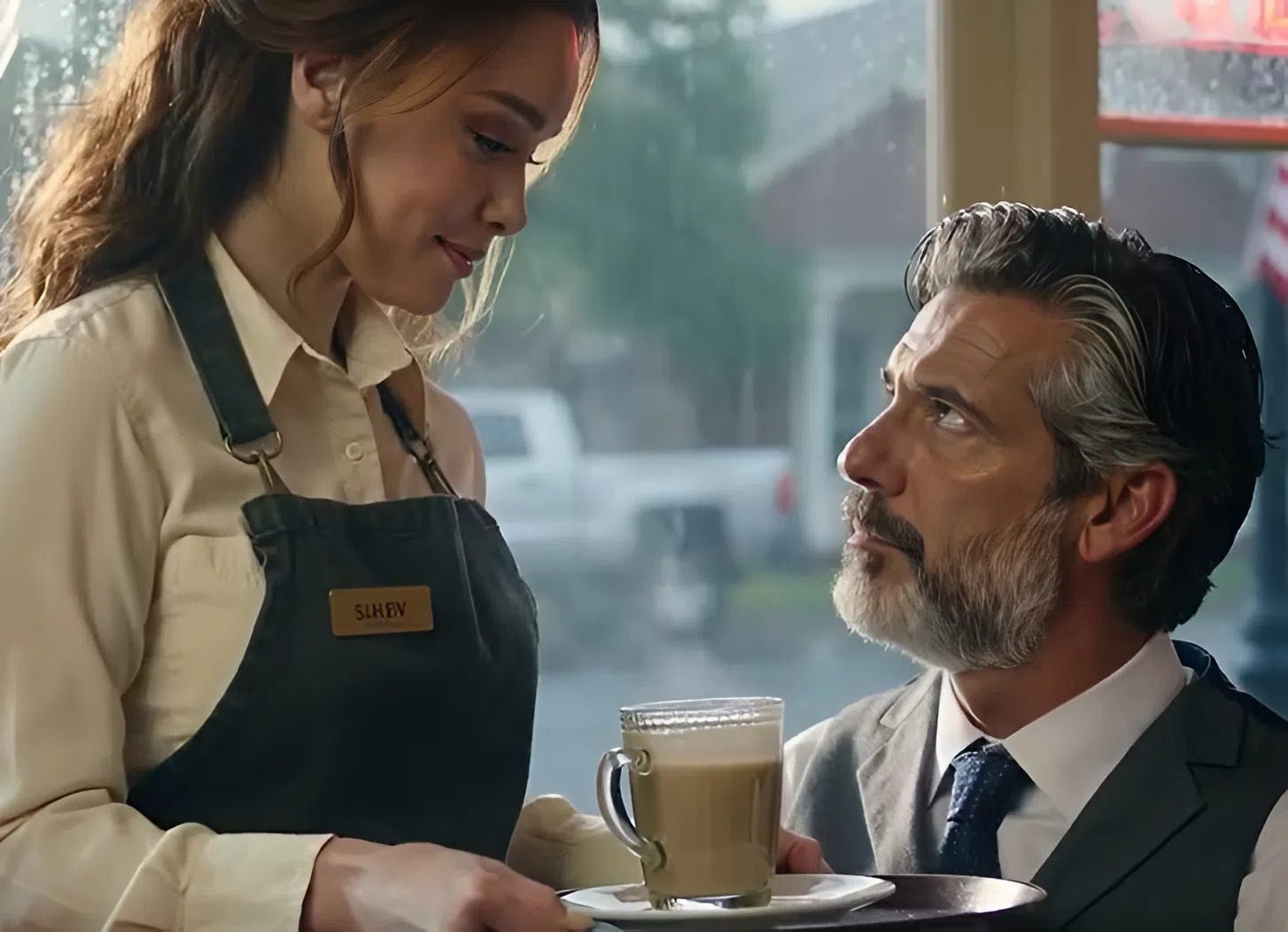
Why people become cruel when they feel powerless. He mentioned authors Emma had never read, and she didn’t try to pretend she knew them. She responded with curiosity, not hypocrisy. Minutes passed, then more. The noise in the café faded into the background. At one point, Emma laughed. She laughed genuinely, for the first time in several days. ‘You’re not who I expected,’ she said. He raised an eyebrow.
“What did you expect?” She shrugged. “Someone who just wanted to say thank you and disappear.” He looked down, then met her gaze again. “I’ve been rich for a long time,” he said. “But very few people have made me feel human again like you did that day. You did that.” Emma didn’t answer. She didn’t need to. In that moment, they were just two people.
Not a waitress and a billionaire, not strangers and a saviour, just two souls finally seen. And neither of them would ever forget it. Exactly one month after their second meeting, Emma received an envelope. There was no return address, no sender’s name, only a heavy ivory card with gold embossing and the unmistakable Aninsley A. logo.
A five-star hotel in the heart of the city, known more to those who host heads of state than to waitresses from local cafes. Her name was clearly printed at the top, Emma L. Bennett, guest of Charles H. Everlin. She stared at it for a long time, the sunlight catching the gold lettering like a secret. ‘It challenges me to open it.’
She almost didn’t go, but curiosity mixed with a strange tightness in her chest led her to the hotel lobby three days later, dressed in her only nice blouse, shoes borrowed from a neighbour, and her hair pinned up with trembling hands. When she stepped through the revolving doors, it was like entering another world. Polished marble floors, chandeliers dripping with light, people walking with quiet authority.
She approached the reception desk, her voice barely steady. ‘Emma Bennett, I believe I have an appointment.’ The concierge nodded without surprise and directed her to a private room on the 21st floor. ‘Mr. Everlin will be with you shortly,’ said Mr. Everlin. She was silent in the lift, her heart pounding.
The room was quiet and luxurious, with deep leather armchairs, soft jazz humming from invisible speakers, and a view of the skyscrapers like a throne room in the sky. She stood by the window, unsure if she belonged anywhere in this world, until the door behind her opened. She turned around. Charles, but not the man from the café, not even the well-dressed guy from days ago. This Charles wore his presence like a bespoke suit.

With two assistants who soon disappeared into the doorway, he entered with the kind of authority that demands no attention. It simply was. ‘Emma,’ he said, his voice smooth and low. ‘Thank you for coming.’ She tried to smile, but her voice caught. ‘This isn’t exactly a café.’
He pointed to the table by the window, already set with tea, fruit, and untouched espresso. ‘Please,’ he said, ‘sit down.’ She obeyed, still unsure whether she was being honoured or tested. He sat down opposite her, folding his arms. ‘I wanted to tell you this in person,’ he began, ‘because anything else would be unfair.’ She waited. ‘My name is Charles H. Everlin. I am the founder of Everlin Holdings. We operate in 12 countries, mainly in infrastructure and social investments.’ Emma blinked. She opened her mouth but said nothing.
‘I wasn’t pretending to be someone else,’ he hastened to add. ‘But that morning in the café, I dressed modestly. Yes, I forgot my wallet on purpose.’ ‘I needed to know what people would be like when they saw me when there was nothing to be gained.’ Emma stared at the tea in front of her as if it could provide clarity. ‘My wife died 15 years ago,’ he continued, his voice growing quieter. ‘Cancer, suddenly. We never had children. After she died, I stopped trusting people, stopped believing that kindness was real.’
‘I started travelling anonymously, visiting towns and villages, not only to see the world, but also to see who else lived in it with heart.’ He looked at her directly. ‘That day, I found someone.’ Emma swallowed. She didn’t know whether to feel honoured or terrible. ‘You set me up,’ she asked, her voice trembling slightly. ‘No,’ he said softly. ‘I didn’t approach you. I didn’t ask for anything. I just watched. And you chose.’ She shook her head slowly. ‘I don’t know if I’m grateful or being manipulated.’ He nodded. ‘I understand that. I do.’ Emma stood up abruptly, her chair sliding across the carpet with a whisper. ‘So now what?’ she asked. ‘You tell me I passed your little moral test, and then what? You write me a cheque? Offer me a job, a car?’ Charles didn’t flinch.

‘I’m not offering anything unless you decide to listen to me.’ Emma’s sigh was shaky, her emotions boiling with contradiction, shock, hurt, curiosity, awe. He stood up too, walked over to the window, his hands clasped behind his back. ‘I wasn’t testing you, Emma,’ he said again. ‘I was searching. Searching for something I thought the world had lost.’