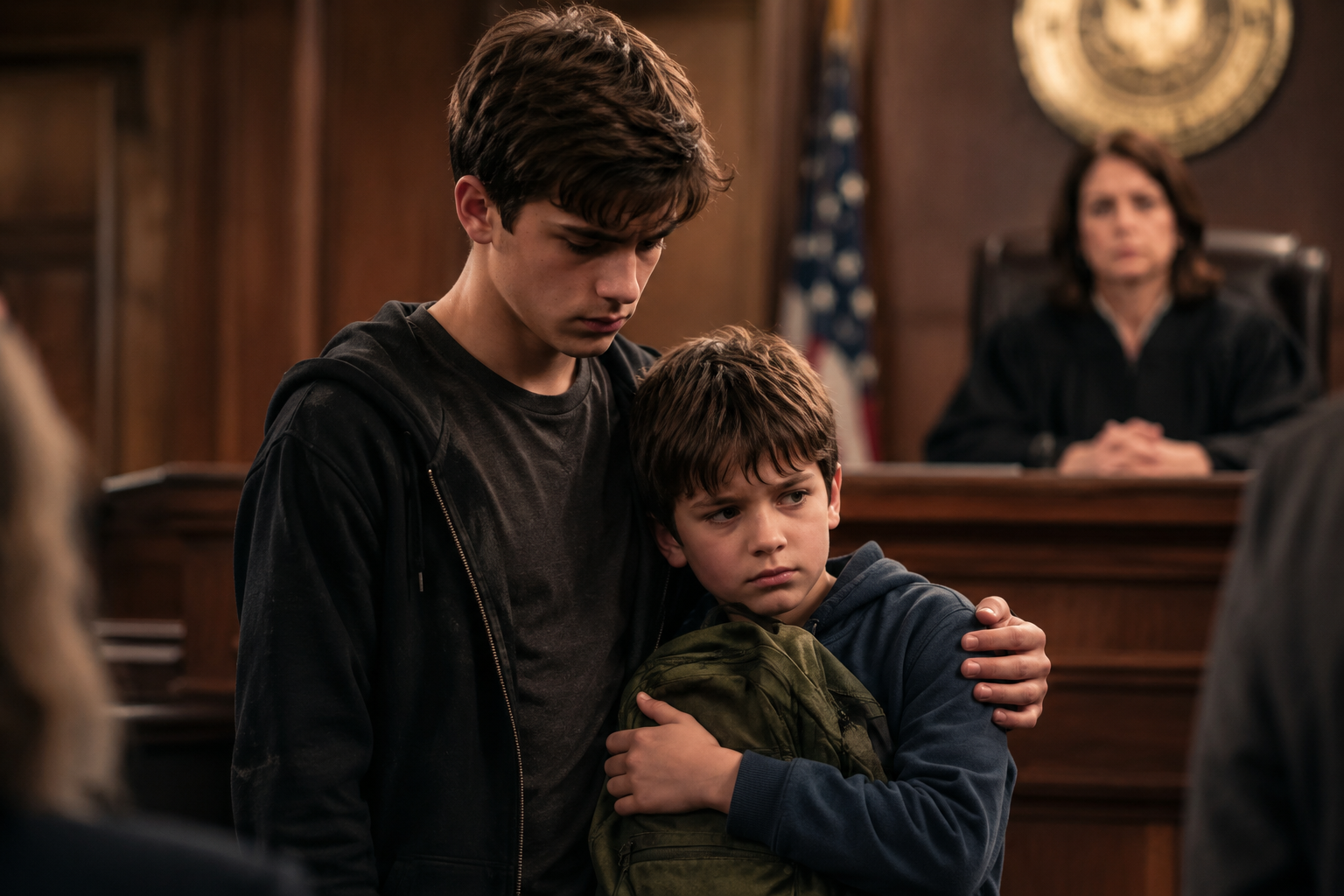
“It means no final decision will be made until every reasonable option for placing you together has been examined.”
Ethan released a breath he seemed to have been holding all morning.
The judge continued.
“Until the assessment is complete, both boys will remain in temporary supervised housing together. Mrs. Hart’s application will receive emergency review.”
Evelyn nodded.
“Thank you, Your Honor.”
“This is not a promise that your application will be approved.”
“I understand.”
“It will require inspections, interviews, regular visits, and cooperation with social services.”
“I expected nothing less.”
Judge Lawson turned toward Ethan.
“You have done something extraordinarily difficult for your brother. But from this moment forward, you are not expected to function as his parent.”
Ethan’s expression tightened.
“I don’t know how to stop worrying about him.”
“No one is asking you to stop loving him.”
The judge’s voice became gentler.
“We are asking you to allow someone to care for you as well.”
Three weeks later, Ethan and Noah carried their belongings down one flight of stairs instead of across the city.
Evelyn’s apartment did not resemble the spacious homes shown in foster-care brochures. The wallpaper in the hallway was old, the floorboards creaked, and the kitchen table had several scratches.
But the radiators worked.
The refrigerator was full.
Two beds stood in the converted dining room, separated by a bookshelf. Noah’s bed had a green blanket and a lamp shaped like a moon. Ethan’s side had a desk, a new notebook, and a secondhand laptop donated by the community center.
Ethan stood in the doorway for a long time.
“What is the desk for?” he asked.
Evelyn placed her cane against the wall.
“Homework.”
“I can work after school.”
“You can study after school.”
“I should help pay for food.”
“You may help wash the dishes.”
“I can repair things.”
“The kitchen drawer sticks.”
“I mean real work.”
Evelyn looked directly at him.
“Being sixteen is real work.”
That night, Noah asked whether the bedroom door would be locked.
“No,” Evelyn answered.
He asked whether Ethan would still be there in the morning.
“Yes.”
He asked whether there would be breakfast.
“Yes.”
He asked whether he was allowed to turn on the hallway light if he had a nightmare.
“You may turn on every light in the apartment if you need to.”
Noah considered this.
“Even the kitchen light?”
“Especially the kitchen light.”
After dinner, Ethan tried to save half of his meal for the next day.
Evelyn noticed and placed another piece of bread on his plate.
“There will be food tomorrow.”
Ethan stared at her.
“You don’t know that.”
“I bought enough for the week.”
“Something could happen.”
“Something could always happen.”
She sat across from him.
“But you are not required to prepare for disaster every minute of your life.”
Later, after Noah had fallen asleep, Ethan found Evelyn washing dishes.
“You didn’t have to do this,” he said.
“No.”
“It could become complicated.”
“It already is.”
“I’m not always easy.”
“I worked in a school library for thirty-nine years. I survived teenagers returning books with sandwiches inside them. You do not frighten me.”
For the first time, Ethan almost smiled.
Then his expression broke.
“I thought they were going to take him.”
Evelyn dried her hands.
“I know.”
“I promised our mother.”
“You kept your promise.”
“What if I can’t keep it forever?”
“You are not supposed to keep it alone.”
Ethan looked toward the bedroom where Noah slept.
Then he began to cry.
Evelyn did not tell him to be brave. She did not remind him that Noah depended on him. She simply stood beside him until the tears stopped.
The following months were not perfect.
Noah sometimes woke before dawn and checked whether Ethan’s bed was occupied. Ethan continued hiding food in his backpack until Evelyn discovered three crushed rolls and an apple beneath his schoolbooks.
Both boys attended counseling.
Ethan’s school attendance improved. He joined an after-school engineering club and discovered that repairing small machines was more interesting when he was not doing it to pay the electricity bill.
Noah began leaving his green backpack beside the front door instead of carrying it from room to room.
Evelyn learned that he disliked peas, loved astronomy, and asked at least twenty questions before breakfast.
The neighbors kept their promises. One drove the boys to medical appointments. Another helped repair the converted bedroom. The owner of the bakery offered Ethan a weekend job with legal hours and proper wages, but only after his grades had stabilized.
Six months later, the brothers returned to Judge Lawson’s courtroom for a review hearing.
This time, Ethan’s jacket fit him.
Noah still held his hand, but he was no longer gripping it in fear.