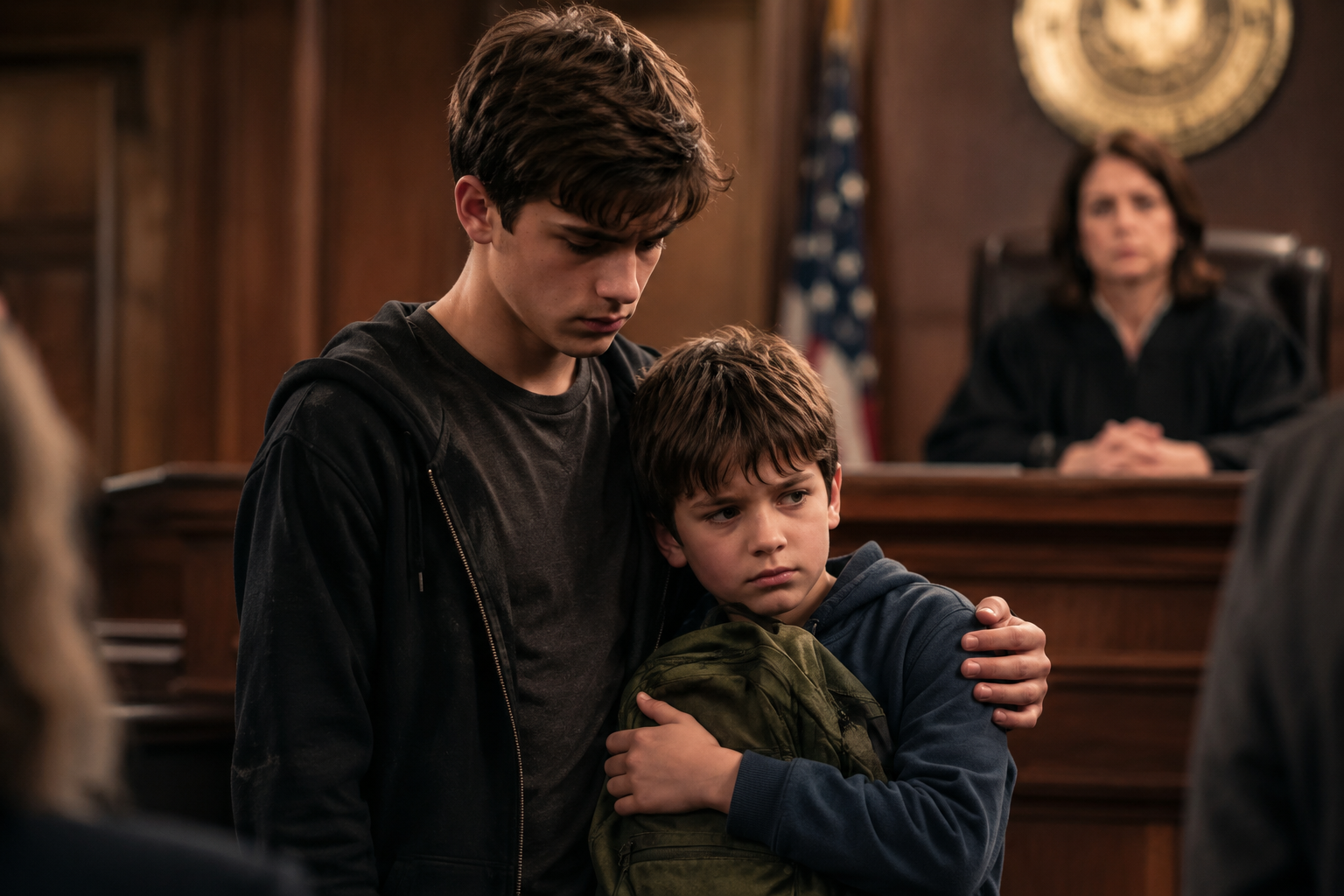
No one answered.
The question had not appeared in any report.
The case had been organized around Noah’s safety because he was the younger child. Every recommendation described what Noah required: food, supervision, healthcare, a dependable adult, and a proper bedroom.
The documents described Ethan differently.
Uncooperative.
Secretive.
Frequently absent from school.
Overly protective.
Resistant to intervention.
No one had written that Ethan was also a frightened child.
Claire looked toward him.
“Ethan, we know that you care deeply about your brother. But caring about someone does not always mean you can give them everything they need.”
“I know,” Ethan replied.
His voice was quiet but steady.
“That’s why I learned to cook more than noodles. That’s why I watched videos at the public library about treating a fever. That’s why I fixed Mr. Howard’s bicycles after school, even when my hands were too cold to hold the tools.”
Judge Lawson removed her glasses.
“You repaired bicycles?”
“For money. The bakery also let me clean the kitchen after closing. Sometimes they gave me bread they couldn’t sell the next morning.”
Claire glanced at her notes.
“Your school records show that you missed twenty-three days.”
“Yes.”
“Why?”
“Because Noah had the flu for one week. Another week, the landlord was changing the locks because I was late with the rent. And sometimes I worked mornings.”
“You told the school you were sick.”
“I didn’t want anyone asking questions.”
“Why not?”
Ethan looked down at the table.
“Because every time an adult asked questions, they started talking about taking Noah away.”
Noah suddenly turned toward the judge.
“Ethan didn’t eat.”
Ethan’s head snapped toward him.
“Noah.”
“He didn’t.”
“You don’t have to talk about that.”
“Yes, I do.”
The little boy placed his backpack on the floor and stood as straight as he could.
“When we didn’t have enough food, Ethan said he had eaten at work. But the bakery was closed that day. I knew because we walked past it.”
Ethan closed his eyes.
Noah continued.
“He gave me the last egg and said he didn’t like eggs anymore. But he does. He puts pepper on them.”
A faint sound moved through the courtroom as someone in the back row exhaled sharply.
“And when the heater stopped working,” Noah said, “he put both blankets on my bed. He wore his coat all night. I woke up and saw him sitting beside the radiator even though it was cold.”
Ethan’s face reddened.
“Please stop, Noah.”
“No. They need to know.”
Noah’s voice trembled, but he did not sit down.
“When I was scared, Ethan made the apartment into a spaceship. The lights didn’t work, so he said we were flying through a dark part of space. He gave me a flashlight and told me I was the navigator.”
Judge Lawson lowered her gaze toward the file.
The report described that evening as another utility failure.
It did not mention the spaceship.
It did not mention the flashlight.
It did not mention a sixteen-year-old boy turning darkness into an adventure so his little brother would not realize they could not afford electricity.
Claire spoke carefully.
“Noah, no one is saying Ethan did not try.”
“He didn’t just try.”
The boy’s voice cracked.
“He stayed.”
Ethan covered his mouth with one hand.
For almost a year, he had refused to cry in front of Noah. He had cried silently in the bathroom once, with the faucet running. He had cried behind the bakery after the owner told him there would be no extra shifts. He had cried on a city bus after realizing that the envelope in his pocket contained their final warning from the landlord.
But never where Noah could see him.
Now his shoulders began to shake.
Judge Lawson waited until he could breathe again.
“Ethan,” she said, “why did you believe hiding your circumstances was the only option?”
He slowly lowered his hand.
“The night our mother died, a hospital worker asked whether we had family. I called every number in her phone.”
He looked toward Noah.
“Our uncle said his apartment was too small. Our grandmother is in assisted living. Our father’s number didn’t work. One cousin promised to call back, but she never did.”
“And after that?”
“A nurse said social services would help us. I heard two people in the hallway talking. One said Noah could be placed quickly because he was young. The other said teenagers were more difficult.”
Claire shifted uncomfortably.
“I thought they would send him somewhere good and send me somewhere else. Maybe far away.”
“So you left the hospital without informing anyone?”
“I took Noah home.”
“You were fifteen.”
“He was seven.”
The simple answer silenced the room.
Judge Lawson studied him for several moments.
“Ethan, love cannot replace a legal guardian, stable housing, education, or medical care.”
“I know.”
“Then what are you asking this court to do?”