The Judge Was Ready to Separavealed the Promise That Had Kept Them Alive

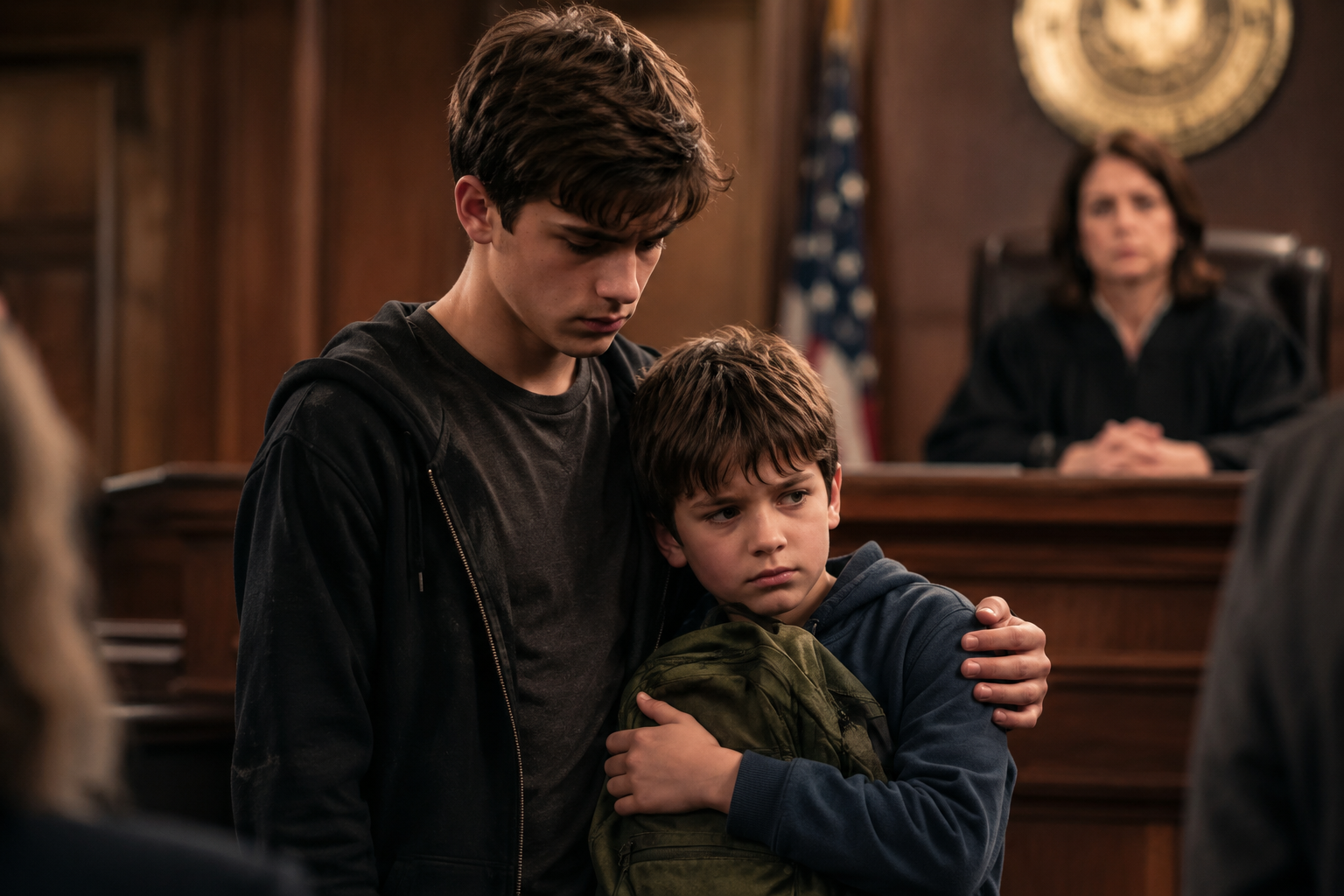
The courtroom doors opened with a low wooden groan, and two boys stepped inside holding hands.

The older one, Ethan Cole, was sixteen, though the exhaustion in his face made him appear much older. His dark jacket was a size too large, the sleeves nearly covering his fingers. The collar of his borrowed shirt was slightly frayed, and his shoes had been polished so carefully that the cracks in the leather shone.

Beside him walked eight-year-old Noah.

The younger boy carried a faded green backpack against his chest as though it contained everything he owned. In truth, it almost did. Inside were two shirts, a small plastic dinosaur, a photograph of their mother, and a storybook Ethan had read to him so many times that the pages had begun to separate from the binding.

Noah did not understand most of the words the adults had been using that morning.

Temporary placement.

Legal guardianship.

Emergency protection.

Separate accommodation.

He understood only one thing: someone in that room might decide that he could no longer go home with his brother.

Judge Miriam Lawson watched the boys approach the table at the front of the courtroom. She had presided over family cases for more than twenty years. She had heard angry parents blame each other, frightened children whisper rehearsed answers, and social workers describe homes that no child should ever have seen.

She had learned to rely on records, interviews, evaluations, and recommendations.

The file in front of her seemed clear.

The boys’ mother had died almost a year earlier after a long illness. Their father had disappeared from their lives several years before that. No relatives had agreed to take responsibility for them. Ethan had hidden the truth about their situation, telling teachers and neighbors that an adult cousin was staying with them.

There was no cousin.

For eleven months, Ethan had paid the rent, bought food, taken Noah to school, signed school papers, washed clothes in the bathtub, and invented excuses whenever anyone asked why their mother was never seen.

The arrangement could not continue.

Ethan was still a minor. He had missed classes, arrived late repeatedly, and fallen asleep at his desk. Their electricity had been disconnected twice. A social worker had found almost nothing in their refrigerator except half a carton of milk, three eggs, and a pot of vegetable stew.

A foster family had agreed to take Noah immediately.

They could provide a warm room, regular meals, medical care, and a stable school routine.

But they could not take Ethan.

That was why the brothers were in court.

Judge Lawson looked down at the report and then at the boys.

“Ethan Cole,” she began, “the information before this court indicates that you have been caring for Noah without an adult guardian for nearly a year. Is that correct?”

Ethan’s fingers tightened around his brother’s hand.

“Yes, Your Honor.”

“You understand that you are not legally old enough to assume full responsibility for another child?”

“Yes.”

“You understand that the current arrangement is unsafe for both of you?”

Ethan hesitated.

Noah looked up at him immediately.

“Are they taking me somewhere?” the little boy asked.

Ethan bent closer, lowering his voice.

“Nothing has been decided yet.”

“But will I stay with you?”

Ethan did not answer.

The silence frightened Noah more than any answer could have.

A social worker named Claire Bennett sat at the opposite table. She was not cruel, and she had not entered the profession to separate families. She had spent weeks trying to find a placement that could accept both brothers.

Nothing had worked.

Some families had space for a young child but not a teenager. Others were unwilling to take siblings with such a large age difference. One family had initially expressed interest in both boys, then changed its mind after reading about Ethan’s school absences and his distrust of authority.

Claire opened a folder.

“We have found a suitable home for Noah,” she explained gently. “The family has experience caring for children his age. He would remain at his current school, receive counseling, and have scheduled contact with Ethan.”

Noah stared at her.

“What does scheduled contact mean?”

“It means you would still see your brother.”

“When?”

“There would be regular visits.”

“Would he live there too?”

Claire paused.

“No.”

Noah moved closer to Ethan until their shoulders touched.

“Then it isn’t my home.”

The judge leaned slightly forward.

“Noah, the adults in this room are trying to make sure you are safe.”

“I am safe with Ethan.”

Judge Lawson glanced at the photographs in the file: the leaking kitchen ceiling, the broken heater, the nearly empty cupboards.

“You both need more support than Ethan can provide alone.”

Noah’s eyes filled with confusion.

“But who is going to support Ethan?”

No one answered.

The question had not appeared in any report.

The case had been organized around Noah’s safety because he was the younger child. Every recommendation described what Noah required: food, supervision, healthcare, a dependable adult, and a proper bedroom.

The documents described Ethan differently.

Uncooperative.

Secretive.

Frequently absent from school.

Overly protective.

Resistant to intervention.

No one had written that Ethan was also a frightened child.

Claire looked toward him.

“Ethan, we know that you care deeply about your brother. But caring about someone does not always mean you can give them everything they need.”

“I know,” Ethan replied.

His voice was quiet but steady.

“That’s why I learned to cook more than noodles. That’s why I watched videos at the public library about treating a fever. That’s why I fixed Mr. Howard’s bicycles after school, even when my hands were too cold to hold the tools.”

Judge Lawson removed her glasses.

“You repaired bicycles?”

“For money. The bakery also let me clean the kitchen after closing. Sometimes they gave me bread they couldn’t sell the next morning.”

Claire glanced at her notes.

“Your school records show that you missed twenty-three days.”

“Yes.”

“Why?”

“Because Noah had the flu for one week. Another week, the landlord was changing the locks because I was late with the rent. And sometimes I worked mornings.”

“You told the school you were sick.”

“I didn’t want anyone asking questions.”

“Why not?”

Ethan looked down at the table.

“Because every time an adult asked questions, they started talking about taking Noah away.”

Noah suddenly turned toward the judge.

“Ethan didn’t eat.”

Ethan’s head snapped toward him.

“Noah.”

“He didn’t.”

“You don’t have to talk about that.”

“Yes, I do.”

The little boy placed his backpack on the floor and stood as straight as he could.

“When we didn’t have enough food, Ethan said he had eaten at work. But the bakery was closed that day. I knew because we walked past it.”

Ethan closed his eyes.

Noah continued.

“He gave me the last egg and said he didn’t like eggs anymore. But he does. He puts pepper on them.”

A faint sound moved through the courtroom as someone in the back row exhaled sharply.

“And when the heater stopped working,” Noah said, “he put both blankets on my bed. He wore his coat all night. I woke up and saw him sitting beside the radiator even though it was cold.”

Ethan’s face reddened.

“Please stop, Noah.”

“No. They need to know.”

Noah’s voice trembled, but he did not sit down.

“When I was scared, Ethan made the apartment into a spaceship. The lights didn’t work, so he said we were flying through a dark part of space. He gave me a flashlight and told me I was the navigator.”

Judge Lawson lowered her gaze toward the file.

The report described that evening as another utility failure.

It did not mention the spaceship.

It did not mention the flashlight.

It did not mention a sixteen-year-old boy turning darkness into an adventure so his little brother would not realize they could not afford electricity.

Claire spoke carefully.

“Noah, no one is saying Ethan did not try.”

“He didn’t just try.”

The boy’s voice cracked.

“He stayed.”

Ethan covered his mouth with one hand.

For almost a year, he had refused to cry in front of Noah. He had cried silently in the bathroom once, with the faucet running. He had cried behind the bakery after the owner told him there would be no extra shifts. He had cried on a city bus after realizing that the envelope in his pocket contained their final warning from the landlord.

But never where Noah could see him.

Now his shoulders began to shake.

Judge Lawson waited until he could breathe again.

“Ethan,” she said, “why did you believe hiding your circumstances was the only option?”

He slowly lowered his hand.

“The night our mother died, a hospital worker asked whether we had family. I called every number in her phone.”

He looked toward Noah.

“Our uncle said his apartment was too small. Our grandmother is in assisted living. Our father’s number didn’t work. One cousin promised to call back, but she never did.”

“And after that?”

“A nurse said social services would help us. I heard two people in the hallway talking. One said Noah could be placed quickly because he was young. The other said teenagers were more difficult.”

Claire shifted uncomfortably.

“I thought they would send him somewhere good and send me somewhere else. Maybe far away.”

“So you left the hospital without informing anyone?”

“I took Noah home.”

“You were fifteen.”

“He was seven.”

The simple answer silenced the room.

Judge Lawson studied him for several moments.

“Ethan, love cannot replace a legal guardian, stable housing, education, or medical care.”

“I know.”

“Then what are you asking this court to do?”

Ethan reached into the inside pocket of his jacket.

Claire immediately looked toward the court officer, but Ethan moved slowly and placed a small object on the table.

It was an old brass compass.

The glass was scratched, and the needle no longer pointed north. A thin green thread had been tied through the metal ring at the top.

“Our mother gave me this when I was ten,” Ethan said. “She found it at a flea market. It was already broken, but she told me a compass didn’t have to work perfectly to remind someone that there was always a way home.”

Noah touched the green thread around his own wrist.

Judge Lawson noticed that it matched the cord tied to the compass.

“On the night she died,” Ethan continued, “Noah kept asking what would happen to us. He thought that if he fell asleep, I might be gone when he woke up.”

Ethan picked up the compass.

“I tied part of this thread around his wrist. I told him that even if we were moved to different places, even if every door closed, I would keep looking until I found him.”

Noah held up his wrist.

The thread was faded and uneven from being retied many times.

“He said it was our map,” the boy whispered.

Ethan swallowed hard.

“I am not asking to keep living the way we were living. I know we need an adult. I know Noah deserves more than a cold apartment and food from the bakery’s back shelf.”

His eyes met the judge’s.

“I’m asking you not to make him believe that the only promise anyone ever kept was a lie.”

Noah grabbed Ethan’s arm.

“I don’t want a better room without him.”

Claire closed the folder in front of her.

“Your Honor, the proposed family cannot accommodate both boys.”

“Are there any placements that can?” Judge Lawson asked.

“None that have been approved.”

“Have all available options been reviewed?”

“Yes.”

“Including temporary kinship or community guardianship?”

Claire hesitated.

“We investigated relatives.”

“I asked about community guardianship.”

Before Claire could answer, the courtroom doors opened.

An elderly woman in a charcoal coat hurried inside, leaning slightly on a wooden cane. Her silver hair had escaped from the loose knot at the back of her head, and she carried a thick envelope beneath one arm.

The court officer stepped toward her.

“I’m sorry,” she said breathlessly. “The bus broke down three streets away, and I had to walk the rest.”

Ethan stared at her.

“Mrs. Hart?”

Evelyn Hart lived on the first floor of the boys’ apartment building. She was a retired school librarian who kept herbs on every windowsill and complained loudly whenever anyone left rubbish in the hallway.

She was also the person who sometimes knocked on the boys’ door holding a pot of soup, insisting that she had accidentally made enough for ten people.

Judge Lawson looked toward the clerk.

“Who is this woman?”

Evelyn raised the envelope.

“My name is Evelyn Hart. I filed an emergency guardianship request for both boys yesterday.”

Ethan looked as though he had misheard her.

“Both of us?”

Evelyn turned toward him.

“Did you think I would volunteer to help Noah and leave you sleeping under a bridge?”

Claire rose from her chair.

“Mrs. Hart, your application has not completed the approval process.”

“I know. That is why I brought every document I could collect.”

She placed the envelope on the table.

Inside were references from former colleagues, a letter from the apartment owner, proof of pension income, a medical evaluation, and written offers of assistance from three neighbors, the local community center, and Noah’s school.

Evelyn had also arranged for her dining room to be converted into a bedroom so each boy could have personal space.

Claire examined the papers.

“You are sixty-eight years old and live alone.”

“I am aware of my age.”

“Caring for two children will be demanding.”

“So is watching a sixteen-year-old carry groceries upstairs at midnight after working two jobs.”

Ethan lowered his eyes.

Evelyn’s voice softened.

“I saw you counting coins beside the washing machines. I saw you sewing Noah’s backpack because you couldn’t buy another one. I saw you standing outside the pharmacy for twenty minutes before deciding you couldn’t afford the medicine.”

She turned toward the judge.

“He does not need punishment for failing to be an adult. He needs an adult to tell him he can stop pretending.”

The courtroom remained still.

Judge Lawson reviewed the documents one by one. Then she looked at Claire.

“How quickly can an emergency home assessment be completed?”

“Ordinarily, several days.”

“Can it begin today?”

Claire looked at the brothers, then at Evelyn.

“Yes.”

Judge Lawson closed the original placement file.

“The court will not approve Noah’s separate placement at this time.”

Noah’s mouth fell open.

“Does that mean I stay with Ethan?”

“It means no final decision will be made until every reasonable option for placing you together has been examined.”

Ethan released a breath he seemed to have been holding all morning.

The judge continued.

“Until the assessment is complete, both boys will remain in temporary supervised housing together. Mrs. Hart’s application will receive emergency review.”

Evelyn nodded.

“Thank you, Your Honor.”

“This is not a promise that your application will be approved.”

“I understand.”

“It will require inspections, interviews, regular visits, and cooperation with social services.”

“I expected nothing less.”

Judge Lawson turned toward Ethan.

“You have done something extraordinarily difficult for your brother. But from this moment forward, you are not expected to function as his parent.”

Ethan’s expression tightened.

“I don’t know how to stop worrying about him.”

“No one is asking you to stop loving him.”

The judge’s voice became gentler.

“We are asking you to allow someone to care for you as well.”

Three weeks later, Ethan and Noah carried their belongings down one flight of stairs instead of across the city.

Evelyn’s apartment did not resemble the spacious homes shown in foster-care brochures. The wallpaper in the hallway was old, the floorboards creaked, and the kitchen table had several scratches.

But the radiators worked.

The refrigerator was full.

Two beds stood in the converted dining room, separated by a bookshelf. Noah’s bed had a green blanket and a lamp shaped like a moon. Ethan’s side had a desk, a new notebook, and a secondhand laptop donated by the community center.

Ethan stood in the doorway for a long time.

“What is the desk for?” he asked.

Evelyn placed her cane against the wall.

“Homework.”

“I can work after school.”

“You can study after school.”

“I should help pay for food.”

“You may help wash the dishes.”

“I can repair things.”

“The kitchen drawer sticks.”

“I mean real work.”

Evelyn looked directly at him.

“Being sixteen is real work.”

That night, Noah asked whether the bedroom door would be locked.

“No,” Evelyn answered.

He asked whether Ethan would still be there in the morning.

“Yes.”

He asked whether there would be breakfast.

“Yes.”

He asked whether he was allowed to turn on the hallway light if he had a nightmare.

“You may turn on every light in the apartment if you need to.”

Noah considered this.

“Even the kitchen light?”

“Especially the kitchen light.”

After dinner, Ethan tried to save half of his meal for the next day.

Evelyn noticed and placed another piece of bread on his plate.

“There will be food tomorrow.”

Ethan stared at her.

“You don’t know that.”

“I bought enough for the week.”

“Something could happen.”

“Something could always happen.”

She sat across from him.

“But you are not required to prepare for disaster every minute of your life.”

Later, after Noah had fallen asleep, Ethan found Evelyn washing dishes.

“You didn’t have to do this,” he said.

“No.”

“It could become complicated.”

“It already is.”

“I’m not always easy.”

“I worked in a school library for thirty-nine years. I survived teenagers returning books with sandwiches inside them. You do not frighten me.”

For the first time, Ethan almost smiled.

Then his expression broke.

“I thought they were going to take him.”

Evelyn dried her hands.

“I know.”

“I promised our mother.”

“You kept your promise.”

“What if I can’t keep it forever?”

“You are not supposed to keep it alone.”

Ethan looked toward the bedroom where Noah slept.

Then he began to cry.

Evelyn did not tell him to be brave. She did not remind him that Noah depended on him. She simply stood beside him until the tears stopped.

The following months were not perfect.

Noah sometimes woke before dawn and checked whether Ethan’s bed was occupied. Ethan continued hiding food in his backpack until Evelyn discovered three crushed rolls and an apple beneath his schoolbooks.

Both boys attended counseling.

Ethan’s school attendance improved. He joined an after-school engineering club and discovered that repairing small machines was more interesting when he was not doing it to pay the electricity bill.

Noah began leaving his green backpack beside the front door instead of carrying it from room to room.

Evelyn learned that he disliked peas, loved astronomy, and asked at least twenty questions before breakfast.

The neighbors kept their promises. One drove the boys to medical appointments. Another helped repair the converted bedroom. The owner of the bakery offered Ethan a weekend job with legal hours and proper wages, but only after his grades had stabilized.

Six months later, the brothers returned to Judge Lawson’s courtroom for a review hearing.

This time, Ethan’s jacket fit him.

Noah still held his hand, but he was no longer gripping it in fear.

Evelyn walked behind them with her cane in one hand and a folder in the other.

Judge Lawson reviewed the latest reports.

“Noah,” she said, “how are you doing in Mrs. Hart’s home?”

“Good.”

“Can you tell me something that has changed?”

Noah thought carefully.

“Ethan eats breakfast now.”

The judge smiled.

“That sounds important.”

“It is. He complains about oatmeal, but he eats it.”

Evelyn whispered, “Everyone complains about my oatmeal.”

The judge looked at Ethan.

“And how are you?”

He glanced at Noah, then at Evelyn.

“I’m learning how to be his brother instead of trying to be everything.”

“That may take some time.”

“I think so.”

Judge Lawson approved an extension of Evelyn’s guardianship, which later became permanent.

The brass compass remained on the bookshelf between the brothers’ beds. It was still scratched. Its needle still pointed in the wrong direction.

One evening, Noah picked it up and asked, “Do we still need our map?”

Ethan looked around the room.

Evelyn was in the kitchen humming while she made soup. Homework books covered the desk. Rain tapped softly against the windows, and the radiators filled the apartment with steady warmth.

“No,” Ethan said. “But we should keep it.”

“Why?”

“To remember that being lost isn’t the same as being alone.”

Noah placed the compass back on the shelf.

The system had originally looked at the brothers and seen two separate problems: a young child who required protection and a teenager who could no longer provide it.

But the truth was simpler.

Saving Noah did not require removing Ethan from his life.

Saving them meant finding someone willing to hold both ends of the thread.

The Judge Was Ready to Separavealed the Promise That Had Kept Them Alive
A man in rhythmic gymnastics. Have you ever seen that before? Now I’ve seen everything!