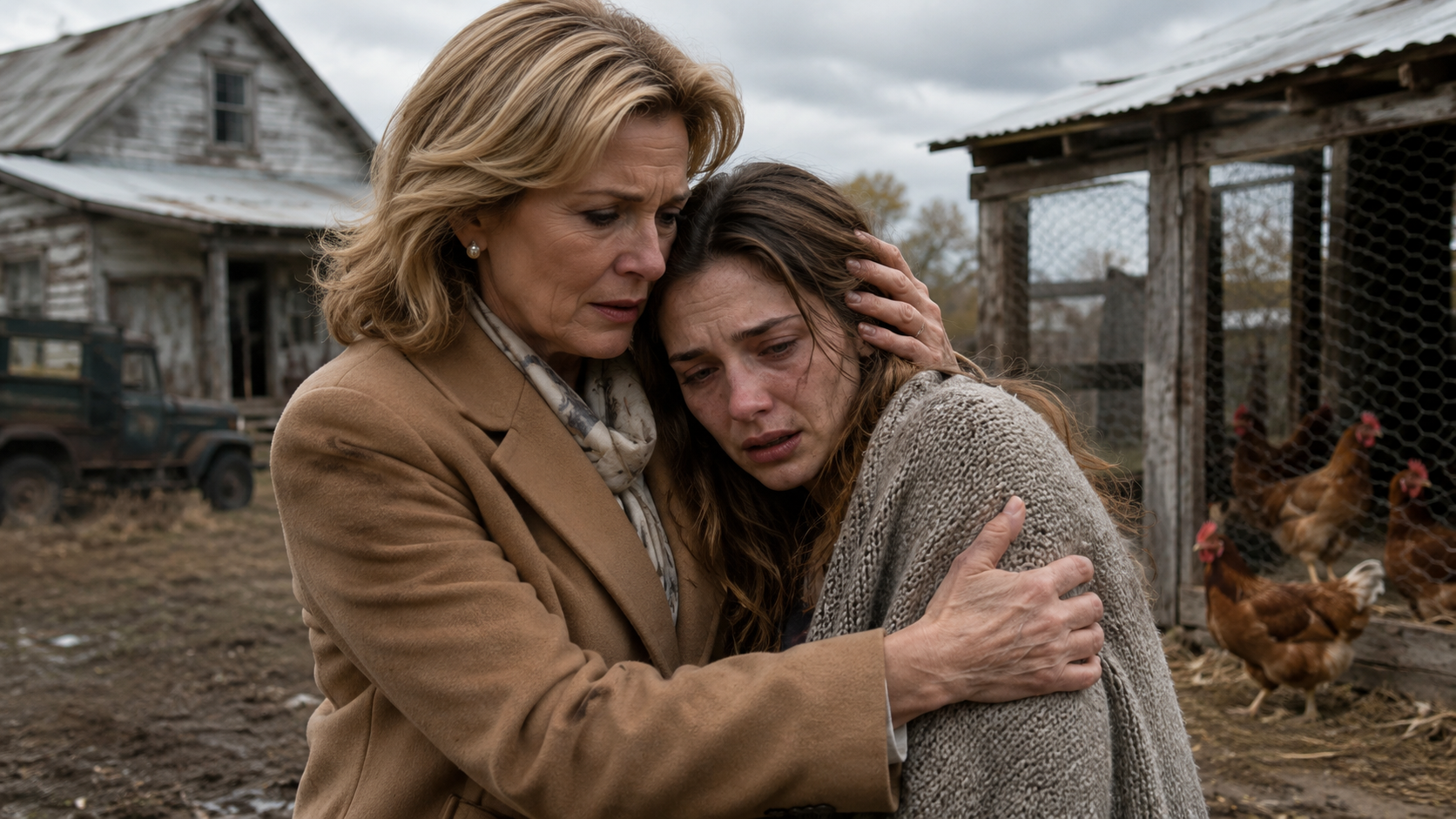
The first thing Elaine Whitmore noticed was the silence.
Not the peaceful silence of the countryside, not the gentle quiet of a farm at sunset, not the kind of silence that rests over fields after a long day of work. This was different. It was heavy. Watchful. A silence that seemed to hold its breath.
She stepped out of her black sedan and stood in the dirt yard of the Harrow family property, one hand still on the car door, her eyes moving slowly from the peeling farmhouse to the sagging barn, from the rusted tractor to the narrow trail of muddy footprints leading toward the chicken enclosure.
For two years, she had tried to be patient.
For two years, she had told herself that her daughter was busy building a marriage, adjusting to another family, learning a new rhythm of life. She had accepted the unanswered calls, the short messages, the excuses.
Mara is resting.
Mara is overwhelmed.
Mara does not feel like talking today.
Mara needs space from you.
The words had always come from someone else. From her son-in-law, Adrian Harrow. From his mother, Beatrice. Sometimes from his younger sister, Lillian, who spoke with the sweet false concern of someone enjoying a secret.
But that morning, Elaine had woken before dawn with a pain under her ribs that no doctor could name and no cup of tea could soothe. She had looked at Mara’s wedding photo on the mantel and realized something that made her hands go cold.
She no longer recognized her daughter’s smile in that picture.
So she had driven four hours without warning anyone.
Now she stood in the Harrow yard, wearing a pale wool coat and city shoes that were already gathering dust, while the house stared back at her with dark windows.
“Mrs. Whitmore?”
The voice came from behind her.
Elaine turned.
Adrian Harrow crossed the yard with long, controlled steps. He was still handsome in the way that had once impressed strangers: tall, neat, dark-haired, with the confident expression of a man who had learned early that charm could open doors faster than honesty. He wiped his hands on a cloth as he approached, though there was nothing on them.
“You should have called,” he said.
Elaine closed the car door.
“I did,” she replied.
His smile twitched. “We’ve been having trouble with the signal.”
“Since January?”
The smile disappeared for half a second before returning, thinner than before.
“Mara has been tired,” he said. “She gets anxious when people pressure her.”
“I am her mother.”
“And that,” he said softly, “is exactly why she gets anxious.”
Elaine studied him. She had negotiated with bankers who wanted to swallow her company whole. She had faced contractors who lied through perfect teeth. She had listened to men in expensive suits explain why a widow should sell the business her husband had helped her build. She knew a rehearsed sentence when she heard one.
“Where is she?” Elaine asked.
Adrian glanced toward the farmhouse.
“Resting.”
“Then I’ll see her.”
“That isn’t a good idea.”
Elaine took one step toward the house.
Adrian moved just enough to block her path.
It was a small movement. Polite, almost. But Elaine saw the truth of it.
He was not stopping a visitor.
He was guarding a prisoner.
The cold pain under her ribs sharpened.
“Move,” Elaine said.
His eyes hardened. “You can’t arrive here uninvited and give orders on my land.”
Elaine looked past him.
That was when she heard it.
A faint sound from the far side of the yard.
Not quite a cry.
Not quite a word.
Something between a breath and a plea.
Elaine turned her head toward the chicken enclosure.
Adrian’s face changed.
Only slightly. Only for a second.
But it was enough.
Elaine began walking.
“Mrs. Whitmore,” he said behind her, no longer pretending to be calm. “Do not go over there.”
She did not stop.
The smell reached her before she opened the crooked wooden gate. Damp feathers. Rotting straw. old feed. Waste. The sour, living stink of neglect. Chickens scattered as she stepped inside, their wings beating against the wire fencing.
At first she saw only shadows.
Then a figure moved near the back wall.
Elaine froze.
Her daughter sat on the filthy ground beside a broken feed bucket, knees drawn to her chest, one hand cupped around cracked yellow corn kernels. Her once-bright hair hung in tangled ropes around her face. Her dress was torn at the hem and stained with mud. Her bare arms were thin enough that Elaine could see every angle of bone. A bruise, fading green at the edges, shadowed one cheek.
Mara looked up.
For one terrible second, she did not seem to know who Elaine was.
Then her lips parted.
“Mom?”
The word came out small and dry.
Elaine felt the world tilt.
“Mara,” she whispered.
Her daughter tried to stand, then winced and sank back down. Corn spilled from her hand into the straw.