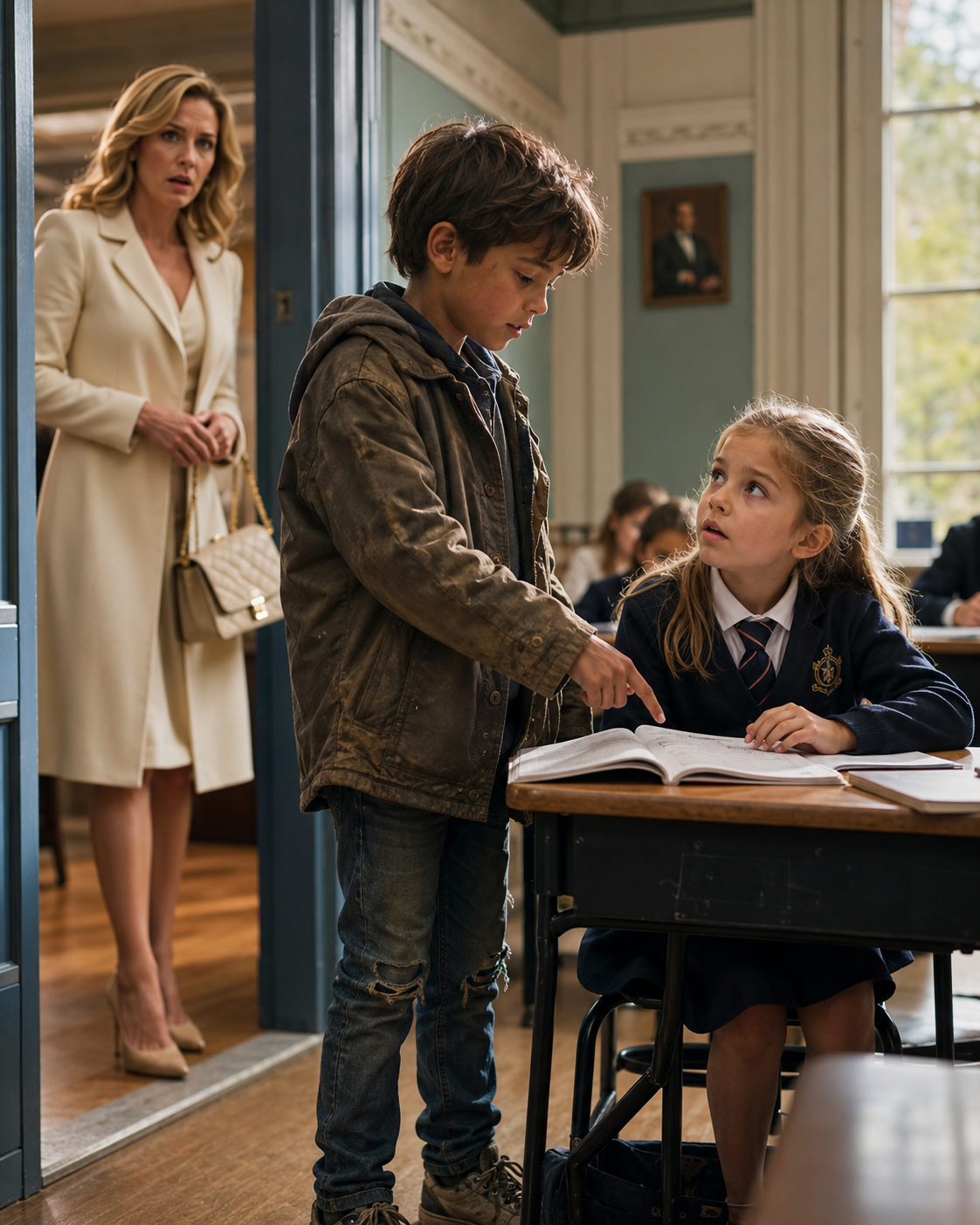
The morning began beneath a ceiling that had never been finished.
Cold wind slipped through the open spaces where windows should have been, stirring dust across the concrete floor of the abandoned construction site. In one corner, hidden behind a stack of cracked cement blocks, eight-year-old Caleb Reed opened his eyes.
He lay beneath a thin gray blanket that had once belonged to his mother. The fabric was torn along one edge and offered little protection from the cold, but Caleb still wrapped it carefully around his shoulders every night. It was the last thing he owned that carried even the faintest memory of her.
For several moments, he remained still, listening.
Cars moved along the distant road. Metal rattled somewhere above him. A dog barked near the market.
Caleb reached beneath a loose piece of cardboard and pulled out a small plastic bag. Inside was half a bread roll he had found behind a bakery the previous evening. It had gone hard overnight, but he held it as though it were something precious.
He broke off the smallest possible piece.
Food had to last.
The streets had taught him that lesson quickly.
As he chewed, pale sunlight crept across the unfinished floor. Caleb turned toward the empty space beside him.
“Good morning, Mom,” he whispered.
Silence answered him.
His mother, Hannah, had been gone for seven months, but Caleb still spoke to her every morning. Sometimes he told her what he planned to do that day. Sometimes he described the books he had found. On especially difficult mornings, he simply said her name so he would not forget how it sounded.
Hannah had worked wherever anyone would hire her. She had washed clothes by hand, scrubbed restaurant floors after midnight, cleaned apartments, and carried boxes at the market. She often returned home exhausted, her palms swollen and her back aching.
Yet she had always managed to smile when Caleb ran to meet her.
“Did you eat?” she would ask.
“Did you?”
“I ate at work,” she always replied.
Caleb had believed her until he became old enough to notice that she drank water at dinner while placing the last piece of bread on his plate.
When Hannah became ill, she tried to hide it. First came the stomach pain. Then the fever. Then days when she could barely stand.
Caleb remembered sitting beside her at a crowded public clinic while adults moved around them without stopping.
A doctor eventually examined her and spoke in a tired voice.
“She needs treatment and proper nutrition.”
Caleb did not understand all the medical words, but he understood the expression on his mother’s face when the cost was mentioned.
“We don’t have that much,” she said quietly.
Caleb grabbed the doctor’s sleeve.
“I can work,” he pleaded. “I can clean the floors. I can carry things. Please help her.”
A nurse gently pulled him back.
The clinic provided what limited assistance it could, but Hannah continued growing weaker. A few weeks later, Caleb woke beside her in their tiny rented room and knew, even before he touched her hand, that she would never speak to him again.
He sat beside her for hours.
Before anyone arrived to take her away, Caleb leaned close and made a promise.
“I’m going to become a doctor,” he whispered. “I’ll help people who don’t have money. No child will have to beg someone to save their mother.”
After Hannah’s death, the landlord emptied the room and changed the lock. Caleb had no father he knew of, and the few neighbors who had once been friendly suddenly avoided his eyes.
For a while, he slept near the market.
Then he discovered the unfinished building.
It was dangerous, cold, and covered in dust, but it had a roof. More importantly, no one bothered him there.
Every day became a contest between survival and the future he refused to abandon.
Caleb searched behind cafés for food and collected plastic bottles to exchange for coins. But he also searched through rubbish bins outside schools and office buildings.
Other children might have looked for toys.
Caleb looked for books.
A mathematics workbook missing its cover was a treasure. A notebook with ten unused pages was a miracle. A pencil too short for anyone else to hold was still useful to him.
At night, he sat beneath a streetlamp near the bus station and taught himself to read.
He copied letters until his fingers cramped. He repeated unfamiliar words aloud until he remembered them. When he ran out of paper, he wrote in the dust or scratched numbers into the ground with a stick.
People sometimes laughed as they passed.
“Look at the little professor.”
“Who do you think you’re fooling?”
Caleb never answered.
He kept studying.
Several streets away stood Westbridge Academy, one of the finest private schools in the city. Its students wore dark blue uniforms, carried polished backpacks, and arrived each morning in expensive cars.
Caleb had watched them for months.
One afternoon, he discovered a damaged section of fence behind the sports field. Beyond it was a narrow path leading to the back of the main classroom building.
The following morning, he crawled through.
He did not enter the classrooms. He knew he would be noticed immediately. Instead, he crouched beneath an open window and listened.
The teacher’s voice drifted outside.
“Seven plus five equals twelve.”
Caleb copied the numbers into his notebook.
“Always show your work.”
He copied that too.
Day after day, he returned.
He learned addition, subtraction, spelling, geography, and fragments of history. When he did not understand something, he searched for answers in discarded textbooks.
During breaks, he hid behind a maintenance shed. When the final bell rang, he watched parents waiting at the front gates.
Children ran toward them, waving papers and calling out their grades.
“I got every answer right!”
“Look what I drew!”
Caleb often imagined his mother standing among them.
In his imagination, she always smiled.
“Well done, Caleb,” she would say. “I knew you could do it.”
But when the schoolyard emptied, only the wind remained.
Caleb would then search beneath desks and benches for abandoned pencils, erasers, and sheets of paper. What the students forgot became the foundation of his education.
On a rainy Tuesday morning, Caleb slipped through the broken fence earlier than usual.
The weather had soaked his jacket, and mud clung to his shoes. Hoping to dry himself before lessons began, he entered an old study room that was normally empty.
This time, someone was already there.
A girl in a perfect Westbridge uniform sat at a desk, staring angrily at a mathematics worksheet. Her dark hair was tied with a silver ribbon, and a lunch bag rested beside her expensive backpack.
She looked up.
Caleb froze near the doorway.
“Who are you?” she asked.
“My name is Caleb.”
“I’ve never seen you here.”
“That’s because I don’t attend this school.”
The girl glanced at his wet clothes and worn shoes.
“Then how did you get inside?”
Caleb hesitated.
“I come to listen to the lessons.”
“You stand in the hallway?”
“Outside the windows.”
She studied him, uncertain whether to believe him.
Caleb pointed at her worksheet.
“You wrote the wrong answer on number four.”
Her eyes narrowed.
“No, I didn’t.”
“You added both numbers. You’re supposed to subtract the second one.”
The girl looked down at the problem and then back at Caleb.
“Our teacher explained it, but I didn’t understand.”
“I can show you.”
She moved her notebook toward the empty side of the desk.
Caleb approached slowly.
“My name is Amelia,” she said.
He sat several inches away from her and picked up a pencil.
Instead of simply giving her the answer, Caleb drew small circles on the page.
“If you have nine apples and give three away, how many are left?”
“Six.”
“Exactly. So nine minus three equals six.”
Amelia tried the next problem by herself.
When she got it right, she smiled.
“You’re better at explaining this than Mrs. Whitmore.”
Caleb laughed softly.
“No, I’m not.”
“You are. Where did you learn all this?”
“I listen through the window. Sometimes I find books behind the school.”
“You learned by yourself?”
“My mother taught me some things before she died. I learned the rest from books.”
Amelia’s smile disappeared.
“Your mother died?”
Caleb nodded.
“Who do you live with?”
“No one.”
Amelia stared at him.
His stomach suddenly growled so loudly that both children heard it.
She reached into her lunch bag and removed a wrapped sandwich.
“Here.”
Caleb shook his head.
“That’s your lunch.”
“I have fruit and biscuits too.”
“I didn’t help you because I wanted food.”
“I know.”
Amelia placed the sandwich between them.
“I’m not paying you. I’m sharing.”
Caleb looked at it but did not touch it.
He could not remember the last time anyone had shared something with him simply because they wanted to.
Before he could respond, footsteps approached.
Mrs. Whitmore appeared in the doorway.
The teacher stopped when she saw Caleb.
“Who are you?”
Caleb stood immediately.
Mrs. Whitmore’s gaze moved over his dirty trousers, wet jacket, and battered bag.
“How did you enter the school?”
“He was helping me,” Amelia said.
“I asked him.”
“That does not explain why he is on private school property.”
“He knows the work,” Amelia insisted. “He showed me how to solve the problems.”
Mrs. Whitmore stepped into the room.
“Young man, you cannot simply enter a school whenever you please.”
Caleb lowered his eyes.
“I’m sorry. I only wanted to learn.”
“I will have to take you to the administration office.”
Fear tightened around Caleb’s chest.
If the school repaired the fence, he would lose everything. He would lose the voices from the classrooms, the lessons, and the only path he had found toward the promise he made his mother.
“I won’t come inside again,” he said quickly. “Please don’t call the police. I didn’t take anything.”
“He didn’t do anything wrong!” Amelia exclaimed.
Mrs. Whitmore reached toward the telephone on the wall.
Before she could pick it up, a calm voice came from the corridor.
“What is happening here?”
A tall woman stood at the entrance.
She wore a cream-colored business suit and carried a black leather bag. Her expression was controlled, but her eyes immediately moved to Amelia.
“Mom!”
Amelia rushed toward her.
The woman was Vivian Grant, founder of one of the country’s largest logistics companies. Newspapers often described her as a billionaire, a ruthless negotiator, and one of the most powerful business leaders in the city.
To Amelia, however, she was simply her mother.
“I came to bring the science project you forgot,” Vivian said. “Why are you here before class, and who is this boy?”
Mrs. Whitmore began explaining.
“He entered the school without authorization. I was about to contact the administration.”
“He was helping me,” Amelia interrupted. “I couldn’t understand my homework, and he taught me.”
Vivian looked at Caleb.
“Is that true?”
Caleb nodded.
“I’m sorry I came inside. I usually stay outside the window.”
“Outside what window?”
“The classroom window.”
“To do what?”
“To listen.”
Vivian’s expression changed.
“You listen to lessons from outside?”
“Yes, ma’am.”
“Why don’t you attend school?”
Caleb glanced toward the floor.
“I don’t have anyone to pay for it.”
“Where are your parents?”
“My mother died.”
“And your father?”
“I don’t know him.”
Vivian studied the boy more carefully. His clothes were not merely untidy. They were worn through. His shoes were splitting at the sides, and his hands were cold enough to tremble.
Amelia held up her completed worksheet.
“Look, Mom. He taught me all of this.”
Vivian checked the answers.
Every one was correct.
She lowered herself until she was at Caleb’s eye level.
“Where did you sleep last night?”
Caleb remained silent.
Vivian did not repeat the question harshly.
“Caleb, I’m not trying to get you into trouble.”
“In an unfinished building near the old market,” he finally said.
“Alone?”
“Yes.”
The room became quiet.
Even Mrs. Whitmore’s expression softened.
Vivian took out her phone, but Caleb stepped backward.
“Please don’t send me away.”
“I’m not calling the police,” she assured him. “I’m contacting someone who can make sure you are safe.”
Amelia tugged at her mother’s sleeve.
“Can he come with us?”
Vivian looked at Caleb again.
“We need to do this properly. But first, he needs food, dry clothes, and someone who will listen to him.”
A few hours later, after speaking with a child welfare officer and arranging the required assessment, Vivian took Caleb and Amelia to a quiet restaurant near the school.
Caleb sat stiffly in his chair.
The polished table, white napkins, and shining silverware made him afraid to move. When a waiter brought warm rice, roasted chicken, vegetables, and fresh bread, Caleb stared at the plates.
“You can eat,” Vivian said gently.
He picked up a fork.
At first, he took tiny bites. Then hunger overcame caution, and he began eating faster.
Amelia slid the basket of bread toward him.
“There’s more.”
Caleb stopped.
“Can I save some?”
Vivian felt something tighten in her chest.
“You don’t have to save dinner for tomorrow.”
Caleb looked at her uncertainly.
“There will be food tomorrow,” she added. “And the day after that.”
He lowered his eyes before they could see the tears gathering in them.
During the meal, Vivian asked about his life. Caleb told her about the unfinished building, the discarded books, and the promise he had made beside his mother.
“You really want to become a doctor?” Amelia asked.
“Yes.”
“What kind?”
“One who doesn’t ask for money before helping someone.”
Vivian turned away for a moment, composing herself.
She had built her fortune by believing every problem had a solution. Yet an intelligent child had been sleeping on concrete less than a mile from one of the most expensive schools in the city.
No one had noticed him until he became useful to someone wealthy.
The thought unsettled her.
That afternoon, Caleb was placed temporarily in a children’s care facility while officials verified his identity and searched for relatives. Vivian visited him every day. Amelia came whenever she was allowed, bringing books, puzzles, and unfinished mathematics worksheets she insisted only Caleb could explain properly.
No relatives were found.
Vivian submitted an application to become his legal guardian.
The process was neither instant nor simple. There were interviews, home inspections, background checks, and court hearings. Caleb attended each meeting in borrowed clothes, convinced that one wrong answer would send him back to the streets.
Vivian repeatedly told him the same thing.
“You are not being tested to see whether you deserve a home. The adults are being tested to make sure they deserve you.”
Months later, the guardianship was approved.
On Caleb’s first evening in the Grant residence, Amelia led him upstairs.
“This is your room.”
Caleb stopped in the doorway.
There was a bed with clean blue blankets, a wooden desk, a lamp, and a shelf already filled with books. A new school uniform hung beside the wardrobe.
“All of this is mine?” he asked.
“Yes.”
“For how long?”
Amelia seemed confused.
“What do you mean?”
“How long can I stay?”
Vivian, standing behind them, answered.
“This is not a hotel, Caleb. You are not here until someone changes their mind.”
He turned toward her.
“You are part of this family now.”
Caleb sat on the edge of the bed and pressed both hands into the blanket, as though proving it was real.
The following Monday, a black car stopped in front of Westbridge Academy.
Amelia jumped out first. Caleb remained seated for several seconds, staring at the main entrance.
For months, he had entered through a hole in the fence.
He had hidden behind walls and learned through open windows.
Now he wore a clean uniform and carried a backpack filled with new notebooks, pencils, and textbooks bearing his name.
Vivian opened his door.
“Are you ready?”
Caleb stepped onto the pavement.
Students moved through the gates around him. No one ordered him to leave. No one demanded to know why he was there.
Amelia took his hand.
“You don’t have to hide anymore.”
Together, they walked through the front entrance.
Inside the classroom, Mrs. Whitmore introduced him as a new student. Caleb sat at his own desk, directly beside Amelia.
For the first time, he could see the entire blackboard.
For the first time, he could raise his hand.
For the first time, when the teacher asked a question, he did not have to whisper the answer from outside.
At the end of the day, Caleb walked through the school gates carrying a page marked with a perfect score.
Vivian waited beside the car.
He almost ran past her out of habit. Then he stopped, remembering that someone was waiting for him.
Vivian noticed the paper in his hand.
“How did you do?”
Caleb held it up.
Her face filled with pride.
“Well done, Caleb.”
The words struck him harder than he expected.
For a moment, he heard his mother’s voice inside Vivian’s.
He looked up at the evening sky and silently repeated the promise he had made long ago.
He would study.
He would become a doctor.
He would remember the children standing beyond classroom windows, listening to futures that seemed to belong to someone else.
And one day, he would open a door for them too.

