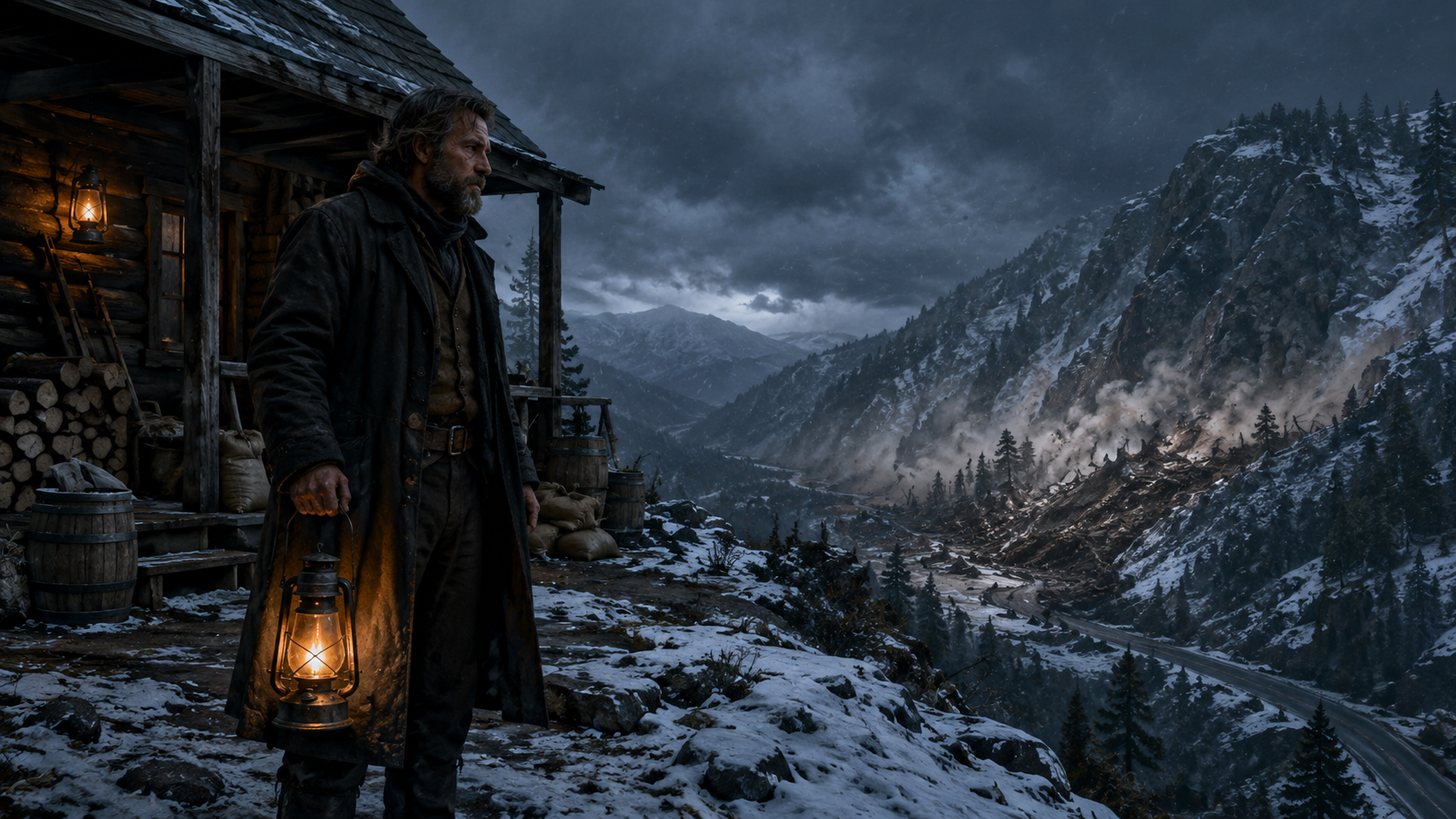
The Hermit of Wolfpine Ridge

They called Nathaniel Crowe a lunatic because he counted potatoes like coins, stacked firewood higher than his roof, and spent the last warm days of summer smoking meat while the rest of Briar Hollow laughed at him from below.

Children made dares of it.

“Run up to the old ridge cabin,” they whispered, “and ask the madman if he’s building a castle for squirrels.”

Men at the livery said grief had hollowed his head.

Women at the church said his daughter, Juniper, deserved better than a father who kept jars under floorboards and nailed shutters twice as thick as any storm required.

The storekeeper, Amos Bell, said Nathaniel bought salt like a man expecting to preserve the whole mountain.

And Mayor Elias Vane, who owned nearly every debt in town, smiled whenever Nathaniel’s name was mentioned.

“Poor Crowe,” Vane would say, folding his polished hands across his silver watch chain. “A man can survive losing a wife, but not always losing his mind.”

Nathaniel heard all of it.

He answered none of it.

Silence had become his strongest tool. Better than an axe. Better than a rifle. Better than prayer, sometimes. Silence did not feed pride. Silence did not waste heat. Silence did not give foolish men something to twist.

So when boys shouted from the road, “How many beans you hiding, Mad Crowe?” Nathaniel kept splitting cedar.

When Amos Bell asked whether he planned to eat through Judgment Day, Nathaniel paid for another sack of flour and said nothing.

When Reverend Peale preached one Sunday about fear disguising itself as wisdom, every eye in the church slid toward Nathaniel’s empty pew.

He had stopped attending months before.

Not because he had stopped believing in God.

Because he had stopped believing that people who felt safe could recognize a warning.

Nathaniel lived halfway up Wolfpine Ridge in a cabin made of black logs and stubbornness. The cabin had belonged to miners once, back when silver fever had pulled men into every seam of the mountain. Those men had dug poorly, drunk heavily, and left suddenly. They abandoned rusted tools, broken rails, and a half-finished root chamber beneath the floor.

Nathaniel found the place after burying his wife, Clara.

He came with one horse, one grieving child, two trunks, and a dog named Birch whose left ear had been torn by a coyote. The townspeople of Briar Hollow watched him pass and assumed he was a man running away from sorrow.

They were wrong.

He was carrying it with him.

Clara had died three winters earlier when fever came through the valley like a thief that knew every door. Their two sons died the same week. Juniper survived because Nathaniel shut her in a cold shed with clean blankets, boiled water, and every curse the neighbors were willing to throw at him.

“She’ll freeze,” they said.

“She’ll hate you,” they said.

“Let the child sit beside her mother,” they said.

Nathaniel had locked the shed door anyway and listened to Juniper crying for Clara until morning burned gray through the cracks.

His wife’s last words had not been grand.

She had not said, “Remember me.”

She had not said, “I love you.”

She had gripped his wrist with a fever-hot hand and whispered, “Keep her alive.”

So he did.

He kept Juniper alive when love would have opened the door.

Since then, he had trusted preparation more than comfort.

By late August of 1891, the mountain began speaking.

It did not speak in words. Mountains never did. Words were for people, and people often used them to lie.

The mountain spoke through elk moving down too soon. Through field mice pouring from the western gullies. Through ravens leaving the quarry cliffs before sunset. Through the sour-metal smell that rose after rain. Through tiny cracks spreading across the old pass road like black veins under skin.

Nathaniel saw the signs and tightened his jaw.

He rode three miles down to Briar Hollow and walked into the mayor’s office with mud on his boots.

Elias Vane looked up from his desk. Everything in that office shone: the brass lamp, the framed land deeds, the black cane leaning against the wall, the mayor’s pale hair combed flat and clean.

Nathaniel disliked clean men who made others dirty.

“The western slope is moving,” Nathaniel said.

Vane blinked slowly. “Good morning to you too.”

“The old mine cuts above the pass are filling with water. The shale is breaking. If we get a hard rain, the road to Mercy Crossing will be buried.”

Mayor Vane leaned back. “You walked into my office to tell me a mountain is unhappy?”

“I came to tell you to stop blasting near the old Silver Hook cut.”

Something changed in Vane’s eyes.

It was small. So small another man might have missed it.

Nathaniel did not.

“Blasting?” Vane said gently. “Who told you there was blasting?”

“No one had to.”

“Then no one did.”

Nathaniel looked at the mayor’s hands. No calluses. No cracked nails. A ring on one finger set with a red stone like a drop of blood.

“You want the upper spring,” Nathaniel said.

Vane’s smile thinned. “Everyone wants clean water, Mr. Crowe. Civilization is built by men who understand value.”

“Civilization dies when men confuse value with ownership.”

The mayor’s cane tapped once against the desk.

“You have become dramatic since Clara died.”

Nathaniel went still.

There were men who struck with fists, men who struck with knives, and men like Elias Vane who learned where a wound lay and pressed it politely.

“She always liked practical men,” Vane continued. “It surprised me when she chose you.”

“She chose a life,” Nathaniel said.

“She chose poverty.”

“She chose freely.”

Vane’s mouth hardened before the smile returned.

“You know,” he said, “I have tried to be generous. I offered to buy that ridge claim twice. I offered enough to put your daughter in a proper house. A school. A society. Instead you keep her among traps, smoke, and jars like some wild thing.”

“She reads better than half your council.”

“She needs people.”

“She has people.”

“No, Crowe. She has you. And whatever ghosts still sit at your table.”

Nathaniel’s hands closed once, then opened.

“You hear me now,” he said. “If that slope comes down, Briar Hollow will have no road, no freight, no doctor from Mercy Crossing, no medicine, and no grain after the store empties. Tell your council. Tell folks to put by food.”

Vane gave a soft sigh, as if Nathaniel were a child he had grown tired of correcting.

“Your grief has turned into a weather vane.”

“My grief buried three people. It knows the cost of being late.”

For the first time, Vane’s voice lost its velvet.

“Get out of my office.”

Nathaniel did.

By sundown, the whole town knew Mad Crowe had warned the mayor that the mountain was about to fall.

By breakfast the next day, the story had grown teeth.

At Bell’s Store, Amos set a jar of beans on the counter and laughed.

“Maybe we ought to sell him the whole barrel before doom arrives.”

“Don’t joke,” said Delia Pratt, whose twin boys had chased Nathaniel’s wagon once. “He might dig a tunnel under the church next.”

One man slapped his knee. “I heard he’s been counting acorns.”

Another said, “I heard he keeps bones in the cellar.”

Amos leaned forward. “I heard he sleeps with flour sacks so he can feel less lonely.”

Everyone laughed.

Not everyone.

Dr. Miriam Holt stood near the door holding a paper-wrapped packet of bandages. She was young for a physician, plain-spoken, and disliked by half the town for refusing to flatter fools. She had treated Juniper’s fever years ago from outside the shed door, passing instructions through Nathaniel because he would not let anyone cross the threshold.

She remembered the child surviving.

She also remembered the neighbors calling him cruel until they needed him to be right.

“Has anyone looked at the western slope?” she asked.

Amos shrugged. “The mayor says it’s nonsense.”

“The mayor is not a mountain.”

The laughter faded just a little.

Then someone coughed and changed the subject.

That evening, Miriam rode toward Wolfpine Ridge.

She found Nathaniel behind the cabin, hanging strips of venison inside a smokehouse he had built with stone walls and a low iron door. Juniper, now thirteen, sat on the porch with a slate in her lap. Birch slept beside her with his scarred ear twitching at flies.

“You came about the slope,” Nathaniel said without turning.

“I came because everyone else is laughing.”

“That isn’t a reason.”

“It is when people laugh instead of check.”

He glanced at her then. “You believe me?”

“I believe water, gravity, and old mine scars don’t care what Mayor Vane says.”

That almost made him smile.

Almost.

He wiped his hands on a cloth and pointed toward the ridge beyond the pines.

“Cracks widened after the last storm. Springs are showing where ground should be dry. Elk are bedding low. Birds left the cliff. You know what that means?”

“I know enough to be worried.”

“Worried is useful. Panic isn’t.”

Juniper looked up from her slate. “Papa says panic is fear with no chores.”

Miriam’s eyes softened. “Does he?”

“He says plenty of things people don’t listen to.”

Nathaniel looked away.

Miriam stepped closer to the smokehouse. “How much food do you have?”

“Enough for us.”

“That was not my question.”

“No,” he said. “But it was my answer.”

She studied him. “If the pass closes, people will come here.”

“People came when Clara was dying. They came with advice. Not wood. Not broth. Not blankets. Advice.”

“Children will come too.”

That reached him.

He resumed tying meat to the drying rods. His fingers moved carefully, but his face had gone hard.

“I know.”

Miriam heard the pain behind those two words and did not press it.

The first heavy rain began on September 6.

It fell straight down, thick and relentless, as if the sky had decided to empty itself over the valley. Gutters overflowed. Horses refused slopes. The creek behind the church turned brown and loud. Cellar floors sweated. The old pass road became a ribbon of mud.

On the third day, Nathaniel rode to the western overlook and saw the whole hillside breathing.

Not moving like an animal.

Moving like a wound.

He marked the broken ground, the leaning firs, the water spilling from old blast holes.

Then he rode down to Briar Hollow one last time.

The council was gathered inside the church because the mayor’s office roof had begun leaking. Men sat in pews, wet hats on their knees, arguing about bridge planks and hay prices.

Nathaniel walked in and rainwater ran from his coat onto the floor.

“Close the pass road,” he said.

Mayor Vane turned from the pulpit steps. “This again.”

“The slope is failing. Send no wagon through.”

“We have freight due from Mercy Crossing.”

“Then stop it before it reaches the cut.”

“And lose money because a grieving trapper smells doom in the rain?”

Nathaniel faced the room.

“You have children. Put flour away. Bring wood under cover. Fill water barrels. If you have medicine, protect it. If you have livestock, move them east. If you have pride, swallow it now because you can’t boil it for soup later.”

A few men shifted.

Amos Bell muttered, “There it is. Mad Crowe’s sermon.”

Nathaniel looked at him. “How much flour in your store?”

Amos flushed. “Enough.”

“How much?”

The storekeeper said nothing.

Dr. Holt stepped from the side aisle. “He is asking because it matters.”

Mayor Vane raised his hands. “Doctor, please. Fear spreads faster than fever when respectable people entertain it.”

“Respectability does not clear a landslide,” Miriam said.

The mayor smiled at the room. “Ladies and gentlemen, we will not govern this town by the nightmares of a man who has never recovered from his losses.”

Nathaniel nodded once.

Not in agreement.

In farewell.

He turned and left.

That night, just after two, the mountain fell.

Juniper woke before the roar. She woke because Birch was standing on her quilt, growling toward the west wall. Then the floor shivered beneath her.

“Papa?”

Nathaniel was already moving.

He flung the door open.

Lightning cracked the sky wide.

For one white second, the world became clear.

The western face of Wolfpine Ridge was sliding.

Trees pitched sideways and vanished. Rock folded over rock. Mud boiled down the ravine, carrying stumps, boulders, old mine timbers, and half the abandoned Silver Hook cut. The sound was larger than thunder. It was larger than fear. It was the kind of sound that made the body understand how small it had always been.

Juniper ran to Nathaniel’s side.

He pulled her against him.

The pass road disappeared beneath a moving wall of earth.

Then darkness swallowed the mountain again.

By morning, Briar Hollow was cut off.

No freight wagon could enter.

No messenger could leave.

No doctor could call for medicine.

No store could refill.

No family could escape.

At first, the town put on its bravest clothes.

Men gathered with shovels. They spoke loudly about teams of horses, ropes, blasting powder, and clearing the way in a week.

They came back after one afternoon.

Not loud anymore.

The pass was not blocked. It was gone. Trees lay under stone. Stone lay under clay. Clay slid underfoot and froze hard by dawn. Every shovel strike released more water. Every attempt to dig brought fresh rock sighing down from above.

A week passed.

Then two.

The rain stopped, but cold followed.

By October, frost silvered the windows.

By November, Bell’s Store had more empty shelves than full ones.

By December, nobody laughed at Nathaniel Crowe.

They whispered instead.

“How much does he have?”

“Enough for a year, I heard.”

“He must have known.”

“He warned us.”

“He could share.”

“He should share.”

“Why should children suffer because one man lost his mind in a useful direction?”

The first child came on a night with no moon.

He was fifteen, though hunger had stolen two years from his face. His name was Tommy Rusk. His father had spent most of his wages in the saloon before the saloon ran out of whiskey and warmth. His mother had died the year before. Tommy had two little sisters hidden in a shed behind their house with a blanket, a cracked jar of pickles, and nothing else.

He climbed Wolfpine Ridge in shoes wrapped with rags.

Birch barked once.

Nathaniel opened the door with a rifle in one hand and a lantern in the other.

Tommy tried to speak, but his lips had gone blue.

He fell forward into the snow.

Nathaniel brought him inside.

Juniper heated broth while Nathaniel stripped the frozen rags from Tommy’s feet. The boy woke long enough to see the shelves along the cabin wall: jars of beans, sacks of meal, dried fruit, smoked fish, bundles of herbs, stacked roots, sealed crocks, candles, salt, oil, blankets.

His eyes filled.

“I won’t steal,” Tommy whispered.

Nathaniel looked at him.

“No,” he said. “You won’t.”

“My sisters—”

“Where?”

Tommy told him.

Nathaniel wrapped his coat tight, took Birch, and went down the ridge before the broth finished warming.

By dawn, Tommy’s sisters slept near the stove.

One was eight. One was five. The youngest held a wooden spoon like a doll and would not let go.

Juniper knelt beside them.

“What are their names?”

“Ruth and Lottie,” Tommy said.

Nathaniel set three bowls on the table.

“You can stay,” he said, “but this is not charity.”

Tommy stiffened.

Nathaniel continued, “Charity with no plan freezes by morning. This house runs on work. You carry water when you can. You stack wood. You clean bowls. You learn. You do not waste a crumb. You do not lie about what we have. You do not invite adults here without my say. You protect the little ones before yourself.”

Tommy swallowed. “Yes, sir.”

“If you are too weak to work, you rest until you are not. A child does not earn the right to breathe.”

The boy stared at him like that sentence hurt worse than hunger.

Then he nodded.

After Tommy came the Pratt twins.

Then a girl whose father had gone to check traps and never returned.

Then three brothers from the south road.

Then a baby carried by Dr. Holt under her coat while the mother coughed blood into a handkerchief and begged only, “Please, just until spring.”

By Christmas Eve, seventeen children slept inside Nathaniel Crowe’s cabin.

They slept on quilts, under tables, beside the stove, in the loft, across benches, and in a row by the wall like bundles of laundry. Juniper moved among them with a steadiness no child should have needed. She tied scarves, washed bowls, told stories, taught letters, and sang when the wind clawed at the shutters.

Nathaniel made rules.

Children could come.

The badly sick could come.

Adults who wanted food had to bring something that helped children survive: firewood, medicine, labor, grain, candles, information.

Some called him cruel.

Dr. Holt did not.

She arrived one afternoon with frost in her lashes and a satchel empty of nearly everything useful.

“You’re making them pay,” she said.

“I’m making them participate.”

“There is a difference?”

“Payment ends with pride. Participation keeps the fire alive.”

She looked toward the children gathered by the stove. Tommy was showing little Lottie how to twist straw into kindling. Juniper was teaching Ruth to count dried beans without eating them.

Miriam’s face softened.

“You understand people better than they think.”

“No,” Nathaniel said. “I understand hunger. People are harder.”

The hardest came in January.

His name was Peter Bell, Amos Bell’s nephew. Nine years old. Small. Fast. Always trying to be useful. He followed Tommy everywhere and begged for work.

“Let me carry wood.”

“That log is bigger than you,” Tommy said.

“I can carry half.”

“Half a log is still a log.”

Peter wanted to prove he deserved his bowl. Nathaniel saw it and hated it.

One morning, he found the boy sweeping snow from the porch before sunrise, shivering in a coat too thin at the wrists.

“Inside,” Nathaniel said.

“I’m helping.”

“You’re freezing.”

“I don’t want folks saying I ate for nothing.”

Nathaniel knelt before him.

“Listen to me. Grown men may trade work for bread. Children do not trade worth for food. You are not alive because you are useful. You are useful because you are alive.”

Peter blinked hard.

“Did your papa tell you that?”

Nathaniel thought of his own father, who had died with a trapline map folded in his coat.

“No,” he said. “I learned it too late.”

Three days later, Peter went missing in a fog.

It happened during the morning water run. Tommy, Peter, and Juniper had taken two buckets to the lower spring. Birch went with them, nose low, uneasy.

The fog rolled in from the creek white and thick. It erased trees. It softened sound. It made distance lie.

Then a shot cracked.

Juniper screamed.

Birch snarled.

Tommy carried Peter back up the ridge with blood darkening the boy’s coat.

Nathaniel took him in the doorway.

One look told him what mercy could not change.

Peter’s eyes found his.

“I dropped the bucket,” the boy whispered.

“It does not matter.”

“I was supposed to carry it.”

“You carried enough.”

“I was helping.”

“You helped.”

Peter’s fingers clutched Nathaniel’s sleeve.

“Will my uncle be mad?”

Nathaniel bent close.

“No.”

The boy tried to breathe again.

Couldn’t.

The cabin went silent in a way no crowded room should ever be silent.

They buried Peter behind the cabin where the ground was so hard the men had to heat stones and lay them over the earth before digging. Amos Bell came up the ridge for the burial and wept like a man whose shame had finally found its own voice.

Nathaniel did not comfort him.

He had comforted the child.

That was all he had left to give that day.

At midnight, Juniper found him outside beside the small grave. Snow had gathered on his shoulders.

“Papa?”

He did not turn.

“I promised your mother I would keep you alive.”

“You did.”

“I promised myself no child would die under my roof.”

“He didn’t die because of you.”

“He died near me.”

“That is not the same.”

Nathaniel closed his eyes.

Juniper stepped beside him. She was thirteen, thin from rationing, brave because she had never been allowed the luxury of anything else.

“You opened the door,” she said. “That is why the rest are breathing.”

“One grave still weighs more than sixteen breaths.”

“No,” she whispered. “It only feels that way because graves don’t speak.”

In the morning, an old woman climbed the ridge.

Her name was Agnes Vale, though she had not used her son’s house or money in years. Mayor Elias Vane’s own mother lived in a two-room cabin behind the church, proud, nearly blind, and sharper than ice. People said the mayor sent her supplies. Agnes said lies were cheaper than flour.

Nathaniel let her in because she brought a sack of turnips and because she had never wasted words.

She sat by the stove, warming bent hands.

“Elias hired the Brant brothers,” she said.

Tommy looked up.

Nathaniel did not move.

Agnes continued, “I heard him through the wall behind the mayor’s office. He promised them your ridge claim if they scared you off or burned you out.”

Dr. Holt, who had come to check the baby, went pale. “Why would he do that?”

Agnes laughed once, bitterly.

“Because my son wants what he has always wanted. Whatever another man refuses to give him.”

Nathaniel knew the answer before Agnes said it.

“The spring,” he said.

“The spring,” she confirmed. “And the pass.”

Miriam frowned. “The pass?”

Agnes leaned forward. “He was blasting above the old mine cut in August. Looking for a silver vein. Secret crew. Paid off-book. I found the ledger after the slide. He weakened that slope and laughed when you warned him.”

The stove popped.

No one spoke.

The truth entered the room slowly, like cold through a crack.

Mayor Vane had helped bury the road. Whether through greed, arrogance, or both, he had trapped the town he claimed to protect. Then, when the one man prepared enough to keep children alive stood in his way, he had paid hungry men to remove him.

Tommy’s face twisted.

“We should go down there.”

“And do what?” Nathaniel asked.

“Make him confess.”

“He will lie.”

“Then make him bleed.”

Juniper flinched.

Nathaniel turned on the boy with such force that Tommy stepped back.

“Do not mistake rage for justice.”

“He killed Peter!”

“No. A gunman killed Peter. Vane may have paid him. We will prove it.”

“And if we can’t?”

“Then we keep the living alive until we can.”

Tommy’s eyes shone with fury. “That’s not enough.”

Nathaniel looked toward the room of sleeping children, then at the stove, then at the dwindling stack of wood near the door.

“It has to be,” he said. “Because enough is not what we want. Enough is what survival gives us.”

That day, the cabin changed.

Not outwardly. From the outside, it remained a crooked black cabin beneath snow-heavy pines.

Inside, Nathaniel moved half the visible supplies into the old mining chamber beneath the floor. He shifted shelves, sealed cracks, reinforced shutters, and strung bells low across the trees where no honest visitor would walk. He placed traps in the snow and marked them with pine cones arranged in patterns only Juniper and Tommy understood.

He trained the children without frightening them more than necessary.

“When I say cellar, you go down.”

“When I say floor, you lie flat.”

“When Birch growls but does not bark, you freeze.”

“When someone knocks, no one speaks until I do.”

Tommy learned to load a rifle. Not because Nathaniel wanted a boy armed, but because he had seen what happened when only bad men carried guns.

“I don’t want to shoot anyone,” Tommy said, hands shaking around the stock.

“Good,” Nathaniel replied. “A person eager to shoot is already half lost. But if the door breaks and children are behind you, your fear does not get to decide for you.”

Three nights later, the Brant brothers came.

Nathaniel smelled lamp oil first.

Then Birch rose beside the stove, hackles lifted, teeth showing.

Nathaniel opened his eyes in the dark.

“Cellar,” he said.

Juniper woke instantly.

She touched Tommy’s shoulder. Tommy touched Ruth. Ruth grabbed Lottie. The children moved like whispers.

A bottle smashed against the smokehouse.

Flame climbed fast.

Orange light filled the window.

Then the first shot struck the cabin wall.

Children cried out below the floorboards. Juniper crawled down last, then reached up to pull the hatch.

Nathaniel stopped her.

“Leave it open one inch.”

Her eyes widened.

“One inch,” he repeated.

She obeyed.

Tommy took his place at the rear window, pale and trembling.

Outside, the smokehouse burned bright enough to show three men moving between the trees. They had expected darkness to hide them.

Fire made them targets.

Nathaniel fired once.

A man cried out and fell behind a stump.

A second shot cracked from outside. Splinters burst from the doorframe near Nathaniel’s cheek.

Tommy gasped.

“Breathe,” Nathaniel said.

“I can’t.”

“Yes, you can. In. Out. Love what’s behind you more than you fear what’s ahead.”

Tommy fired.

His bullet struck the tree above one attacker, showering bark.

The man cursed and ducked back.

Birch launched himself at the door with a roar, but Nathaniel caught his collar.

“Not yet.”

Another bottle flew. It broke against the porch rail and flared.

Nathaniel pulled a bucket from beside the stove and kicked the door open just wide enough to throw water over the flames. A bullet tore through his sleeve. Heat bit his hand. Smoke flooded the room.

From below the floor, Lottie whimpered.

Juniper whispered, “Quiet as snow. Quiet as snow.”

The attack lasted less than ten minutes.

Cowards want victims, not battles.

When one brother was wounded and another heard bells ringing from the trapline behind him, they dragged themselves back into the trees, shouting curses they did not have the courage to finish.

At dawn, the smokehouse was gone.

The stone walls remained, black and cracked, but the roof had collapsed. Meat lay ruined in ash. The children stood in the snow, staring at the destruction like they were looking at the future being taken from them.

Tommy’s voice broke.

“That was food.”

Nathaniel stared at the burned beams.

“Yes.”

“We needed it.”

“Yes.”

“What do we do?”

Nathaniel let the silence stretch until panic began to settle.

Then he went inside, lifted the floor planks, and opened the hidden chamber.

The children gathered around.

Below lay barrels, sacks, sealed jars, bundles wrapped in oilcloth, smoked fish packed in crocks, dried apples, beans, cornmeal, roots buried in sand, and herbs hanging from old mine supports.

Tommy looked at him as if seeing a different man.

“You moved it.”

“I moved enough.”

“When?”

“When I learned who wanted it burned.”

Juniper let out a shaky breath.

Little Lottie hugged Nathaniel’s leg.

He looked down at her.

“We are not safe,” he said gently. “But we are not finished.”

The Brant brothers did not make it far.

One, Miles Brant, was found two days later in the church vestibule with a fevered wound and frost-blackened fingers. Dr. Holt treated him because doctors did not get to choose only decent patients.

The whole town crowded outside, hungry for the truth and afraid of it.

Mayor Vane arrived in a fur-lined coat, face stern with manufactured concern.

“This is what comes,” he announced, “when desperate men are led to believe one hoarder’s stores matter more than the town.”

Miles laughed blood onto his collar.

“You paid us,” he rasped.

Vane froze.

Someone gasped.

Miles lifted his head. “You said burn the madman out. Said folks would cheer when his food came down the hill. Said the claim would be ours once he was dead.”

“That is a lie,” Vane said.

Agnes Vale stepped forward from the crowd.

Everyone moved aside for her, partly from respect and partly because she looked capable of striking her own son with her cane.

“No,” she said. “It is not.”

Vane’s face changed. “Mother, go home.”

“I did go home. Years ago. When I finally understood what kind of man I raised.”

He took a step toward her. “You are confused.”

“I am old. That is not the same thing.”

From under her shawl, she pulled a packet wrapped in waxed cloth.

“Your ledger,” she said. “Payments to blasting men in August. Powder. Fuses. Night labor above the Silver Hook cut. And three payments to Miles and Oren Brant after the slide.”

The town erupted.

Vane tried to speak, but the room had shifted away from him. Power survives only while people agree to pretend it is natural. That morning, hunger stripped away the pretending.

Amos Bell pushed through the crowd, face gray.

“My nephew is dead,” he said.

Vane lifted his chin. “Because Crowe gathered children into a target.”

“No,” Dr. Holt said, quiet enough that the room had to lean in. “Because you made a target of the only door that opened.”

A woman began to cry.

A man who owed Vane money stepped forward.

Then another.

Then another.

They did not hang Elias Vane. Briar Hollow had already buried too many.

They took his keys, seized his hidden flour, opened his locked smoke cellar, and found enough provisions to keep half the town alive for weeks. They locked him in his own storage room under guard until the pass reopened and law could be brought from Mercy Crossing.

It was not mercy exactly.

It was restraint.

The next morning, Nathaniel saw people climbing the ridge.

At first, he reached for his rifle.

Then he saw Amos Bell at the front, carrying a sack of beans.

Behind him came Delia Pratt with a jar of peaches she had hidden for her twins. Two ranch hands carried ham. Dr. Holt carried medicine. Reverend Peale carried candles and shame. Others brought meal, turnips, dried peas, onions, blankets, soap, and one cracked violin because someone thought children might need music as much as bread.

Amos set his sack on Nathaniel’s porch.

“I called you mad,” he said.

Nathaniel said nothing.

“I laughed at you.”

Nathaniel waited.

“I told people you were hoarding while we starved.”

“You did.”

Amos swallowed. “My nephew died up here.”

“Yes.”

“I don’t know how to carry that.”

Nathaniel looked at the man’s shaking hands.

“Carry wood first,” he said. “Guilt later.”

Amos stared at him.

Nathaniel pointed toward the ruined smokehouse.

“If you came to be forgiven, you will be disappointed. If you came to work, start there.”

Amos nodded once and turned toward the burned stones.

That was how Briar Hollow began changing.

Not with speeches.

With work.

Men rebuilt the smokehouse in stone thick enough to outlast malice. Women learned to dry apples in winter sun and pack roots in sand. Children learned to identify edible greens, read animal movement, twist cordage, stack wood so it breathed but did not rot, and keep an inventory without sneaking bites.

Dr. Holt wrote everything down.

“Smoke slows decay,” she said one afternoon, examining a strip of fish.

“My father said smoke teaches meat to remember fire,” Nathaniel replied.

“That is less scientific.”

“It worked before science found its boots.”

Miriam smiled. “Fair.”

By March, everyone was thin.

By April, everyone was thinner.

But the fires still burned.

That was the difference between tragedy and survival. Not plenty. Not comfort. A small flame refusing to die.

Then Ruth fell ill.

It began with a cough. Then fever. Then the wet, rattling breath Nathaniel knew too well.

Dr. Holt listened to the girl’s chest and closed her eyes.

“I have no proper medicine left.”

Juniper stood beside Ruth’s bed, holding the child’s hand.

“Papa,” she whispered.

Nathaniel knew what she was asking.

In the locked chest beneath his bed were the last of his strongest remedies: willow bark, wild cherry, elderflower, dried yarrow, horehound, and one small jar of honey Clara had sealed years before. Enough for one child. Maybe enough.

If Juniper fell ill later, there would be nothing.

The shed door rose in his memory.

Juniper crying.

Clara burning with fever.

Keep her alive.

Nathaniel took out the herbs.

Juniper watched him.

He brewed the medicine slowly, carefully, with hands that did not shake until the kettle was off the fire. He sweetened the first dose with Clara’s honey.

For two nights, he fed Ruth by the spoonful.

Juniper stayed awake until sleep pulled her head down and jerked it up again.

Tommy kept the fire steady.

Birch lay against the bed and would not move.

At dawn on the third morning, Ruth’s fever broke.

She opened her eyes and whispered, “Is there still soup?”

Juniper laughed and cried at the same time.

Nathaniel turned away before anyone saw his face.

Spring came on April 19.

It came as dripping from eaves. As mud under snow. As the creek loosening its hard white mouth. As a birdcall so bright that little Lottie burst into tears because she had forgotten the world could make sounds other than wind.

Nathaniel walked to the garden patch and pressed his fingers into the soil.

“Soft enough,” he said.

The whole valley planted that day.

Beans. Corn. potatoes. squash. onions. herbs. Anything with a chance.

When the pass finally reopened in late May, the first wagon from Mercy Crossing came loaded with flour, medicine, shovels, and coffins.

The driver looked at Briar Hollow in confusion.

He had expected silence.

Instead, he found children hauling water, women spreading sliced apples on racks, men building a common storehouse beside the church, and Nathaniel Crowe standing on a scaffold teaching Amos Bell how to lay smokehouse stone.

“How did you people make it?” the driver asked.

Amos looked up toward Wolfpine Ridge.

“We laughed at the man who listened,” he said. “Then, when our children knocked, he opened the door.”

Years passed.

Briar Hollow never became rich. Mountain towns rarely do. But it became wiser.

Every autumn, each household brought a share to the common storehouse. Every child learned preservation before penmanship and weather signs before politics. Every spring, the western slope was inspected by people who no longer believed titles made a man smarter than mud.

Juniper became a teacher. She taught reading, arithmetic, seed saving, first aid, and the difference between fear and preparation.

Tommy Rusk grew into a broad-shouldered farmer who never let a neighbor’s cellar sit empty. Ruth and Lottie stayed close to the ridge and called Nathaniel “Uncle Crowe” long after they were grown.

Dr. Miriam Holt wrote a paper years later about the winter Briar Hollow survived, though Nathaniel refused to let her make him the center of it.

“Write what keeps people alive,” he told her. “Names don’t fill bowls.”

“Sometimes names help people listen.”

“Then write the children’s names.”

Elias Vane was taken away when the pass opened. Some said he died in prison. Some said he bought his way into another town under another name. Nathaniel never asked. Revenge had once tempted him, but he had learned that revenge was a fire that consumed the hand holding it first.

Birch died old, gray, and fat beside the stove.

Nathaniel buried him on the sunny side of the cabin where spring touched the ridge first.

“You guarded what was left of me,” he said over the grave. “Rest easy.”

When Nathaniel Crowe died in 1914, Juniper sat beside his bed holding one hand, and Tommy held the other. Ruth and Lottie stood near the window. Dr. Holt, older now and slower, rested a palm against the bedpost.

Near the end, Nathaniel opened his eyes.

“June,” he whispered.

“I’m here, Papa.”

“The shed.”

Tears filled her eyes. “I remember.”

“I hated the door.”

“I know.”

“Your mama said—”

“You kept me alive,” Juniper whispered. “You kept all of us alive.”

Nathaniel’s gaze drifted toward the window, toward the ridge, toward something no one else could see.

For a moment, his face softened.

Maybe he saw Clara.

Maybe his sons.

Maybe Peter Bell.

Maybe every child who had slept on his floor and woken to another morning because a mocked man had prepared for a storm before it had a name.

“I opened it,” he said.

Those were his last words.

The whole valley climbed Wolfpine Ridge to bury him.

Amos Bell, now old and bent, gave the eulogy with his hat in both hands.

“My generation called Nathaniel Crowe mad because he prepared while we laughed. We called him selfish because he counted food. We called him cruel because he demanded work from desperate people. Then the mountain took our road, hunger took our pride, and our children climbed to his door.”

His voice broke.

“And he opened it. That is the measure of the man. Not that he was right. Not that we were wrong. But that when the laughter stopped and the begging began, he did not become small enough to enjoy our shame. He fed the children first.”

Every year after, on the anniversary of the landslide, families walked to the ridge.

They left flowers for Clara, for Nathaniel, for Peter, and for Birch, the good dog who watched the door.

They showed their children the stone smokehouse.

They taught them how to stack wood, how to listen to birds, how to smell rain changing, how to store roots, how to share without wasting, and how to prepare without becoming hard.

Most of all, they taught what Wolfpine Ridge had taught them.

Prepare while the sky is clear.

Listen when the land speaks.

Never confuse laughter with wisdom.

And when winter comes, when the road is buried, when the proud knock like beggars and the hungry bring their children to your door, remember this:

Survival without mercy is only another kind of death.

Nathaniel Crowe survived because he prepared.

Briar Hollow survived because he prepared for more than himself.

And because of that, a valley lived.