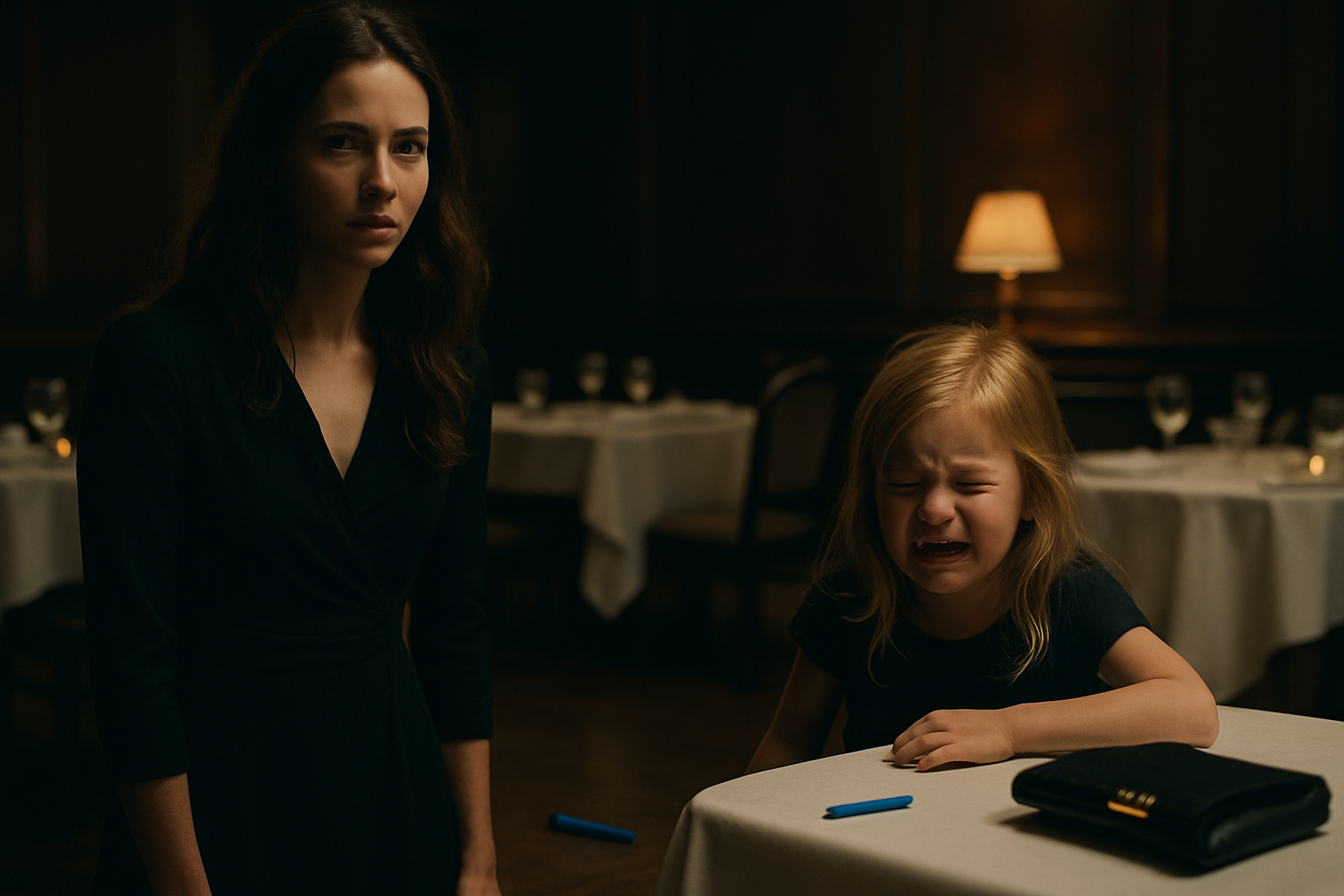
Charles Bennett survived only because he had built his life around plausible deniability. He had kept his signature off the dirtiest documents. He had let subordinates send the emails, consultants sign the authorizations, vendors collect the money, and lawyers create enough distance for him to stand in public with clean hands.
But Claire knew better.
So did Governor Pierce.
And now, inside the glittering private dining room of Archer & Vale, everyone else was beginning to know it too.
Charles gripped the back of a chair so hard his knuckles blanched.
“This is slander,” he said.
His voice was loud enough, but not strong. There was a tremor beneath it, a hairline crack running through the polished surface of Charles Bennett.
Claire looked at him gently.
That gentleness was unbearable.
“No, Dad,” she said. “Slander is false.”
The word Dad struck the room oddly. Not because it was affectionate, but because it reminded everyone that beneath the scandal, beneath the money, beneath the political consequences gathering like storm clouds, there had once been a family. A father. A daughter. A house where a child had learned to walk and speak and trust.
Diane’s lips parted.
“You ungrateful girl,” she whispered.
Governor Pierce’s eyes cut toward her with the clean, lethal precision of a blade.
“Mrs. Bennett,” she said, “I would choose your next words very carefully.”
But Diane was unraveling.
Public humiliation had stripped her of the manners she wore like perfume. The room was full of people whose opinions mattered to her: donors, attorneys, society wives, men with foundations and women with committees, Senator Marlowe and his circle, Vanessa’s friends, Charles’s associates. They had seen the obituary. They had heard Claire speak. They had watched Charles falter.
Diane could survive cruelty. She could survive lies. What she could not survive was being exposed as ordinary in her cruelty.
“We gave you everything,” Diane said, her voice rising. “Schools, clothes, a name. We gave you a life most girls would have been grateful for. And you repay us by marching in here with that child and trying to destroy your father?”
Claire adjusted Lily on her hip. Her daughter was growing heavier, but Claire did not put her down.
“You gave me a name,” Claire said, “then printed it in an obituary while I was still breathing.”
Diane’s face twisted.
“Because you left.”
“You threw me out.”
“You shamed us.”
“I was pregnant.”
“You were unmarried.”
“I was your daughter.”
The words landed quietly.
They were not shouted. They did not need to be. They moved through the room with the force of something ancient and undeniable. A truth so simple that all the wealth in Richmond could not dress it into something else.
I was your daughter.
For a moment, something seemed to fracture—not in Diane, perhaps. Some people could not be broken open by truth because they had spent too many years hardening themselves against it. But around the room, faces changed.
A woman near the windows lowered her champagne glass.
One of Charles’s board members stared at the floor.
An older man who had laughed at Diane’s jokes earlier now looked at Claire as if seeing the outline of a ghost become human.
The story Diane had told for years began collapsing inside the minds of those who had repeated it without question. Claire had been troubled. Claire had run off. Claire had died tragically. Claire had made choices that could not be discussed.
But now Claire stood there, living proof that silence had been curated.
Vanessa crossed her arms, the diamond bracelet at her wrist flashing under the chandelier.
“Fine,” she said. “Let’s all feel sorry for Claire. She always did love being the victim.”
Claire’s smile was small.
“No, Vanessa,” she said. “You loved me being the victim. It gave you a role.”
Vanessa’s expression flickered. The perfect mask slipped just long enough for everyone to see the panic underneath, raw and ugly before she smoothed it away.
Ethan Marlowe stepped toward Claire.
He had gone pale. The confident ease he usually wore—the inherited ease of men who had rarely been denied space—had deserted him. For the first time that evening, he looked not like a senator’s son, not like a political heir, not like Vanessa’s polished companion, but like a man standing at the edge of a grave he had never bothered to inspect.
His voice was low.
“Is Lily mine?”
The room went silent again.
Even the waitstaff froze.
Lily looked from Ethan to Claire, sensing that she had become the center of something she did not understand. Her small fingers curled into the fabric of Claire’s sleeve.
Claire looked at Ethan fully then.
For years, she had imagined this moment in different forms. In the early days, she had imagined rage. She had imagined screaming at him on a sidewalk, throwing every unanswered message in his face. Later, she imagined coldness. Then, when Lily was a baby and Claire was too tired to hate anyone properly, she had imagined nothing at all.