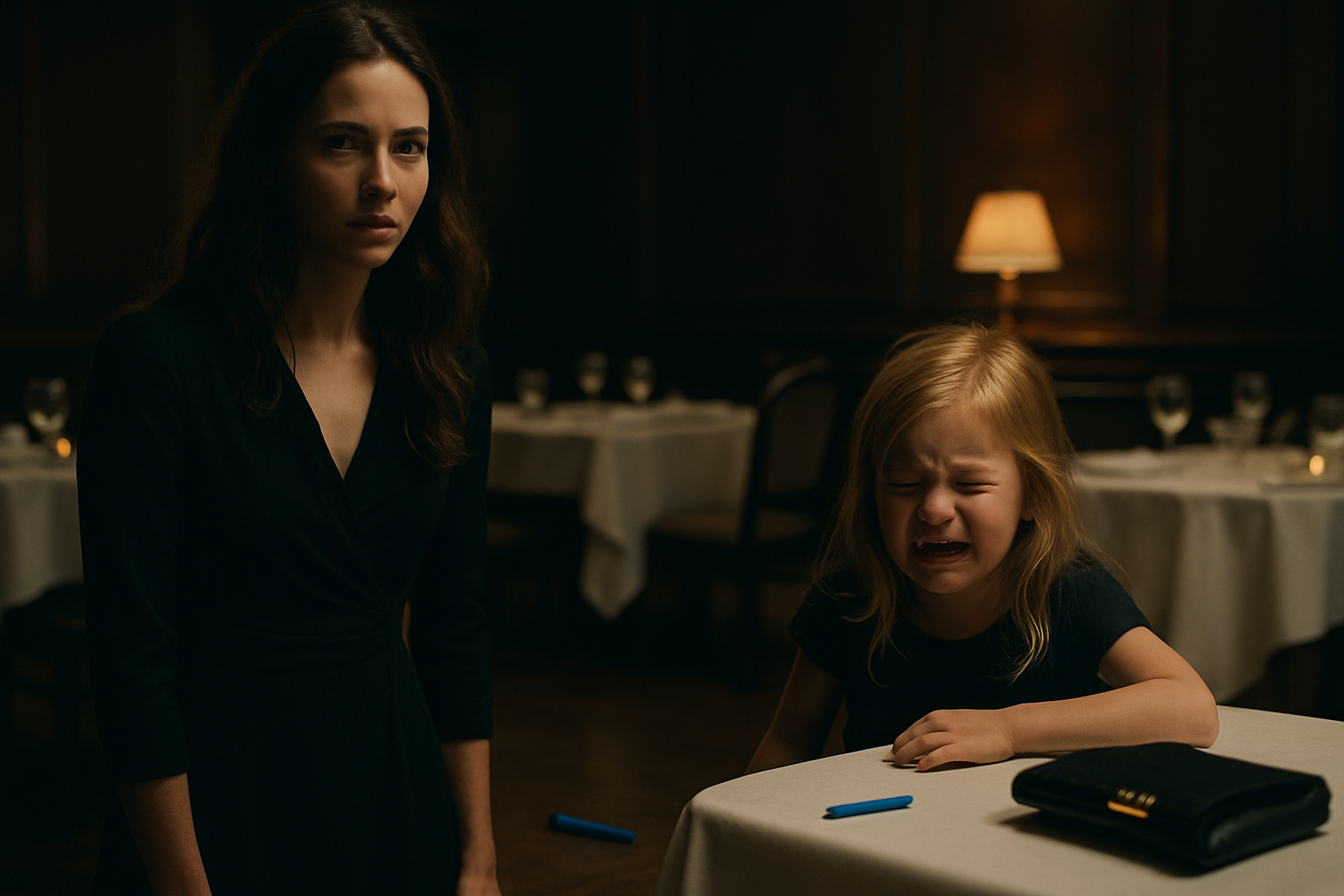
“You leaked my medical appointment to the press. You bribed the driver who said I visited a lover. You had my prenatal vitamins replaced. You told Adrian my father was a criminal when you knew I never knew my father at all.”
Adrian went white.
“What?” he said.
Seraphina did not look at him. She could not. If she did, the fragile restraint in her voice might break, and she refused to break in front of them again.
“And when I started asking about the Hawthorne name,” she continued, “you sent me a warning.”
Vivienne’s silence became confession.
Adrian took one step forward. “What warning?”
Seraphina reached into her handbag and withdrew a small envelope, worn soft from being opened and closed too many times. She handed it to Malcolm, who removed a single photograph.
A childhood photograph.
A little girl in a white dress standing beside a fountain.
On the back, written in red ink:
Dead girls should stay dead.
Adrian stared at it.
Then at his mother.
The woman who had raised him.
The woman whose grief he had trusted. Whose instincts he had obeyed. Whose judgment he had mistaken for love.
“What did you do?” he asked.
Vivienne’s nostrils flared. “I did what your father was too weak to do. The Hawthornes would have destroyed us. That estate, those shares—do you have any idea what your father risked when he tied our companies together? A child inheriting that much power would have destabilized everything.”
“A child?” Seraphina whispered. “I was six.”
“You were an asset,” Vivienne hissed. “One that disappeared.”
Adrian’s face twisted, not with rage yet, but with the horror that comes before rage—the moment the mind tries to reject what the soul has already accepted.
“You knew she survived.”
Vivienne said nothing.
“You knew,” Adrian repeated, voice dropping.
Malcolm closed the folio. “The evidence suggests Mrs. Blackwell became aware within a year of the fire. Rather than report it, she assisted in maintaining the concealment. When Ms. Vale married you, the risk of exposure increased.”
Seraphina’s gaze finally moved to Adrian.
“And when I became pregnant,” she said, “your mother realized the Hawthorne bloodline would be impossible to bury again.”
Adrian looked down at the torn ultrasound pieces in his hand.
His own cruelty stared back at him.
He had not protected his child.
He had nearly helped erase them.
Vivienne reached for him. “Adrian, listen to me.”
He stepped back.
That single movement shattered something in her face.
“Adrian.”
“No,” he said.
His voice was hoarse, but steady.
“No more.”
The rain broke harder against the window, a furious applause from the darkening sky.
Vivienne’s expression transformed. The elegance vanished, leaving only the steel beneath.
“You think she loves you?” she said. “She will take everything. The moment the courts recognize her, Vale & Hawthorne will rise again. She will own enough voting power to challenge Blackwell Global from the inside. She will take your name, your child, your company—”
“She can have it,” Adrian said.
The room froze.
Vivienne blinked. “What?”
Adrian did not look away from Seraphina.
“If that is what it takes to make right what was stolen from her, she can have it.”
For the first time since he entered the room, Seraphina’s mask shifted. Not softened. Not forgiven.
But shaken.
Adrian turned to Malcolm. “File everything. Tonight. Notify the board. Freeze any accounts tied to my mother’s foundation, her personal holdings, and all trusts that passed through the Hawthorne receivership. I want independent auditors in every office by morning.”
Vivienne let out a sharp breath. “You would ruin your own mother?”
“You ruined yourself.”
“I made you.”
Adrian’s face hardened. “No. You trained me to mistake power for truth. She”—his eyes flicked to Seraphina—“tried to teach me the difference.”
Vivienne slapped him.
The sound cracked through the room.
Adrian did not move.
Security appeared in the doorway, summoned silently by one of the administrators. Vivienne looked at them as if the world itself had committed treason.
“You cannot remove me from my son’s hospital.”
“This is not your hospital,” Dr. Greer said. “And he is not your weapon.”
Vivienne’s gaze burned over Seraphina. “This isn’t over.”
Seraphina lifted her chin.
“For you,” she said, “it is.”
Malcolm signaled to security. Vivienne resisted for one humiliating second, then remembered the audience and straightened her coat as if she were leaving by choice. But when she passed Seraphina, she leaned close enough for only her to hear.
“You should have died in that fire.”
Adrian heard it.
So did Malcolm.
So did Dr. Greer.
And Seraphina, who had spent her life feeling hunted by shadows she could not name, finally smiled.
“Maybe,” she said. “But I didn’t.”
Vivienne was escorted out.
The door closed.
And the silence that followed was not peaceful.
It was the silence after an explosion, when survivors stand among the wreckage and realize survival is not the same as safety.
Adrian turned toward Seraphina.