“A beautiful cage is still a cage when someone else keeps the key.”
Thomas survived.
His recovery was slow. Forty-two years of confinement, untreated injuries and experimental medication had left permanent damage. He could walk only a few steps, and some mornings he woke believing he was still beneath the tower.
On those mornings, Miriam sat beside him and described the view from her apartment window until he remembered where he was.
Leo visited every afternoon after school.
He and Thomas built model ships together, though neither of them spoke about the ferry while working. Their first ship sank in Miriam’s bathtub because Leo had used the wrong glue.
Thomas called it historically accurate.
Claire returned to restoring damaged recordings. She also began working with investigators to identify voices found in the St. Orison archive.
Miriam discovered that retirement no longer suited her.
She became an adviser to the commission established to reunite separated families and correct falsified medical records. Her desk filled with photographs, letters and requests from people whose official lives had begun with lies.
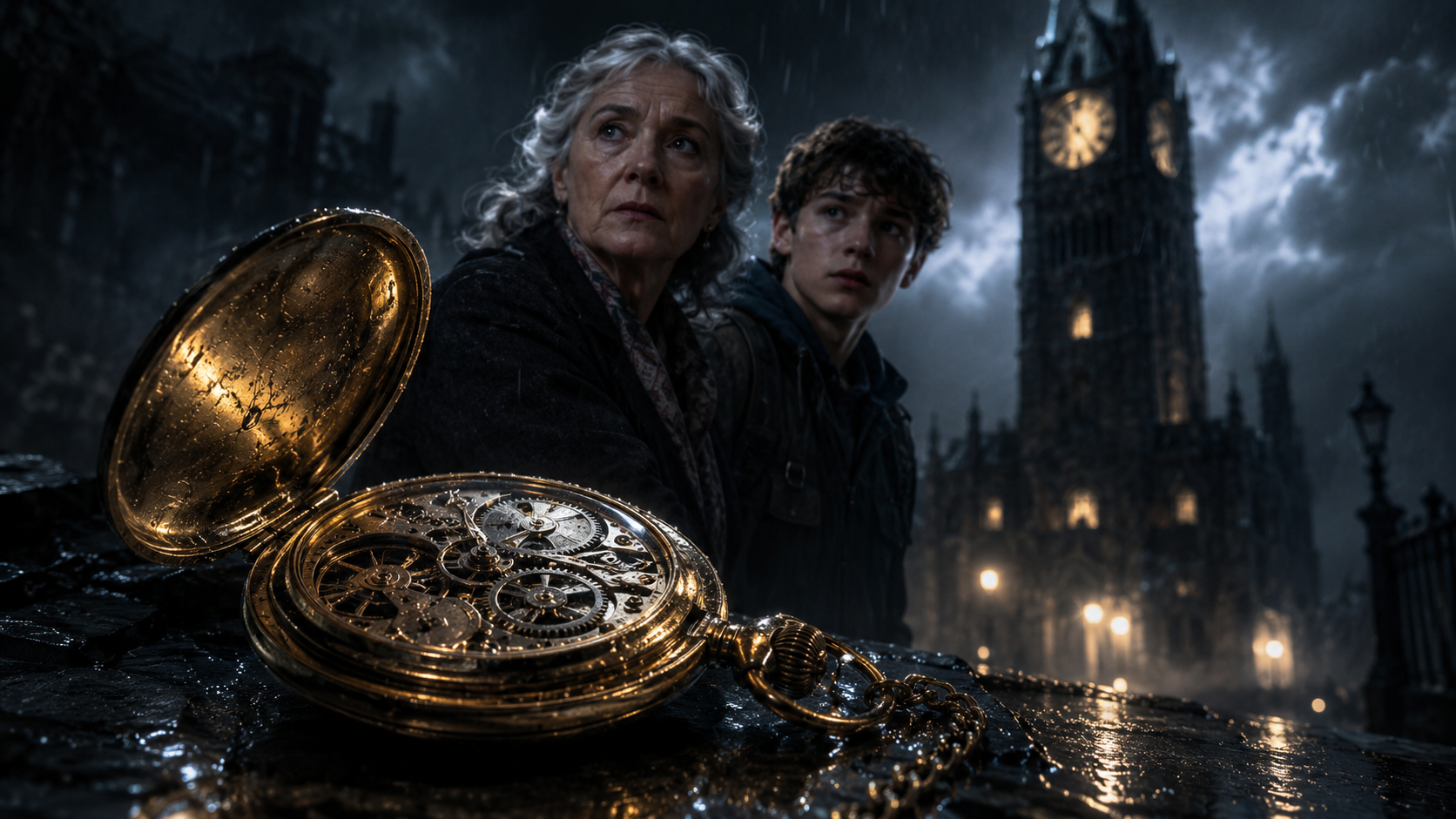
The golden watch remained with Leo.
A master clockmaker repaired its damaged case but refused to replace the unusual mechanism. The watch could still play Thomas’s message, though the recording became quieter each time.
One evening, nearly two years after the tower opened, the family gathered in Miriam’s apartment.
Rain touched the windows, just as it had on the day the parcel arrived.
Thomas sat near the fireplace. Claire read through a newly recovered list of names. Leo worked at the table with the watch open beside his books.
Suddenly, he called Miriam over.
“Look.”
The watch had always moved backward.
Now the second hand was traveling forward.
Tick.
Tick.
Tick.
Miriam picked it up carefully.
The hands passed 2:17 without stopping.
Thomas watched from across the room.
“I wondered when it would do that.”
“You knew?”
“I hoped.”
Leo frowned.
“How can a watch decide to change direction?”
Thomas tapped the side of his head.
“A watch is only a machine. But a machine can be built to finish one task before beginning another.”
“What was its first task?”
“To lead the truth home.”
“And the next one?”
Thomas looked at Claire, at Leo and finally at Miriam.
“To measure the time we still have.”
Months later, the Meridian Clock Tower reopened as a public archive and memorial.
The false death records were displayed beside corrected names. Visitors could listen to testimonies from survivors and read letters that institutions had hidden for decades.
At the center of the main hall stood an empty glass case.
A small plaque explained that the object responsible for unlocking the archive remained with the family who had carried it there.
Leo had refused to surrender the watch.
“It doesn’t belong in a museum,” he said. “It still works.”
On the anniversary of the tower’s opening, Leo stood with Miriam on the upper balcony while the restored city clocks struck noon.
Far below, hundreds of people filled the square.
Some held photographs of missing relatives. Others carried signs bearing the names they had been given at birth. Parents embraced children who had grown old without them.
Thomas was too weak to attend, but the ceremony was broadcast to his room.
Claire stepped onto the balcony and joined Miriam and Leo.
“Ready?” she asked.
Leo opened the golden watch.
The tiny mechanism caught the daylight. Its scars had not been polished away. Thomas had insisted on keeping every dent and scratch.
Leo held it near the microphone.
For several seconds, the entire square listened to its steady ticking.
There were no speeches.
No music.
No grand promise that everything broken could be made whole.
Only the simple sound of time moving in the right direction.
Miriam placed one hand on Claire’s shoulder and the other on Leo’s.
For most of her life, she had believed the past was a sealed room. She had thought grief was the lock and memory was the key that could open it only from the inside.
She understood now that the past was not a room.
It was a clock.
It could be hidden, stopped or forced to run backward. Its face could be altered and its numbers replaced. But somewhere inside, beneath every lie, the original mechanism continued to move.
Waiting for someone to listen.
Waiting for someone to open the case.
Waiting for the lost to find their way home.