Iris pulled it down.
Nothing happened.
Tessa crossed to another pipe.
“My mother said the final valve sticks.”
Together they gripped the large iron wheel.
It refused to move.
Water rose around their ankles.
“Push!” Tessa shouted.
They pushed.
The wheel shifted a fraction.
Above them, the entire tower tilted.
Iris lost her balance and struck the floor.
Tessa caught the rail with one hand.
The mechanical gauge slipped from her pocket and shattered.
For a moment, she stared at it.
Then she looked at the vibrating pipes.
“We have less than two minutes.”
Iris stood.
Blood ran from a cut above her eyebrow.
They gripped the wheel again.
“My mother is still down there,” Tessa said.
Iris looked at her.
“In the service shaft?”
“She may be alive.”
“We will find her.”
“People keep saying that when they want children to cooperate.”
Iris placed both hands on the wheel.
“I am not asking you to cooperate.”
“What are you asking?”
“I am asking you to help me correct something I should have prevented.”
Tessa searched her face.
Then she nodded.
Together, they forced the wheel around.
Once.
Twice.
A heavy thump came from inside the machinery.
The auxiliary pump roared to life.
They climbed back to the control chamber.
The two keys were still positioned in the panel.
“Again,” Tessa said.
They placed their hands on the keys.
“One.”
The floor shook.
“Two.”
A monitor exploded in sparks.
“Three.”
They turned.
For one terrible second, nothing happened.
Then an enormous sound rolled through the tower.
Gate Seven began to move.
Outside, the weakened section of the barrier slowly lowered beneath the surface, redirecting the storm surge toward an empty spill basin.
The pressure warning changed from red to amber.
Then from amber to green.
The false digital monitors went black.
The real emergency lights remained on.
Tessa leaned against the wall.
“Is it over?” Iris asked.
“The city is safe.”
“And your mother?”
Tessa looked toward the lower access corridor.
“Not yet.”
They found Elara Rowe forty minutes later.
She was unconscious inside an emergency compartment above the flooded shaft.
Her left arm was broken. Her body temperature was dangerously low.
But she was alive.
When the rescue team carried her into the tower, Tessa ran to her.
Elara opened her eyes only once.
She saw her daughter.
Then she saw Iris.
“You listened,” Elara whispered.
Iris knelt beside the stretcher.
“Too late.”
Elara’s eyes moved toward the lights of the city.
“Not too late for them.”
The rescue helicopter lifted her from the platform minutes later.
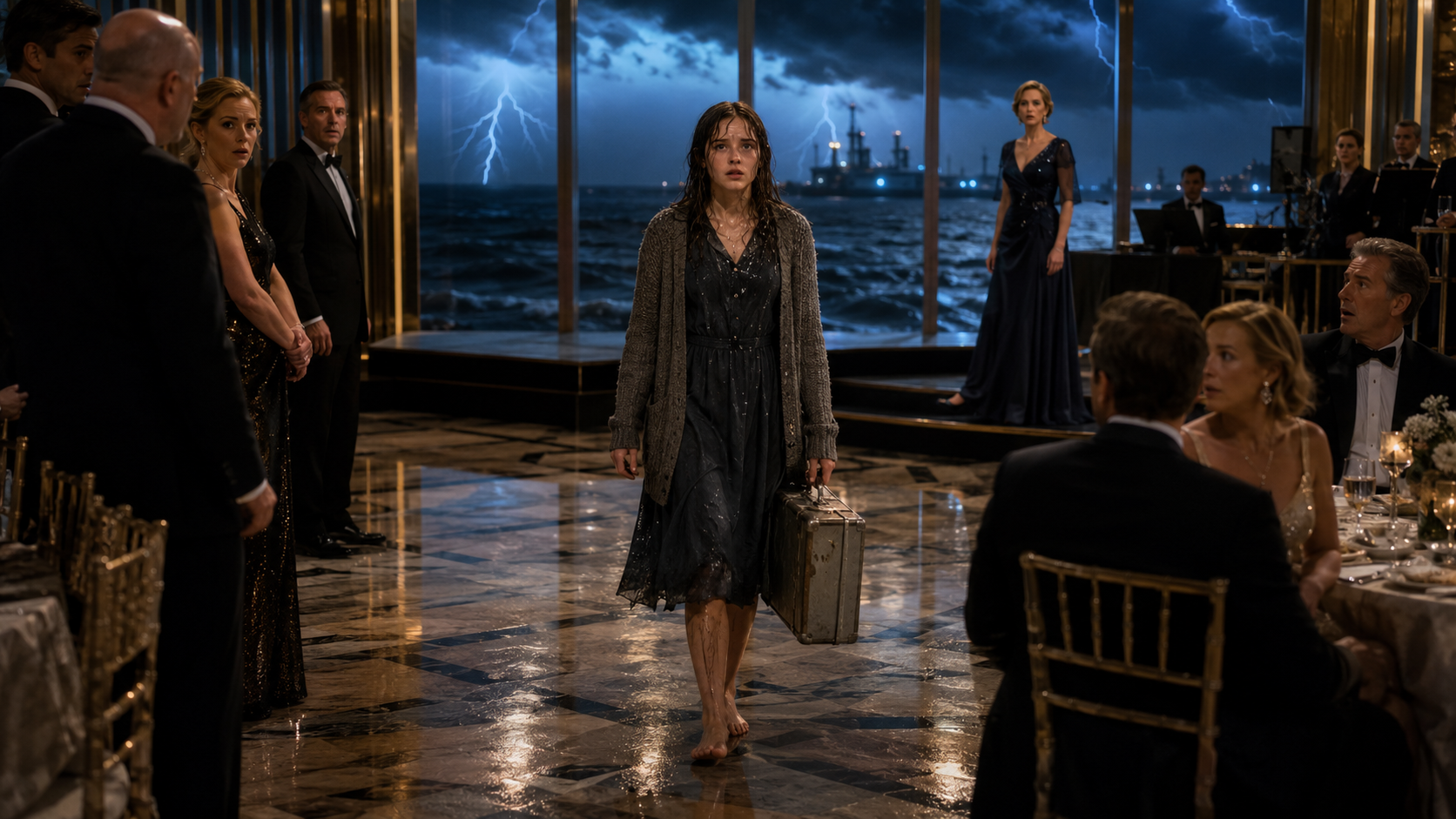
At the hotel, the gala had ended.
The guests remained inside because the roads were still flooded. They stood silently beneath the chandeliers when Iris returned shortly before dawn.
Her dress was torn.
Blood had dried beside her eye.
Tessa walked beside her wearing a security officer’s coat and a pair of shoes several sizes too large.
Adrian Cross was waiting in handcuffs.
He said nothing as investigators led him away.
Iris stepped onto the stage.
No music played.
No promotional film appeared behind her.
She looked at the investors, officials, and executives who had gathered to celebrate the Harbor Crown.
“The barrier did not save the city tonight,” she said.
“A fourteen-year-old girl did.”
Every face turned toward Tessa.
Iris continued.
“Dr. Elara Rowe warned my company that the western gate was defective. Her reports were buried. Her evidence was stolen. She was threatened and removed from a project she helped create.”
She paused.
“My executives deceived me. But that does not remove my responsibility. I built a company in which protecting the leader became more important than telling her the truth.”
Nobody moved.
“Effective immediately, construction records for every Maddox Meridian project will be opened to independent investigators. All supplier contracts connected to Adrian Cross will be suspended. The Harbor Crown will remain inactive until every component has been inspected.”
A board member approached the stage.
“Iris, you should speak with counsel before making further statements.”
She looked at him.
“That advice is seventeen years too late.”
He stepped back.
Iris turned toward Tessa.
“Would you like to say something?”
Tessa looked across the room.
Some of the guests who had laughed at her earlier lowered their eyes.
She walked to the microphone.
“My mother did not try to destroy this company,” she said. “She tried to stop this company from destroying itself.”
Her voice was quiet, but it reached every corner of the ballroom.
“She used to say that machines fail for understandable reasons. Metal breaks. Wires burn. Sensors stop working. But people fail when they decide the truth is inconvenient.”