THE GIRL WHO WALKED INTO THE STORM

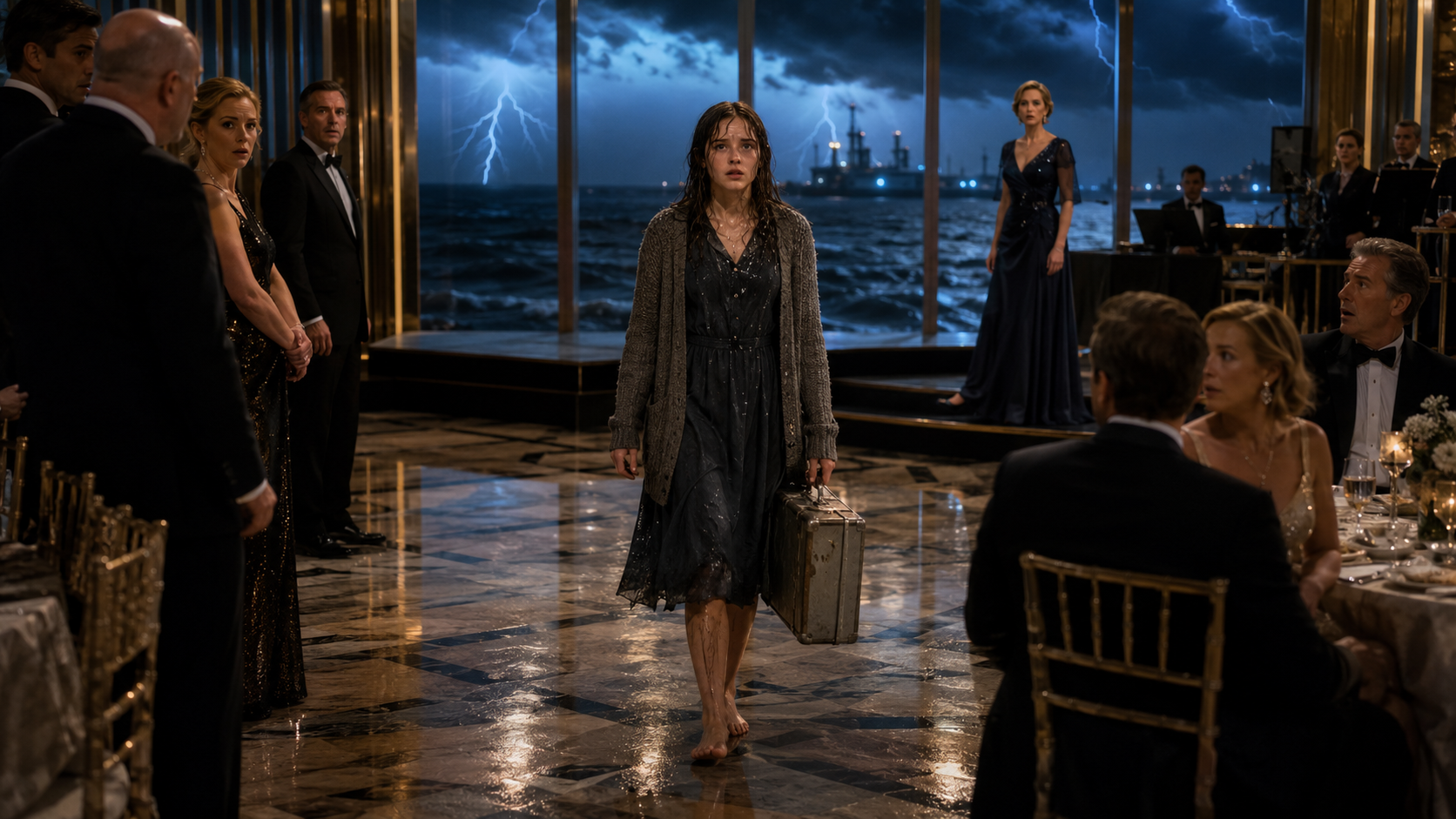
The first person to notice the barefoot girl was a waiter carrying a tower of crystal glasses.

He stopped so suddenly that the glasses chimed against one another.

A second waiter followed his stare.

Then a woman in a silver evening gown turned around.

Within seconds, half the ballroom was watching.

The girl could not have been older than fourteen. Rainwater ran from her dark hair and dripped onto the polished marble floor. Her gray sweater was torn at one elbow. Mud covered the bottom of her dress, and she held a dented metal case against her chest as if it were the most valuable object in the building.

Around her, three hundred guests glittered beneath enormous chandeliers.

Politicians.

Investors.

Celebrities.

Executives who had arrived in black cars and private helicopters.

The girl looked as though she had walked through the storm outside.

Someone laughed.

“Did she swim here?”

Another voice answered, “Perhaps this is part of the entertainment.”

A few guests raised their phones.

The girl ignored them.

She stared across the ballroom at the woman standing on the illuminated stage.

Iris Maddox.

Founder and chief executive of Maddox Meridian.

Owner of shipping lines, energy companies, hotels, and half the newly rebuilt harbor.

That evening, Iris was supposed to announce the completion of the Harbor Crown, the largest storm barrier ever constructed on the eastern coast.

The barrier was a masterpiece of steel, concrete, and artificial intelligence.

At least, that was what every screen in the ballroom had been telling the guests for the past hour.

Behind Iris, a wall of glass revealed the black ocean and the distant lights of the barrier. Lightning flashed beyond the windows.

“Miss,” a security guard said, stepping toward the girl. “You cannot be here.”

The girl tightened her grip on the metal case.

“I need to speak to Iris Maddox.”

The guard almost smiled.

“Mrs. Maddox is occupied.”

“The harbor wall is going to fail tonight.”

The people nearest to her became quiet.

The guard’s smile disappeared.

“What did you say?”

“The Harbor Crown will fail before midnight.”

A man holding a champagne glass laughed loudly.

“That wall cost six billion dollars.”

The girl looked at him.

“Then someone made a very expensive mistake.”

More laughter moved through the room.

Onstage, Iris stopped speaking.

She had not heard every word, but she had seen the disturbance. She handed the microphone to her assistant and walked toward the edge of the stage.

“What is happening?” she asked.

The head of security approached her.

“A child entered through the service corridor. We are removing her.”

The girl raised her voice.

“Water remembers every shortcut.”

Iris froze.

The ballroom noise seemed to move farther away.

“What did you say?” she asked.

The girl looked directly at her.

“Water remembers every shortcut.”

Iris descended the steps.

Her chief operating officer, Adrian Cross, followed her.

He was a tall man with perfectly arranged gray hair and the calm expression of someone who was never surprised in public.

“Iris,” he said quietly, “security can handle this.”

She ignored him.

The sentence the girl had spoken belonged to another time.

Her father used to say it whenever he took Iris to the shipyards as a child.

Water remembers every shortcut.

It had been his warning against careless engineering, hurried construction, and people who believed nature could be persuaded by money.

He had been dead for seventeen years.

Iris stopped in front of the girl.

“What is your name?”

“Tessa Rowe.”

“How did you enter this building?”

“Through the old delivery tunnel.”

“That tunnel was sealed.”

“Not completely.”

Adrian Cross stepped between them.

“This has gone far enough. Remove her.”

Tessa opened the metal case.

Several guests leaned closer.

Inside were notebooks wrapped in plastic, a damaged tablet, a brass key, and a small mechanical gauge with a trembling red needle.

Adrian’s face changed.

Only slightly.

But Iris noticed.

Tessa noticed too.

“My mother built this,” the girl said, lifting the gauge. “It measures pressure inside the western foundation chamber.”

Adrian recovered quickly.

“A homemade instrument proves nothing.”

“It started rising four hours ago.”

“Your mother has no access to our foundation chambers.”

“She designed them.”

The ballroom became quiet again.

Iris looked at the girl.

“Who is your mother?”

“Dr. Elara Rowe.”

This time, Adrian could not hide his reaction.

He looked toward the security team.

“Take the case.”

Two guards moved forward.

Tessa stepped back.

Iris raised one hand.

The guards stopped.

“Elara Rowe worked for us,” Iris said.

“She warned you,” Tessa replied.

Iris’s expression hardened.

“Your mother left the project eleven months ago.”

“She was forced out.”

“That is not what the official report says.”

“My mother wrote the official report. Mr. Cross replaced it.”

Adrian gave a quiet, humorless laugh.

“This is an accusation from a frightened child during a storm.”

Tessa pulled one of the notebooks from the case and opened it.

Page after page contained calculations, diagrams, handwritten observations, and photographs of enormous bolts covered in orange corrosion.

“My mother discovered that the western gates were built with the wrong alloy,” Tessa said. “The supplier changed the steel after the final inspection. Saltwater weakened the hinges. When the tide reaches maximum pressure, Gate Seven will twist.”

Iris looked toward the ocean.

The storm barrier stood three miles away, visible only when lightning illuminated its towers.

“When is maximum pressure?” she asked.

Tessa checked the mechanical gauge.

“Forty-three minutes.”

Adrian stepped closer to Iris.

“You are allowing a child to interrupt an international event with scraps of paper.”

“The pressure gauge is real,” Tessa said.

Adrian turned toward her.

“Do you understand how many independent systems monitor the Harbor Crown?”

“Twenty-six.”

“And all of them show normal conditions.”

“Because they read data from digital sensors.”

“Exactly.”

“My mother discovered the sensors were being recalibrated remotely.”

Adrian’s eyes narrowed.

Tessa took the damaged tablet from the case.

“She disconnected one pressure line from the network and connected it to an analog gauge. Something nobody could change from a computer.”

Iris examined the trembling needle.

“Why didn’t your mother bring this to me?”

“She tried.”

“I never received anything.”

“Your office returned every letter.”

“I receive thousands of letters.”

“She came to the tower.”

Adrian interrupted.

“She was unstable. Security removed her after she threatened employees.”

Tessa stared at him.

“My mother never threatened anyone.”

“She broke into a restricted facility.”

“She entered a chamber she designed.”

“She stole company property.”

“She collected evidence.”

The guests were no longer laughing.

Some had lowered their phones. Others were recording more carefully.

Thunder shook the windows.

The lights flickered.

A computerized voice sounded through the ballroom.

“Severe coastal storm warning. Harbor personnel should remain indoors.”

Adrian looked toward the event manager.

“Continue the program.”

Iris did not move.

“When did you last speak to your mother?” she asked Tessa.

“Three days ago.”

“And where is she now?”

Tessa’s jaw tightened.

“At the bottom of the north service shaft.”

Nobody spoke.

Iris stared at her.

“What?”

“My mother went to inspect Gate Seven. She called me from inside the maintenance tunnel. She said someone had locked the upper door.”

Tessa’s voice remained steady, but her hands were shaking.

“She told me to take the case and find you.”

Adrian shook his head.

“This is madness.”

Tessa looked at him.

“She also told me not to trust the man wearing her father’s watch.”

Adrian’s hand moved instinctively toward his left wrist.

A heavy brass watch rested beneath his cuff.

Iris recognized it immediately.

It had belonged to her father.

She had not seen it since the week he died.

“Where did you get that?” she asked.

Adrian slowly covered the watch with his sleeve.

“Your father gave it to me.”

“No, he didn’t.”

“I worked beside him for twelve years.”

“He promised that watch to my brother.”

“Your brother died before he could receive it.”

“My brother died in the same shipyard fire that destroyed the original Harbor Crown plans.”

Adrian’s calm expression began to fracture.

“This is not the time to reopen family tragedies.”

Tessa reached into the case and removed a small voice recorder.

“My mother found it behind a wall in the old engineering office.”

She pressed a button.

Static filled the ballroom.

Then a man’s voice emerged.

Older.

Tired.

Familiar.

Iris stopped breathing.

It was her father.

“If this recording survives, the replacement contracts must be investigated. Adrian has moved the gate order to a shell supplier. The metal will not survive prolonged salt exposure.”

Adrian lunged toward the recorder.

A security guard blocked him.

The voice continued.

“I confronted him tonight. If anything happens to me or Daniel, the original test results are hidden beneath the western control platform.”

Iris looked at Adrian.

“My father made this recording the night he died.”

Adrian’s face had become pale.

“It could be fabricated.”

Tessa pressed another button.

A second voice played.

Elara Rowe.

“If you are hearing this, I failed to return from Gate Seven. The barrier can still be saved, but the automatic system must be disabled before the gate bends. The manual release requires two keys. One is stored in the western tower. The other is the founder’s emergency key.”

Everyone looked at Iris.

Tessa lifted the brass key from the case.

“This is the tower key.”

Iris reached beneath the neckline of her dress and pulled out a thin chain.

A small black key hung from it.

Her father had given it to her when she became chief executive.

She had never known what it opened.

Adrian took a step backward.

“You cannot go to the barrier in this weather.”

Iris removed her high-heeled shoes.

The guests watched in astonishment as she placed them on the marble floor.

She looked at Tessa’s bare feet.

“What happened to your shoes?”

“The delivery tunnel flooded.”

Iris handed her evening jacket to an assistant.

“Find her something dry. Then bring my car.”

“The roads are closed,” the head of security said.

“Then prepare the harbor launch.”

Adrian’s voice rose.

“The launch will never reach the western tower.”

Iris turned toward him.

“You sound certain.”

Adrian looked toward the doors.

The security guards surrounded him.

“Mr. Cross,” Iris said, “you will remain here.”

“You have no evidence against me.”

“I have enough to stop you from leaving.”

“You will destroy the company.”

“If that wall fails, there may not be a company tomorrow.”

Tessa closed the metal case.

Iris looked down at her.

“Can you operate the manual release?”

“My mother taught me the sequence.”

“Then show me.”


Rain struck the harbor launch like thrown gravel.

Iris sat beside Tessa inside the narrow cabin while the pilot fought the waves. Two security officers held the rail behind them.

The city lights disappeared whenever the boat fell between swells.

Tessa watched the pressure gauge.

The needle had entered the dark red section.

“How much time?” Iris asked.

“Twenty-one minutes.”

“Your mother allowed you to work with her?”

“She never called it work.”

“What did she call it?”

“Making sure I could survive people who thought they were smarter than the ocean.”

Despite everything, Iris almost smiled.

“That sounds like her.”

“You knew her?”

“Not well enough.”

Tessa looked at her.

“My mother admired you once.”

Iris turned toward the rain-covered window.

“Once?”

“She said you used to visit the workshops yourself. She said you remembered the names of mechanics and welders.”

“I was younger.”

“She said becoming powerful made you easier to deceive.”

The words struck harder than Iris expected.

She did not defend herself.

After a moment, she said, “She was right.”

The western tower appeared through the storm.

It rose from the water like a black pillar. Emergency lights flashed around its base.

The launch slammed against the platform.

A security officer secured the line.

Iris and Tessa climbed the ladder.

By the time they reached the entrance, both were soaked.

Tessa inserted the brass key into the tower door.

It would not turn.

She tried again.

“It’s jammed.”

Iris looked through the narrow window.

A red emergency light pulsed inside.

The security officer lifted a metal bar from the launch.

“Stand back.”

He struck the lock.

Once.

Twice.

On the third blow, the door opened.

An alarm screamed.

They entered the control chamber.

Every monitor displayed green symbols.

SYSTEM NORMAL.

PRESSURE STABLE.

NO STRUCTURAL RISK.

Tessa looked at the analog gauge.

Its needle shook against the final mark.

“The screens are lying,” she said.

A deep metallic groan moved through the tower.

Iris felt it beneath her feet.

Gate Seven was bending.

Tessa ran toward the rear wall.

A circular panel contained two keyholes.

She inserted the brass key into the first.

Iris placed the black key into the second.

“Turn on three,” Tessa said.

“One.”

The tower shook.

“Two.”

Somewhere below them, metal screamed.

“Three.”

They turned the keys.

Nothing happened.

Tessa stared at the panel.

“No.”

“What is wrong?”

“The manual system needs hydraulic pressure.”

Another alarm began.

This one was not controlled by a computer.

It was mechanical, deafening, and real.

Tessa opened her mother’s notebook.

“There is an auxiliary pump beneath the control floor.”

The security officer pulled open a maintenance hatch.

Hot air rushed upward.

A ladder descended into darkness.

“I’ll go,” he said.

Tessa stopped him.

“You won’t know the valve sequence.”

“Tell me.”

“There are twelve valves. The labels were removed during construction.”

Iris looked into the shaft.

“I’m going with her.”

The officer shook his head.

“Mrs. Maddox—”

“That is not a request.”

Tessa descended first.

The chamber below was filled with pipes, wheels, and waist-high machinery. Water sprayed from a broken seal.

She moved quickly, touching each valve as if remembering a map.

“Blue wheel, half turn,” she said.

Iris turned it.

“Small lever beside the pressure line.”

Iris pulled it down.

Nothing happened.

Tessa crossed to another pipe.

“My mother said the final valve sticks.”

Together they gripped the large iron wheel.

It refused to move.

Water rose around their ankles.

“Push!” Tessa shouted.

They pushed.

The wheel shifted a fraction.

Above them, the entire tower tilted.

Iris lost her balance and struck the floor.

Tessa caught the rail with one hand.

The mechanical gauge slipped from her pocket and shattered.

For a moment, she stared at it.

Then she looked at the vibrating pipes.

“We have less than two minutes.”

Iris stood.

Blood ran from a cut above her eyebrow.

They gripped the wheel again.

“My mother is still down there,” Tessa said.

Iris looked at her.

“In the service shaft?”

“She may be alive.”

“We will find her.”

“People keep saying that when they want children to cooperate.”

Iris placed both hands on the wheel.

“I am not asking you to cooperate.”

“What are you asking?”

“I am asking you to help me correct something I should have prevented.”

Tessa searched her face.

Then she nodded.

Together, they forced the wheel around.

Once.

Twice.

A heavy thump came from inside the machinery.

The auxiliary pump roared to life.

They climbed back to the control chamber.

The two keys were still positioned in the panel.

“Again,” Tessa said.

They placed their hands on the keys.

“One.”

The floor shook.

“Two.”

A monitor exploded in sparks.

“Three.”

They turned.

For one terrible second, nothing happened.

Then an enormous sound rolled through the tower.

Gate Seven began to move.

Outside, the weakened section of the barrier slowly lowered beneath the surface, redirecting the storm surge toward an empty spill basin.

The pressure warning changed from red to amber.

Then from amber to green.

The false digital monitors went black.

The real emergency lights remained on.

Tessa leaned against the wall.

“Is it over?” Iris asked.

“The city is safe.”

“And your mother?”

Tessa looked toward the lower access corridor.

“Not yet.”


They found Elara Rowe forty minutes later.

She was unconscious inside an emergency compartment above the flooded shaft.

Her left arm was broken. Her body temperature was dangerously low.

But she was alive.

When the rescue team carried her into the tower, Tessa ran to her.

Elara opened her eyes only once.

She saw her daughter.

Then she saw Iris.

“You listened,” Elara whispered.

Iris knelt beside the stretcher.

“Too late.”

Elara’s eyes moved toward the lights of the city.

“Not too late for them.”

The rescue helicopter lifted her from the platform minutes later.

At the hotel, the gala had ended.

The guests remained inside because the roads were still flooded. They stood silently beneath the chandeliers when Iris returned shortly before dawn.

Her dress was torn.

Blood had dried beside her eye.

Tessa walked beside her wearing a security officer’s coat and a pair of shoes several sizes too large.

Adrian Cross was waiting in handcuffs.

He said nothing as investigators led him away.

Iris stepped onto the stage.

No music played.

No promotional film appeared behind her.

She looked at the investors, officials, and executives who had gathered to celebrate the Harbor Crown.

“The barrier did not save the city tonight,” she said.

“A fourteen-year-old girl did.”

Every face turned toward Tessa.

Iris continued.

“Dr. Elara Rowe warned my company that the western gate was defective. Her reports were buried. Her evidence was stolen. She was threatened and removed from a project she helped create.”

She paused.

“My executives deceived me. But that does not remove my responsibility. I built a company in which protecting the leader became more important than telling her the truth.”

Nobody moved.

“Effective immediately, construction records for every Maddox Meridian project will be opened to independent investigators. All supplier contracts connected to Adrian Cross will be suspended. The Harbor Crown will remain inactive until every component has been inspected.”

A board member approached the stage.

“Iris, you should speak with counsel before making further statements.”

She looked at him.

“That advice is seventeen years too late.”

He stepped back.

Iris turned toward Tessa.

“Would you like to say something?”

Tessa looked across the room.

Some of the guests who had laughed at her earlier lowered their eyes.

She walked to the microphone.

“My mother did not try to destroy this company,” she said. “She tried to stop this company from destroying itself.”

Her voice was quiet, but it reached every corner of the ballroom.

“She used to say that machines fail for understandable reasons. Metal breaks. Wires burn. Sensors stop working. But people fail when they decide the truth is inconvenient.”

Tessa looked at the wet footprints she had left across the marble hours earlier.

“I did not come here because I wanted money. I came because no one believed her.”

Iris stood beside her.

“I believe her.”

Tessa faced her.

“Now you do.”

The words carried no cruelty.

That made them harder to hear.

Iris nodded.

“Now I do.”


Elara spent three weeks in the hospital.

Tessa visited every day.

Iris visited too, although she never arrived with photographers or assistants.

During the investigation, the original engineering records were recovered from beneath the western platform. They proved that Adrian Cross had approved the use of inferior metal and manipulated the digital monitoring system to hide the damage.

The old shipyard fire had not been an accident.

Iris’s father and brother had discovered the supplier scheme seventeen years earlier. Adrian had destroyed the records and allowed investigators to blame an electrical failure.

He had built his career beside Iris while hiding the truth that had destroyed her family.

The scandal cost Maddox Meridian billions.

Contracts disappeared.

Board members resigned.

News networks predicted the collapse of Iris’s empire.

For the first time in years, she did not care about the predictions.

Six months later, the Harbor Crown reopened.

Every gate had been rebuilt.

A new independent engineering council controlled the monitoring system. No executive could alter the data. Every safety report was available to workers, inspectors, and the public.

At the western tower, a small metal plate was installed beside the manual release.

It contained no mention of Iris Maddox.

It carried only one name.

DR. ELARA ROWE
ENGINEER, WHISTLEBLOWER, PROTECTOR OF THE HARBOR

On the morning of the reopening, Iris stood on the platform with Elara and Tessa.

The ocean was calm.

Tessa wore strong work boots and carried a new mechanical pressure gauge.

“You still do not trust digital sensors?” Iris asked.

“I trust them.”

“But?”

“I trust having a second opinion more.”

Elara smiled.

Iris looked across the water at the city.

“I spent years believing power meant never admitting uncertainty.”

“What do you believe now?” Tessa asked.

Iris considered the question.

“That power is useless if everyone is afraid to tell you that you are wrong.”

Tessa handed her the pressure gauge.

The needle rested steadily in the safe zone.

“You should keep this one.”

“Why?”

“So you remember.”

“Remember what?”

Tessa looked toward the enormous steel gates beneath the water.

“That the truth does not become less dangerous just because you refuse to measure it.”

Iris accepted the gauge.

Behind them, workers opened the western control room.

Ahead of them, sunlight spread across the harbor.

Months earlier, a barefoot girl had walked into a ballroom where powerful people laughed at her muddy clothes.

She had arrived with no invitation, no influence, and no reason to believe anyone would listen.

But she carried something more powerful than money.

Evidence.

Courage.

And the truth her mother had nearly died protecting.

That night, Tessa Rowe had not merely stopped a wall from breaking.

She had broken something far stronger.

The silence surrounding people who believed they were too important to be questioned.


SEEDANCE VIDEO TRAILER PROMPTS

1

Create a cinematic 15-second dramatic thriller trailer, photorealistic, widescreen 16:9, realistic storm lighting, consistent characters and natural facial movement.

0–3 seconds: Inside an extravagant glass ballroom at night, wealthy guests in formal clothing laugh as a soaked barefoot fourteen-year-old girl enters carrying a dented metal case. Thunder flashes outside.

A guest mocks her: “Did you swim here?”

3–7 seconds: Close-up of the girl staring fearlessly at billionaire Iris Maddox on the stage.

The girl says clearly: “Your harbor wall will fail before midnight.”

7–11 seconds: Rapid cinematic cuts: a pressure gauge entering the red zone, a massive steel gate bending beneath violent ocean waves, the company executive secretly hiding an old brass watch.

Iris whispers: “Who taught you this?”

The girl answers: “My mother.”

11–15 seconds: Iris and the girl turn two emergency keys together inside a shaking control tower. Sparks fly, alarms sound, water crashes against the windows.

The girl shouts: “Turn it now!”

End on Iris turning the key as the tower violently shakes. Intense orchestral sound, thunder, metal groaning, realistic English dialogue. No subtitles, no captions, no logos, no written text, no title cards, no visible interface elements.

2

Generate a 15-second emotional mystery trailer with realistic cinematic visuals, dark blue storm atmosphere, elegant lighting, natural English speech and consistent character appearance.

0–4 seconds: A barefoot teenage girl stands alone in the center of a luxurious ballroom, surrounded by silent billionaires and politicians. Water drips from her clothes onto the marble floor.

The billionaire woman asks: “What is your name?”

The girl replies: “Tessa Rowe.”

4–8 seconds: The girl opens a metal case containing engineering notebooks, a brass key and an old voice recorder. A frightened executive watches from the background.

A recorded male voice says: “Adrian changed the steel contracts.”

8–12 seconds: Close-up of the executive’s face losing color. Security guards step toward him. Lightning fills the ballroom windows.

The billionaire says coldly: “You knew the wall was defective.”

12–15 seconds: Fast cut to the storm barrier cracking under a giant wave. The girl looks at the billionaire and says: “You have fifteen minutes to believe me.”

Deep cinematic bass, rain, distant alarms and emotional orchestral music. No subtitles, no on-screen text, no captions, no logos, no title graphics.

3

Create a high-intensity 15-second disaster movie trailer, photorealistic Hollywood style, dynamic camera movement, realistic ocean physics, English dialogue and no visible text.

0–3 seconds: A small harbor launch fights through enormous waves at night. Inside, billionaire Iris Maddox and fourteen-year-old Tessa hold a shaking analog pressure gauge.

Iris asks: “How much time?”

Tessa answers: “Two minutes.”

3–7 seconds: The boat crashes against a dark control tower. Iris and Tessa run through heavy rain as lightning strikes behind the massive storm barrier.

7–11 seconds: Inside the tower, pipes explode, water floods the floor, warning lights flash red. The two struggle to turn a rusted iron wheel.

Tessa screams: “Push!”

Iris shouts: “I’m trying!”

11–15 seconds: They turn two keys simultaneously. The giant barrier gate begins lowering as a towering wave approaches the city.

Tessa says breathlessly: “Come on… come on…”

End just before the wave hits. Loud alarms, thunder, mechanical impacts and powerful trailer music. No subtitles, no captions, no words, no logos, no title cards, no watermarks.

4

Produce a 15-second cinematic emotional trailer combining mystery, danger and redemption, realistic human acting, dramatic close-ups, warm ballroom light contrasted with cold storm light, natural English dialogue.

0–4 seconds: Wealthy guests laugh and film a barefoot girl standing in a magnificent ballroom. The camera slowly pushes toward her determined face.

A woman laughs: “Security, remove her.”

The girl says: “My mother died trying to warn you.”

4–8 seconds: Billionaire Iris Maddox listens to an old recorder. Her expression changes from disbelief to horror.

The recorded voice says: “The gate will not survive the storm.”

8–12 seconds: Quick flashes: a corrupt executive being surrounded by guards, a woman trapped inside a flooded maintenance shaft, Iris and the girl running through a control tower.

Iris says: “Why should I trust you?”

The girl answers: “Because the ocean already knows the truth.”

12–15 seconds: At dawn, Iris and the girl stand beside the saved harbor. Iris holds the broken pressure gauge.

Iris quietly says: “You saved them all.”

The girl replies: “My mother did.”

Emotional orchestral ending, rain fading into calm ocean sounds. No subtitles, no captions, no written words, no logos, no credits, no title cards, no visible interface.