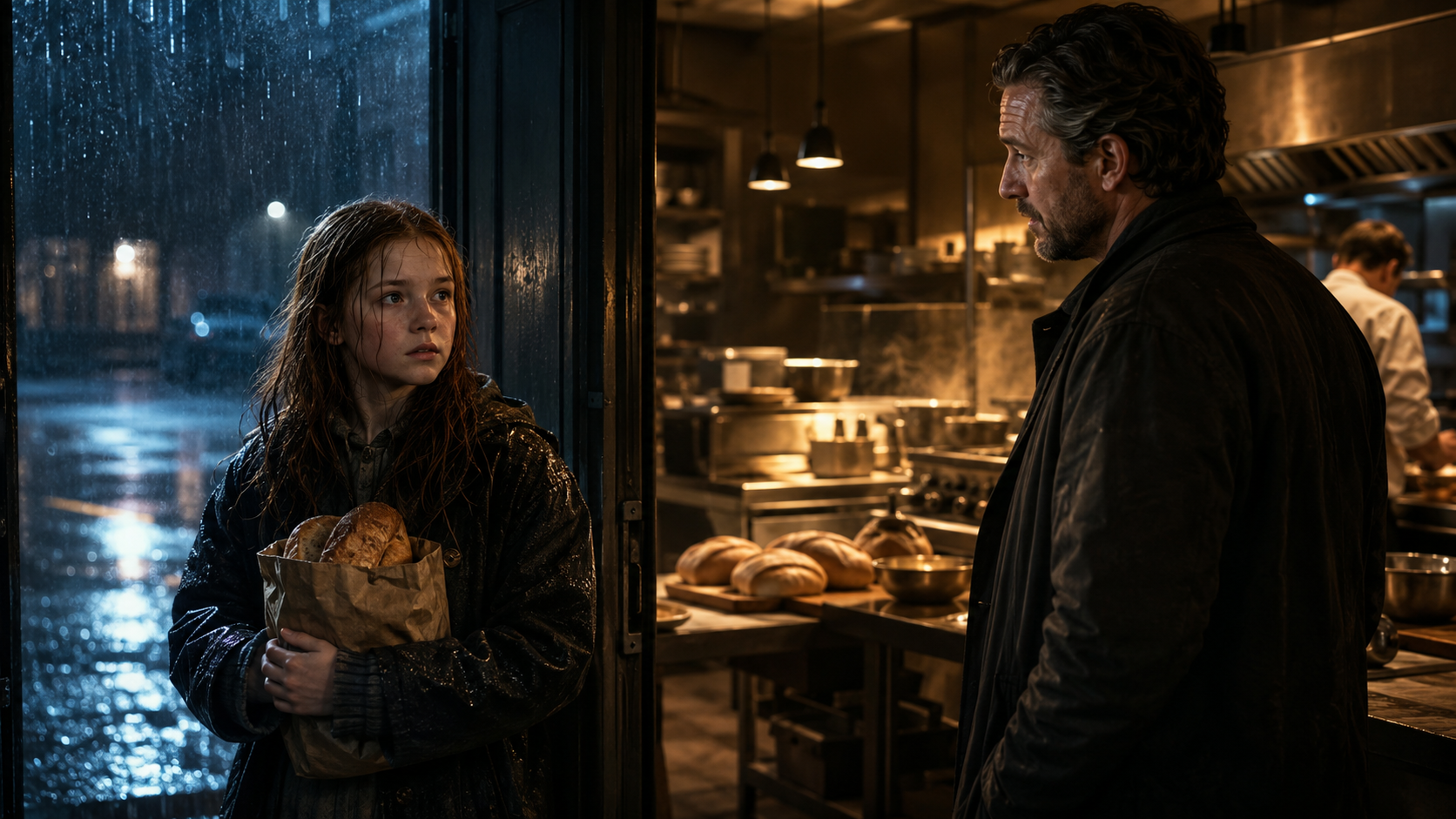
“I understand that now.”
“No, you don’t.”
Lena took off her kitchen apron and placed it on the table.
“You stood in front of me that night and asked why I stole bread.”
Adrian closed his eyes.
“You looked at me like I was something dirty,” she continued. “But I stole three loaves. You stole her future.”
She left the restaurant before he could answer.
For the first time in his adult life, Adrian did not know how to solve a problem with money, influence, or persistence.
Lena refused his calls.
She finished school and accepted a scholarship to study law in another city. She continued writing to the other children but sent Adrian nothing.
He attended her graduation without telling her.
He stood at the back of the hall and left before the ceremony ended.
During the following years, Adrian changed the way his companies operated.
The recipe was renamed Elena’s Winter Bread.
Every menu described its true origin.
A percentage of the sales funded legal support for children in temporary care. Adrian opened shared residences designed to keep siblings and bonded foster groups together.
Reporters praised him.
He refused every interview.
Public redemption felt too much like advertising.
Eight years after Lena left Bellhaven, Adrian received a package.
Inside was an old blue notebook.
The pages were stained with flour, smoke, and age. Recipes filled the first half in Elena Marrow’s handwriting.
The final pages contained letters she had never sent.
One was addressed to Adrian.
She wrote that she had been proud when she heard about his first restaurant. She had recognized her bread in a newspaper photograph.
She had not been angry that he used the recipe.
She had been hurt that he forgot the lesson behind it.
Bread, Elena wrote, was never valuable because of the flour. It was valuable because someone had decided that another person should not remain hungry.
At the bottom of the last page, Lena had added a single sentence.
Meet me at the old station tomorrow at midnight.
The storm arrived at eleven.
Adrian drove through the rain to the abandoned railway district. The warehouse where he had found the children was still standing, although new apartment buildings had appeared nearby.
A light burned inside.
He entered.
Lena stood beside a long wooden table. She was twenty-six now, dressed in a dark suit, with her mother’s blue notebook in her hands.
Jonah, Mae, Iris, and Toby stood behind her.
Adrian stopped.
“What is this?”
“A board meeting,” Lena said.
Jonah grinned.
“You’re late.”
Lena placed several documents on the table.
She had created a nonprofit organization that would provide emergency housing, medical assistance, and legal representation to children avoiding separation.
Mae had agreed to run its arts program. Jonah would oversee housing renovations. Iris had designed the buildings. Toby, now studying medicine, would coordinate health services.
“We have grants,” Lena said. “We have government approval and three properties.”
Adrian looked at the documents.
“What do you need from me?”
“A kitchen.”
He looked up.
Lena’s expression softened.
“Every residence should have a real kitchen. Not an institution’s cafeteria. A place where children can cook together and know that the food will still be there tomorrow.”
Adrian swallowed.
“How much?”
“I’m not asking for money.”
“Then what are you asking for?”
“Your time.”
Rain struck the metal roof.
Lena opened the blue notebook and turned it toward him.
“We want you to teach the children how to make Elena’s bread.”
Adrian’s hands began to tremble.
“After everything I did?”
“You also came back.”
“That does not erase what I took from your mother.”
“No.”
“Then why?”
Lena looked around at the four people who had become her family.
“Because my mother believed feeding someone was a decision, not a reward. I’m trying to believe that too.”
Adrian lowered himself into a chair.
For years, he had imagined forgiveness as a door that opened once and allowed a person to pass through.
Now he understood it was nothing like that.
It was work.
It was returning.
It was choosing, again and again, not to run from the damage one had caused.
He looked at Lena.
“I’m sorry.”
“I know.”
“I should have said it years ago.”
“Yes.”
“I can’t give your mother back what I took.”
“No.”
“But I can spend the rest of my life honoring her properly.”
Lena placed a bag of flour on the table.
“Then start tonight.”
They worked until morning.
Adrian taught them how Elena had warmed the bowl before mixing the dough. Lena showed him the folding technique her mother had taught her as a child.
Jonah added too much salt.
Mae burned the first loaf.
Iris covered the walls with flour.
Toby ate a piece before it had cooled and complained that his mouth would never recover.
When the final loaf emerged from the oven, the storm had passed.
Sunlight entered through the broken warehouse windows.
They gathered around the table and divided the bread into six uneven pieces.
Adrian lifted his portion but could not eat.
Lena noticed.
“What’s wrong?”
He looked at the children he had once considered someone else’s problem.
“Nothing,” he said. “I’m just trying to remember this correctly.”
“Remember what?”
“The moment the bread became hers again.”
Lena shook her head.
“It was always hers.”
Then she handed him a larger piece.
“But now we can share it.”
Years later, the warehouse became the first Harbor House.
No child was turned away because of an empty wallet. Brothers, sisters, and children who had chosen one another were given every possible opportunity to remain together.
Each kitchen displayed a small framed page copied from Elena’s notebook.
It contained no company logo.
No photograph of Adrian.
No list of donors.
Only one handwritten sentence:
Feed the person before you judge the hunger.
And every winter, on the night of the first great storm, Lena returned to the kitchen where the program had begun.
She rolled up her sleeves.
Adrian warmed the mixing bowl.
The others gathered around the table.
Together, they baked enough bread for everyone who came through the door.