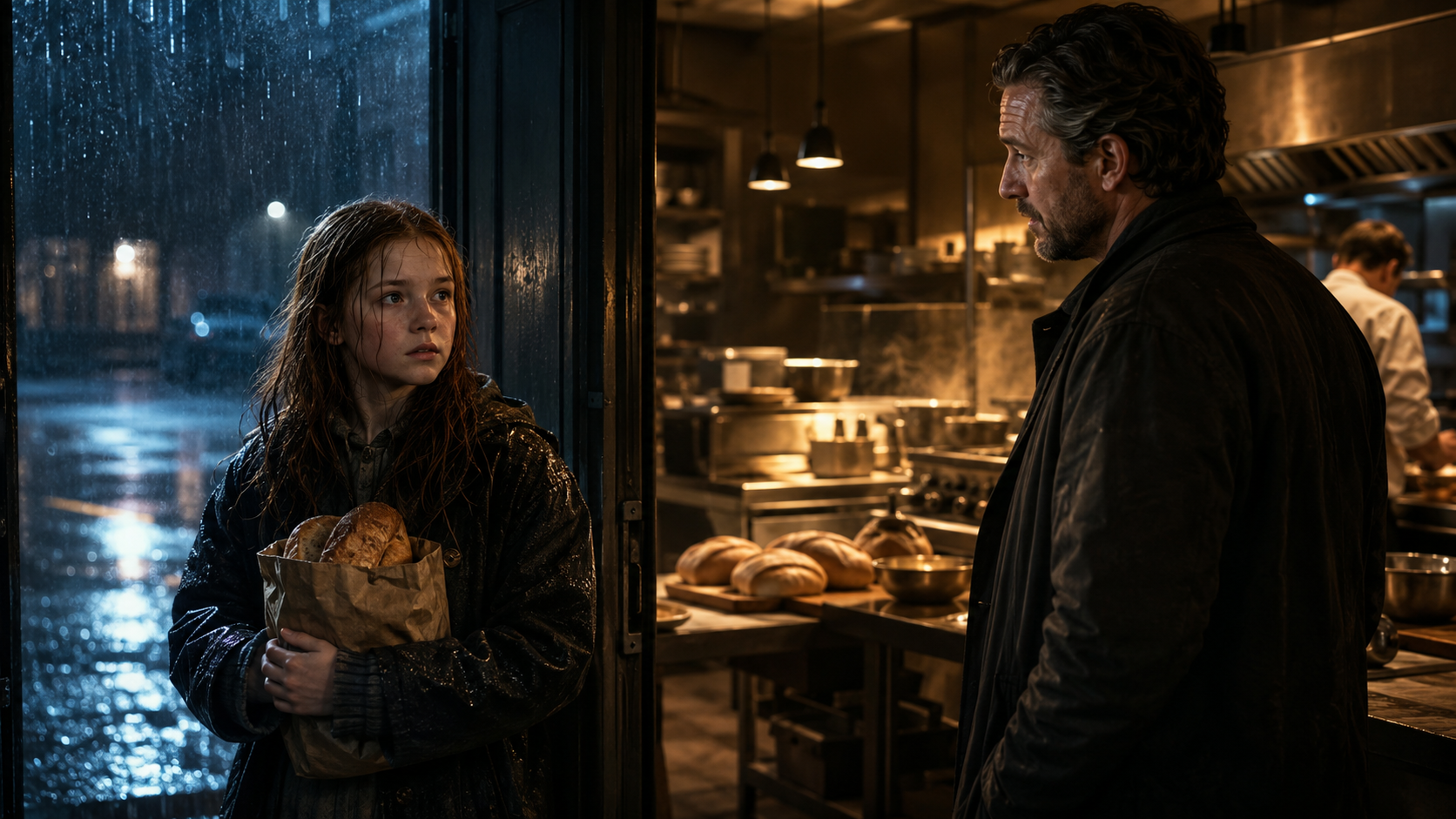
THE GIRL WHO STOLE THE WINTER BREAD

The storm reached Bellhaven shortly after midnight.

It came in from the sea with enough force to shake windows, tear branches from trees, and send cold water rushing through the streets near the harbor. By one in the morning, the fashionable restaurants along Lantern Avenue had locked their doors. Their golden signs vanished behind iron shutters, and the last customers hurried toward waiting cars.

Only one kitchen remained lit.

The Hearth Crown was the most celebrated restaurant in the city. Its dining room was famous for crystal chandeliers, hand-painted ceilings, and meals that cost more than many dockworkers earned in a week.

Below the dining room, however, there was nothing elegant about the kitchen after closing.

Steam clouded the windows. Pans soaked in metal sinks. Half-cleaned counters smelled of roasted garlic, burnt sugar, and industrial detergent.

Adrian Cross stood alone beside the preparation table, reading the evening’s financial report.

At fifty-two, Adrian owned eleven restaurants, two hotels, a catering company, and a food distribution business. Newspapers called him a visionary. His employees used other words when he was not listening.

Demanding.

Cold.

Impossible.

He believed kindness made people careless. He believed loyalty had to be purchased. Most of all, he believed that anyone could escape poverty through discipline because he had done it himself.

A metallic crash sounded near the pantry.

Adrian raised his head.

“Who’s there?”

No answer.

He placed the report on the table and walked toward the sound. The night staff had already left. The security guard was stationed upstairs.

Adrian opened the pantry door.

A small figure darted past him.

He caught the back of a wet coat before the intruder reached the stairs.

The thief twisted desperately, knocking a basket of onions onto the floor.

“Let go!”

It was a girl.

She looked twelve or thirteen, although hunger had made her face seem younger. Rainwater streamed from her tangled copper-colored hair. Her coat was too thin for winter, and one of her shoes was held together with silver tape.

Under her arm, she clutched a paper bag.

Adrian tightened his grip.

“What did you take?”

“Nothing.”

“The bag.”

She pulled it closer to her chest.

“Give it to me.”

“No.”

Her refusal surprised him more than the theft.

Most children would have cried. Most adults would have apologized. This girl stared at him with the furious concentration of a cornered animal.

Adrian removed the bag from her hands.

Inside were three loaves of bread, a jar of honey, two packages of sliced meat, and a small bottle of children’s fever medicine.

“You broke into my restaurant for this?”

“I didn’t break anything,” she said. “The delivery door was open.”

“That does not make it yours.”

“I know.”

“Then why did you take it?”

The girl looked toward the stairs.

Adrian stepped between her and the exit.

“I asked you a question.”

“And I said I know it was wrong.”

“That isn’t an answer.”

Thunder shook the building.

For a moment, the girl appeared ready to fight him. Then her shoulders dropped.

“My brother’s sick.”

Adrian studied her face.

“Where are your parents?”

“They’re not here.”

“Where is your brother?”

She remained silent.

Adrian picked up the telephone mounted beside the pantry door.

The girl lunged forward.

“Please don’t call the police!”

“Then tell me the truth.”

“I am telling the truth.”

“Part of it.”

Tears appeared in her eyes, but her voice stayed firm.

“The medicine is for him. The bread is for everyone else.”

“Everyone else?”

She glanced at the bag.

Adrian slowly lowered the telephone.

“How many?”

The girl pressed her lips together.

“How many children are waiting for you?”

“Four.”

Adrian looked again at the food she had chosen. There were no sweets, no expensive items and nothing she could easily sell. Only basic food and medicine.

“What is your name?”

“Lena.”

“Your full name.”

“Lena Marrow.”

“Take me to them.”

Her eyes widened.

“No.”

“You can take me there, or I can call the police and allow them to find the place without you.”

“You’ll scare them.”

“I will bring the food.”

“You’ll take it back.”

“I won’t.”

She looked at him suspiciously.

“Why should I trust you?”

Adrian handed her the paper bag.

“You shouldn’t. But your brother needs the medicine.”

They left through the service entrance.

Adrian’s driver had already gone home, so they crossed the flooded streets in Adrian’s dark sedan. Lena sat rigidly in the passenger seat, holding the bag with both arms.

She gave directions one word at a time.

“Left.”

“Straight.”

“Past the bridge.”

The expensive shops disappeared behind them. The streets narrowed. Streetlights became less frequent, and the buildings leaned toward one another like exhausted giants.

Eventually, Lena pointed toward an abandoned railway district.

“There.”

“That station has been closed for twenty years.”

“I know.”

She climbed out before Adrian had fully stopped the car.

He followed her through a broken section of fence and across weed-covered tracks. Rain struck the rusting train cars and produced a hollow metallic roar.

Lena stopped beside an old luggage warehouse. One window had been covered with cardboard. A pale glow escaped through a gap beneath the door.

She knocked three times, paused, and knocked twice more.

A child’s voice came from inside.

“Lena?”

“It’s me.”

“Did you get it?”

“Yes. Open the door.”

A wooden crate scraped across concrete.

The door opened just wide enough for Lena to enter. Adrian stepped forward, and the child inside immediately tried to close it.

“He’s with me,” Lena said.

A boy of about ten stared at Adrian. He held a broken broom handle like a spear.

“Who is he?”

“The man from the restaurant.”

The boy’s face hardened.

“You brought him here?”

“He has the medicine.”

That changed everything.

The boy lowered the broom.

Inside, the warehouse had been divided with old curtains and wooden pallets. Candles burned inside glass jars. A camping stove stood beneath a cracked window.

Near the far wall, a younger boy lay on a mattress made from flattened coats. His breathing came in short, dry bursts.

Two little girls sat beside him. The older one pressed a damp cloth against his forehead. The younger one held his hand.

Adrian stopped walking.

The children did not look surprised to see a stranger. They looked prepared to run.

“This is Toby,” Lena said, kneeling beside the sick boy. “He’s eight.”

She opened the medicine bottle.

Adrian watched as she read the instructions twice before measuring the dose.

“You can read that?” he asked.

Lena looked offended.

“Of course I can read.”

“I didn’t mean—”

“You thought thieves couldn’t read?”

The boy with the broom laughed once.

Adrian ignored him.

“Has a doctor seen Toby?”

“No.”

“How long has he had the fever?”

“Three days.”

“And the cough?”

“Longer.”

Toby opened his eyes.

“You came back,” he whispered.

“I always come back,” Lena said.

She gave him the medicine and a little water.

Adrian walked toward the camping stove. A metal pot contained a thin mixture of water and potatoes.

“Is this all you have been eating?”

The boy with the broom moved between Adrian and the pot.

“It’s enough.”

“No, it isn’t.”

“It has to be.”

Adrian looked around the warehouse.

There were five children in total. Lena was the oldest. Toby was sick. The boy with the broom introduced himself as Jonah. The two girls were Mae and Iris.

None of them was related by blood.

They had lived in the same temporary foster home on the northern edge of Bellhaven. According to Lena, the woman responsible for them had disappeared six weeks earlier after taking the money intended for food and rent.

The children had escaped before social services arrived because Jonah had overheard that they would be separated.

“So you chose this?” Adrian asked.

“We chose each other,” Lena replied.

“That is not the same thing.”

“It is to us.”

Adrian called a private medical service.

Lena tried to stop him.

“They’ll report us.”

“Toby may have pneumonia.”

“They’ll split us up.”

“If he stays here, he could die.”

The word silenced everyone.

Lena looked down at her brother’s pale face.

“They always promise we can stay together,” she whispered. “Then they send us to different places.”

Adrian removed his coat and placed it over the little boy.

“Then I will make a different promise.”

Lena looked at him.

“What promise?”

“That no one makes a decision before Toby is safe.”

“You can’t control everything.”

Adrian met her eyes.

“No. But I can control more than most people.”

The doctors arrived twenty minutes later.

Toby was taken to St. Anne’s Hospital with a severe lung infection. Lena rode in the ambulance. Adrian drove the other children behind them.

By sunrise, Toby was receiving antibiotics and oxygen.

Lena sat outside his room, still wearing her wet coat. Adrian returned from the reception desk carrying five cups of hot chocolate and a tray of sandwiches.

Jonah accepted a sandwich immediately.

Lena did not.

“What do you want?” she asked.

Adrian placed a cup beside her.

“Right now, I want you to eat.”

“No one does this for nothing.”

“I haven’t decided what I want.”

“That means it will cost more later.”

Adrian sat across from her.

“Who taught you to think like that?”

“Everyone.”

He had no reply.

During the next two days, Adrian made calls.

He contacted lawyers, child welfare officials, doctors, and the director of a small residential school outside the city. He donated enough money to repair an unused house on the school grounds but insisted that the children be allowed to live there together under the care of the same guardians.

Officials objected.

Adrian argued.

They mentioned regulations.

He hired specialists.

They requested inspections.

He arranged them before lunch.

By the end of the week, an emergency placement had been approved.

Lena remained suspicious.

“This house belongs to the school?” she asked.

“It belongs to a charitable trust.”

“Your trust?”

“For now.”

“And when you get bored?”

“I rarely get bored.”

“When you get angry, then?”

Adrian considered the question.

“The house will still be yours.”

“You could be lying.”

“Yes.”

She studied him.

“But I’m not.”

Toby recovered slowly. When he was released from the hospital, all five children moved into the small brick house behind the school.

It had four bedrooms, a bright kitchen, a fireplace, and an apple tree in the garden.

For the first month, Lena slept on the floor beside the front door.

She did not trust beds that could disappear.

She did not trust cupboards that remained full.

She especially did not trust Adrian.

He visited every Sunday afternoon.

At first, he arrived with practical things: winter coats, school supplies, medicine, and boxes of food from his restaurants.

The children thanked him politely but kept their distance.

Then, one Sunday, Adrian brought a chessboard.

Jonah defeated him in twelve minutes.

“You let me win,” Jonah said.

“I absolutely did not.”

“Then you’re bad at chess.”

“I own eleven restaurants.”

“That doesn’t make you good at chess.”

The following week, Adrian brought three books about strategy and demanded another match.

Lena watched from the kitchen doorway.

“You hate losing,” she said.

“I consider losing an educational emergency.”

For the first time, she smiled at him.

Months became years.

Jonah developed a gift for engineering and spent his evenings repairing radios and bicycles. Mae loved music and learned to play the cello. Iris filled notebooks with drawings of imaginary cities. Toby grew stronger and became the fastest runner at school.

Lena read everything she could find about business law.

She never forgot the night in the restaurant kitchen.

At sixteen, she asked Adrian for a job.

“You already have an allowance,” he said.

“I don’t want an allowance.”

“What do you want?”

“To earn money.”

He offered her a position in one of his offices.

She refused.

“I want to work in the kitchen.”

“Why?”

“Because that’s where you caught me.”

Adrian looked at her for a long moment.

“You’ll start by washing dishes.”

“I expected to.”

“You will receive no special treatment.”

“I was hoping you’d say that.”

Lena became one of the hardest workers at the Hearth Crown.

She washed plates, peeled vegetables, cleaned floors, and carried deliveries. Later, the chefs taught her to prepare sauces and bread.

One evening, an elderly pastry chef noticed the way Lena shaped a loaf before placing it in the oven.

“Who taught you to fold dough like that?” he asked.

“My mother.”

The chef stared at her hands.

“What was her name?”

“Elena Marrow.”

The bowl slipped from his fingers.

It struck the floor and cracked.

Adrian was called into the kitchen.

The old chef sat beside the ovens, his face drained of color.

“Tell her,” he said when Adrian arrived.

“Tell her what?”

“About Elena.”

Adrian’s expression changed.

Lena noticed it immediately.

“You knew my mother?”

Adrian dismissed the kitchen staff and locked the door.

For several seconds, only the ovens could be heard.

Then he said, “Yes.”

Lena stepped closer.

“How?”

Adrian pulled out a chair but did not sit.

“When I was nineteen, I worked in a factory canteen near the harbor. I had no money and nowhere permanent to live. Your mother was the assistant cook.”

Lena waited.

“She gave me meals when I couldn’t pay. She taught me how to make bread. Not ordinary bread—the winter loaf we still serve here.”

“The Hearth Loaf?”

Adrian nodded.

It was the signature dish of his restaurant empire. Food critics had written entire articles about it. Customers traveled from other cities to taste it.

“My mother created that recipe?”

“Yes.”

“Then why is your name attached to it?”

Adrian’s face tightened.

“Because I took it with me.”

The words seemed to change the air in the room.

Lena stared at him.

“You stole it.”

“I told myself it was only a recipe.”

“You built your company around it.”

“Not the entire company.”

“But it opened the first restaurant.”

“Yes.”

“And you never gave her credit.”

“I tried to find her years later.”

“After you were rich?”

“Yes.”

“After it was safe?”

Adrian looked away.

Lena’s voice became quieter.

“You knew her name all this time.”

“I knew Elena. I didn’t know she had children.”

“You never asked?”

“She disappeared after the factory closed. I was told she had moved overseas.”

“She didn’t.”

“I understand that now.”

“No, you don’t.”

Lena took off her kitchen apron and placed it on the table.

“You stood in front of me that night and asked why I stole bread.”

Adrian closed his eyes.

“You looked at me like I was something dirty,” she continued. “But I stole three loaves. You stole her future.”

She left the restaurant before he could answer.

For the first time in his adult life, Adrian did not know how to solve a problem with money, influence, or persistence.

Lena refused his calls.

She finished school and accepted a scholarship to study law in another city. She continued writing to the other children but sent Adrian nothing.

He attended her graduation without telling her.

He stood at the back of the hall and left before the ceremony ended.

During the following years, Adrian changed the way his companies operated.

The recipe was renamed Elena’s Winter Bread.

Every menu described its true origin.

A percentage of the sales funded legal support for children in temporary care. Adrian opened shared residences designed to keep siblings and bonded foster groups together.

Reporters praised him.

He refused every interview.

Public redemption felt too much like advertising.

Eight years after Lena left Bellhaven, Adrian received a package.

Inside was an old blue notebook.

The pages were stained with flour, smoke, and age. Recipes filled the first half in Elena Marrow’s handwriting.

The final pages contained letters she had never sent.

One was addressed to Adrian.

She wrote that she had been proud when she heard about his first restaurant. She had recognized her bread in a newspaper photograph.

She had not been angry that he used the recipe.

She had been hurt that he forgot the lesson behind it.

Bread, Elena wrote, was never valuable because of the flour. It was valuable because someone had decided that another person should not remain hungry.

At the bottom of the last page, Lena had added a single sentence.

Meet me at the old station tomorrow at midnight.

The storm arrived at eleven.

Adrian drove through the rain to the abandoned railway district. The warehouse where he had found the children was still standing, although new apartment buildings had appeared nearby.

A light burned inside.

He entered.

Lena stood beside a long wooden table. She was twenty-six now, dressed in a dark suit, with her mother’s blue notebook in her hands.

Jonah, Mae, Iris, and Toby stood behind her.

Adrian stopped.

“What is this?”

“A board meeting,” Lena said.

Jonah grinned.

“You’re late.”

Lena placed several documents on the table.

She had created a nonprofit organization that would provide emergency housing, medical assistance, and legal representation to children avoiding separation.

Mae had agreed to run its arts program. Jonah would oversee housing renovations. Iris had designed the buildings. Toby, now studying medicine, would coordinate health services.

“We have grants,” Lena said. “We have government approval and three properties.”

Adrian looked at the documents.

“What do you need from me?”

“A kitchen.”

He looked up.

Lena’s expression softened.

“Every residence should have a real kitchen. Not an institution’s cafeteria. A place where children can cook together and know that the food will still be there tomorrow.”

Adrian swallowed.

“How much?”

“I’m not asking for money.”

“Then what are you asking for?”

“Your time.”

Rain struck the metal roof.

Lena opened the blue notebook and turned it toward him.

“We want you to teach the children how to make Elena’s bread.”

Adrian’s hands began to tremble.

“After everything I did?”

“You also came back.”

“That does not erase what I took from your mother.”

“No.”

“Then why?”

Lena looked around at the four people who had become her family.

“Because my mother believed feeding someone was a decision, not a reward. I’m trying to believe that too.”

Adrian lowered himself into a chair.

For years, he had imagined forgiveness as a door that opened once and allowed a person to pass through.

Now he understood it was nothing like that.

It was work.

It was returning.

It was choosing, again and again, not to run from the damage one had caused.

He looked at Lena.

“I’m sorry.”

“I know.”

“I should have said it years ago.”

“Yes.”

“I can’t give your mother back what I took.”

“No.”

“But I can spend the rest of my life honoring her properly.”

Lena placed a bag of flour on the table.

“Then start tonight.”

They worked until morning.

Adrian taught them how Elena had warmed the bowl before mixing the dough. Lena showed him the folding technique her mother had taught her as a child.

Jonah added too much salt.

Mae burned the first loaf.

Iris covered the walls with flour.

Toby ate a piece before it had cooled and complained that his mouth would never recover.

When the final loaf emerged from the oven, the storm had passed.

Sunlight entered through the broken warehouse windows.

They gathered around the table and divided the bread into six uneven pieces.

Adrian lifted his portion but could not eat.

Lena noticed.

“What’s wrong?”

He looked at the children he had once considered someone else’s problem.

“Nothing,” he said. “I’m just trying to remember this correctly.”

“Remember what?”

“The moment the bread became hers again.”

Lena shook her head.

“It was always hers.”

Then she handed him a larger piece.

“But now we can share it.”

Years later, the warehouse became the first Harbor House.

No child was turned away because of an empty wallet. Brothers, sisters, and children who had chosen one another were given every possible opportunity to remain together.

Each kitchen displayed a small framed page copied from Elena’s notebook.

It contained no company logo.

No photograph of Adrian.

No list of donors.

Only one handwritten sentence:

Feed the person before you judge the hunger.

And every winter, on the night of the first great storm, Lena returned to the kitchen where the program had begun.

She rolled up her sleeves.

Adrian warmed the mixing bowl.

The others gathered around the table.

Together, they baked enough bread for everyone who came through the door.