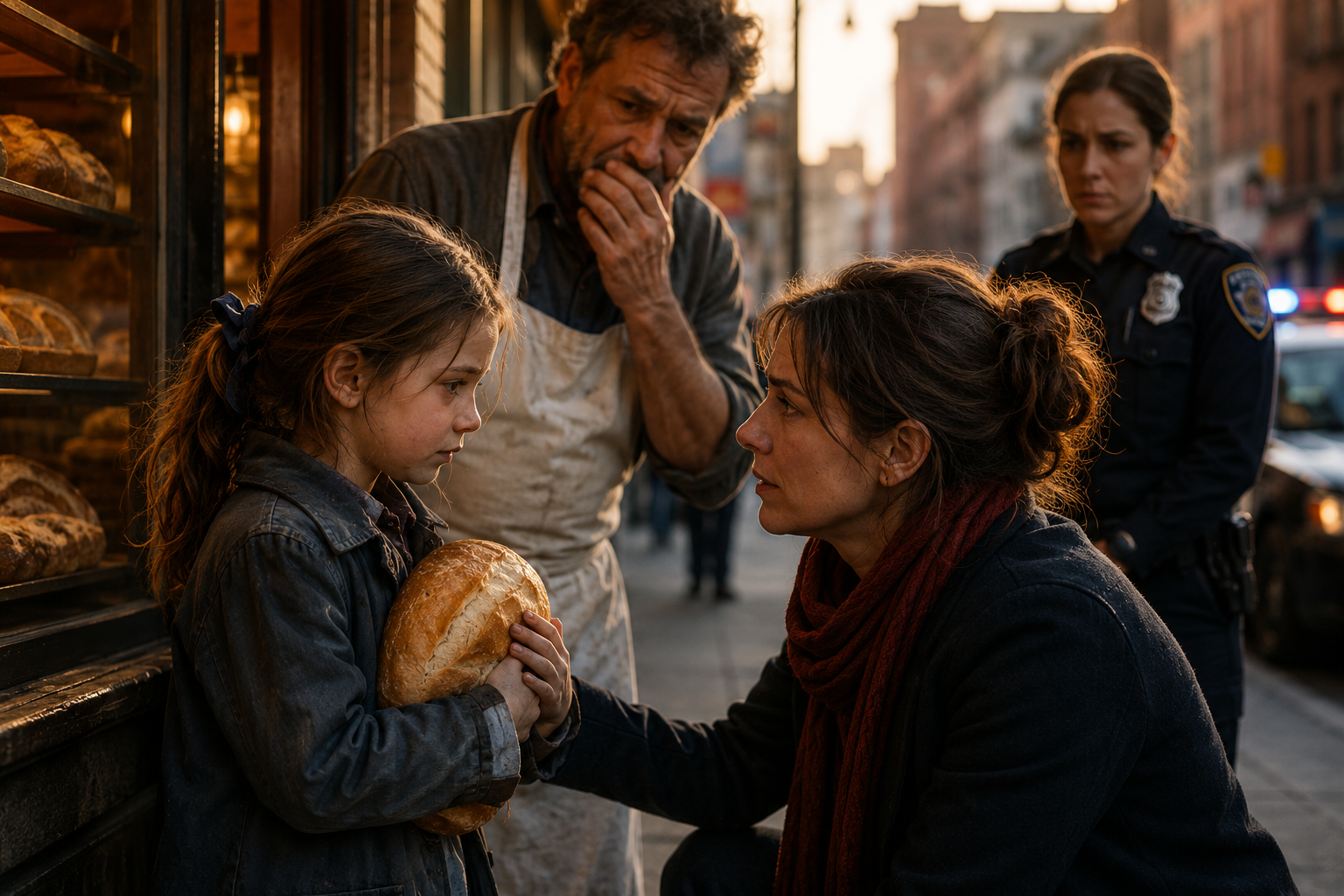
Now her face had gone pale.
“I was only buying fruit,” Denise said.
“No one accused you of anything,” Officer Monroe replied.
But Denise was already shaking.
And guilty people often answer questions no one has asked.
Within minutes, Grace had another officer securing the alley and checking traffic cameras. Clara kept Ellie inside the bakery, where Mr. Porter made hot chocolate with too much cream and placed three untouched pastries in front of her as if food could apologize.
“I’m sorry,” he said quietly.
Ellie did not answer.
She kept looking at the door.
Waiting.
Children should not have to wait for mothers the world has taken from them.
Clara sat beside her.
“Your mom was very brave,” she said.
Ellie’s chin trembled. “She told me brave means doing something even when your hands shake.”
“Your mom is right.”
“My hands are shaking.”
“Then you are being brave too.”
The investigation moved quickly after that, because fear had finally made a mistake.
The traffic camera at the corner had caught the black car. A delivery driver remembered the license plate because the car had blocked his van. Denise Vale, faced with evidence and Officer Monroe’s patient silence, began to speak.
Nora Bennett had discovered that Bellamy House was hiding more than unpaid wages.
The studio’s charity program, the one praised in newspapers for helping struggling single mothers learn sewing skills, was being used to trap women in debt. Fees appeared after training. Rent was deducted from wages. Documents vanished. Anyone who complained was threatened with lawsuits, deportation, or the loss of custody.
Nora had secretly recorded conversations.
She had sewn the tiny camera into a bridal jacket during a fitting.
And that morning, she was supposed to hand the recording to Clara.
But Vincent Bellamy had found out.
By noon, Bellamy House was surrounded by police cars.
Not violently. Not dramatically. Just firmly.
The kind of firmness that tells powerful men the room no longer belongs to them.
Clara stood across the street with Ellie, Officer Monroe beside them.
The little girl had not let go of the loaf.
When Vincent Bellamy stepped out, he was still trying to smile. Even with officers around him, even with cameras turning, even with Denise crying behind him, he smiled as if the world might still choose his version.
Then he saw Ellie.
For one second, the smile disappeared.
That was enough.
Ellie saw it.
Clara saw it.
Officer Monroe saw it too.
“Where is my mom?” Ellie asked.
Her voice was small.
But it crossed the street like a bell.
Vincent looked away.
An officer opened the back door of a second car, and Nora Bennett stepped out wrapped in a gray blanket.
Ellie dropped the bread.
“Mom!”
Nora turned.
The sound that left her was not a word. It was something deeper than language, something only a mother makes when the child she feared lost is suddenly alive in front of her.
They ran to each other.
No one stopped them.
Nora fell to her knees and caught Ellie in both arms. She pressed her face into her daughter’s hair and cried without shame, without restraint, without caring who watched.
“I’m sorry,” Nora kept saying. “I’m so sorry.”
Ellie clung to her. “I got the lady with the red notebook.”
Nora looked up at Clara.
There are thank-yous that can be spoken.
And there are thank-yous that live in a person’s eyes forever.
This was the second kind.
By evening, the story had spread through the city.
Not the false version, where a hungry child stole from a bakery.
The real version.
A child took a loaf of bread because it was the last piece of a normal morning before fear swallowed her world. A mother risked everything to protect women who had been silenced. A baker learned the difference between theft and desperation. A woman with a red notebook finally had the proof no one could ignore.
Bellamy House closed before sunset.
Its windows still held the white dresses, glowing under soft lights like nothing had changed. But everything had changed.
The next morning, Mr. Porter placed a new sign in his bakery window.
No one hungry leaves empty-handed.
There were no cameras when he taped it up.
No speeches.
No applause.
Only Ellie standing beside Nora, holding a warm loaf he had given her for free.
Mr. Porter cleared his throat.
“This one is paid for,” he said.
Ellie looked confused. “By who?”
He nodded toward Clara.
Clara shook her head. “Not me.”
Officer Monroe, standing near the door with two coffees, smiled. “Not me either.”
Mr. Porter looked at Ellie.
“By the courage of a girl who told the truth.”
Ellie hugged the bread to her chest again.
But this time, her hands did not shake.