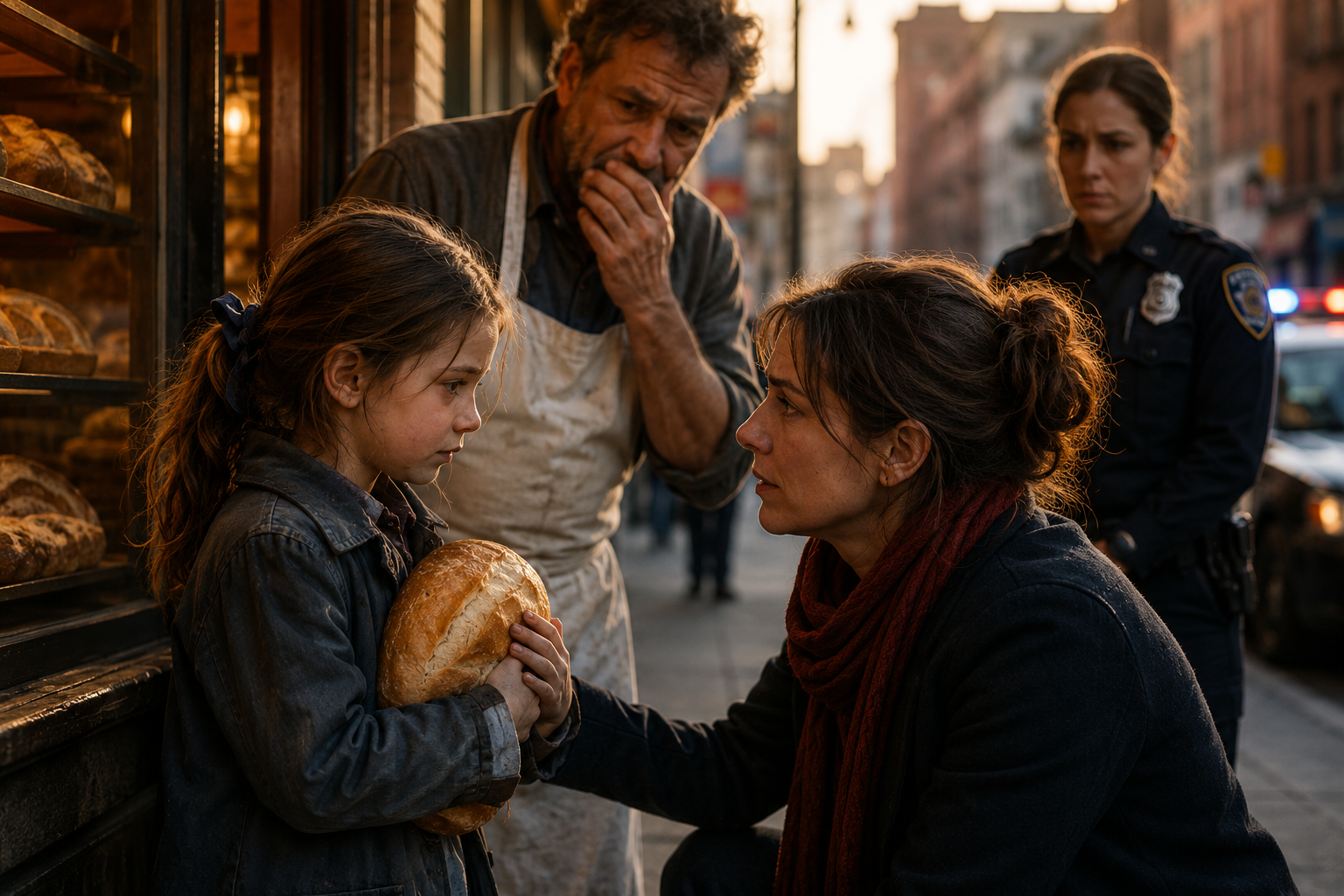
The Girl Who Stole a Loaf of Bread and the Secret No One Expected

The first thing Clara Harlow noticed was not the bread.

It was the way the little girl held it.

Not like a thief protecting stolen goods. Not like a spoiled child clutching something she had decided belonged to her. She held the small loaf against her chest with both hands, fingers trembling around the paper sleeve, her shoulders lifted almost to her ears as if she expected the whole world to strike her at once.

The morning market was already loud.

Vendors called prices over baskets of apples and tomatoes. Metal shutters rattled open. Delivery carts rolled over wet stone. Somewhere near the flower stalls, a woman laughed too loudly into her phone. Steam rose from the bakery window, carrying the warm smell of fresh bread into the cold street.

And in the middle of all that ordinary noise, a child stood frozen.

“Stop right there!” shouted Mr. Porter, the baker.

The girl flinched so hard that Clara felt it in her own chest.

She looked about nine years old. Maybe ten, if hunger had made her smaller than she should have been. Her coat was too thin for the weather, one sleeve torn at the wrist. Her dark hair had been tied back with a blue ribbon that had almost come undone. Her cheeks were red from the cold, but her eyes were not the eyes of a child caught in a silly mistake.

They were the eyes of someone who had already seen too much that morning.

Mr. Porter came around the counter holding a flour-dusted rolling pin, more from habit than threat. He was not a cruel man, Clara knew that. He had once slipped extra rolls into her bag when she was between jobs and pretending not to be. But embarrassment can make decent people loud, and a crowd can make loudness feel like authority.

“She took it,” he said, pointing at the loaf. “I turned around for one second, and she grabbed it.”

People began to stare.

A woman with pearls clicked her tongue. A teenage boy lifted his phone, then slowly lowered it when Clara looked at him. An old man shook his head as if the world had confirmed something he had always suspected.

The little girl tried to speak.

Nothing came out.

Clara stepped forward.

“What is your name?” she asked softly.

The baker frowned. “Miss Harlow, she stole from me.”

“I heard you.” Clara did not take her eyes off the child. “What is your name, sweetheart?”

The girl swallowed. Her lips moved once before sound finally appeared.

“Ellie.”

“Ellie,” Clara repeated, giving the name back gently. “I’m Clara. Are you hungry?”

The child looked down at the bread.

That answer was simple.

But then she shook her head.

Not yes.

Not no.

Something else.

Mr. Porter let out a frustrated breath. “Hungry or not, she cannot just take what she wants.”

“I know,” Clara said. “And we will pay for it.”

“We?” he asked.

Clara reached into her coat pocket and placed a bill on the counter. “For the loaf. And for whatever else she needs.”

That should have ended it.

The crowd should have moved on. The market should have swallowed the little scene back into its morning rhythm. Mr. Porter should have softened, Ellie should have cried, Clara should have walked her somewhere warm.

But Ellie did not move.

Instead, she gripped Clara’s sleeve with one hand and whispered, “Please don’t send me back there.”

The words were so quiet that only Clara heard them.

And everything changed.

Clara lowered herself until her eyes were level with the girl’s.

“Back where?”

Ellie’s gaze darted toward the narrow alley beside the bakery.

The alley was mostly used by delivery men and shopkeepers. It ran behind the market, past old brick walls and metal doors, then opened near the bus stop. At that hour, it should have been empty except for crates, puddles, and the occasional cat looking for scraps.

Clara looked at the alley.

Then back at Ellie.

“What happened there?”

Ellie’s mouth trembled. “They took my mom.”

The market noise seemed to fall away.

Mr. Porter’s expression changed first from anger to confusion, then from confusion to shame. The rolling pin dropped slowly to his side.

Clara remained still.

She had learned long ago that fear runs faster when you chase it. So she did not demand. She did not shake. She did not rush the child into a story her body was not ready to tell.

She only said, “Who took her?”

Ellie tried to answer. Her throat worked, but the words broke apart.

Clara held out one hand. “You’re safe right now.”

The little girl looked at the hand as if safety were something she had forgotten how to recognize. Then, slowly, she placed her cold fingers into Clara’s palm.

“My mom said we had to meet someone,” Ellie whispered. “She said he was going to help us.”

“Who?”

“A man from her work.”

“What is your mother’s name?”

“Nora Bennett.”

Clara knew that name.

Not personally. Not well. But she had seen it printed in small letters on a community notice taped to the library door three weeks earlier.

Missing employment records. Unpaid wages. Workers asking for help.

Nora Bennett had been one of the names.

Clara’s pulse changed.

“What does your mom do?” she asked.

“She sews dresses,” Ellie said. “Fancy ones. The kind in windows.”

“For which shop?”

Ellie pointed across the street.

There, between a florist and a luxury shoe boutique, stood Bellamy House, one of the most expensive bridal studios in the city. Its front windows were full of white silk, pearls, lace, and impossible dreams. Behind the glass, everything looked pure and delicate.

Clara had never liked the place.

Not because of the dresses.

Because of the owner.

Vincent Bellamy was the kind of man who smiled with all his teeth and none of his heart. He chaired charity breakfasts. He donated coats in winter. He put his name on hospital plaques. Every public photo showed him beside flowers, children, or politicians.

But Clara had covered enough local stories to know that money often wore kindness like a costume.

She had once been a journalist before the newspaper closed. Before her mother got sick. Before the world became smaller and rent became larger. Now she wrote freelance pieces when anyone would pay and helped at the community center three afternoons a week.

And recently, women from Bellamy House had been coming to that center.

Quietly.

Ashamed.

Afraid.

They spoke of wages withheld, passports locked in office drawers, contracts changed after signatures, threats wrapped in polite language. They never stayed long. They always looked over their shoulders before leaving.

Nora Bennett had been scheduled to meet Clara that very afternoon.

Clara looked again toward the alley.

“What did your mother tell you before she went in there?” she asked.

Ellie squeezed the loaf so tightly the paper tore.

“She said if anything happened, I should find the woman with the red notebook.”

Clara stopped breathing for half a second.

In her tote bag, under folded flyers and a small umbrella, was a red notebook.

The notebook where she had written the names of the women from Bellamy House.

The notebook Nora Bennett was supposed to help her complete.

Clara stood slowly.

“Mr. Porter,” she said, “call Officer Monroe. Tell her Clara Harlow needs her at the market now.”

The baker blinked. “The police?”

“Not the front desk. Officer Grace Monroe. Tell her it involves Bellamy House.”

At that name, a woman near the fruit stand turned away too quickly.

Clara noticed.

So did Ellie.

The child pressed closer to Clara’s coat.

“Is my mom in trouble?” she whispered.

“No,” Clara said. “But someone else is.”

Officer Grace Monroe arrived seven minutes later.

She came without sirens, without drama, wearing a dark coat over her uniform. She had the kind of face people trusted before they realized why. Calm eyes. Straight posture. A voice that never needed to rise to be heard.

She listened as Clara explained.

Then she crouched in front of Ellie.

“Can you tell me what you saw?”

Ellie nodded, though tears slipped down her cheeks.

“A black car,” she said. “No sign on it. One man had a gray scarf. The other had shiny shoes. My mom said, ‘You promised this would be public.’ Then the man said, ‘You should have stayed quiet.’”

Officer Monroe’s expression did not change.

But her hand tightened around her pen.

“Did they hurt her?”

Ellie shook her head quickly. “They held her arms. She told me to run. I ran, but then I got scared. I didn’t know where to go.”

“And the bread?”

Ellie looked ashamed.

“My mom promised me breakfast after the meeting.”

Mr. Porter turned away.

For the first time that morning, no one in the crowd said anything.

Officer Monroe stood. “Clara, I need the notebook.”

Clara opened her tote bag and pulled it out.

Ellie stared at it.

“That’s it,” she whispered. “That’s what Mom meant.”

Inside the notebook were dates, names, fragments of testimony, copies of messages written down by women too afraid to forward them. It was not enough for a case on its own.

But it was enough to start one.

And then Ellie said something that made everything worse.

“My mom gave me a button.”

Clara frowned. “A button?”

Ellie reached into the pocket of her coat and pulled out a small gold button wrapped in tissue. At first glance, it looked decorative, the kind used on expensive bridal jackets. But Clara turned it over and saw the tiny black dot in the center.

Officer Monroe took it carefully.

“That is not a button,” she said.

“What is it?” asked Mr. Porter.

“A camera.”

The woman by the fruit stand began walking away.

Officer Monroe looked up. “Ma’am. Stay where you are.”

The woman froze.

Her name was Denise Vale. Clara recognized her from Bellamy House advertisements. She managed appointments, greeted wealthy clients, and appeared in social media posts holding champagne flutes beside smiling brides.

Now her face had gone pale.

“I was only buying fruit,” Denise said.

“No one accused you of anything,” Officer Monroe replied.

But Denise was already shaking.

And guilty people often answer questions no one has asked.

Within minutes, Grace had another officer securing the alley and checking traffic cameras. Clara kept Ellie inside the bakery, where Mr. Porter made hot chocolate with too much cream and placed three untouched pastries in front of her as if food could apologize.

“I’m sorry,” he said quietly.

Ellie did not answer.

She kept looking at the door.

Waiting.

Children should not have to wait for mothers the world has taken from them.

Clara sat beside her.

“Your mom was very brave,” she said.

Ellie’s chin trembled. “She told me brave means doing something even when your hands shake.”

“Your mom is right.”

“My hands are shaking.”

“Then you are being brave too.”

The investigation moved quickly after that, because fear had finally made a mistake.

The traffic camera at the corner had caught the black car. A delivery driver remembered the license plate because the car had blocked his van. Denise Vale, faced with evidence and Officer Monroe’s patient silence, began to speak.

Nora Bennett had discovered that Bellamy House was hiding more than unpaid wages.

The studio’s charity program, the one praised in newspapers for helping struggling single mothers learn sewing skills, was being used to trap women in debt. Fees appeared after training. Rent was deducted from wages. Documents vanished. Anyone who complained was threatened with lawsuits, deportation, or the loss of custody.

Nora had secretly recorded conversations.

She had sewn the tiny camera into a bridal jacket during a fitting.

And that morning, she was supposed to hand the recording to Clara.

But Vincent Bellamy had found out.

By noon, Bellamy House was surrounded by police cars.

Not violently. Not dramatically. Just firmly.

The kind of firmness that tells powerful men the room no longer belongs to them.

Clara stood across the street with Ellie, Officer Monroe beside them.

The little girl had not let go of the loaf.

When Vincent Bellamy stepped out, he was still trying to smile. Even with officers around him, even with cameras turning, even with Denise crying behind him, he smiled as if the world might still choose his version.

Then he saw Ellie.

For one second, the smile disappeared.

That was enough.

Ellie saw it.

Clara saw it.

Officer Monroe saw it too.

“Where is my mom?” Ellie asked.

Her voice was small.

But it crossed the street like a bell.

Vincent looked away.

An officer opened the back door of a second car, and Nora Bennett stepped out wrapped in a gray blanket.

Ellie dropped the bread.

“Mom!”

Nora turned.

The sound that left her was not a word. It was something deeper than language, something only a mother makes when the child she feared lost is suddenly alive in front of her.

They ran to each other.

No one stopped them.

Nora fell to her knees and caught Ellie in both arms. She pressed her face into her daughter’s hair and cried without shame, without restraint, without caring who watched.

“I’m sorry,” Nora kept saying. “I’m so sorry.”

Ellie clung to her. “I got the lady with the red notebook.”

Nora looked up at Clara.

There are thank-yous that can be spoken.

And there are thank-yous that live in a person’s eyes forever.

This was the second kind.

By evening, the story had spread through the city.

Not the false version, where a hungry child stole from a bakery.

The real version.

A child took a loaf of bread because it was the last piece of a normal morning before fear swallowed her world. A mother risked everything to protect women who had been silenced. A baker learned the difference between theft and desperation. A woman with a red notebook finally had the proof no one could ignore.

Bellamy House closed before sunset.

Its windows still held the white dresses, glowing under soft lights like nothing had changed. But everything had changed.

The next morning, Mr. Porter placed a new sign in his bakery window.

No one hungry leaves empty-handed.

There were no cameras when he taped it up.

No speeches.

No applause.

Only Ellie standing beside Nora, holding a warm loaf he had given her for free.

Mr. Porter cleared his throat.

“This one is paid for,” he said.

Ellie looked confused. “By who?”

He nodded toward Clara.

Clara shook her head. “Not me.”

Officer Monroe, standing near the door with two coffees, smiled. “Not me either.”

Mr. Porter looked at Ellie.

“By the courage of a girl who told the truth.”

Ellie hugged the bread to her chest again.

But this time, her hands did not shake.

The Girl Who Stole a Loaf of Bread and the Secret No One Expected
A stray cat with knitted ears has finally found a home forever