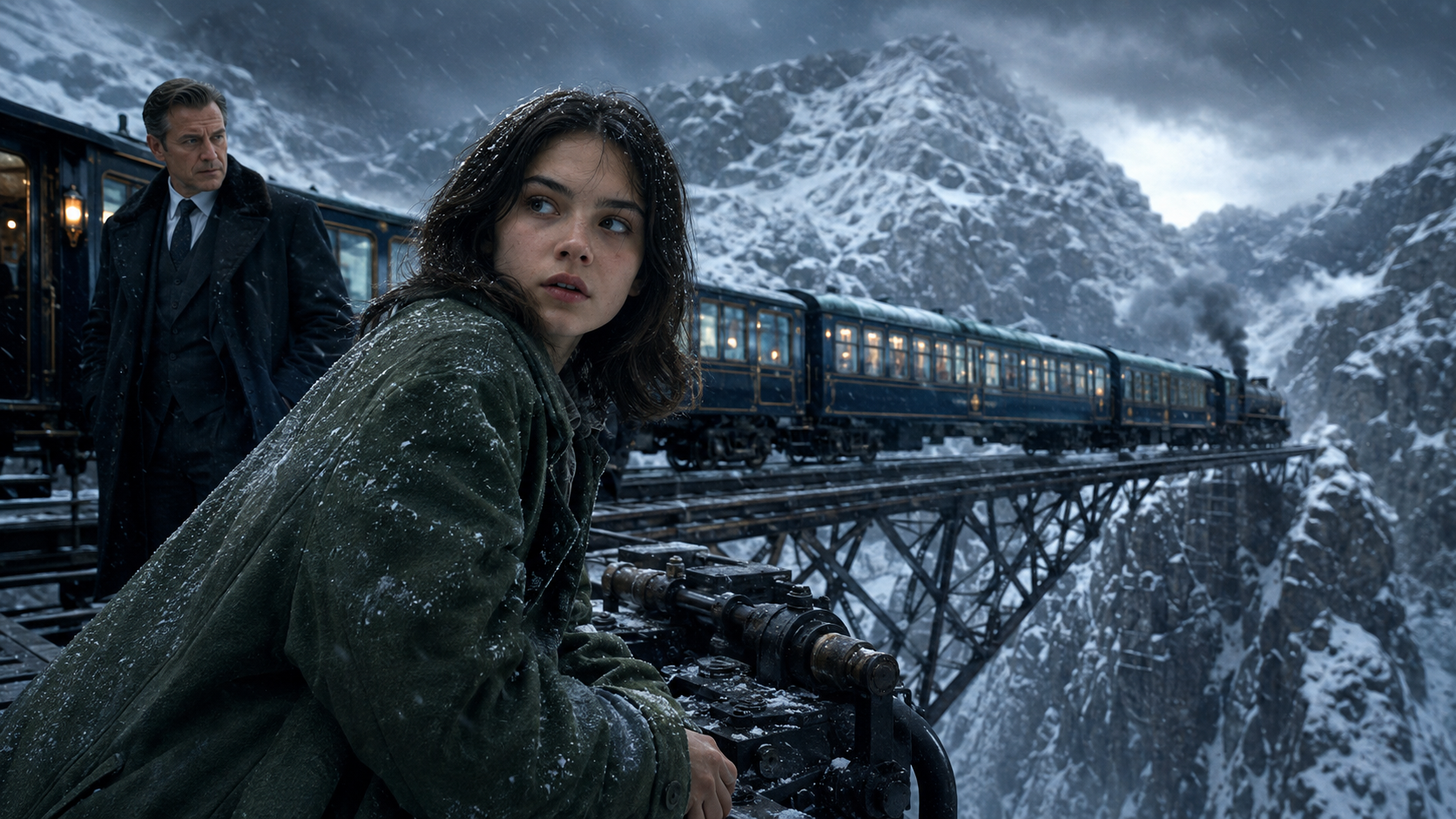
The first warning came as a faint metallic knock beneath the floor.
Almost nobody noticed it.
The guests aboard the Aurora Crown were too busy admiring the mountain scenery, exchanging business cards, and raising crystal glasses to the future of transportation.
The luxury train was climbing through the Arken Pass, carrying politicians, investors, journalists, and industrial leaders toward the World Engineering Summit. Beyond the panoramic windows, snow-covered peaks rose into a darkening sky. Far below, frozen rivers twisted through the valleys like veins of silver.
At the center of the observation carriage stood Victor Hale.
At fifty-one, Victor was one of the most powerful industrialists in Europe. His company manufactured turbines, aircraft engines, medical machinery, and the revolutionary hydrogen system currently pulling the Aurora Crown through the mountains.
The newspapers called it the engine that would change the world.
Victor preferred a simpler description.
“The engine that cannot fail.”
He had said those words less than ten minutes earlier.
Then the metallic knock came again.
This time it was louder.
A glass trembled on a nearby table.
Victor stopped speaking.
The train shuddered beneath his feet.
For one long second, the lights dimmed. The elegant music playing through the carriage speakers faded into silence.
Then the emergency brakes engaged.
Champagne spilled. Chairs slid across the polished floor. Several passengers cried out as the Aurora Crown came to a violent stop.
Outside the windows, there was nothing but snow, darkness, and the narrow steel bridge beneath the train.
The Aurora Crown had stopped halfway across the Skyridge Viaduct.
Victor grabbed the edge of a table and looked toward the conductor.
“What happened?”
The conductor touched the communication device in his ear.
“I don’t know, sir.”
“You don’t know?”
“The engine has entered emergency shutdown.”
“That system was designed to prevent emergency shutdown.”
“Yes, sir.”
“Then restart it.”
The conductor hesitated.
“The control computer is refusing the command.”
A nervous murmur moved through the carriage.
Victor glanced at the passengers. Several journalists were already recording. Investors whispered to one another. A government minister stared through the window at the black ravine below.
Victor forced himself to remain calm.
“Tell the chief engineer to activate the secondary drive.”
The conductor listened to his earpiece again.
His face changed.
“The chief engineer was injured when the train stopped. The medical team is treating him.”
“And the assistant engineer?”
“Locked in the rear control room. The doors have lost power.”
A sharp gust of wind struck the train.
Snow swept across the windows so heavily that the mountains disappeared.
Victor looked at his watch.
The temperature outside was falling rapidly.
“How long will the heating system operate?”
“Approximately forty minutes on emergency power.”
No one spoke after that.
The Aurora Crown was celebrated as the safest train ever built, but safety meant little when hundreds of tons of machinery were stranded on an exposed bridge during a mountain blizzard.
Victor removed his jacket.
“Take me to the engine.”
The conductor started to answer, but a young voice interrupted him.
“The engine isn’t frozen.”
Everyone turned.
A girl stood near the doorway to the service corridor.
She appeared to be thirteen or fourteen years old. Her dark hair had been cut unevenly just below her shoulders. An oversized green coat hung from her thin frame, and melted snow darkened the legs of her worn trousers.
She did not look frightened.
She looked annoyed.
Two security officers rushed toward her.
“How did you get in here?” one demanded.
The girl ignored him and looked directly at Victor.
“Your cooling valve is choking the turbine.”
Victor stared at her.
“What did you say?”
“The knocking started seventeen minutes ago. First every twelve seconds, then every seven. The pressure regulator is trying to compensate, but it can’t.”
One of the investors gave a nervous laugh.
Victor did not.
“How do you know that?”
“Because I listened.”
She tilted her head slightly.
For a moment, the only sounds were the storm and the soft ticking of cooling metal beneath the floor.
“There,” she said.
A dull knock echoed through the train.
“Three seconds between impacts now.”
The conductor looked at Victor.
“Sir, she may be hearing the pressure relay.”
“That is impossible,” Victor said.
The girl folded her arms.
“So is an engine that cannot fail.”
Several passengers exchanged glances.
Victor walked toward her.
“What is your name?”
“Leona Vale.”
“How did you board this train?”
“At the maintenance station.”
“That station was restricted.”
“The fence was easy to climb.”
One of the security officers reached for her arm.
Leona stepped back.
“Don’t touch me.”
Victor studied her dirty boots, the old coat, and the canvas bag hanging from her shoulder.
“You trespassed onto a private train.”
“I needed to speak to you.”
“You could have contacted my office.”
“I tried.”
“Then you should have made an appointment.”
“I sent twenty-three letters.”
Victor’s expression remained cold.
“My staff receives thousands of letters.”
“I know. They returned mine unopened.”
The lights flickered again.
This time they did not immediately recover.
A woman screamed from the far end of the carriage.
The conductor checked his device.
“Emergency power has dropped to seventy percent.”
Leona looked toward the floor.
“You have less than forty minutes.”
The conductor frowned.
“The system says thirty-six.”
“The system is measuring the batteries, not the ice forming around the intake.”
Victor felt irritation rise in him.
“You expect me to believe that a child understands my engine better than the people who built it?”
Leona’s eyes hardened.
“No.”
She took a small metal tool from her pocket.
It was a folding caliper, old and scratched from years of use.
“I expect you to believe the person who taught me.”
She moved toward the engine carriage.
The security officers blocked her path.
Victor looked at the conductor.
“Can she damage the system?”
“The system is already disabled.”
“That was not my question.”
The conductor hesitated.
“With access to the turbine chamber, yes.”
Leona gave a humorless smile.
“You don’t need my help to destroy it. You’ve nearly done that yourselves.”
Victor stepped closer until he stood directly in front of her.
“What do you need?”
“A twelve-millimeter wrench, insulated gloves, a copper pin, and five minutes.”
“And if you are wrong?”
“Then your engineers can continue failing without me.”
Another gust struck the train.
The carriage leaned slightly against the wind.
A child began crying somewhere among the passengers.
Victor glanced at the cameras pointed toward him. Every decision he made would be recorded. Allowing an unknown girl into the engine compartment could destroy his reputation.
Refusing her might destroy far more.
“Give her what she asked for,” he said.
The conductor’s eyes widened.
“Sir?”
“Do it.”
They moved through three darkened carriages toward the front of the train.
Leona walked quickly, using one hand against the wall whenever the Aurora Crown swayed. Victor followed her with the conductor and two security officers.
The temperature dropped with every carriage they crossed.
In the engine room, red emergency lights illuminated a maze of pipes, cables, and steel housings. Steam curled through the air. The turbine vibrated with a low, uneven growl.
Leona stopped inside the doorway.
Her face became completely still.
“What is it?” Victor asked.
“She sounds worse in here.”
“You speak about the engine as though it were alive.”
“All machines speak. Most people are too loud to hear them.”
She placed her canvas bag on the floor and removed her coat. Beneath it, she wore an old gray sweater with several repaired holes along the sleeves.
The conductor handed her the wrench and gloves.
“You cannot remove any pressurized component,” he warned.
“I know.”
“You cannot touch the primary fuel line.”
“I know.”
“You must not disengage the containment seal.”
Leona looked at him.
“Do you want to explain the engine to me, or do you want me to fix it?”
The conductor fell silent.
Leona climbed onto the narrow maintenance platform beside the turbine. She pressed one gloved hand against a pipe and closed her eyes.
The turbine knocked.
She moved her hand.
It knocked again.
“There you are,” she whispered.
Victor watched her remove a protective panel.
Behind it, a cluster of frost-covered valves trembled under pressure.
The conductor stepped forward.
“That section isn’t included in the public schematics.”
“It was included in the original ones,” Leona replied.
She pointed toward a thin metal cylinder.
“The automatic bypass is trapped halfway between open and closed. The computer thinks it’s moving, but the connector is turning without the valve.”
“That connector is titanium,” Victor said.
“It was supposed to be.”
Leona scraped the surface with the edge of her tool. Small silver flakes fell away.
“This is an alloy substitute.”
The conductor stared at it.
“That material becomes brittle below minus twenty degrees.”
“I know.”
“How?”
Leona did not answer.
The train shook violently.
A warning alarm began to sound.
Pressure readings climbed across the control panel.
Leona reached for the valve.
The conductor grabbed her shoulder.
“If you open that manually, the coolant could rupture the chamber.”
“If I don’t, the pressure will rupture it anyway.”
“You cannot know that.”
Leona pointed to the monitor.
“Watch the third number.”
They watched.
The pressure increased.
“Now the sixth.”
The temperature dropped sharply.
“The numbers are fighting each other,” she said. “That means the valve is lying to the computer.”
Victor felt something cold that had nothing to do with the storm.
He had heard those exact words before.
Not from Leona.
From someone else.
Years earlier.
Leona pushed the conductor’s hand away.
“Move.”
She removed a hairpin from behind her ear, straightened it, and held it against the broken connector.
“You asked for a copper pin,” the conductor said.
“This is copper.”
“That cannot hold the pressure.”
“It only has to hold it long enough for me to turn the valve.”
The alarm grew louder.
Victor stepped toward her.
“Leona, stop.”
She looked down at him.
“Do you trust your computer?”
“Yes.”
“It says the valve is open.”
Victor looked at the frost spreading across the pipe.
The valve was clearly not open.
Leona tightened her grip on the wrench.
“Do you trust me?”
Victor had built his empire by trusting almost no one.
Now more than a hundred lives depended on his answer.
“Yes.”
Leona turned the wrench.
The pipe screamed.
Steam exploded through the compartment.
Victor threw an arm over his face. The conductor shouted for everyone to get back.
Leona remained on the platform.
She pulled harder.
The copper pin began to bend.
“Come down!” Victor shouted.
“Not yet!”
The valve moved a fraction.
The turbine’s knocking became a violent hammering.
Leona placed both hands on the wrench.
For a moment, she looked far too small to be standing beside such an enormous machine.
Then she screamed and forced the valve open.
A blast of coolant rushed through the pipe.
The alarm stopped.
The pressure reading fell.
The turbine gave one final shudder and settled into a deep, steady vibration.
The control panels illuminated one after another.
The main lights returned.
A second later, the Aurora Crown’s engine restarted.
The sound traveled through the entire train like distant thunder.
In the passenger carriages, people began applauding.
Leona climbed down from the platform. Her hands were shaking, but her expression remained calm.
Victor stared at the repaired valve.
“You saved the train.”
“I corrected a mistake.”
“You could have been killed.”
“So could everyone else.”
The conductor examined the broken connector.
“Who taught you to diagnose a turbine by sound?”
Leona picked up her old caliper.
Victor finally noticed the letters engraved into its handle.
D.V.
His breath caught.
“Where did you get that?”
Leona slipped the tool into her pocket.
“It belonged to my father.”
Victor’s voice became quieter.
“What was his name?”
She looked directly into his eyes.
“Daniel Vale.”
The engine room seemed to narrow around them.
Victor heard the turbine, the wind, and the distant celebration from the other carriages, but all of it appeared to come from very far away.
Daniel Vale had once been the finest engineer at Hale Dynamics.
He had designed the first functional version of the AuroraDrive turbine. He had worked through nights, holidays, and illnesses, often sleeping beneath his drafting table. He understood machinery with an intuition Victor had never been able to explain.
Daniel had also been stubborn.
He refused shortcuts.
He challenged executives during meetings.
He delayed production whenever he found a weakness, no matter how much money the delay might cost.
Nine years earlier, shortly before the first public demonstration of the AuroraDrive, Daniel had discovered a problem with the cold-weather bypass valve.
He demanded that the launch be postponed.
Victor refused.
The company was close to collapse. Investors were losing patience. Competitors were preparing similar technology.
Daniel threatened to report the defect to the safety commission.
Two days later, Victor dismissed him for violating company policy.
The official story claimed Daniel had attempted to sabotage the project after being denied a promotion.
Victor had allowed that story to spread.
Within a year, Daniel Vale had disappeared from the engineering world.
Victor had never seen him again.
“Your father is Daniel Vale?” he asked.
“Was.”
Victor swallowed.
“When did he die?”
“Seven months ago.”
“How?”
“His lungs were damaged in a factory fire. He survived for three years.”
Victor struggled to speak.
“I didn’t know.”
“You never asked.”
Leona took her canvas bag and pulled out a thick notebook wrapped in cloth.
She placed it on a metal table.
“My father kept every original drawing. Every calculation. Every test result.”
Victor did not touch it.
“He told me you would deny everything.”
“I am not denying it.”
“You haven’t heard everything yet.”
Leona reached into the bag again and removed a small voice recorder.
“My father recorded your last meeting.”
Victor stared at the device.
The conductor quietly stepped away.
Leona pressed the button.
Static filled the engine room.
Then Daniel’s voice emerged from the tiny speaker.
“The valve will fail in extreme cold, Victor.”
Victor heard his own younger voice answer.
“We replace it after the demonstration.”
“You could kill someone.”
“The demonstration lasts twelve minutes.”
“A machine does not care about your schedule.”
“The investors do.”
“Then tell them the truth.”
“I am trying to save this company.”
“No. You are trying to save your name.”
The recording ended.
Leona placed the device beside the notebook.
Victor could not look at her.
He remembered the meeting clearly now.
Daniel had stood across from him, exhausted and furious. Victor had believed that one successful demonstration would provide enough money to correct every defect.
The demonstration had succeeded.
The company had survived.
Victor became famous.
And once success arrived, the temporary compromise became permanent.
“Why did you come here?” he asked.
“My father wanted the truth made public.”
“You could have sent the recording to a newspaper.”
“I did.”
“What happened?”
“They wanted proof that the voice was yours. They wanted company documents. They wanted lawyers. They wanted interviews with my father.”
Her voice tightened.
“He was already dead.”
Victor looked at the notebook.
“So you climbed onto my train.”
“I heard you would be speaking at the summit.”
“You planned to confront me in front of the press.”
“Yes.”
“And when the engine failed?”
“I almost stayed hidden.”
“Why didn’t you?”
Leona looked at the turbine.
“Because the passengers didn’t build the defective valve.”
Victor closed his eyes.
A child he had never met had shown more responsibility in five minutes than he had shown in nine years.
The train began moving.
Slowly at first, then with growing confidence, the Aurora Crown continued across the bridge.
When they returned to the observation carriage, the passengers stood and applauded Leona.
She seemed uncomfortable with the attention. She put her oversized coat back on and moved toward an empty seat near the window.
Victor followed her.
A waiter offered her champagne without thinking.
Leona stared at the glass.
Victor took it and handed it back.
“Bring her something warm to eat.”
“I didn’t come for food,” she said.
“I know.”
The waiter returned with soup, bread, and tea.
Leona looked at the meal for several seconds before quietly picking up the spoon.
Victor sat across from her.
“What happened to your mother?”
“She works at a textile factory.”
“Does she know you are here?”
“No.”
“She must be terrified.”
“She thinks I’m staying with my aunt.”
Victor almost smiled.
“Your father would have called that a poorly designed plan.”
“He would have called it an efficient use of available information.”
That time, Victor did smile.
It disappeared quickly.
“The summit begins in one hour,” he said.
“I know.”
“The hall will be full of cameras.”
“I know that too.”
“My company could collapse after this becomes public.”
Leona tore a piece of bread.
“Is that supposed to frighten me?”
“No.”
“Good.”
“I can compensate your family.”
She stopped eating.
“I didn’t come to sell his name back to you.”
“I didn’t mean—”
“You did.”
Her eyes were not angry now.
That was worse.
They were disappointed.
Victor lowered his voice.
“What do you want from me?”
“The truth.”
“In private?”
“In front of everyone.”
Victor looked around the carriage.
The investors who had praised him earlier were watching from a distance. His advisers whispered urgently near the door. One of them held up a phone filled with messages.
The train incident was already spreading through the media.
Victor knew what his board would tell him to do.
Question the girl’s identity.
Challenge the recording.
Hide behind lawyers.
Blame a supplier for the defective alloy.
Announce an investigation and quietly allow it to disappear.
That was how powerful institutions survived.
For the first time in his career, Victor wondered whether survival was always worth the price.
When the Aurora Crown arrived at the summit station, hundreds of people were waiting.
Cameras flashed.
Reporters shouted questions about the engine failure.
Victor stepped onto the platform first.
His advisers surrounded him.
“Do not discuss the defect,” his legal director whispered.
“The official explanation is temporary sensor interference.”
Victor looked back.
Leona stood in the doorway holding her father’s notebook.
“She repaired the train,” he said.
“We will thank her privately.”
“No.”
“Victor, anything you say now could be used in criminal proceedings.”
“I know.”
“Then say nothing.”
Victor looked toward the enormous summit hall.
A banner above the entrance displayed his photograph beside the words THE MAN WHO BUILT THE FUTURE.
He had spent decades building that name.
Daniel Vale had spent nine years buried beneath it.
Victor walked into the hall.
Leona followed.
The audience rose as he entered. Applause rolled through the building. A presenter welcomed him to the stage and invited him to introduce the next generation of the AuroraDrive.
Victor stood behind the microphone.
The prepared speech waited on a screen in front of him.
He did not read it.
“The engine bringing us here failed today,” he said.
The hall became quiet.
“My company will tell you that a sensor malfunctioned. That explanation is incomplete.”
His legal director lowered his head.
Victor continued.
“The engine failed because a component became brittle in extreme cold. Hale Dynamics knew about the risk nine years ago.”
Voices moved through the audience.
Cameras turned toward him.
“A brilliant engineer discovered the defect. He asked me to delay the launch. I refused.”
Victor looked at Leona.
“I took credit for his work. When he challenged me, I destroyed his reputation to protect my company and myself.”
The audience was completely silent now.
“His name was Daniel Vale.”
Victor stepped away from the microphone.
He extended his hand toward Leona.
She did not move at first.
Then she climbed the steps and joined him.
Victor lowered the microphone so she could reach it.
Leona opened her father’s notebook.
“My father wrote something on the final page,” she said. “He wrote that every machine contains the choices of the people who built it. Good choices can carry strangers safely through a storm. Bad choices can remain hidden for years, waiting for the cold.”
She closed the notebook.
“He also wrote that the truth is like pressure inside a sealed pipe. You can ignore it, but you cannot make it disappear.”
No one applauded.
Not yet.
They were listening too carefully.
Victor returned to the microphone.
“Effective immediately, Hale Dynamics will release the original AuroraDrive patents to an independent engineering trust. Every train using the system will be inspected. The families of affected workers will receive compensation, and all records connected to Daniel Vale’s dismissal will be made public.”
His advisers stared at him in disbelief.
“I will resign as chief executive and cooperate with any investigation that follows.”
A reporter shouted from the front row.
“Mr. Hale, are you admitting criminal negligence?”
Victor looked at Leona.
“Yes.”
The answer moved through the hall like an explosion.
Some people shouted questions. Others rushed toward the exits to make phone calls.
Leona remained beside Victor.
“You’re going to lose everything,” she said.
“Not everything.”
“What will you have left?”
Victor glanced at the notebook in her hands.
“The chance to stop lying.”
For the first time since she boarded the train, Leona’s expression softened.
Six months later, Hale Dynamics no longer belonged to Victor.
The board had removed him within twenty-four hours. Government investigations followed. Several executives resigned. The company’s value fell, recovered, and then changed direction under new leadership.
Victor sold his private aircraft, his villas, and most of his art collection.
Part of the money went to the families of factory workers.
The rest established the Daniel Vale Institute for Mechanical Safety in a converted railway depot near Leona’s hometown.
Leona refused every private school Victor offered.
She accepted an apprenticeship at the institute instead.
On her first morning, she stood beside a restored AuroraDrive turbine while a group of young engineering students adjusted its valves.
Victor entered carrying two cups of tea.
“You’re late,” Leona said.
“I no longer own a helicopter.”
“That sounds inconvenient.”
“It is.”
He handed her a cup.
The turbine began to vibrate.
Leona tilted her head.
Victor watched her listen.
“What does it say?” he asked.
She walked toward the cooling assembly and tightened a loose connector.
The vibration disappeared.
“That someone forgot to check their work.”
Victor looked toward the embarrassed students.
“Anything else?”
Leona placed her father’s old caliper in her pocket.
“Yes.”
“What?”
She smiled faintly.
“It says the truth sounds better when nobody is trying to silence it.”
Outside, a train passed the depot and sounded its horn.
Leona watched it disappear beyond the hills.
Then she turned back to the engine, picked up her wrench, and continued the work her father had begun.

