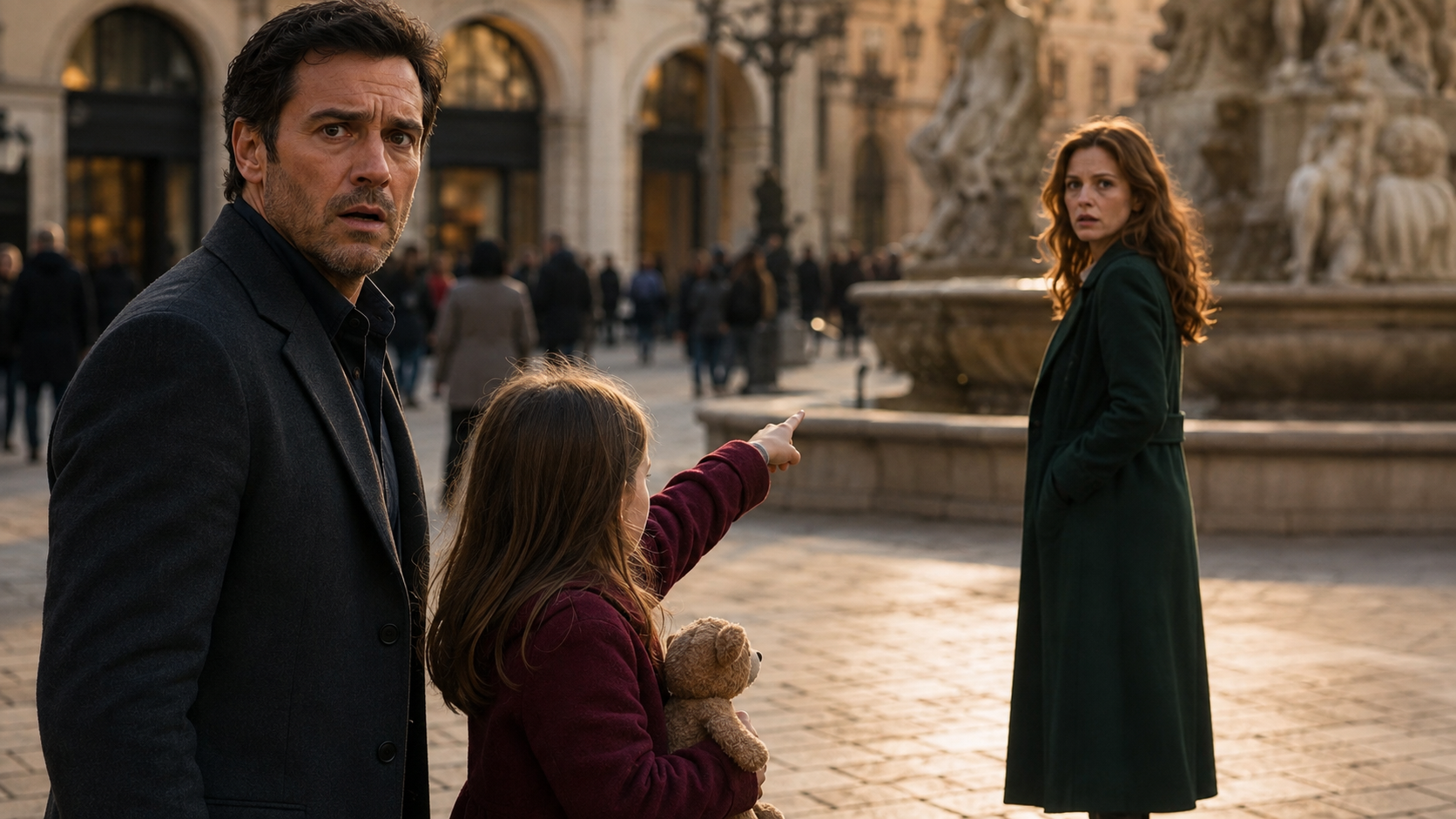
THE GIRL POINTED TO A WOMAN WITH HIS DEAD WIFE’S FACE — THEN HE LEARNED WHY THEY LOOKED EXACTLY ALIKE

Five years after burying his wife, Julian Cross had finally learned how to walk past the places where she still existed.

He could pass the bakery where Amelia used to buy cinnamon rolls on Sunday mornings without stopping.

He could drive past the small brick cinema where they had kissed for the first time.

He could hear the song from their wedding playing in a restaurant and continue eating.

None of those things meant he had forgotten her.

They only meant grief had become quieter.

That Saturday afternoon, Julian was crossing the central plaza after leaving a meeting when a little girl stepped directly into his path.

She looked about eight.

Dark red coat. Black boots. Brown hair tied with a silver ribbon.

In one hand she carried a small paper bag. In the other she held the hand of a teddy bear so old that one of its ears had been repaired with blue thread.

Julian moved to the side.

The girl moved with him.

He stopped.

So did she.

“Can I help you?”

She stared at his face with the uncomfortable seriousness children sometimes had when adults expected them to smile.

Then her attention dropped to his chest.

Julian followed her gaze.

A thin silver chain disappeared beneath his shirt.

He wore it every day.

Hanging from it was Amelia’s wedding ring.

The girl pointed.

“Where did you get that?”

Julian instinctively covered the ring with his hand.

“Why?”

“My mom has one like it.”

Something tightened behind his ribs.

It was ridiculous.

Thousands of wedding rings looked alike.

Probably millions.

He forced a polite smile.

“I’m sure she does.”

“No.”

The girl frowned.

“Exactly like that.”

Before Julian could answer, she suddenly looked past him.

Her entire face changed.

“There she is.”

Julian barely listened.

He was already checking his watch.

Then the girl said, “Mom!”

Julian turned.

Across the plaza, beside an old stone fountain, stood a woman in a dark green coat.

For one second Julian understood nothing.

His eyes recorded details his mind refused to assemble.

Chestnut hair.

Pale skin.

A familiar tilt of the head.

A narrow face.

The tiny crease beside the left eyebrow.

Hands held nervously together.

Then the woman turned fully toward him.

Julian stopped breathing.

His briefcase slipped from his fingers and hit the pavement.

A folder opened.

Papers scattered across the square.

He didn’t notice.

The woman beside the fountain had Amelia’s face.

Not a resemblance.

Not the vague similarity of strangers.

Her face.

The same eyes.

The same mouth.

The same small curve at the end of her nose.

Julian heard the fountain.

Children laughing somewhere behind him.

A bicycle bell.

A bus changing gears.

Then all of it seemed to retreat behind a wall.

The woman stared at him.

Her expression changed from confusion to alarm.

The little girl ran toward her.

“Mom!”

The woman caught the child by the shoulders.

Julian remained where he was.

Five years earlier, he had identified Amelia’s body.

Five years earlier, he had stood in a cemetery while rain collected on black umbrellas.

Five years earlier, he had watched a coffin disappear beneath flowers and earth.

He had signed papers.

Chosen a headstone.

Packed away her clothes.

Sold the car she had loved.

Slept on only one side of their bed for almost a year because lying on hers felt like trespassing.

And now she was standing thirty yards away.

Older.

Different clothes.

A child calling her Mom.

But alive.

Julian began walking.

The woman noticed.

She pulled the girl behind her.

Julian walked faster.

“Amelia.”

The woman stiffened.

He crossed the last few yards.

“Amelia.”

Her eyes widened.

“I think you have the wrong person.”

Her voice almost knocked him down.

It wasn’t merely similar.

It carried the same low softness, the same faint rasp Amelia had when nervous.

Julian stared at her.

“Don’t.”

The woman glanced around.

“Excuse me?”

“Whatever this is, don’t do that.”

“Do what?”

“Tell me you’re someone else.”

Fear entered her expression.

“I am someone else.”

Julian laughed once, but no humor came with it.

He reached beneath his collar and pulled out the chain.

Amelia’s ring caught the afternoon light.

The woman stared at it.

Then she slowly lifted her own hand to her throat.

Beneath her green coat was another silver chain.

She drew it out.

A ring hung from it.

Not identical to Amelia’s.

Older.

Thinner.

Engraved along the edge with tiny leaves.

Julian knew that ring.

He had seen it in Amelia’s jewelry box.

She had called it her mother’s ring.

But it had disappeared shortly before Amelia died.

Julian’s voice became barely audible.

“Where did you get that?”

The woman looked at the ring.

“My mother left it to me.”

“No.”

“Yes.”

“That belonged to my wife.”

The little girl peeked around her mother.

“Mom?”

“It’s okay, Sophie.”

The woman extended an arm protectively across the child.

Julian stared at her.

“What’s your name?”

“Nora.”

“Nora what?”

“Nora Bell.”

Julian shook his head.

“You’re Amelia Cross.”

“No.”

“You are.”

“I have never heard that name.”

Something in the way she said it made him stop.

There was no recognition.

No guilt.

No performance that he could detect.

Only fear.

And something else.

Curiosity.

Julian slowly took out his phone.

His fingers trembled as he found a photograph.

It had been taken seven years earlier on the coast.

Amelia stood barefoot on wet sand, laughing into the wind.

He held the screen toward Nora.

Nora looked.

The color disappeared from her face.

Sophie came closer.

“Mom, that’s you.”

Nora didn’t answer.

The photograph seemed to pull her forward.

She took Julian’s phone without asking.

She enlarged the image.

Touched the screen.

Looked at Julian.

“Who is she?”

“My wife.”

“When was this taken?”

“Seven years ago.”

Nora swallowed.

“And where is she now?”

Julian looked into a face he had once known better than his own.

“She died five years ago.”

Nora stared at him.

Sophie reached for her mother’s hand.

Julian continued.

“Her name was Amelia. She was thirty-three. She taught art history. She hated olives, loved old houses, couldn’t sleep without opening a window, and sang badly when she cooked.”

Nora’s eyes filled with tears.

Julian noticed.

“Why are you crying?”

“I don’t know.”

He pulled up another photograph.

Their wedding.

Another.

Amelia asleep on a sofa with a book over her face.

Another.

Amelia painting their kitchen cabinets.

Another.

Her thirty-first birthday.

Nora looked at every photograph.

Her hand began shaking.

Finally she returned the phone.

“I have to go.”

Julian stepped forward.

“You can’t just leave.”

“I don’t know you.”

“But you knew her.”

“I told you—”

“Look at yourself!”

Sophie flinched.

Julian immediately lowered his voice.

“I’m sorry.”

Nora held her daughter close.

Julian looked from the frightened child to the woman with his dead wife’s face.

Then he asked the only question that made sense.

“When were you born?”

Nora hesitated.

“October nineteenth.”

Julian felt his stomach drop.

Amelia’s birthday.

Same day.

Same year.

“Where?”

“I don’t know.”

“What do you mean?”

“I was adopted.”

Silence settled between them.

Nora looked at Julian.

And Julian watched the moment she understood it too.


They went to a café across the plaza.

Sophie sat between them drinking hot chocolate while Julian and Nora tried not to stare at each other.

It was impossible.

Every tiny movement disturbed him.

The way Nora wrapped both hands around her cup.

Amelia had done that.

The way she pushed loose hair behind her right ear.

Amelia had done that too.

But other details were wrong.

Nora drank coffee black.

Amelia had practically drowned hers in milk.

Nora wrote with her left hand.

Amelia had been right-handed.

Nora had a small scar beneath her chin.

Amelia hadn’t.

They weren’t the same woman.

Julian slowly began to understand that.

Which left an explanation almost as impossible.

“Tell me about the adoption,” he said.

Nora glanced at Sophie.

“My parents never hid it from me. They adopted me when I was three months old.”

“From where?”

“A private agency called St. Catherine Family Services.”

Julian stared at her.

Nora noticed.

“What?”

“Amelia was adopted through St. Catherine.”

The cup stopped halfway to her mouth.

“Are you certain?”

“I helped her look for her biological family.”

Nora set the coffee down.

“When?”

“About six months before she died.”

Sophie looked between them.

“Mom, did you have a sister?”

Nora didn’t answer immediately.

“I don’t know, sweetheart.”

Julian did.

Or at least he suddenly believed he did.

Amelia and Nora had been born on the same day.

Adopted as infants.

Through the same agency.

They had the same face.

There was only one realistic explanation.

“You’re twins.”

Nora whispered, “Don’t.”

“You know that.”

“I don’t know anything.”

“Look at the photographs.”

“People can look alike.”

“Not like this.”

Nora stood so quickly her chair scraped across the floor.

Several customers looked over.

“I can’t do this.”

Julian stood too.

“Then do a DNA test.”

She stared at him.

“You meet me in a plaza and within twenty minutes you want my DNA?”

“I buried someone with your face.”

The words silenced both of them.

Julian immediately regretted their cruelty.

But he couldn’t take them back.

Nora sat down again.

For a while neither spoke.

Finally she said, “My mother kept a box.”

“What box?”

“Things from before the adoption. At least that’s what I think they were. She wouldn’t talk about it.”

“Your adoptive mother?”

“Yes.”

“Is she alive?”

Nora shook her head.

“She died three years ago.”

Julian looked at the ring around Nora’s neck.

“Was that inside?”

“Yes.”

“Anything else?”

Nora hesitated.

“A photograph.”

Julian’s pulse accelerated.

“Of what?”

“Two babies.”


Two hours later Julian stood inside Nora Bell’s house.

He had expected to feel uncomfortable.

Instead he felt as though he had stepped into a life that had developed beside his own without ever touching it.

Family photographs covered the hallway.

Nora holding newborn Sophie.

Nora at a lake.

Nora beside an elderly couple Julian assumed were her parents.

Christmas mornings.

School photographs.

Birthday cakes.

Evidence of decades Amelia had never known existed.

Sophie disappeared upstairs.

Nora returned carrying a rectangular wooden box.

She placed it on the dining table.

“I haven’t opened this since my mother died.”

Julian said nothing.

Nora lifted the lid.

Inside were several letters, an old hospital bracelet, the ring’s original velvet pouch and a black-and-white photograph.

She handed him the photograph.

Two newborn babies slept side by side.

Both wore identical knitted caps.

Behind them, written in faded ink, were four words.

Baby A and Baby B.

Julian’s heart hammered.

“Anything on the back?”

Nora turned it over.

There was a date.

October 19.

The year of Amelia’s birth.

And initials.

E.R.

“Who is E.R.?” Nora asked.

Julian already knew.

“Eleanor Rhodes.”

“Who?”

“Amelia’s biological mother.”

Nora sat down.

“No.”

Julian found an old photograph stored on his phone.

It showed Amelia at twenty-seven beside Eleanor Rhodes, a fragile woman with silver hair.

They had met her only once.

Eleanor had cried through almost the entire conversation.

She had told Amelia that giving her up had been the greatest regret of her life.

But she had never mentioned another baby.

Never mentioned a twin.

Nora stared at Eleanor’s photograph.

“She looks like Sophie.”

Julian looked at the child smiling in a photograph on the wall.

She did.

Not dramatically.

But enough.

Nora opened one of the letters.

Her adoptive mother’s handwriting covered three pages.

She read silently at first.

Then stopped.

“What?”

Nora pushed the letter toward him.

Julian read.

The letter was an apology.

Nora’s mother had written it shortly before dying but apparently never found the courage to give it to her daughter.

She described how she and her husband had been told the biological mother had requested the twins be separated.

They had believed it.

Years later they discovered that wasn’t true.

St. Catherine Family Services had separated twins deliberately because two adoption fees were worth more than one.

Some children had been placed hundreds of miles apart.

Records had been altered.

Birth certificates had been rewritten.

And adoptive parents had been warned that attempts to contact biological families could threaten the legality of their adoptions.

Nora covered her mouth.

Julian continued reading.

One sentence made him stop.

A woman from St. Catherine had contacted Nora’s parents years later and asked whether Nora had ever attempted to find a sister.

Her parents had said no.

The woman told them to keep it that way.

“What year was this?” Julian asked.

Nora checked.

“Five years ago.”

Julian looked up.

“When five years ago?”

Nora read the date.

Three weeks before Amelia died.


Amelia had died in a house fire.

That was what everyone believed.

She had gone to the abandoned family home of Eleanor Rhodes after Eleanor’s death.

Julian had been in another city for work.

At 11:40 that night, a neighbor reported flames.

By morning, the old house was gone.

Investigators blamed damaged electrical wiring.

Amelia’s body was found upstairs.

The case had been closed.

Julian had never questioned it.

Until now.

Nora saw the change in his face.

“What happened?”

“My wife died three weeks after someone contacted your parents about a sister.”

Nora’s expression tightened.

“That doesn’t mean—”

“Amelia was searching.”

“For me?”

“I don’t know.”

Julian began pacing.

“She became obsessed with finding out why Eleanor had given her up. She kept saying there were gaps in the story.”

“What gaps?”

“Eleanor claimed she had signed papers for one child.”

Nora went still.

Julian remembered the night perfectly.

Amelia had been standing in their kitchen with documents covering the table.

“She said the paperwork didn’t make sense. One set of signatures. One medical record. But references to two identification numbers.”

Nora whispered, “She knew.”

“Maybe.”

“And she never told you?”

“She didn’t tell me everything.”

Julian hated admitting it.

During Amelia’s final months, they had argued constantly.

He thought the adoption investigation was consuming her.

She thought he didn’t understand.

He had asked her to stop.

She had accused him of wanting a convenient version of the truth.

Their last telephone conversation had ended badly.

Julian had carried that guilt for five years.

Now another possibility entered the room.

Maybe Amelia hadn’t been chasing ghosts.

Maybe she had been close to finding Nora.

“What was she doing at Eleanor’s house?” Nora asked.

“Looking for records.”

“Did she find anything?”

“The police said most of the upstairs was destroyed.”

“Most?”

Julian stared at her.

There had been one thing recovered.

A metal document box.

At the time he had been unable to open it.

He had taken it home and put it in the basement with the rest of Amelia’s belongings.

He hadn’t looked at it since.


They opened the box shortly after midnight.

Nora stood in Julian’s basement while Sophie slept upstairs in the guest bedroom.

Julian found the metal case beneath old photographs and moving cartons.

Smoke stains still covered one side.

Inside were charred documents, newspaper clippings and a small voice recorder wrapped in plastic.

Julian stared at it.

He had never seen the recorder before.

Nora pressed the power button.

Nothing.

“The battery’s dead,” she said.

Julian found a cable.

A small charging light appeared.

Neither spoke.

Ten minutes later Nora tried again.

The screen illuminated.

There were eleven recordings.

Most were interviews between Amelia and Eleanor.

Julian heard his wife’s voice for the first time in years.

His knees weakened.

Nora noticed.

“Should we stop?”

“No.”

“You don’t have to—”

“Play it.”

Nora selected the final recording.

Static filled the room.

Then Amelia spoke.

“If you’re hearing this, I’ve finally found the missing file.”

Julian gripped the edge of the workbench.

Amelia continued.

“Mom didn’t give away two daughters. She was told the second baby died.”

Nora stopped breathing.

“The agency sold both adoptions separately. They lied to her. They lied to both families.”

Paper rustled in the recording.

“I have names. I have dates. And I know where my sister was sent.”

Nora covered her mouth.

Amelia’s voice became softer.

“Her name is Nora Bell.”

Nora began crying.

Julian closed his eyes.

Five years late, one sister had finally spoken the other’s name.

The recording continued.

“I found her address. She has a daughter. I haven’t contacted her yet because I don’t know how you walk into someone’s life and tell them half their identity was stolen.”

A long silence followed.

Then Amelia laughed nervously.

“I’ve practiced it twenty times.”

Her voice changed, playfully formal.

“Hello, Nora. I’m Amelia. Apparently we shared a womb and nobody thought that information might be useful.”

Nora laughed through her tears.

Julian did too.

For one impossible second Amelia seemed to be downstairs with them.

Then her tone became serious.

“Someone called me tonight.”

Julian’s smile disappeared.

“He knew I’d requested the old St. Catherine files. He told me Eleanor’s house wasn’t mine and that some histories should stay buried.”

Nora looked at Julian.

Amelia continued.

“I called the police. They said unless he threatened me directly there isn’t much they can do. I’m going to the house anyway. The original intake ledger may still be there.”

The recording ended.

Julian stared at the device.

Nora whispered, “She didn’t die in an accident.”

“We don’t know that.”

“You know it.”

He did.

And that terrified him.


Detective Mara Chen had retired eighteen months earlier.

She had investigated Amelia’s death.

Julian found her the following morning.

When he told her about Nora, she thought he was joking.

Then Nora walked into the room.

Mara’s expression changed.

“My God.”

“We need the case reopened,” Julian said.

Mara looked at Nora for a long time.

Then at the recording.

Then at photographs of the documents.

“You need to take this to the police.”

“We will.”

“But?”

Julian leaned closer.

“You didn’t believe the fire was accidental, did you?”

Mara didn’t answer.

That was enough.

“What happened?”

She exhaled.

“The electrical report never satisfied me.”

“Why?”

“The fire started in two locations.”

Julian felt cold.

“Why wasn’t I told?”

“Because both ignition points were near damaged wiring. The fire marshal couldn’t rule out coincidence.”

“You didn’t believe it.”

“No.”

“Who did you suspect?”

Mara looked at Nora.

“St. Catherine Family Services closed twenty-two years ago. But its director didn’t disappear.”

“Who was the director?”

“Dr. Malcolm Voss.”

Nora frowned.

“I know that name.”

Julian turned.

“From where?”

“My mother.”

She searched through photographs of the letters on her phone.

Then found one.

Nora enlarged the bottom of a page.

Her adoptive mother had written:

Dr. Voss told us that asking questions could destroy everything. We believed him.

Mara nodded.

“Voss ran the medical side of the adoption network. He later founded a private fertility clinic.”

“Is he still alive?”

“Yes.”

“Where?”

Mara’s expression darkened.

“About ten miles from here.”


They didn’t go to Voss.

Not immediately.

They gave everything to the police.

The old investigation was reopened.

Reporters discovered the story within forty-eight hours.

Then more families began calling.

One twin separated from a brother.

Three women whose birth records contained impossible dates.

A man whose mother had supposedly signed adoption papers six months after she died.

The story expanded far beyond Amelia.

St. Catherine hadn’t been an adoption agency.

It had been a marketplace disguised as charity.

For nearly sixteen years, desperate young mothers had been deceived.

Some were told their babies had died.

Some were told adoption was temporary.

Some had signatures forged.

Children were placed according to what wealthy applicants were willing to pay.

Twins were especially profitable when separated.

Dr. Malcolm Voss denied everything.

His attorneys called the allegations fantasies built from incomplete records.

Then someone broke into Nora’s house.

Nothing valuable was taken.

The television remained.

Jewelry remained.

Cash remained.

Only the wooden box disappeared.

That night Julian moved Nora and Sophie into his house.

At two in the morning he found Nora sitting in the kitchen.

“You should sleep.”

“So should you.”

He sat opposite her.

For a while they listened to the refrigerator hum.

Nora looked around the kitchen.

“Was this hers?”

“What?”

“The house.”

“Ours.”

She nodded.

“It’s strange.”

“For me too.”

“No, I mean… being here.”

She touched the edge of the table.

“She probably touched this.”

“Every day.”

Nora withdrew her hand.

Julian understood.

“People keep looking at you like you’re her.”

“You do.”

“I know.”

“Does it hurt?”

“Yes.”

Nora absorbed the answer.

“I’m sorry.”

“Don’t be.”

He looked at her carefully.

“You’re not Amelia.”

It was the first time he had said it and truly meant it.

Nora’s eyes lifted.

“You laugh differently.”

She smiled faintly.

“That’s your evidence?”

“You hate tea.”

“Tea tastes like somebody washed leaves in warm water.”

Julian laughed.

“Amelia owned twenty-seven kinds.”

“She sounds exhausting.”

“She was.”

Nora’s smile faded.

“I wish I’d known her.”

Julian looked toward the dark window.

“So do I.”

Then Nora said, “Tell me something she wouldn’t put in a photograph.”

Julian thought.

“She couldn’t whisper.”

“What?”

“She believed she could, but her whisper was basically talking with more air.”

Nora laughed.

“Another.”

“She was terrified of moths.”

“Seriously?”

“She once made me evacuate a hotel room because one was sitting above the door.”

Nora laughed harder.

“Another.”

So Julian told her.

Until sunrise.

Not about the woman in the coffin.

About Amelia.

The living one.

The ridiculous one.

The one who burned pancakes.

The one who cried at documentaries about whales.

The one who always bought books faster than she could read them.

The one Nora should have known.

And slowly, Amelia became something other than a mystery connecting them.

She became Nora’s sister.


Three weeks later police arrested Malcolm Voss.

The breakthrough didn’t come from Amelia’s files.

It came from Sophie.

The little girl was drawing at Julian’s dining table when she looked up.

“Mom?”

“Yes?”

“Why did Grandma put papers inside Teddy?”

Nora frowned.

“What?”

“My bear.”

Sophie lifted the battered teddy with the blue stitching on its ear.

“Grandma opened him before she died. She told me never to lose him.”

Nora and Julian exchanged a glance.

Nora carefully opened the old stitches.

Inside the bear was a plastic envelope.

The missing records had never been stored only in the wooden box.

Nora’s mother had made copies.

The envelope contained payments.

Names.

Birth records.

Private letters.

And a photograph of Malcolm Voss standing beside several St. Catherine employees.

On the back, Nora’s mother had written:

If Nora ever asks why she has no sister, tell her I was afraid. But don’t let fear erase the truth forever.

The documents were enough to connect Voss to the illegal adoptions.

They also placed him near Eleanor Rhodes’s home on the night Amelia died.

A traffic camera had captured his vehicle less than a mile away.

Forensic investigators reopened the fire evidence.

A chemical accelerant overlooked in the original investigation was discovered in preserved samples.

Voss was eventually charged with crimes spanning decades.

One of them was Amelia’s murder.

Julian attended every hearing.

Nora sat beside him.

Not because she was replacing Amelia.

Because she had lost her too.

Just in a different way.


Eight months after the girl in the red coat stopped him in the plaza, Julian returned to Amelia’s grave.

Nora and Sophie came with him.

Autumn leaves covered the cemetery.

Nora stood several feet away at first.

She seemed afraid to approach.

Julian understood.

How do you visit the grave of someone whose face is your own?

Finally Nora stepped forward.

She looked at Amelia’s photograph engraved into the stone.

Tears appeared immediately.

“Hi,” she whispered.

Julian moved away.

This conversation wasn’t his.

Sophie remained beside her mother.

Nora crouched.

“I don’t know what sisters are supposed to say to each other.”

She laughed shakily.

“I suppose most sisters get years to figure that out.”

She touched the stone.

“I found the recordings.”

A pause.

“I heard you say my name.”

Julian looked away.

Nora continued.

“I wish you had found me sooner.”

Her voice broke.

“I wish I had looked for you.”

Sophie placed one small hand on her mother’s shoulder.

Nora wiped her eyes.

“And your husband told me you were afraid of moths, which is embarrassing.”

Julian smiled.

Nora glanced back at him.

“He also says you couldn’t whisper.”

Julian raised both hands defensively.

“Historical accuracy matters.”

Sophie giggled.

For the first time, the cemetery didn’t feel like a place where Julian’s life had ended.

It felt like a place where pieces of several lives had finally met.

When they reached the cemetery gate, Sophie tugged on Julian’s sleeve.

“Julian?”

“Yes?”

She looked embarrassed.

“Can I call you Uncle Julian?”

He stopped.

Nora watched him.

Julian looked at the little girl who had walked into his path carrying an old teddy bear and changed the shape of everything he believed about the past.

He smiled.

“I’d like that.”

Sophie took his hand.

Nora took hers.

They walked toward the parking lot together.

Julian glanced once over his shoulder.

For five years he had thought grief meant carrying Amelia away from the world with him.

Keeping her photographs.

Keeping her ring.

Keeping her memory untouched.

But perhaps love didn’t survive by remaining untouched.

Perhaps it survived by continuing to reveal things.

A hidden sister.

A stolen history.

A little girl who inherited a teddy bear filled with secrets.

A family that should have existed decades earlier but had somehow found a way to begin late.

Julian touched the ring beneath his shirt.

He didn’t feel the familiar stab of pain.

Not this time.

Months later, he would finally remove it from the chain.

He wouldn’t throw it away.

He wouldn’t lock it in a drawer.

He would give it to Nora.

Not because she looked like Amelia.

Not because she could replace her.

But because the ring had belonged to Nora’s sister.

And Nora had been robbed of almost everything sisters were supposed to share.

She deserved at least one thing returned.

Years later, Sophie would still remember the afternoon in the plaza.

She would remember the scattered papers.

The strange man’s white face.

Her mother’s frightened expression.

She would remember asking why he wore a ring like theirs.

But what Julian remembered most was the moment before he turned around.

A child’s finger pointing across a crowded square.

A casual movement.

Almost nothing.

Yet on the other side of that gesture stood a woman wearing the face of someone he had buried.

Not a ghost.

Not a miracle.

Not a wife returned from death.

Something Julian eventually realized was even more extraordinary.

A sister who had been stolen from Amelia before either girl was old enough to know what had been taken.

And a truth that had waited more than thirty years for two strangers to cross the same plaza at exactly the right moment.

THE GIRL POINTED TO A WOMAN WITH HIS DEAD WIFE’S FACE — THEN HE LEARNED WHY THEY LOOKED EXACTLY ALIKE
From ship to ball: how the ‘girl in the red bikini’ made a daring escape from the USSR to Australia