Simone had returned it with Adrian’s personal belongings after Mara disappeared. He had kept it without understanding why.
Now he placed it on the table.
Mara stared at it.
“You kept this?”
“For fifteen years.”
“You stopped wearing it after the first hotel opened.”
“I thought it made me look unprofessional.”
“It cost twelve dollars.”
“Eight. You negotiated.”
She picked it up.
“I thought you threw it away.”
“I threw away many things. Not this.”
“Why are you giving it back?”
“I’m not.”
He held out his hand.
“I’m asking whether I may wear it again.”
Mara looked at him for a long time.
“A ring does not make you trustworthy.”
“No.”
“It does not mean we are returning to what we were.”
“We can’t.”
“It does not promise that I will marry you.”
“I understand.”
She placed the ring in his palm.
“Then wear it.”
His fingers closed around it.
Across the garden, Lily called them.
“Come look! The snow is falling upward!”
Warm air near the glass lifted the smallest snowflakes before they melted.
Mara stood.
Adrian offered his hand.
For a moment, she only looked at it.
Then she took it.
They joined Lily beside the fountain.
Epilogue
The Building That Breathed
Four years later, Lily stood before her class with a cardboard model of a small apartment building.
The roof collected rainwater.
Trees grew through protected openings between the floors.
Every apartment faced a shared garden.
Adrian and Mara sat together in the second row.
They were not married.
Not yet.
Their relationship had grown slowly through therapy, arguments, ordinary mornings, and hundreds of promises small enough to keep.
Adrian had returned to Vale House as chairman of an ethics and design council but never reclaimed complete control. The company’s new charter required shared authorship, independent communication channels, and direct protections for employees who reported executive misconduct.
Mara led Open Door Studio.
Her projects included schools, clinics, transitional housing, and libraries.
She refused to name any building after herself.
Lily disagreed with this policy.
“My project is called the Ellison-Vale House,” she announced to the class.
Mara whispered, “She didn’t tell me that.”
“She didn’t tell me either.”
Lily pointed to the model.
“The garden is in the middle because my mom says buildings should make room for life. There are windows in every hallway because my dad says people make worse choices when they hide in rooms without light.”
Several parents laughed.
Adrian did not.
It was accurate.
“And there is a big table downstairs,” Lily continued. “Anyone who is hungry can eat there. You don’t have to prove you live in the building.”
Her teacher smiled.
“Why is the table important?”
Lily looked toward her parents.
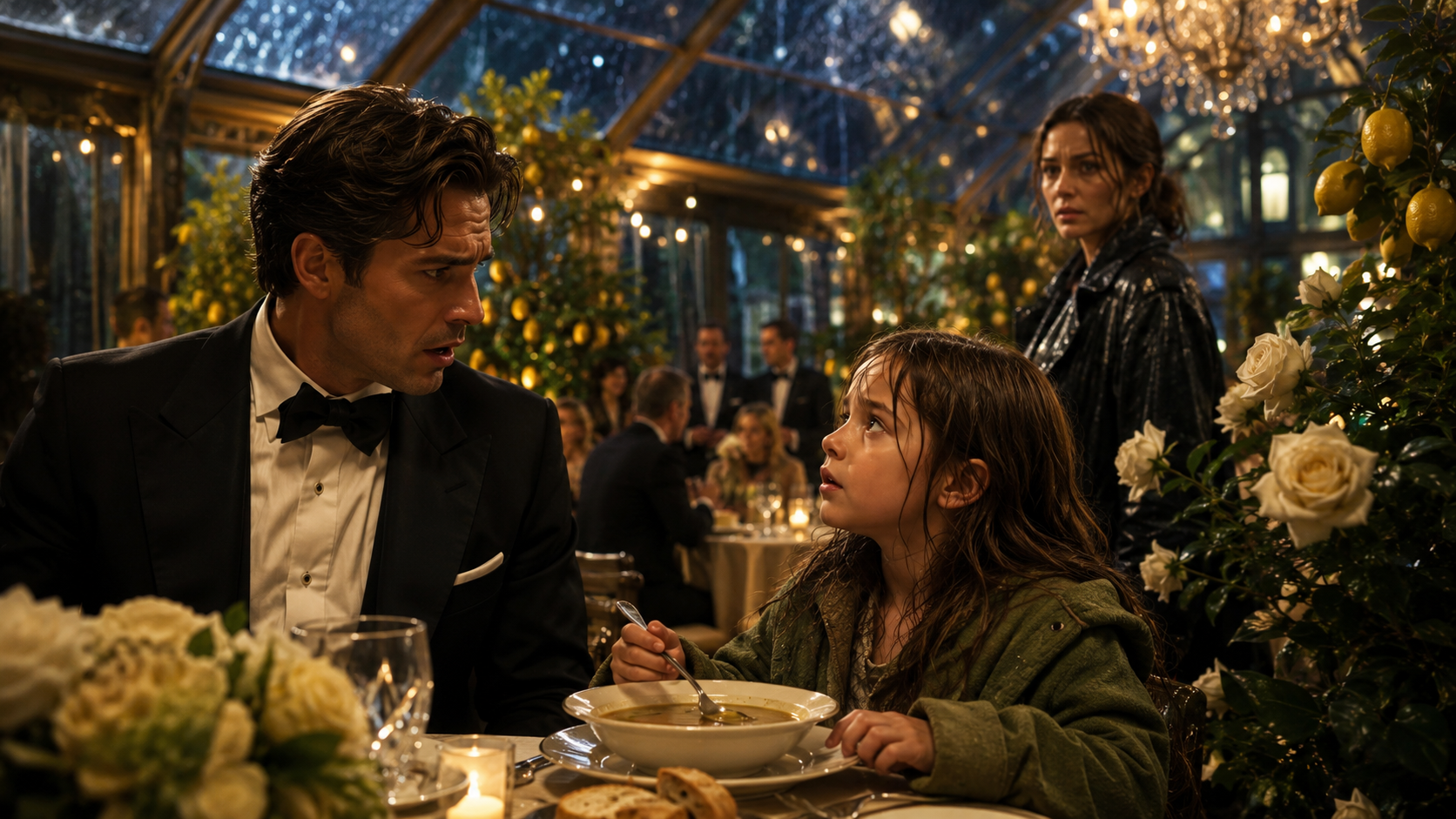
“Because I met my dad at a table when I was hungry.”
The room became quiet.
“He had lots of food, but he was eating alone. My mom says he had made mistakes so big that people built hotels on top of them.”
Mara covered her face.
Adrian whispered, “Still accurate.”
Lily continued.
“My dad gave me dinner. Then my mom made him tell the truth. The truth cost him a lot of money, but Mom says that was not the expensive part.”
“What was the expensive part?” the teacher asked.
“Time.”
Lily touched the tiny cardboard garden.
“You can earn more money. You can build another company. You can buy another house. But you cannot buy the years when someone needed you.”
Adrian looked down.
Mara found his hand.
Lily smiled at them.
“But you can be there for the years that come next.”
After the presentation, they walked home beneath spring rain.
Lily ran ahead, jumping over puddles.
Mara carried the cardboard model. Adrian carried Lily’s backpack and the remains of a volcano project that had collapsed in the school hallway.
“You’re wearing the ring,” Mara said.
“I wear it every day.”
“I still notice.”
They reached the corner where their apartment building stood.
It was not Adrian’s old townhouse.
They had chosen the place together—a renovated brick building with wide windows, imperfect floors, and a shared courtyard designed by Mara.
Adrian stopped at the gate.
“What?” she asked.
“I have a question.”
“If this is about adding another lemon tree, the answer is no.”
“It isn’t.”
He handed her the broken volcano.
Then he removed a small box from his coat.
Mara stared at it.
“Adrian.”
“There are no photographers. No musicians. Lily is approximately thirty feet away and pretending not to watch.”
Lily hid badly behind a tree.
Adrian opened the box.
Inside was a simple ring made by the same street artist who had created the silver band years earlier. Adrian had found her through an old market receipt.