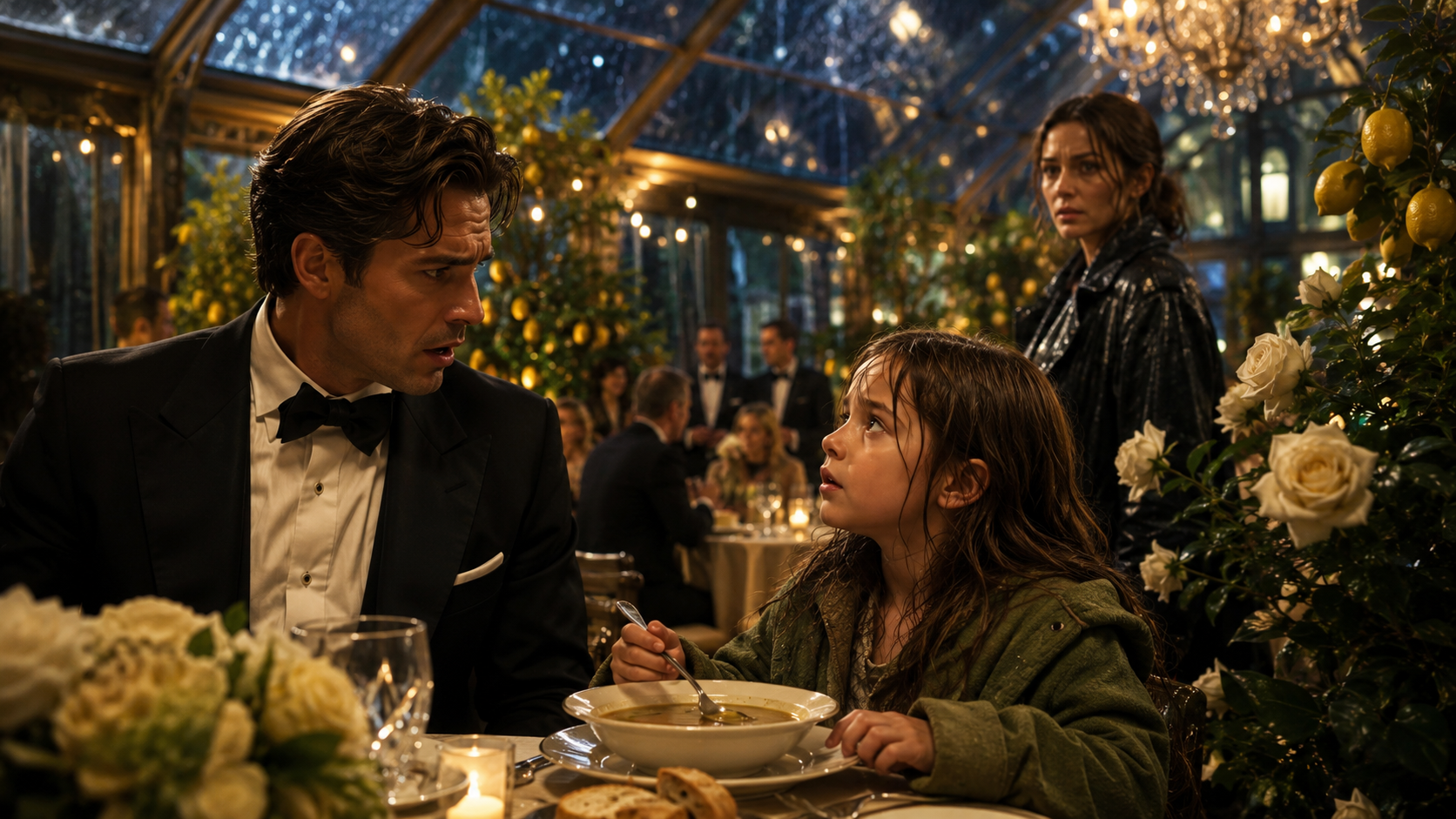
Each visit had been removed from Adrian’s electronic calendar.
A former receptionist remembered Simone instructing staff never to connect calls from Mara Ellison.
Then an archivist named Owen Price found a storage box in a warehouse outside Worcester.
Owen had worked for Vale House during its first years. He had kept old project files because Simone had ordered a rushed office clearance and he feared tax records might be destroyed.
The box contained early drawings of the garden system.
Every page bore Mara’s initials.
Several also contained Adrian’s handwritten comments:
Could we build this above a train station?
Ask Mara about winter airflow.
Mara says trees must come before tables.
One sheet contained a coffee stain shaped like a crescent.
Adrian remembered making it.
Another box held the blue envelope.
It had never been opened.
Simone had preserved it.
Perhaps as insurance.
Perhaps as a trophy.
Adrian received it in the independent investigator’s office.
Mara sat across the table.
Lily was at school for the first time in several weeks, enrolled through a temporary family housing program that Adrian had funded anonymously after Mara refused anything bearing the Vale name.
The envelope was faded but intact.
Adrian turned it in his hands.
“I don’t have the right to open it now.”
Mara looked at him.
“It was written to you.”
“To the man I was seven years ago.”
“He is still part of you.”
“That is what frightens me.”
She considered this.
“Open it.”
Inside was a photograph of newborn Lily wrapped in a yellow blanket.
A hospital document listed Adrian Vale under “father,” followed by a handwritten question mark.
Mara’s letter covered four pages.
Adrian read the first paragraph.
Then he stopped.
His hands began to shake.
Mara looked toward the window.
“Read it aloud.”
“I can’t.”
“You refused to hear it once.”
The words were not cruel.
They were necessary.
Adrian began again.
He read Mara’s description of Lily’s birth. The emergency surgery. The fear. The way the baby quieted whenever rain touched the hospital window.
Mara had written that she did not expect them to repair their relationship immediately. She asked only that Adrian meet his daughter before deciding what place he wanted in her life.
The final paragraph was short.
I loved the man who could see a home inside an empty building. I hope that man still exists somewhere inside the person you are becoming. Lily does not need your empire. She needs the chance to know whether her father will come when she calls.
Adrian finished.
The room remained silent.
“I would have come,” he said.
Mara looked at him.
“I think I would have.”
“That is not something either of us can know.”
“I hate that.”
“So do I.”
He pressed the photograph against the table.
“I let Simone decide who could reach me.”
“Yes.”
“I saw your handwriting and chose not to open it.”
“Yes.”
“I accepted your work without asking how the company obtained it.”
“Yes.”
Each answer removed another place to hide.
“Why are you here?” he asked.
Mara’s expression softened slightly.
“Because Lily asked whether people can become different.”
“What did you tell her?”
“That people can become more honest. Different takes longer.”
The investigation found more than theft.
Simone had used shell companies to receive licensing payments connected to Mara’s designs. She had redirected millions of dollars into accounts controlled by herself and Marcus Thorne.
Marcus had known about the forged assignment.
The planned European merger would have allowed them to move the disputed intellectual property into a new corporate structure, making Mara’s claim almost impossible to pursue.
When the evidence became public, Marcus resigned.
Simone was arrested two days later.
As officers escorted her from Vale House headquarters, she asked to speak with Adrian.
He met her in a conference room under the supervision of attorneys.
She wore no jewelry. Without the silver dresses, glass offices, and people awaiting her instructions, she appeared smaller than he remembered.
“You found the envelope,” she said.
“Yes.”
“I kept it because I knew this day might come.”
“Why?”
“Because part of me wanted proof that I had saved you.”
“You saved a company.”
“I made you powerful.”
“You made yourself necessary.”
Her eyes flashed.
“You would have failed without me.”
“Possibly.”
The answer unsettled her.
Adrian sat across from her.
“I might have returned to Mara and become a terrible father. I might have panicked. I might have chosen work again.”
“You would have.”
“Perhaps. But those failures would have been mine. You stole our right to face them.”
“I protected thousands of employees.”
“You stole millions through shell companies.”
“I earned what you never would have given me.”