Chapter One
The Empty Chair
On the night Adrian Vale opened the most expensive hotel in Boston, every chair in the grand ballroom was occupied except the one beside him.
Eight hundred guests had gathered beneath chandeliers made from hand-cut Venetian glass. Governors, investors, actors, foreign diplomats, and men whose family names appeared on museums raised crystal glasses beneath a ceiling painted to resemble a summer sky.
Outside, November rain silvered the streets.
Inside, the Halcyon Crown glowed like a palace that had never heard of winter.
Adrian sat at the center table, wearing a black dinner jacket tailored in Milan. He had just delivered a speech about vision, courage, and the future of luxury hospitality. The audience had applauded for nearly three minutes.
Now no one spoke to him.
They waited for him to speak first.
That was the burden of becoming powerful. People stopped approaching you as a person and began approaching you as a door.
To his left, a senator discussed waterfront permits with Adrian’s chief legal officer. To his right, a technology investor laughed too loudly at something that had not been funny. Across the ballroom, Adrian’s company president, Simone Krell, moved from table to table with the calm authority of someone who believed every detail belonged to her.
Adrian lifted his wineglass but did not drink.
He had built thirty-seven hotels in fourteen countries. He owned apartments he rarely visited, cars he never drove, and a vineyard whose wine he did not enjoy. Business magazines called him a visionary. His employees called him demanding when they thought he could not hear them.
His mother, before her death, had called him restless.
A waiter placed a plate of truffle risotto before him.
Adrian stared at it.
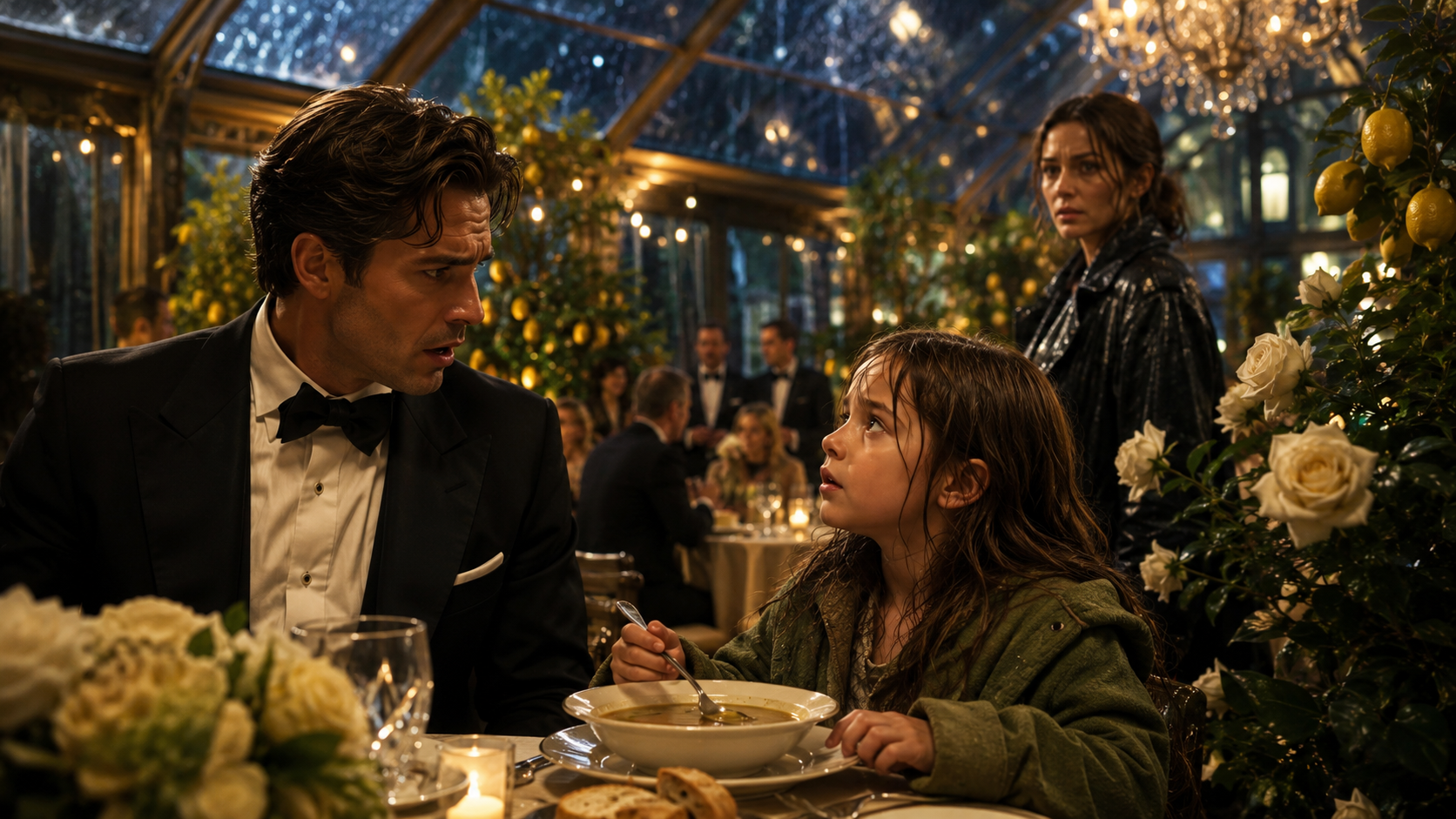
Beyond the ballroom doors stood the hotel’s signature feature: a vast glass garden filled with lemon trees, climbing roses, stone fountains, and warm paths designed to make winter guests feel as though they had stepped into another season.
The garden was the reason investors had supported the Halcyon Crown.
It was also the reason Adrian had become famous.
Every Vale House hotel contained one—a sheltered courtyard where rainwater moved through hidden channels, warm air rose naturally through angled glass, and living walls regulated temperature without visible machinery.
Architectural critics called the design the Vale Garden.
Adrian had accepted the name for fifteen years.
Tonight, however, he felt no pride when he looked through the doors.
He felt watched.
At first, he assumed it was another photographer.
Then he noticed a small face behind one of the lemon trees.
A little girl stood barefoot on the garden stones.
She was perhaps six years old, thin beneath an oversized green coat. Rain had darkened her brown hair, and she held a pair of broken shoes by their straps. A paper hospital bracelet circled one wrist.
She looked at Adrian’s plate.
Not at the chandelier.
Not at the famous guests.
Not at the diamonds or the flowers or the television cameras.
Only at the food.
A security officer noticed her a moment later.
He crossed the garden quickly.
The child stepped backward.
Adrian put down his glass.
“Stop,” he said.
He had not raised his voice, but the security officer froze.
Several guests turned.
Adrian rose and walked through the open doors.
The little girl watched him approach. Her eyes were gray-green, startlingly calm in a face that should have been frightened.
“What are you doing here?” Adrian asked.
The security officer answered for her.
“She came through the service entrance, Mr. Vale. We’ll remove her immediately.”
“I asked her.”
The girl lifted her chin.
“I smelled bread.”
A few guests near the doorway exchanged amused smiles.
Adrian did not.
“Are your parents here?”
“My mother is in the garden.”
He looked around.
“I don’t see her.”
“She told me to stay beside the fountain, but then she sat down because she got dizzy. When I came back, she was gone.”
The security officer touched his earpiece.
“I’ll have the staff locate the mother.”
The girl’s gaze drifted again toward Adrian’s table.
“When did you last eat?” he asked.
She thought carefully.
“Yesterday.”
The answer was delivered without self-pity.
That made it worse.
Adrian turned toward the security officer.
“Find her mother. Don’t frighten either of them.”
“Yes, sir.”
Adrian looked at the child’s bare feet.
“What happened to your shoes?”
“The rain happened.”