“I told you not to come looking for me,” he said weakly.
“You also told me never to trust instructions given by frightened adults.”
Despite everything, he laughed.
Mara hurried to them.
“Where is my mother?”
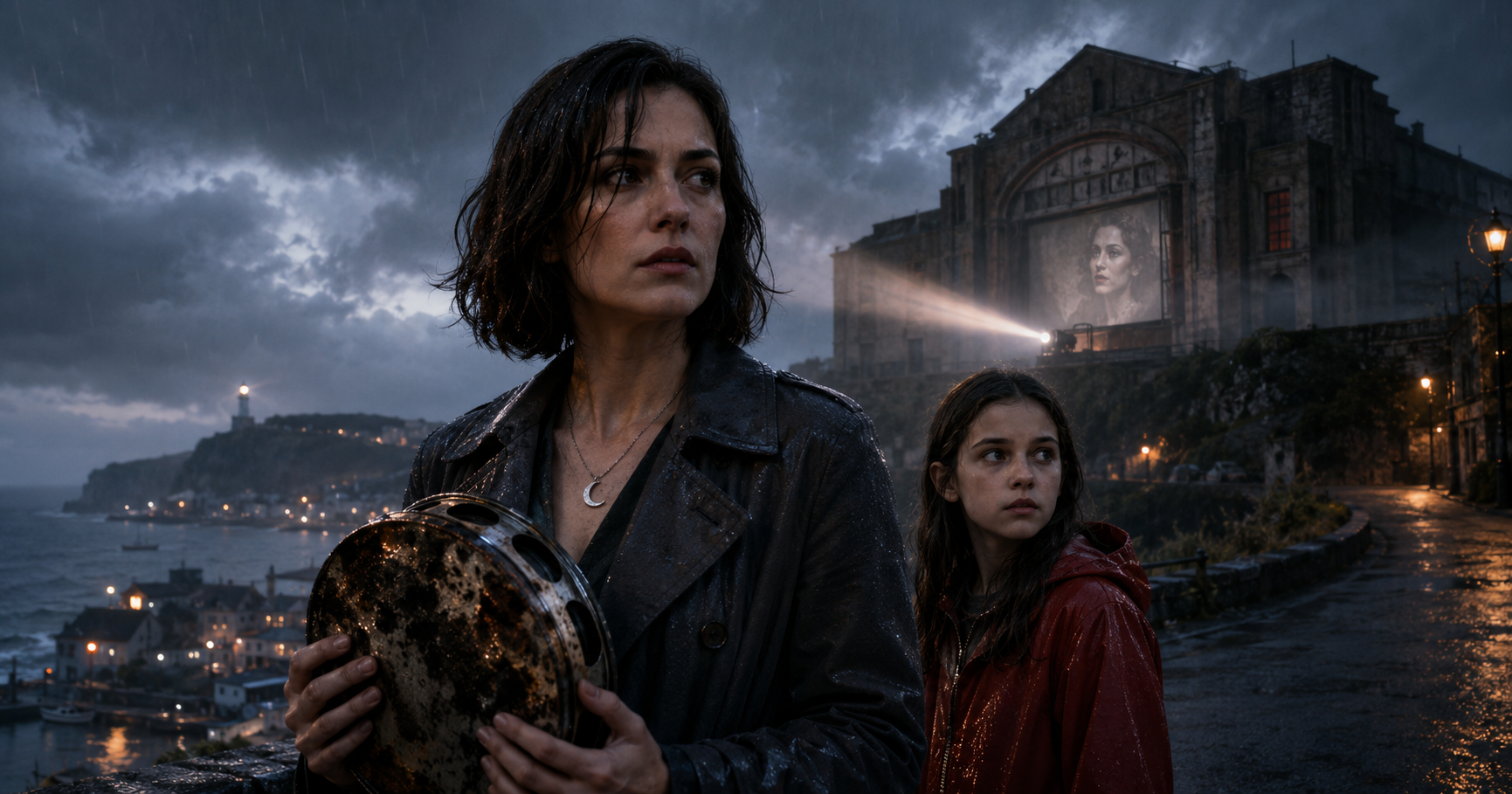
Elias looked at the projection on the town hall wall.
“Safe, the last time I heard from her.”
“That could have been years ago.”
“Six weeks.”
Mara’s heart struck painfully against her ribs.
“You spoke to her six weeks ago?”
“She was waiting to see whether you would sign the demolition order.”
“Why?”
“Because if you signed, she would know Gideon still controlled the story.”
Mara looked at the torn papers scattered somewhere near the ferry terminal.
“And because I refused?”
Elias nodded.
“She asked me to give you a choice.”
Sirens approached from several directions.
This time Gideon looked genuinely confused.
Elias smiled.
“I did not call the local police.”
Federal investigators entered the roof with members of the harbor authority behind them.
Gideon did not resist when they took him.
He only looked at Mara and said, “You have destroyed everything.”
Mara watched Celeste’s face disappear as the reel ended.
“No,” she replied. “I stopped helping you preserve it.”
Near dawn, Mara sat inside the projection booth with a blanket around her shoulders.
Elias had been taken to the hospital. His injuries were serious but not life-threatening. Saffy had refused to leave him and was now asleep in a chair beside his bed.
The cinema remained standing.
The demolition order had been suspended. Investigators filled the hidden archive room, photographing ledgers and sealing film cans inside evidence boxes.
Mara sat alone before the projector.
Her phone rested on the table.
Elias had given her the name of a railway station in the mountains, hundreds of miles from Blackwater Bay. Celeste had collected mail from a box there six weeks earlier.
It was not an address.
It was only a beginning.
Mara touched the silver crescent at her throat.
Her phone rang.
The number was hidden.
For several seconds she could not move.
Then she answered.
“Hello?”
Static whispered across the connection.
A woman breathed on the other end.
Her voice, when it came, was older than the one Mara remembered and softer than the voice on the film.
But Mara knew it.
“Did the bells ring?” the woman asked.
Mara closed her eyes.
Outside, the first gray light of morning entered through the broken roof.
“Yes,” she whispered.
“Did you look up?”
“I did.”
A quiet sob crossed the distance between them.
Mara gripped the phone with both hands.
“Mom?”
“I’m here.”
Mara had imagined this moment in a thousand different ways during the years after the drowning.
She had imagined accusations.
Questions.
Anger sharp enough to cut through bone.
Instead, only one sentence found its way out.
“I thought you chose to leave me.”
Celeste was silent for a moment.
“I chose whatever kept you alive. I was not always right about what that meant.”
“Where are you?”
“I can tell you now.”
Mara looked through the booth window at the empty auditorium.
Rainwater shone on the red seats. Dust moved through the first beam of sunlight. The old screen hung torn and colorless, waiting for another story.
“No,” Mara said.
Her mother’s breathing stopped.
Mara smiled through her tears.
“Don’t tell me over the phone. Stay where you are.”
“Mara—”
“I’m coming to you.”
“You don’t know what you’ll find.”
“I’ve spent eighteen years living with what I couldn’t find.”
She stood and placed her hand on the projector.
“I’m done being afraid of the truth.”
Beyond the cinema walls, Blackwater Bay was waking.
Shop doors opened.
Boats left the harbor.
People gathered in the square beneath the blank wall where Celeste’s face had appeared.
The town had not collapsed beneath the weight of the truth.
It had simply become a different town.
“Mara,” Celeste whispered.
“Yes?”
“I watched every film you made.”
Mara bowed her head.
“You saw them?”
“Every one.”
“Why didn’t you contact me?”
“Because Gideon watched you too.”
Mara thought of the career opportunities her uncle had arranged, the contracts he had reviewed and the cities he had encouraged her to visit. What she had mistaken for support had also been surveillance.
“He can’t watch me anymore,” she said.
“I know.”
“How?”
“I saw the projection.”
Mara turned toward the window.
From the cinema roof, the entire harbor was visible.
So were the hills beyond it.
“Are you in Blackwater Bay?”
“No.”
“But you saw it?”
“Elias arranged a live camera in the square. He said if the truth finally appeared on that wall, I deserved to witness it.”
Mara laughed and cried at the same time.
“That sounds like him.”
“He was always too dramatic.”
“He worked in a cinema.”