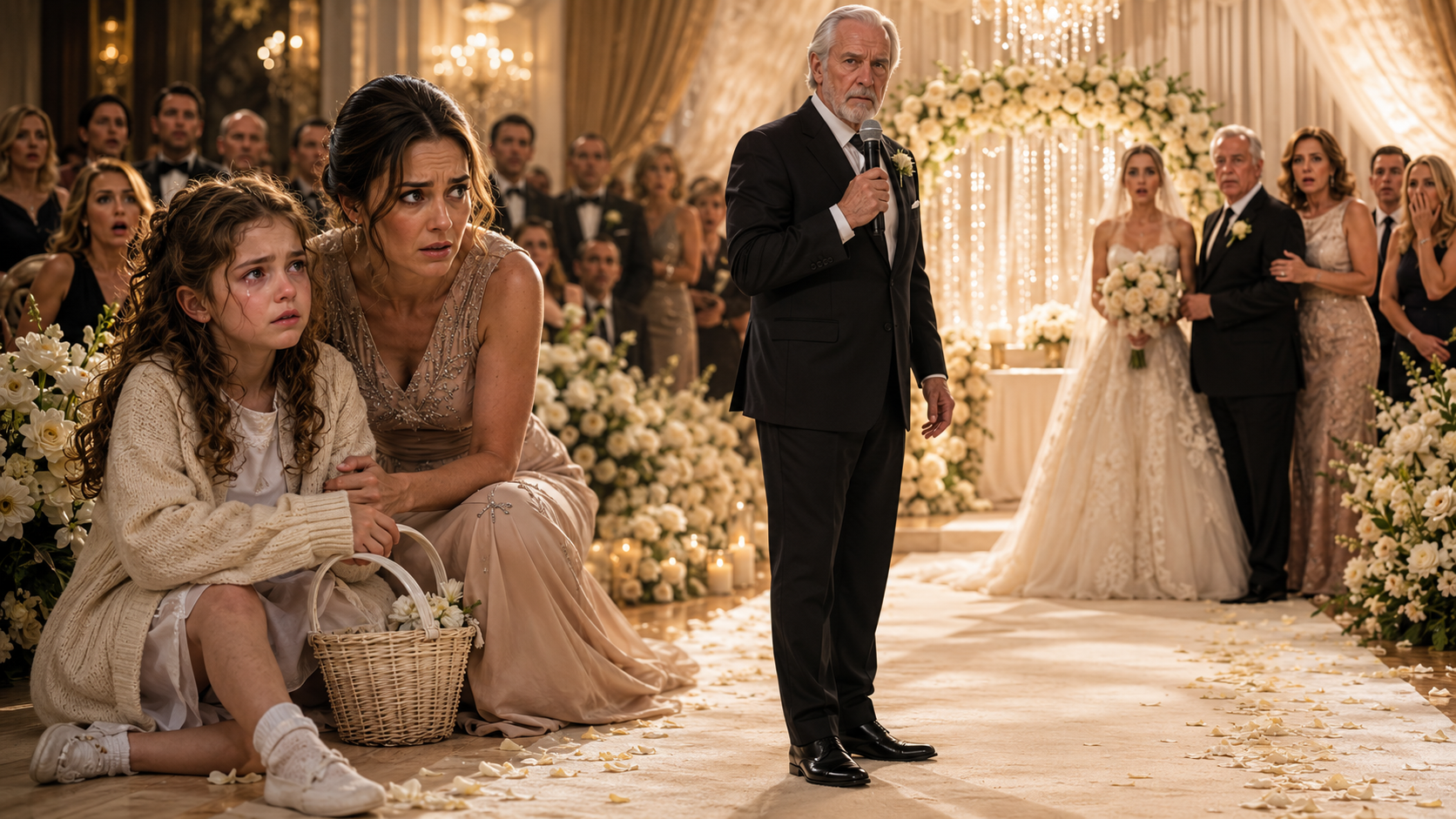
The hallway smelled of roses, wax, and expensive perfume. The same velvet bench waited near the coatroom, holding the sash they had taken from her hands. You picked it up, folded it once, and dropped it into the nearest trash bin.
Lily watched.
“Mom?”
“Yes?”
“Was I bad luck for the wedding?”
You crouched in front of her so your eyes were level.
“No. You were the only honest thing in that room.”
She thought about that.
Then she touched the silver sparrow on her cardigan.
“Grandpa was really mad.”
“Yes.”
“At them?”
“Yes.”
“At me?”
“Never.”
Her shoulders loosened a little.
Outside, the afternoon sun had softened into gold. Guests had begun spilling out of the ballroom behind you, some whispering into phones, some pretending not to stare, some openly looking ashamed.
You helped Lily into the car.
Before you closed the door, she looked back toward the venue.
“Do you think Cousin Vivian will still get married?”
You followed her gaze.
Through the tall windows, you could see movement inside. Nathan stood with his parents near the front. Vivian was crying. Marissa was arguing with the coordinator. Graham had both hands on his head.
Your father stood alone beside the lectern, his cane in one hand, the microphone in the other.
He looked old.
He looked tired.
But he did not look defeated.
“I don’t know,” you said.
Lily leaned back against the seat.
“I don’t want her dress anymore.”
You smiled sadly.
“Good.”
“I want chicken nuggets.”
That surprised a laugh out of you.
“Chicken nuggets?”
“And a milkshake.”
“After all that?”
She nodded solemnly. “Especially after all that.”
You kissed her forehead.
“Then chicken nuggets and a milkshake it is.”
As you drove away, your phone began buzzing.
First your mother.
Then Graham.
Then an unknown number.
Then Marissa.
You didn’t answer.
At the first red light, a message appeared from your brother.
You destroyed everything.
You stared at it for a moment.
Then you deleted it.
Because for once, he was wrong.
You had not destroyed anything.
The rot had already been there.
Your father had simply opened the door and let everyone smell it.
By evening, the wedding was over—not completed, just over.
Nathan had postponed the ceremony indefinitely. That was the polite word his family used when they left the venue. Postponed. As if trust could be rescheduled with a new deposit and a revised flower order.
The next morning, your father’s attorney called.
By noon, Graham called you seventeen times.
By three, Marissa sent a message that began with For Lily’s sake, we should all calm down and ended with you have no idea what your father’s accusations could cost us.
You did not respond.
At six, Vivian texted Lily.
You read it first.
I’m sorry you got upset yesterday. Everything was stressful. I hope you understand.
You showed it to your father when he came over that night with a folder under his arm and Lily’s favorite lemon cookies from the bakery down the street.
He read the message once.
Then he handed the phone back.
“That is not an apology.”
“I know.”
Lily was in the living room building a tower out of blocks. She had placed the silver sparrow pin on the very top.
Your father watched her for a long time.
“I changed my will today,” he said.
You turned toward him.
“Dad.”
“No. Listen.”
You sat beside him at the kitchen table.
He looked older than he had yesterday. The fire had gone out of his anger, leaving only the ache beneath it.
“I should have done it sooner. I kept thinking Graham would remember who he was. I kept thinking Marissa was the problem and he was just weak. But weakness can become cruelty when it keeps choosing the cruel side.”
You said nothing.
Because that was true.
He opened the folder.
“The house will be sold after my passing. Graham will not control any trust, account, property, or legal decision connected to this family again. Lily’s education fund is being restored separately, in an account only you can manage until she is grown.”
Your eyes burned.
“Dad, you don’t have to—”
“I do.”
He placed his hand over yours.
“I failed you in small ways because I wanted peace. Then I watched those small failures become a hallway where my granddaughter sat without her shoes.”
You looked away.
“I should have fought harder too.”
“No,” he said firmly. “You were surviving. There is a difference.”
In the living room, Lily laughed at something on television.
Your father smiled faintly.
“She still laughs,” he said. “That is a blessing.”
“It is.”
“Protect that.”
“I will.”
He tapped the folder.
“And when they call again—and they will—remember this. People who hurt children and then complain about consequences are not asking for forgiveness. They are asking for permission to do it again.”
You nodded.