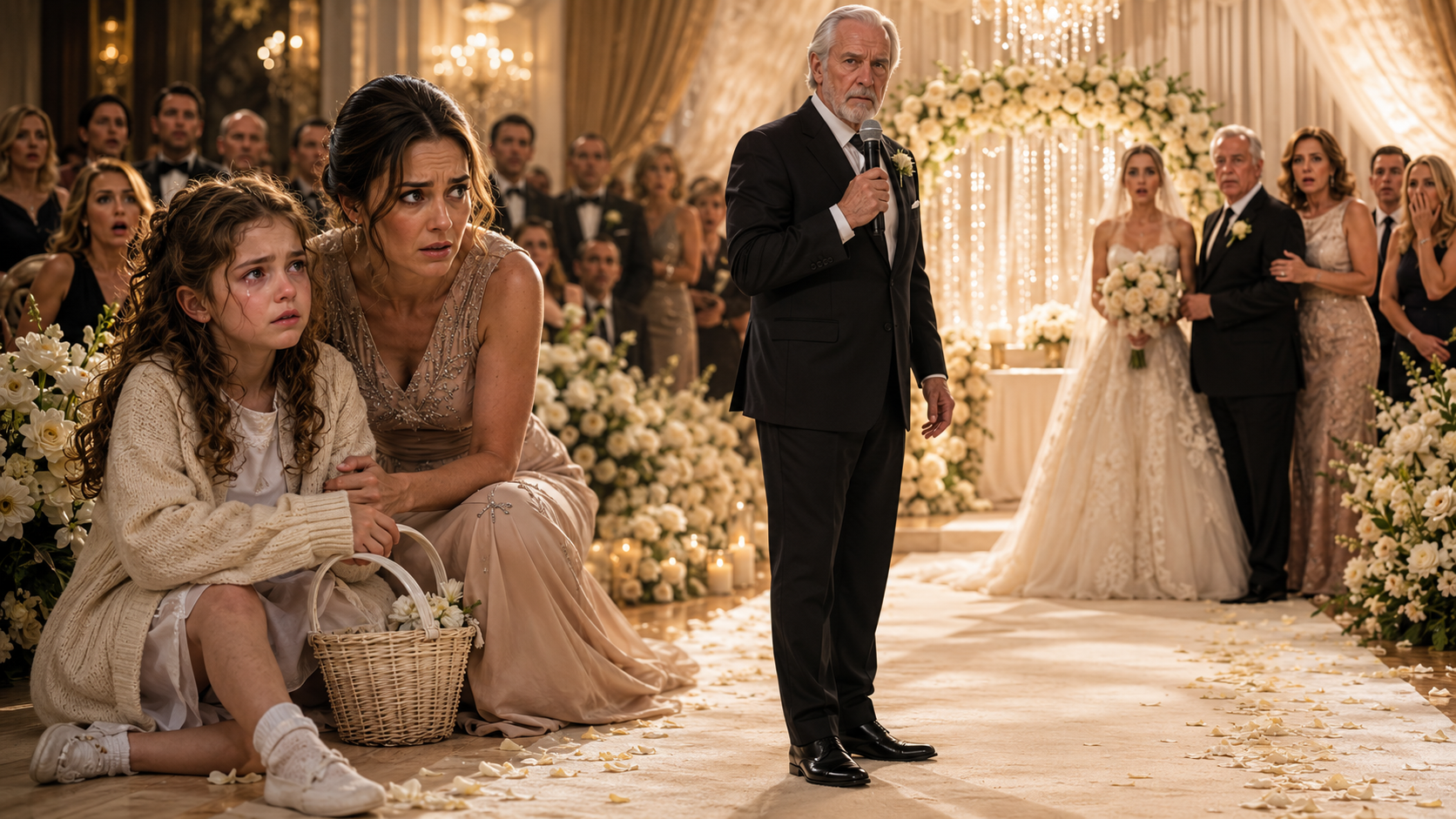
This was deliberate cruelty.
You touched Lily’s face gently.
“Listen to me,” you said. “You did nothing wrong.”
Her lower lip shook.
“But maybe I embarrassed them.”
“No.”
“Maybe because Dad didn’t come, and everyone knows—”
“No.” Your voice sharpened, then softened. “No, Lily. You are not embarrassing. You are not less than anyone in that room. Do you hear me?”
She nodded, but she didn’t believe you yet.
That was what hurt most.
The lie had already reached her.
Behind you, a cane tapped once against the marble floor.
You turned.
Your father stood at the end of the hallway.
Walter Hayes was seventy-two years old, tall even with the slight bend in his shoulders, wearing his old navy suit and the silver tie Lily had picked for him. His white hair was combed back neatly. His face, usually calm and unreadable, was hard in a way you had not seen since the day your divorce papers were signed.
He looked from Lily’s tear-streaked face to the sash in her hands.
Then he looked at you.
“Tell me,” he said.
You didn’t want to.
Not because you were afraid of the family.
Because your father had already survived enough humiliation from them. After your mother died, your brother Graham had slowly taken control of every family gathering, every holiday, every tradition. He had money. He had the larger house. He had a wife who knew how to make cruelty sound like etiquette.
Your father had often stayed quiet to keep peace.
But today, his granddaughter was sitting in a hallway without her dress.
So you told him everything.
Every word made his expression colder.
Lily whispered, “Grandpa, please don’t be mad.”
He walked to her slowly, lowered himself onto one knee despite the pain you knew it caused him, and took her hands.
“I am not mad at you, little sparrow.”
“They said I could still have cake later.”
Your father closed his eyes.
When he opened them, something had changed.
“Did they?”
Lily nodded.
He kissed her knuckles. “Then they have mistaken kindness for permission.”
Inside the ballroom, the applause rose. Vivian must have reached the altar.
Your father stood.
“Stay with your mother,” he said.
“Dad,” you said carefully.
He turned toward the ballroom doors.
“What are you going to do?”
He adjusted his cuffs.
“What I should have done years ago.”
Then he walked inside.
You followed because you were afraid of what might happen.
But for the first time in years, you were not afraid of him making a scene.
You were afraid he wouldn’t.
The ceremony had begun. The officiant was speaking in a warm, practiced voice about love, family, and the sacred joining of two lives. Vivian stood under a white floral arch beside her groom, Nathan Pierce, who looked handsome and uncomfortable, like a man slowly realizing he had married into a house where everything beautiful had teeth.
Marissa saw your father first.
Her face changed.
Only for a second.
Then she smiled.
That was Marissa’s gift. She could smile through anything. She had smiled when she told you your apartment was too small for Thanksgiving. She had smiled when she said Lily was “sensitive” after your daughter overheard cousins joking about her secondhand coat. She had smiled when she explained that single mothers had to be realistic about what they could expect from family.
Your father walked down the side aisle, not toward his seat, but toward the small platform where the microphone stand had been placed for speeches later.
A ripple moved through the guests.
The officiant paused.
Graham finally looked over.
“Dad?” he mouthed.
Your father took the microphone.
A low squeal of feedback cut through the hall.
The harpist stopped.
The officiant cleared his throat. “Sir, we’re in the middle of—”
“I know exactly where we are,” your father said.
His voice filled the room.
Not loud.
Worse.
Clear.
Every guest turned.
Vivian’s smile froze at the altar.
Marissa stood from the front row. “Walter, this is not appropriate.”
Your father looked at her.
“No, Marissa. What happened in the hallway was not appropriate.”
A silence fell so complete you could hear the faint buzz of the chandeliers.
Your brother rose halfway from his seat. “Dad, give me the microphone.”
“No.”
One word.
It hit harder than a shout.
You stood near the back with Lily tucked against your side. She clung to your hand.
Your father looked past the rows of guests, past the expensive flowers, past the photographer who had lowered his camera in shock.
“My granddaughter Lily was invited to be part of this ceremony,” he said. “She practiced for weeks. She was fitted for a dress. She was told she mattered. Then, moments before the doors opened, she was removed from the wedding party and replaced with another child because someone decided she did not fit the image this family wanted to sell.”
Whispers erupted.