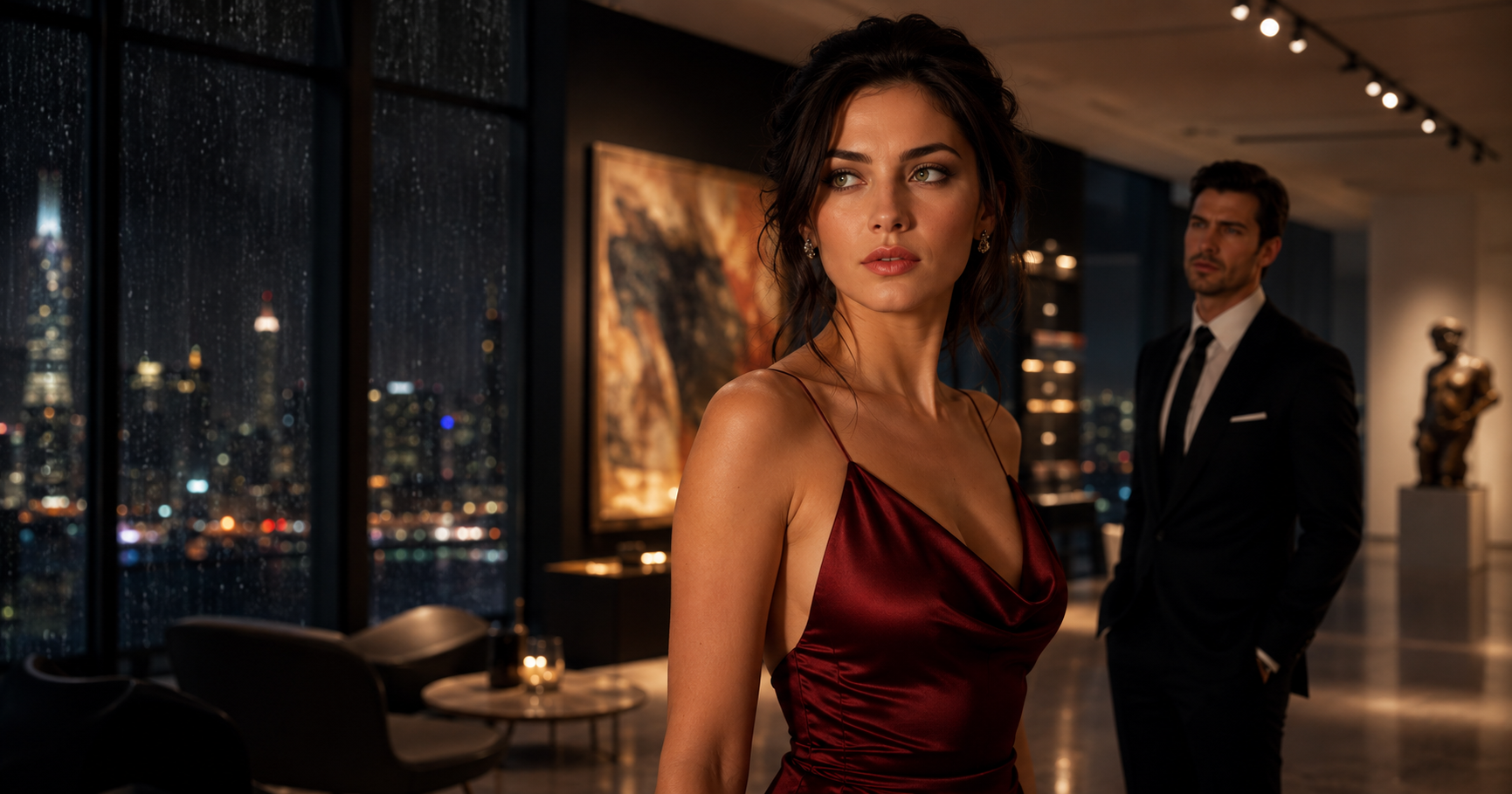
Not completely. Not magically. Roman Vale was still intense, still impatient, still capable of making grown executives reconsider their life choices with one look. But he had learned to ask before acting. He had learned that protection without respect was only another locked door. He had learned to stand beside Lena in public without making her disappear in his shadow.
And Lena had changed too.
She no longer measured rooms by exits. She no longer apologized before speaking. She no longer believed visibility always came with danger.
One evening in early spring, Roman took her back to the gallery where Miles had betrayed her.
It had reopened under new ownership. The walls were brighter now. The first exhibition featured restored fabrics from forgotten theater productions, many repaired by Lena’s apprentices.
She stood before a century-old crimson dress displayed behind glass. Its hem had been burned in one corner, then repaired with such care the damage had become part of its beauty.
Roman stood beside her.
“That one reminds me of you,” he said.
Lena looked amused. “Because it survived?”
“Because someone foolish might notice only the color first.”
“And someone wise?”
He looked at her, not the dress.
“Would study the seams.”
Her throat tightened.
Roman reached into his coat pocket.
Lena’s eyes widened. “Roman.”
He froze. “Too soon?”
“That depends entirely on what is in your hand.”
He removed a small velvet box.
Her breath vanished.
Around them, the gallery continued softly: footsteps, murmurs, the faint clink of glasses. No cameras. No crowd. No empire watching. Just fabric, light, and the man who had once mistaken distance for safety.
Roman opened the box.
Inside was a ring with a small antique emerald set between two diamonds. Not enormous. Not a trophy. Beautiful in a way that asked to be looked at closely.
“My grandmother’s,” he said. “She was the only person in my family who understood that love is not ownership.”
Lena could not speak.
Roman did not kneel immediately.
Instead, he asked, “May I?”
She smiled through sudden tears. “Yes.”
Only then did he lower himself to one knee.
“Lena Marlow,” he said, voice unsteady, “I saw you too late. I respected you too slowly. I loved you before I deserved to say it. You owe me nothing. Not forgiveness, not forever, not an answer that makes this easy.”
A tear slipped down her cheek.
He continued, “But if you choose me, I promise I will spend my life choosing you back. Not as something to protect behind glass. Not as proof I became better. As my partner. My equal. The woman who taught me that being seen is not the same as being understood, and love is not real until it does both.”
Lena looked at him kneeling in the same gallery where another man had tried to buy her silence with attention.
Then she looked at the crimson dress behind glass.
Repaired.
Radiant.
Still standing.
“Yes,” she whispered.
Roman closed his eyes like the word had undone him.
Then he slipped the ring onto her finger with hands that trembled.
Later, when they stepped outside, rain had begun again. The city smelled like stone and spring. Roman opened an umbrella over them, and Lena laughed.
“What?” he asked.
“You look nervous.”
“I proposed to the most formidable woman in New York. Nervous is rational.”
She leaned into him.
For a few moments, they stood beneath the umbrella, watching the rain turn streetlights into gold.
Then Lena looked up at him.
“You were wrong that night.”
His brows drew together. “About what?”
“The dress.”
Roman’s mouth softened.
She touched the lapel of his coat.
“It wasn’t for Miles,” she said. “But it wasn’t for you either.”
“No?”
“No.” She smiled. “It was for me.”
Roman looked at her with the kind of reverence that did not shrink her.
“Good,” he said. “I would hate to be jealous of a dress and lose.”
She laughed, bright and unafraid.
A year later, Lena walked down the aisle in the garden behind the apprenticeship studio, wearing a simple ivory gown her students had helped restore from vintage silk. Mrs. Pell sobbed loudly. Tomas handed out tissues like emergency supplies. Amara delivered the rings with the solemn expression of a woman closing a historic legal argument.
Roman waited beneath an arch of white roses.
When Lena reached him, he did not say she looked beautiful first.
He said, “I see you.”
And because he finally understood what those words meant, Lena smiled.
“I know,” she said.
The woman who had once disappeared in gray corridors stood in sunlight, loved by a man who had learned not to mistake seeing for claiming.
The dress had never been for him.
The rescue had never been his alone.
And the invisible maid had not become visible because a billionaire noticed her.
She had become visible because she finally stopped accepting shadows as the price of survival.