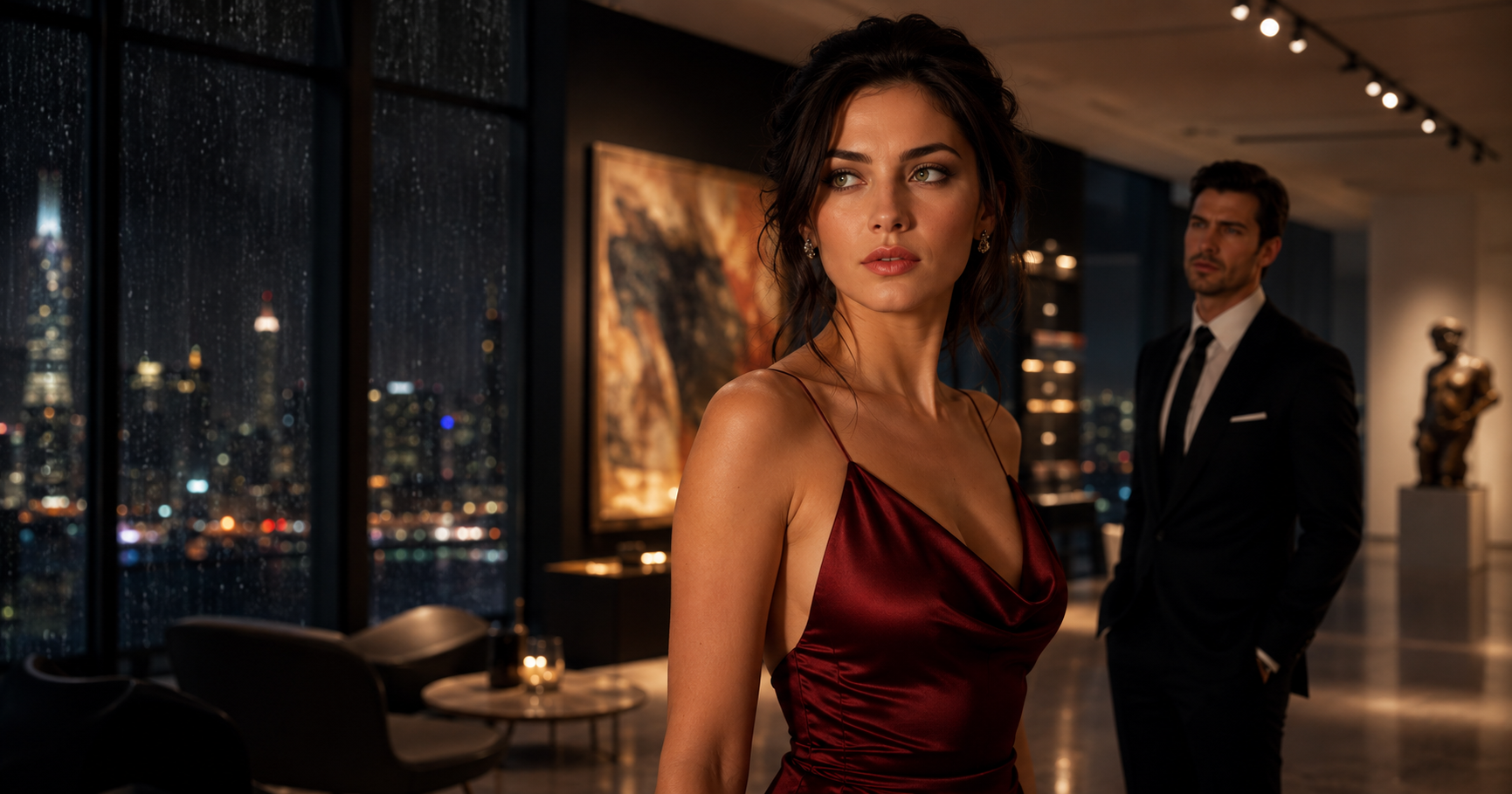
The silence was so sudden that the person on the other end of the call must have noticed.
Roman lowered the phone slowly.
For the first time since Lena had begun working in his home, he looked at her as if he was actually seeing a person instead of a function.
His eyes moved once over the dress. Not rudely. Not like Miles had looked at her, with easy admiration practiced enough to be harmless. Roman looked stunned, almost wounded, as if the sight of her had opened a door in a room he thought was locked.
“Lena?” he said.
Her name sounded strange in his voice.
“Yes, Mr. Vale.”
His jaw tightened. “Where are you going?”
The question landed too sharply.
She lifted her chin. “Out.”
His eyes flicked to the small clutch in her hand. “With whom?”
“That is not part of my employment contract.”
For a second, something like surprise crossed his face. Then it vanished behind cold control.
“No,” he said. “It isn’t.”
His phone buzzed again. He ignored it.
Lena adjusted her coat around her shoulders. “I’m off duty.”
“I know.”
“Then I should go.”
He stepped slightly to the side, but not enough to let her pass. “Is this about Miles Waverly?”
Lena’s fingers tightened around the clutch.
The air changed.
“How do you know that?”
“He asked my assistant about tonight’s gallery opening.”
“So?”
“So Miles Waverly has never attended a private art event in his life unless someone paid him to stand near a collector.”
“That sounds like snobbery.”
“That sounds like experience.”
Lena laughed once, without humor. “Of course. A man smiles at the maid, so he must have a motive.”
Roman’s face hardened. “That is not what I said.”
“It is what you meant.”
“No. What I meant is that he has been asking questions about my house, my schedule, and my staff.”
“Maybe because he talks to people instead of walking through them.”
The words escaped before she could stop them.
Roman went very still.
Lena felt the force of the sentence between them. She almost apologized, then decided she was tired of apologizing for telling the truth.
His voice lowered. “You think I walk through you?”
“Don’t you?”
He did not answer.
That was answer enough.
Lena moved to pass him. “Good night, Mr. Vale.”
“Take a car.”
“No.”
“Lena.”
She stopped because he had said her name again, and this time it did not sound like an order. It sounded like something he had been keeping in his mouth too long.
Roman looked at the elevator behind her, then back at her face.
“I’ll send my driver,” he said. “He will stay outside. No interference.”
“I don’t need protection.”
“You work in my home.”
“I clean your home.”
“You know things about me that people would pay to learn.”
She smiled sadly. “That is the most important you have ever made me sound.”
His expression changed.
The elevator doors opened behind her.
Lena stepped backward into them.
Roman took one step forward, then stopped himself.
Just before the doors closed, his gaze dropped to the red satin beneath her coat.
“That dress,” he said quietly.
She held his eyes.
“It isn’t for him, sweetheart.”
The doors closed.
Lena stood alone inside the elevator, heart pounding so hard she could feel it in her throat.
By the time she reached the lobby, she was angry enough to breathe again.
She told herself Roman Vale did not get to look at her once and decide what her dress meant. He did not get to ignore her for nearly a year, then act wounded when another man invited her into the world. He did not get to use concern as a prettier name for control.
Outside, the city shone under rain. Roman’s black car waited by the curb.
Lena nearly walked past it.
Then the driver, a silver-haired man named Tomas, stepped out and opened the rear door without a word. He had once left cough drops outside the laundry room when Lena was sick. He had never treated the staff as furniture.
She sighed and got in.
The gallery was in a converted printing warehouse near the river, all brick walls, warm lights, and people in expensive black clothing pretending not to judge each other. Miles Waverly stood near the entrance with two champagne glasses and a smile that widened when he saw her.
“Lena,” he said. “My God.”
She smiled despite everything. “Too much?”
“Not enough,” he said, handing her a glass. “You should have walked in with music.”
It was ridiculous.
It still made her blush.
For the first half hour, she let herself enjoy being noticed. Miles introduced her to a sculptor, a curator, two collectors, and a woman who ran a restoration studio in Brooklyn. He told them Lena had an “extraordinary eye,” which made her laugh because he had never actually seen her work, but it was pleasant to be exaggerated instead of erased.
Then Miles asked, “So how late does Vale usually keep you there?”
The question was casual.
Too casual.
Lena turned from a series of framed silk fragments. “What?”