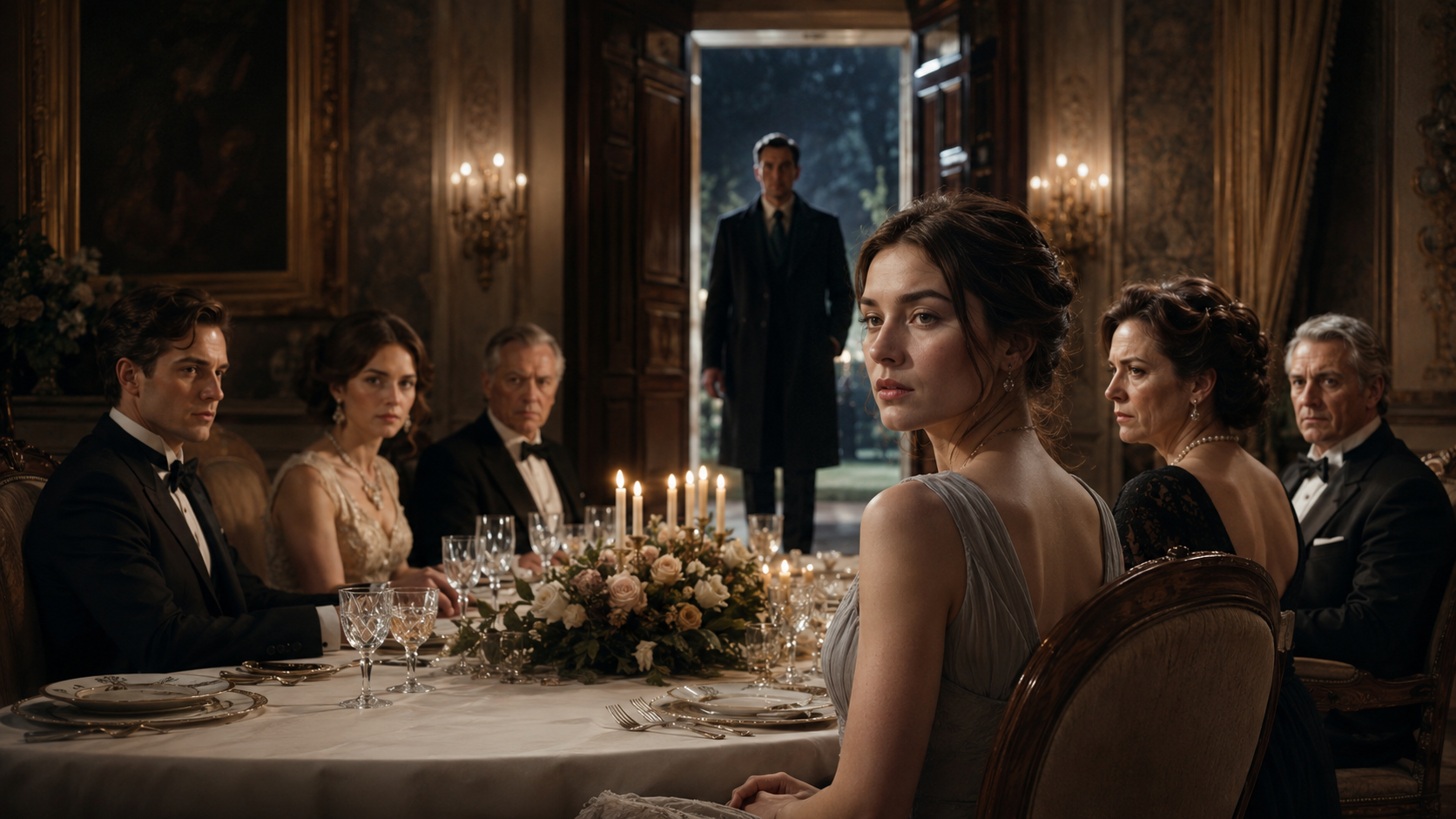
Elias followed Nora into the corridor.
He kept a respectful distance.
“You don’t owe me gratitude,” he said.
Nora turned.
“Good,” she answered. “Because I don’t know what I feel.”
“That is fair.”
“Why now?”
Elias looked toward the closed dining room doors.
“Because the watch reached me. My nephew recognized the mechanism in a photograph. He remembered a sound from the night of the fire, a little metal bird singing in the smoke. He said the girl who saved him had held something like it in her hand.”
Nora looked down.
“I used to fix broken toys when I was scared.”
“I know.”
She frowned. “How?”
Elias reached into his coat and took out a small wooden horse. One leg had been repaired with a silver pin.
Nora’s breath caught.
“I fixed that.”
“My nephew kept it,” Elias said. “All these years.”
Nora touched the tiny silver pin.
For fourteen years, her family had called her difficult, jealous, unstable, dramatic.
Somewhere in the world, a child she barely remembered had kept proof that she had once been kind in the middle of fire.
Her eyes filled, but she did not let the tears fall.
“What happens to them?” she asked.
Elias’s gaze was steady.
“What they earned. Not more. Not less.”
“And Celeste?”
“She will live without applause.”
Nora nodded slowly.
It sounded simple.
It sounded impossible.
By sunrise, the Carrow name had begun to collapse.
The first call came from Marcus’s mother, canceling the engagement announcement. The second came from the board of Roland’s company, demanding an emergency meeting. By noon, Celeste’s charity foundation removed her portrait from its website. By evening, reporters filled the iron gates outside the estate, calling questions into the cold air.
Vivienne refused to leave her bedroom.
Roland called every powerful friend he had ever bought and discovered that purchased loyalty expires quickly when fear becomes expensive.
Adrian went to Nora’s studio and found it empty.
Every drawer cleared.
Every tool gone.
Only one thing remained on the workbench: the velvet box, open, with the pocket watch inside.
Beneath it lay a note.
Not for Celeste.
Not for Vivienne.
Not for Roland.
For Marcus.
“You believed the person who cried loudest. I hope one day you learn to hear silence.”
Marcus read it three times.
Then he sat down on the studio floor and wept like a man who had arrived at the truth after the funeral, only to find the grave still open and waiting for him.
Nora did not attend the public hearings that followed.
She did not watch Celeste lose her invitations, her fiancé, her carefully polished legend. She did not watch Roland testify with hollow eyes. She did not watch Vivienne step past reporters, face hidden behind black glasses, while strangers shouted the same word at her again and again.
Monster.
Nora had no use for the spectacle.
She left the city for a coastal town where no one knew the Carrow name.
For a while, she slept badly.
Then she slept better.
She rented a small shop between a bakery and a closed cinema. She repaired clocks, music boxes, watches, mechanical birds, broken locks, and once, a carousel horse from an amusement park that had shut down before she was born.
People brought her dead things.
She made them move again.
Months later, a letter arrived.
No return address.
Inside was a photograph of a young man in a graduation robe. On the back, a message had been written in careful handwriting.
“My name is Theo Voss. You carried me out of the fire. I have lived every day because you were brave before anyone knew your name. Thank you.”
Nora sat behind the counter of her little shop for a long time, holding the photograph.
Then she placed it beside the wooden horse Elias had returned to her.
That evening, when the bell over the shop door rang, she looked up to find Elias Voss standing in the entrance with rain on his coat and no bodyguards behind him.
“I need a repair,” he said.
Nora glanced at his hands. “What broke?”
He placed the gold pocket watch on the counter.
“The bird sings too softly.”
Nora studied him.
Then the watch.
Then the rain outside.
“You came all this way for that?”
Elias’s mouth curved faintly.
“No,” he said. “I came to ask whether the woman who saved my family might allow mine to remember her properly.”
Nora was quiet.
The old Nora would have wondered what her mother would say. What her father would think. Whether Celeste would accuse her of stealing another spotlight.
That Nora had been left behind in a dining room full of liars.
This Nora opened the watch, listened to the tiny bird’s weak metallic note, and reached for her tools.
“Sit down,” she said.
Elias obeyed.
For the first time in her life, Nora Carrow worked beneath lamplight without waiting for someone to take credit, twist the story, or call her selfish for wanting her own name attached to her own hands.
Outside, rain silvered the dark street.
Inside, the little bird sang louder.
And far away, in the ruined Carrow mansion, Vivienne sat alone at a dining table that no longer hosted guests, staring at the empty chair near the end.
The small one.
The forgotten one.
The one that had belonged to the daughter she had tried to erase.
But truth is a patient thing.
It waits beneath dust.
It hides inside hinges.
It survives in photographs, recordings, scars, and the memory of a child carried through smoke.
And when the door finally opens, truth does not ask permission to enter.
It walks in wearing a black coat.
It lays the evidence on the table.
And it makes every liar remember the name they tried to bury.