The Dinner Where They Tried to Bury Her Name

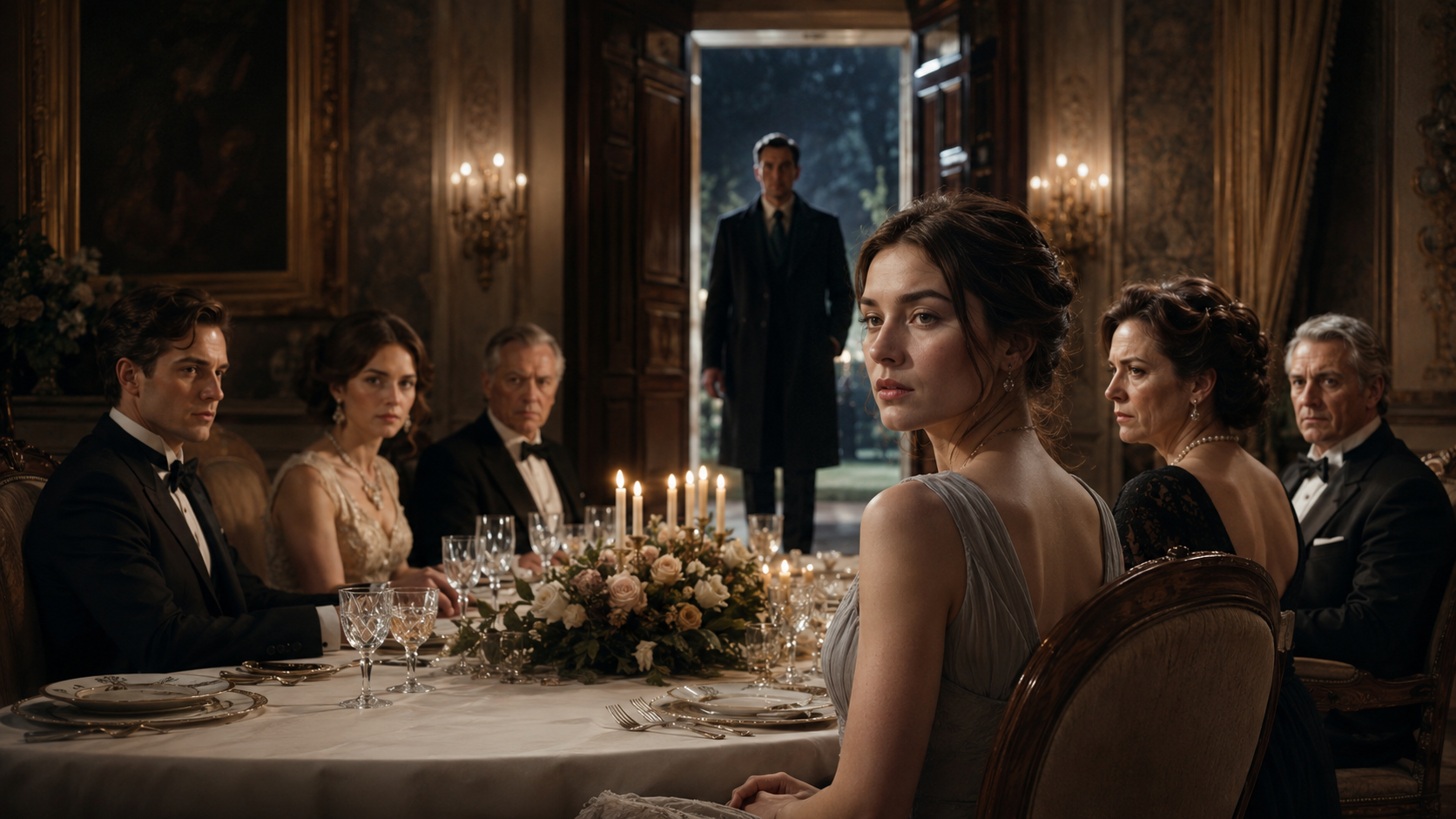
Nora Carrow had learned to enter her own family’s dining room as if she were trespassing.

She did not arrive loudly. She did not let her heels strike the marble too sharply. She did not wear anything bright enough to be accused of stealing attention. Even the pale gray dress she had chosen that evening was deliberate: soft, forgettable, almost the color of rainwater.

Still, when she stepped beneath the chandelier, every conversation stopped.

Her mother looked up first.

Vivienne Carrow sat at the head of the long table in a gown of black silk, one diamond bracelet glittering on her wrist, her smile cold enough to frost glass. Beside her sat Roland Carrow, Nora’s father, his eyes already lowered to his wine as though the sight of his eldest daughter exhausted him.

Nora’s brother, Adrian, smirked into his glass.

Her younger sister, Celeste, lifted one delicate hand to her throat and sighed, as if Nora’s presence had physically pained her.

Only one empty chair remained.

The small one near the end of the table.

The chair usually reserved for visiting accountants, distant cousins, or anyone the family wanted to acknowledge without honoring.

Nora took it without complaint.

She had long ago discovered that arguing with the Carrows was like shouting at a portrait. Nothing changed. The painted faces only stared back, beautiful and unmoved.

Vivienne tapped her fork against her plate.

“You’re late.”

Nora glanced toward the grandfather clock in the corner. “Dinner was called for eight. It’s two minutes before.”

“That tone,” Vivienne said, smiling at the guests seated around them. “Do you hear it? Always correcting. Always making herself the victim of facts.”

A few people laughed softly.

Nora looked down at the untouched napkin beside her plate.

She had not wanted to come.

For three years she had avoided family celebrations whenever possible. But tonight, her father had sent a message in his clipped, businesslike way: Attend. Your absence will be interpreted as disrespect.

Disrespect.

That was the word the Carrows used whenever Nora chose silence over humiliation.

Across the table, Celeste glowed in a champagne-colored dress. Her hair had been curled into soft golden waves, her cheeks flushed with practiced innocence. Everyone looked at her the way people looked at expensive flowers: admiring the beauty, ignoring the thorns.

Beside Celeste sat Marcus Ellery, the man Nora had once been promised to marry.

He would not meet Nora’s eyes.

Two months earlier, Marcus had stood beneath the willow trees behind the Carrow estate and said, “I never meant to hurt you.”

Nora had answered, “Then why did you choose the one person who would enjoy watching me bleed?”

He had said nothing.

Now his hand rested over Celeste’s, and a silver engagement ring flashed between their fingers like a blade catching candlelight.

Vivienne raised her glass.

“Tonight is a night of joy,” she announced. “Our beautiful Celeste has brought honor to this family. She is everything a daughter should be: graceful, loyal, beloved.”

Nora felt Adrian’s gaze slide toward her.

Vivienne continued, “And Marcus has finally understood where his heart truly belongs.”

A murmur of approval moved around the table.

Nora lifted her water glass with everyone else. Her hand did not tremble. She was proud of that.

Celeste smiled at her over the rim of her champagne flute.

It was a small smile. Private. Cruel.

The kind of smile she had given Nora since childhood, after every stolen prize, every shifted blame, every lie repeated until even Nora began to wonder whether truth mattered if no one loved it enough to defend it.

Dinner began.

The servants moved silently. Silverware chimed. Wine was poured. Laughter rose. Nora ate little.

Then Vivienne turned her gaze toward her.

“Nora,” she said lightly, “you’ve been quiet. Don’t you have anything warm to say to your sister?”

The table stilled again.

Nora placed her fork down.

“I wish Celeste happiness,” she said.

Celeste’s eyes widened, glittering with tears that appeared far too quickly.

“That sounded so cold.”

Nora breathed in. “It wasn’t meant to.”

“But it was,” Celeste whispered. “Even tonight, you can’t be kind.”

Marcus shifted uncomfortably.

Vivienne leaned back, satisfied.

“There it is,” she said. “That bitterness. That rot. I have spent my life trying to understand how two daughters raised beneath the same roof could become so different.”

Nora looked at her mother.

Vivienne’s voice softened, which made it more dangerous.

“One brings light into every room. The other waits in corners, counting what she believes she is owed.”

Nora’s throat tightened, but she said nothing.

Adrian gave a short laugh. “Maybe she’s upset because Marcus escaped.”

A few guests chuckled.

Roland finally looked up. “Enough, Nora. Don’t ruin the evening.”

Nora stared at him.

“I haven’t spoken.”

“You don’t need to,” he said. “Your face says enough.”

Celeste covered her mouth, shoulders shaking.

To anyone else, she might have looked wounded.

Nora knew better.

Vivienne reached toward a velvet box placed beside Celeste’s plate. “Perhaps this will improve the mood. Celeste, darling, show everyone the gift you restored for Marcus.”

Celeste brightened at once.

She opened the box.

Inside lay a pocket watch.

The room murmured appreciatively.

It was an old watch, gold-cased and engraved with a pattern of laurel leaves. The hands had been replaced. The glass had been polished. A tiny mechanical bird, once broken, now lifted from a hidden compartment when the latch was pressed.

Nora stopped breathing.

That watch had been on her workbench for six months.

It had arrived in pieces from Marcus’s late grandfather’s estate. Marcus had given it to Nora during their engagement, embarrassed by its condition, and asked if she could repair it.

“You’re the only person I know who can make dead things move again,” he had said.

Nora had worked on it through sleepless nights. She had found a missing spring no larger than an eyelash. She had rebuilt the little bird mechanism by hand. She had engraved a private mark beneath the inner hinge so Marcus would know it had been restored by someone who had loved the work, and once, loved him.

Three nights ago, the watch had vanished from her studio.

Now Celeste pressed the latch.

The bird rose.

Everyone applauded.

Marcus stared at the watch in amazement. “Celeste… you did this?”

Celeste blushed beautifully. “It took a long time. But you deserved something meaningful.”

Nora’s chair scraped the floor before she realized she had moved.

Celeste’s smile flickered.

Vivienne’s eyes sharpened.

Nora’s voice came out low. “That was mine.”

Silence.

Celeste blinked. “What?”

“I restored that watch,” Nora said. “It was taken from my studio.”

Adrian groaned. “Here we go.”

Vivienne’s expression filled with disgust. “Must you do this?”

Nora looked at Marcus. “Open the back plate.”

Marcus hesitated.

Celeste’s breathing changed.

Nora said, “There’s a small mark beneath the hinge. N.C.”

Vivienne stood so suddenly her chair struck the floor behind her.

“You selfish little parasite.”

The words landed harder than a slap because Nora had heard them before. Not often. Only when her mother forgot that cruelty was more effective when dressed as disappointment.

Celeste’s tears spilled over.

“I knew she would do this,” she whispered. “I told you she couldn’t let me have tonight.”

Marcus closed the box without opening the watch.

Nora felt something inside her fold in on itself.

“You don’t even want to know?” she asked him.

Marcus looked away.

Vivienne stepped around the table slowly, every eye following her.

“You were born with that hunger in you,” she said. “Always reaching. Always grabbing. Love, attention, praise, men who do not want you. And when your sister receives what she earned, you bare your teeth.”

Nora stood very still.

“You know she didn’t repair it.”

“I know,” Vivienne said, voice rising, “that Celeste has spent her entire life trying to survive your jealousy.”

Nora almost laughed.

Survive.

Celeste had survived by being believed.

Nora had survived by learning not to beg.

Roland stood. “Apologize to your sister.”

Nora turned to him. “For telling the truth?”

“For humiliating this family.”

“The family humiliated itself years ago,” Nora said.

The words slipped out before she could stop them.

Vivienne’s face changed.

For one second, Nora saw fear.

Then her mother lifted her hand and struck her across the mouth.

The sound cracked through the dining room.

Nora’s head turned with the force of it. Pain burst along her cheekbone. A metallic taste spread beneath her tongue.

No one moved.

Celeste let out a soft, satisfied breath.

Vivienne leaned close enough for only Nora to hear.

“You should have stayed gone.”

Nora touched her bleeding lip.

Then the doors at the far end of the dining room opened.

Not quietly.

They struck the walls with a force that killed every whisper.

A man in a black overcoat walked in as if the estate belonged to him and everyone inside had merely been permitted to breathe there temporarily.

Two men followed behind him.

No one asked who he was.

They knew.

Everyone in the city knew Elias Voss.

Not because his name appeared in newspapers. It rarely did. Not because he gave interviews. He never had. But his shadow lay across docks, private banks, luxury clubs, shipping routes, and whispered debts. Men with older fortunes than the Carrows spoke carefully when Elias Voss entered a room.

Vivienne’s face went pale.

Roland set his glass down with shaking fingers.

“Mr. Voss,” he said. “We weren’t expecting you.”

Elias did not look at him.

His eyes were fixed on Nora’s bleeding mouth.

The room seemed to grow colder.

“Clearly,” Elias said, “I arrived just in time.”

Vivienne recovered first. “This is a private family dinner.”

Elias walked closer.

“No,” he said. “This is a crime scene with candles.”

A guest gasped.

Adrian pushed his chair back. “Watch how you speak in this house.”

One of Elias’s men looked at Adrian.

Adrian sat down again.

Elias stopped beside Nora.

For the first time that night, someone looked at her as if she were not furniture, not an inconvenience, not a stain on the family portrait.

He removed a white handkerchief from his pocket and held it out.

Nora did not take it at first.

She knew better than to accept gifts from dangerous men.

Elias seemed to understand.

He placed it gently beside her plate instead.

Then he turned toward the table.

“I came for the watch.”

Celeste’s fingers tightened around the velvet box.

Marcus frowned. “The watch?”

Elias held out his hand.

No one moved.

His voice dropped. “Now.”

Marcus slowly lifted the box and placed it in Elias’s palm.

Elias opened it, studied the watch, then pressed the latch. The tiny bird rose, delicate and shining.

For a moment, something almost sorrowful crossed his face.

“Exquisite,” he said.

Celeste swallowed. “I restored it.”

Elias looked at her.

“No.”

The single word silenced everything.

Celeste’s lips parted.

Elias turned the watch over, opened the back plate with a small tool one of his men handed him, and angled the inner hinge toward the chandelier.

“There,” he said.

Marcus stood slowly.

He saw the mark.

N.C.

Nora closed her eyes.

Not because she was relieved.

Because being believed so late felt less like justice than another wound.

Vivienne’s mouth hardened. “Anyone could have marked it.”

Elias smiled without warmth. “You are right. That is why I brought more than a mark.”

He snapped his fingers.

One of his men placed a leather folder on the table.

Elias opened it and removed photographs.

Nora’s studio. The watch in pieces. Nora’s hands holding the mechanism. Notes written in her precise script. Dates. Receipts. Sketches.

Then another photograph.

Celeste entering Nora’s studio at 2:13 in the morning.

Another.

Celeste leaving with the velvet box.

Marcus turned toward Celeste. “Tell me that isn’t true.”

Celeste’s tears returned. “I only borrowed it. I wanted tonight to be perfect.”

Nora laughed once.

The sound was small and broken.

Vivienne pointed at her. “Do not mock your sister.”

Elias’s hand came down on the table.

Not loudly.

But every glass trembled.

“You still don’t understand,” he said. “The watch is only the thread. I followed it here because it was attached to a much older lie.”

Roland’s face drained of color.

Vivienne took one step back.

Elias noticed.

“So you do remember.”

Nora looked between them.

“Remember what?”

No one answered.

Elias removed another document from the folder.

It was a yellowed police report.

Nora saw the date and felt the room tilt.

Fourteen years ago.

The fire.

Her lungs seemed to close.

She was eleven again, barefoot on winter marble, smoke pouring beneath a nursery door, Celeste screaming in the hallway, Adrian coughing, her mother shouting, and Roland nowhere to be found.

For years the story had been told one way.

Celeste had saved a child from the fire in the east wing.

Nora had frozen.

Nora had panicked.

Nora had been useless.

After that night, Celeste became the family miracle.

Nora became the family disappointment.

Elias placed the report on the table.

“The official statement says Celeste Carrow rescued my nephew from the east wing nursery.”

Vivienne whispered, “This is unnecessary.”

Elias’s eyes cut to her. “You sold me a lie about the night my sister died. I decide what is necessary.”

The guests began to murmur.

Nora’s pulse roared in her ears.

Elias continued. “My sister, Mara Voss, was employed here under a false name. She was protecting my nephew from men who wanted to use him against me. The fire was not an accident. It was set by someone looking for documents hidden in the nursery wall.”

Roland gripped the back of his chair.

Elias glanced at him. “Yes, Roland. We found the payments.”

Roland’s knees nearly buckled.

Vivienne turned on him. “You said that was buried.”

The words left her mouth before she could stop them.

The room went dead silent.

Elias smiled.

“There it is.”

Nora stared at her parents.

“What did you do?”

Vivienne looked at Nora then, and for the first time in Nora’s life, there was no performance left in her mother’s face.

Only panic.

Elias opened another envelope.

Inside was a photograph, smoke-stained and creased.

A little girl stood outside the burning east wing, holding a toddler wrapped in a blanket. Her nightdress was blackened with soot. Blood ran down one arm. Her hair had been burned short on one side.

Nora took one step closer.

Her own childhood face looked back at her.

Not Celeste.

Nora.

Elias’s voice softened slightly.

“You carried my nephew out through the servant corridor. You broke your arm forcing the nursery door open. You inhaled so much smoke that the hospital warned your parents you might never breathe properly again.”

Nora could not speak.

Her mother had told her the scars on her arm were from falling through a glass cabinet.

Her father had told her the nightmares were inventions.

Celeste had worn the praise like a crown.

Elias laid down a second photograph.

Celeste, clean-faced and wrapped in a blanket, standing beside Vivienne while photographers arrived.

“They put your sister in front of the cameras,” Elias said. “They called her brave. They called you unstable. Then your father accepted money to keep silent about why the fire started.”

Roland whispered, “It was complicated.”

Elias turned on him. “No. It was profitable.”

Nora felt the dining room move around her as if she were underwater.

All those years.

Every ceremony where Celeste had been praised.

Every charity event built on the story of the brave little girl who saved a child.

Every time Nora had been told she imagined her pain because she wanted attention.

It had all been stolen.

Not misunderstood.

Not forgotten.

Stolen.

Celeste rose from her chair. “I was a child.”

“So was she,” Elias said.

Celeste’s face twisted. “I didn’t ask them to do it.”

“No,” Nora said quietly.

Everyone looked at her.

Her cheek throbbed. Her mouth bled. Her voice shook, but it held.

“You only kept it.”

Celeste stared at her.

Nora continued, “You kept the praise. You kept the scholarships. You kept the charity foundation named after your courage. You kept every room that opened for you because people thought you were brave.”

Celeste’s lips trembled. “You don’t know what it was like being loved for something I didn’t do.”

Nora looked at her sister for a long moment.

“No,” she said. “I know what it was like not being loved for something I did.”

That broke something in the room.

Marcus sank back into his chair, face gray.

Adrian whispered, “Mom?”

Vivienne was crying now, but Nora knew those tears. Her mother wept for exposure, not remorse.

Elias removed the final item from the folder.

A small recorder.

He pressed play.

Roland’s voice filled the dining room.

“If Voss ever learns the child survived because of Nora, everything collapses. Keep Celeste as the face of the story. Nora is easier to dismiss. She always has been.”

Vivienne’s voice answered.

“And if Nora remembers?”

“She already remembers too much. We’ll call it hysteria.”

The recording clicked off.

No one breathed.

Nora looked at her father.

Roland could not meet her eyes.

“Say something,” she whispered.

He opened his mouth.

No words came.

Vivienne reached for Nora’s hand. “Darling, we were trying to protect the family.”

Nora stepped back.

“You mean the name.”

Vivienne flinched.

“The family was never me,” Nora said.

Elias closed the folder.

“Here is what happens now,” he said. “By dawn, every donor who built Celeste Carrow’s reputation will receive the evidence. Every partner in Roland Carrow’s company will know he paid arsonists and buried witness statements. Every society paper that praised Vivienne’s perfect daughter will learn which daughter she erased.”

Roland staggered. “You’ll ruin us.”

Elias’s expression did not change.

“You ruined a child and served dessert over the grave of her truth.”

Celeste grabbed Marcus’s sleeve. “Please. Don’t listen to them. I love you.”

Marcus looked at her hand as though it belonged to a stranger.

“You watched her be slapped for telling the truth.”

Celeste sobbed. “I was scared.”

Nora looked at Marcus.

“And you?”

He turned slowly.

His eyes were wet.

“Nora, I didn’t know.”

She nodded once.

“You never tried to.”

That was the sentence that ended them.

Not with shouting.

Not with revenge.

Just a truth too clean to survive denial.

Nora picked up the handkerchief Elias had placed beside her plate and pressed it gently to her mouth.

Then she turned toward the door.

Vivienne lunged after her. “You cannot walk out of this house.”

Nora paused.

For the first time all evening, she smiled.

It was not warm. It was not cruel.

It was free.

“I’m not walking out of a house,” she said. “I’m leaving a lie.”

She stepped into the hallway.

Behind her, the dining room erupted.

Vivienne screamed at Roland. Roland shouted for lawyers. Celeste cried Marcus’s name. Adrian demanded answers no one wanted to give. Guests hurried out with pale faces and shaking hands, carrying the scandal into the night like sparks from a burning roof.

Elias followed Nora into the corridor.

He kept a respectful distance.

“You don’t owe me gratitude,” he said.

Nora turned.

“Good,” she answered. “Because I don’t know what I feel.”

“That is fair.”

“Why now?”

Elias looked toward the closed dining room doors.

“Because the watch reached me. My nephew recognized the mechanism in a photograph. He remembered a sound from the night of the fire, a little metal bird singing in the smoke. He said the girl who saved him had held something like it in her hand.”

Nora looked down.

“I used to fix broken toys when I was scared.”

“I know.”

She frowned. “How?”

Elias reached into his coat and took out a small wooden horse. One leg had been repaired with a silver pin.

Nora’s breath caught.

“I fixed that.”

“My nephew kept it,” Elias said. “All these years.”

Nora touched the tiny silver pin.

For fourteen years, her family had called her difficult, jealous, unstable, dramatic.

Somewhere in the world, a child she barely remembered had kept proof that she had once been kind in the middle of fire.

Her eyes filled, but she did not let the tears fall.

“What happens to them?” she asked.

Elias’s gaze was steady.

“What they earned. Not more. Not less.”

“And Celeste?”

“She will live without applause.”

Nora nodded slowly.

It sounded simple.

It sounded impossible.

By sunrise, the Carrow name had begun to collapse.

The first call came from Marcus’s mother, canceling the engagement announcement. The second came from the board of Roland’s company, demanding an emergency meeting. By noon, Celeste’s charity foundation removed her portrait from its website. By evening, reporters filled the iron gates outside the estate, calling questions into the cold air.

Vivienne refused to leave her bedroom.

Roland called every powerful friend he had ever bought and discovered that purchased loyalty expires quickly when fear becomes expensive.

Adrian went to Nora’s studio and found it empty.

Every drawer cleared.

Every tool gone.

Only one thing remained on the workbench: the velvet box, open, with the pocket watch inside.

Beneath it lay a note.

Not for Celeste.

Not for Vivienne.

Not for Roland.

For Marcus.

“You believed the person who cried loudest. I hope one day you learn to hear silence.”

Marcus read it three times.

Then he sat down on the studio floor and wept like a man who had arrived at the truth after the funeral, only to find the grave still open and waiting for him.

Nora did not attend the public hearings that followed.

She did not watch Celeste lose her invitations, her fiancé, her carefully polished legend. She did not watch Roland testify with hollow eyes. She did not watch Vivienne step past reporters, face hidden behind black glasses, while strangers shouted the same word at her again and again.

Monster.

Nora had no use for the spectacle.

She left the city for a coastal town where no one knew the Carrow name.

For a while, she slept badly.

Then she slept better.

She rented a small shop between a bakery and a closed cinema. She repaired clocks, music boxes, watches, mechanical birds, broken locks, and once, a carousel horse from an amusement park that had shut down before she was born.

People brought her dead things.

She made them move again.

Months later, a letter arrived.

No return address.

Inside was a photograph of a young man in a graduation robe. On the back, a message had been written in careful handwriting.

“My name is Theo Voss. You carried me out of the fire. I have lived every day because you were brave before anyone knew your name. Thank you.”

Nora sat behind the counter of her little shop for a long time, holding the photograph.

Then she placed it beside the wooden horse Elias had returned to her.

That evening, when the bell over the shop door rang, she looked up to find Elias Voss standing in the entrance with rain on his coat and no bodyguards behind him.

“I need a repair,” he said.

Nora glanced at his hands. “What broke?”

He placed the gold pocket watch on the counter.

“The bird sings too softly.”

Nora studied him.

Then the watch.

Then the rain outside.

“You came all this way for that?”

Elias’s mouth curved faintly.

“No,” he said. “I came to ask whether the woman who saved my family might allow mine to remember her properly.”

Nora was quiet.

The old Nora would have wondered what her mother would say. What her father would think. Whether Celeste would accuse her of stealing another spotlight.

That Nora had been left behind in a dining room full of liars.

This Nora opened the watch, listened to the tiny bird’s weak metallic note, and reached for her tools.

“Sit down,” she said.

Elias obeyed.

For the first time in her life, Nora Carrow worked beneath lamplight without waiting for someone to take credit, twist the story, or call her selfish for wanting her own name attached to her own hands.

Outside, rain silvered the dark street.

Inside, the little bird sang louder.

And far away, in the ruined Carrow mansion, Vivienne sat alone at a dining table that no longer hosted guests, staring at the empty chair near the end.

The small one.

The forgotten one.

The one that had belonged to the daughter she had tried to erase.

But truth is a patient thing.

It waits beneath dust.

It hides inside hinges.

It survives in photographs, recordings, scars, and the memory of a child carried through smoke.

And when the door finally opens, truth does not ask permission to enter.

It walks in wearing a black coat.

It lays the evidence on the table.

And it makes every liar remember the name they tried to bury.