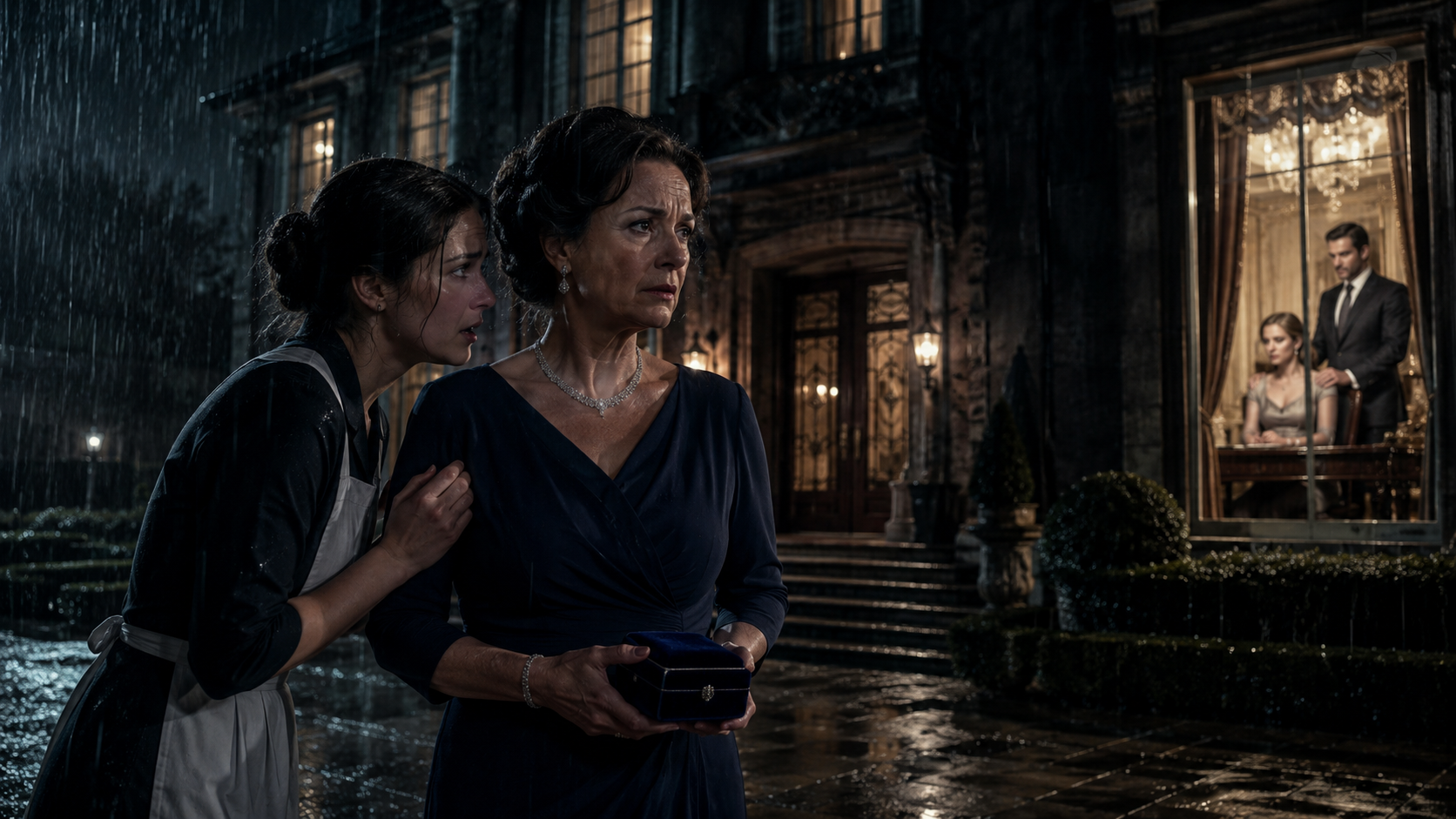
Lena clutched Eleanor’s coat.
Gideon looked at her then.
Not with love.
Not even anger.
With ownership.
“You will regret this,” he said softly.
For the first time, Lena lifted her head.
Her voice shook, but the words came.
“I already regret staying.”
The smile left Gideon’s face.
Mara whispered, “We need to go.”
They moved quickly.
Lena was taken for medical evaluation. Mara gave a formal statement. Naomi filed for protective orders before noon. By evening, the story Gideon had planned for Eleanor began to collapse under the weight of recordings, documents, altered messages, financial records, and Lena’s toxicology screening.
It did not happen cleanly.
Nothing real does.
Gideon denied everything. His lawyers called it a family feud, a misunderstanding, a mental health crisis, a campaign of revenge by a bitter mother. He accused Mara of theft. He accused Naomi of ambition. He accused Eleanor of poisoning Lena against him.
But for once, accusation did not become truth simply because a powerful man spoke it first.
The court froze the attempted conservatorship filings. Millstone House was protected. Lena entered treatment under doctors Gideon did not know. Mara was moved into temporary housing through an advocacy program. Gideon’s business partners began asking questions he could not polish away.
And Eleanor waited.
That was the hardest part.
Waiting while Lena slept.
Waiting while doctors adjusted medications.
Waiting while her daughter remembered things in fragments and broke down over memories that returned like knives.
Some days Lena apologized until Eleanor had to beg her to stop.
Some days Lena was angry, not at Gideon, not at the court, but at herself.
“I was not weak before him,” she said once, sitting by the window in Naomi’s office with a blanket around her shoulders. “I don’t know how I became that woman.”
Eleanor sat beside her.
“You became a woman surviving a room designed to confuse you.”
Lena looked at her. “You make it sound less ugly than it was.”
“No,” Eleanor said. “I make it sound less final.”
Three weeks after the night at the gate, Eleanor took Lena to Millstone.
The house stood under tall pines, gray and stubborn against the winter sky. The porch sagged at one corner. Moss climbed the stone steps. The orchard behind it was bare, its branches black against the clouds.
Lena stood in the driveway for a long time.
“I thought you kept this place because you loved Uncle Thomas more than you loved me,” she said.
Eleanor looked at her daughter carefully.
“Who told you that?”
Lena’s mouth trembled.
“You know who.”
Eleanor did not touch her right away.
She had learned that healing required permission.
“I kept it,” she said, “because every time I imagined selling it, I saw you at seven years old chasing fireflies by that fence. I saw your father teaching you to skip stones before he got sick. I saw Thomas pretending he hated children while saving the biggest peaches for you.”
Lena covered her face.
Eleanor waited.
After a while, Lena whispered, “I don’t deserve to come back here.”
“No,” Eleanor said.
Lena looked up, startled.
Eleanor stepped closer.
“You do not deserve to come back unchanged. Neither do I. We both have work to do. You have to tell the truth, even when shame tells you to hide. I have to stop pretending love means never being hurt. But this place was never a prize for perfect people.”
The wind moved through the pines.
Eleanor reached into her coat pocket and took out the velvet box.
Lena stared at it.
“I brought this to dinner that night,” Eleanor said.
With shaking fingers, Lena opened the box.
The old charm bracelet lay inside, silver dulled with time.
A paintbrush.
A moon.
A key.
A bird.
Lena touched the bird charm and began to cry.
“I thought you threw it away.”
“I kept it for someday.”
Lena let out a broken laugh through tears.
“Is this someday?”
Eleanor looked at the house, the trees, the long road behind them, the uncertain road ahead.
“No,” she said softly. “This is the morning after.”
Lena leaned into her mother then, carefully at first, then fully.
Eleanor held her.
She did not pretend the past year had vanished. It had not. Trust is not a window that can be wiped clean with one apology. It is a wall rebuilt brick by brick, and some bricks cut the hands.
But her daughter was alive.
Her daughter was free.
And the truth, once dragged into daylight, had begun doing what truth does best.
It had begun making liars afraid.
Months later, people in town would still talk about the Vale case.
They would discuss the lawyer, the hidden recordings, the financial scheme, the dramatic dawn escape. They would call Mara brave. They would call Gideon monstrous. They would call Lena tragic, then resilient, then lucky.
But Eleanor would remember something quieter.
She would remember the front steps of a beautiful house where danger wore manners.
She would remember a young housekeeper stepping from the shadows, trembling but unyielding.
She would remember the sentence that saved her life.
Not “I love you.”
Not “I’m sorry.”
Not “Come home.”
Only this:
“Do not knock.”
Sometimes salvation does not arrive with trumpets.
Sometimes it wears a gray uniform, carries laundry in shaking hands, and whispers the truth just before the door opens.