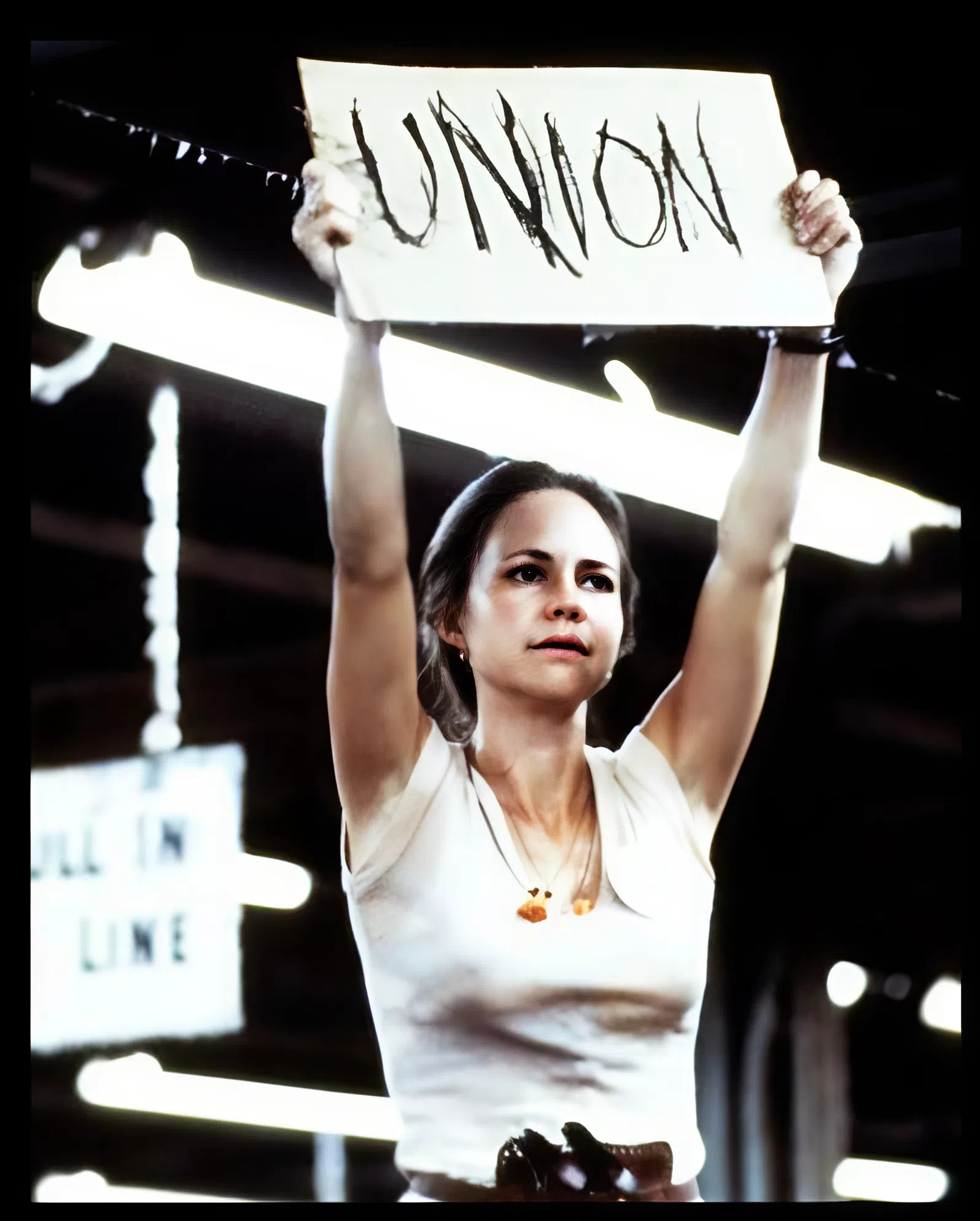
Sally Field’s powerful performance in Norma Rae (1979) cemented her place as one of Hollywood’s finest actresses.
Her portrayal of a determined textile worker fighting for labor rights earned her an Academy Award and left audiences in awe.
But behind the scenes, the path to that unforgettable performance was marked by emotional struggles, self-doubt, and even a few broken ribs.
Holidays, the 40-hour work week, healthcare, worker safety laws, child labor protections, minimum wage — the list goes on. None of these crucial worker rights would exist without unions, even for those not in them.
In Norma Rae, Sally Field’s iconic portrayal of a woman standing up for her rights and the rights of her fellow workers is still a reminder of how far we’ve come.
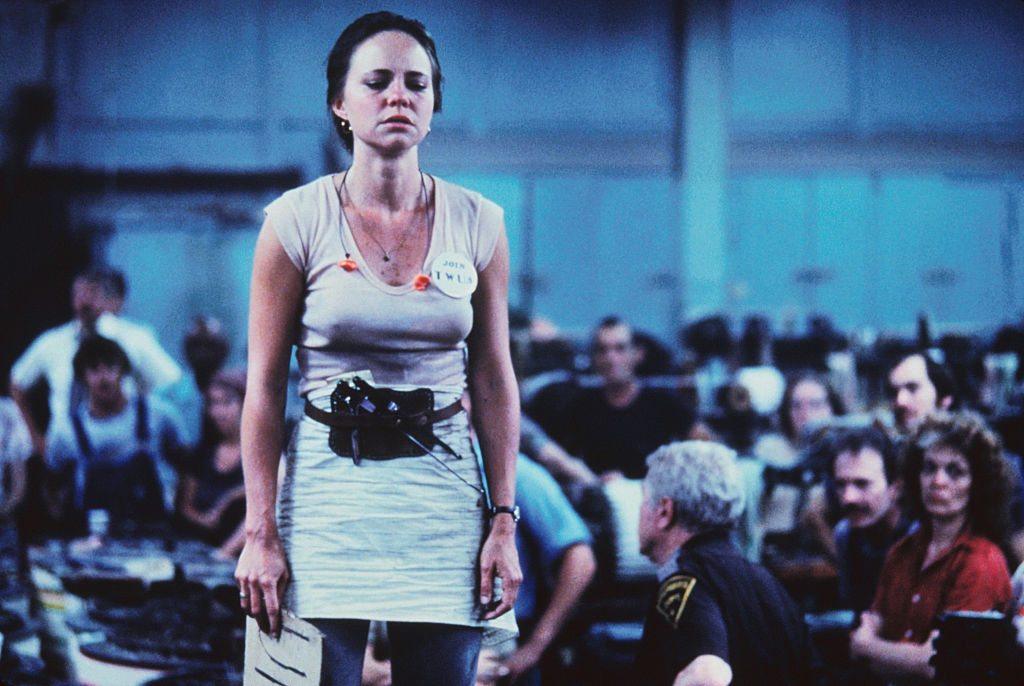
Sally’s performance not only earned her the recognition she deserved, but also likely inspired future powerhouse performances from actresses like Julia Roberts in Erin Brockovich and Meryl Streep in Silkwood.
But as mentioned, she had to pay a high price for her iconic role.
Did the film against Burt Reynolds’ advice
Before Norma Rae, Sally Field was still trying to break free from her early TV image as The Flying Nun and Gidget. Hollywood didn’t take her seriously, and she knew she had to prove herself. When the opportunity to play Norma Rae Webster came along, she saw it as a chance to redefine her career — but it wouldn’t be easy.
A major problem was that Sally’s then-boyfriend, superstar Burt Reynolds, was being unsupportive and jealous.
Reynolds didn’t approve of Field taking on the role of Norma Rae and famously told her, ”No lady of mine is gonna play a whore.” When Field tried to explain that it was just a part she was playing, Reynolds mocked her, saying, ”Oh, so now you’re an actor… you’re letting your ambition get the better of you.”
Sally recalled the moment she first watched the film, sitting in a small screening room at Fox Studios next to her mother, feeling an overwhelming fear.
”What flashed through my head was the fear that I wasn’t enough to hold an audience for two hours,” she reflected.
Proposed on the last day of filming
The high-profile relationship between Sally and Reynolds began after he asked her to star in Smokey and the Bandit. At first, their connection was instantaneous and intense, but it soon turned into a nightmare for Sally.
She describes how the movie star quickly began to ”housebreak” her, dictating ”what was allowed and what was not,” which led her to become a ”shadowy version of herself.” His negative attitude toward her role in Norma Rae was just the latest manifestation of all the criticism Burt had for Sally.
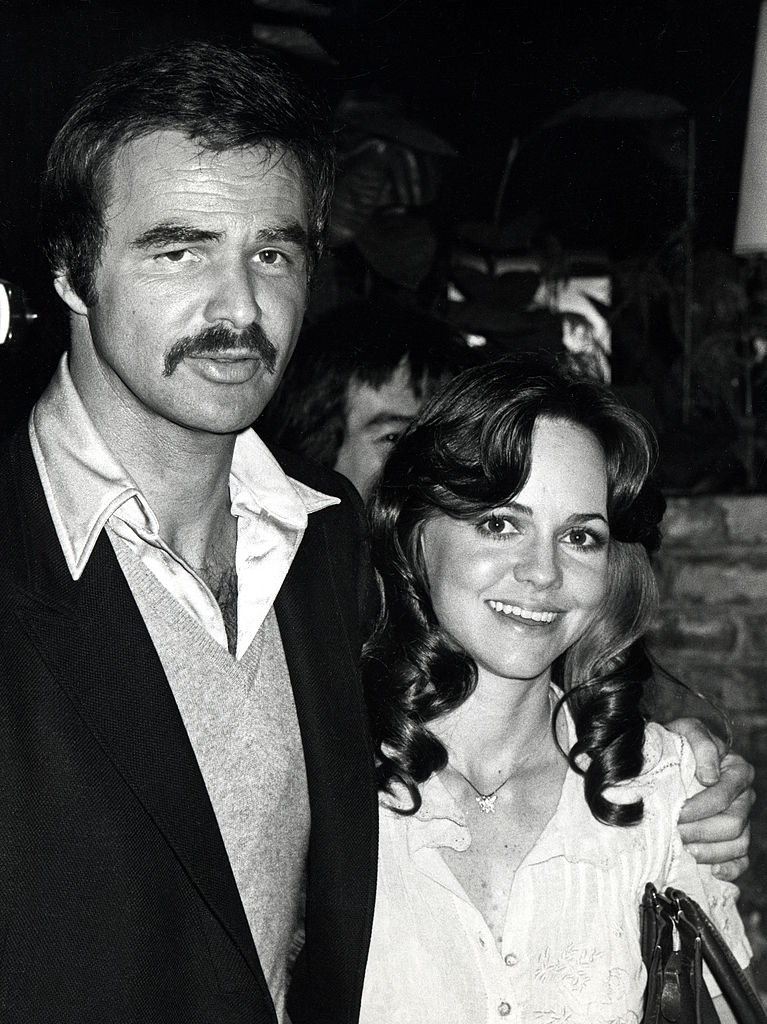
Despite his objections, Field went ahead with the role. On the final day of filming, Reynolds showed up on set and proposed with a diamond ring. Field recalls the moment, saying it felt ”not me,” and she didn’t accept his proposal. The awkward exchange left her with little to say other than a simple, ”thank you.”
After Norma Rae wrapped up, Field began to feel herself growing more confident and independent – it was almost as if the role and her personal life collided. Field noticed her personality starting to ”flare out,” which did not sit well with Reynolds.
He responded with ”shocked disapproval.”
Worked in the mill every day for two weeks
As many might recall, Norma Rae is inspired by the real-life story of Crystal Lee Sutton, a textile worker from Roanoke Rapids, North Carolina, where the fight for a workers’ union unfolded at a J.P. Stevens Textiles mill.
Field auditioned for the role while briefly visiting New York from the set of Hooper and was chosen for the part, which had already been passed over by several actresses. (According to her autobiography, Shirley MacLaine had initially expressed interest in the role.)
To fully prepare for her role, Sally Field dove deep into the lives of Southern mill workers. She and Beau Bridges conducted thorough research by spending time working in a factory, according to IMDb. Field immersed herself in the environment, adopting the workers’ mannerisms, understanding their struggles, and experiencing the physical and emotional exhaustion they faced.
”I worked in the mill every day for two weeks; not all day long, I didn’t have an 8-hour shift, but I felt like it. I guarantee, two hours in that weaving room felt like 8 hours anyplace else, because the vibration is like the motion on a ship, the whole room shakes and it makes you seasick. So you have to get used to it, get your sea legs. All the actors and the crew were saying, ‘I don’t know how they do it’,” Sally Field explained.
Where did they shoot Norma Rae?
While the real story of Crystal Lee Sutton unfolded in Roanoke Rapids, North Carolina – but Norma Rae was actually filmed in Opelika, Alabama.