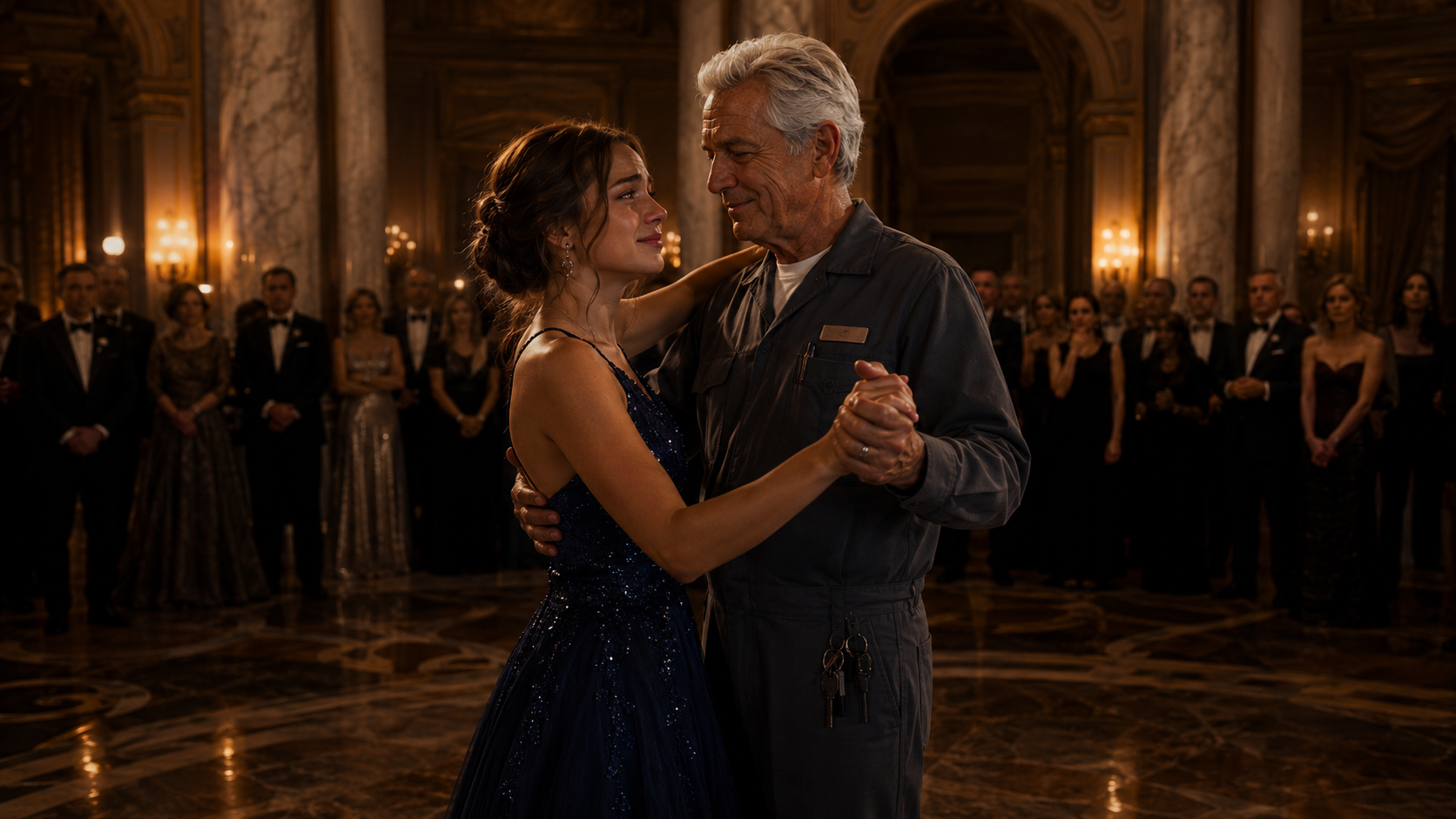
“I wish Mom could see us.”
Daniel smiled.
“She can.”
On the final note, he guided Celeste into the same gentle turn he had taught her when she was eight years old.
She returned to him, and he kissed her forehead.
For several seconds, no one made a sound.
The ballroom was completely silent.
Then Noah began to clap.
A woman near the orchestra joined him. Another guest rose from his chair. Within moments, the entire ballroom was standing.
The applause became thunderous.
Daniel looked overwhelmed.
Celeste embraced him.
The chandeliers suddenly came back to life, flooding the ballroom with gold.
This time, Daniel did not retreat toward the shadows.
Celeste took his hand and led him toward the main table.
Marcus intercepted them.
“You’ve made your point,” he said.
Celeste looked at him calmly.
“This was never about making a point.”
“You embarrassed me in front of everyone.”
“I danced with my father.”
“You turned a respected event into a spectacle.”
“No. You turned my family into something I was expected to conceal.”
Marcus glanced at Daniel.
“This is a private conversation.”
Daniel released Celeste’s hand.
“I’ll give you some space.”
She stopped him.
“You don’t have to leave.”
Then she turned back to Marcus.
“My father spent years repairing buildings so Noah and I could study. He worked nights after my mother became ill. He sold the only car he had to pay my university fees. Every opportunity I have began with something he sacrificed.”
Marcus’s jaw tightened.
“I never insulted him.”
“You were embarrassed by his existence.”
“That’s unfair.”
“Is it?”
Several guests nearby pretended not to listen.
Marcus lowered his voice.
“We are getting married in three weeks. Do you really want to destroy our future because you became emotional during a song?”
Celeste looked at the diamond ring on her hand.
For months, she had ignored small moments that made her uncomfortable. Marcus corrected the way she spoke about her childhood. He discouraged Noah from visiting without notice. He had suggested that Daniel attend the wedding as an ordinary guest rather than walk Celeste down the aisle because the photographs would look “more balanced” with Marcus’s father beside her.
Celeste had accepted each wound separately.
Now she saw them together.
She removed the ring.
Marcus stared at it.
“Don’t be ridiculous.”
“I have spent too many years becoming someone other people would approve of.”
She placed the ring in his palm.
“I will not spend the rest of my life doing it.”
“Celeste.”
She closed his fingers around the ring.
“Our wedding is canceled.”
A shocked whisper passed through the nearest tables.
Marcus’s face became pale.
“You’ll regret this.”
Celeste looked at her father, her brother, and the ballroom filled with people who had finally seen her clearly.
“No,” she said. “I think I would have regretted marrying you.”
She walked away.
Daniel followed her into a quiet corridor beyond the ballroom. Noah joined them a moment later.
For several seconds, none of them spoke.
Then Noah laughed.
Celeste stared at him.
“What is funny?”
“You canceled the most expensive wedding in the city while standing beside a broken lighting panel.”
Daniel tried not to smile.
“It isn’t broken anymore.”
That made Celeste laugh too.
The sound surprised her. It grew until she was crying and laughing at the same time.
Daniel placed his arms around both of his children.
“I’m sorry about the wedding,” he said.
“I’m not,” Celeste answered.
“You might be tomorrow.”
“Then remind me of tonight.”
Daniel looked through the open ballroom doors. The orchestra had started another song, and couples were returning to the dance floor.
“I think tonight is going to be difficult to forget.”
Three months later, Celeste left the Aurelia Foundation.
The decision surprised the board, but she no longer wanted a career built around gaining approval from people who measured human value by wealth, family names, or invitations.
She created a smaller organization in an unused community theater near the neighborhood where she had grown up. Its purpose was simple: to provide music, dance, and arts programs for children whose families could not afford private lessons.
Noah managed the finances.
Daniel repaired the theater.
On opening night, they placed Isabelle’s old music box in the lobby inside a glass case. Beneath it was a small card containing the only words Celeste wanted displayed:
Listen first.
Your feet will understand.
At the end of the evening, after the families had gone home and the children had stopped running across the stage, Celeste found her father sweeping the wooden floor.
She took the broom from his hands.
“The work can wait.”
Daniel heard the opening notes of “When the Rain Returns” coming from a small speaker beside the stage.
He shook his head.
“Again?”
“You’re the one who taught me never to refuse this song.”
Daniel offered her his hand.
This time there were no chandeliers, wealthy guests, cameras, or formal gowns.
There was only an old theater, a worn wooden floor, and the music that had carried their family through love, grief, silence, and forgiveness.
They began to dance.
And there was no one left for Celeste to impress.