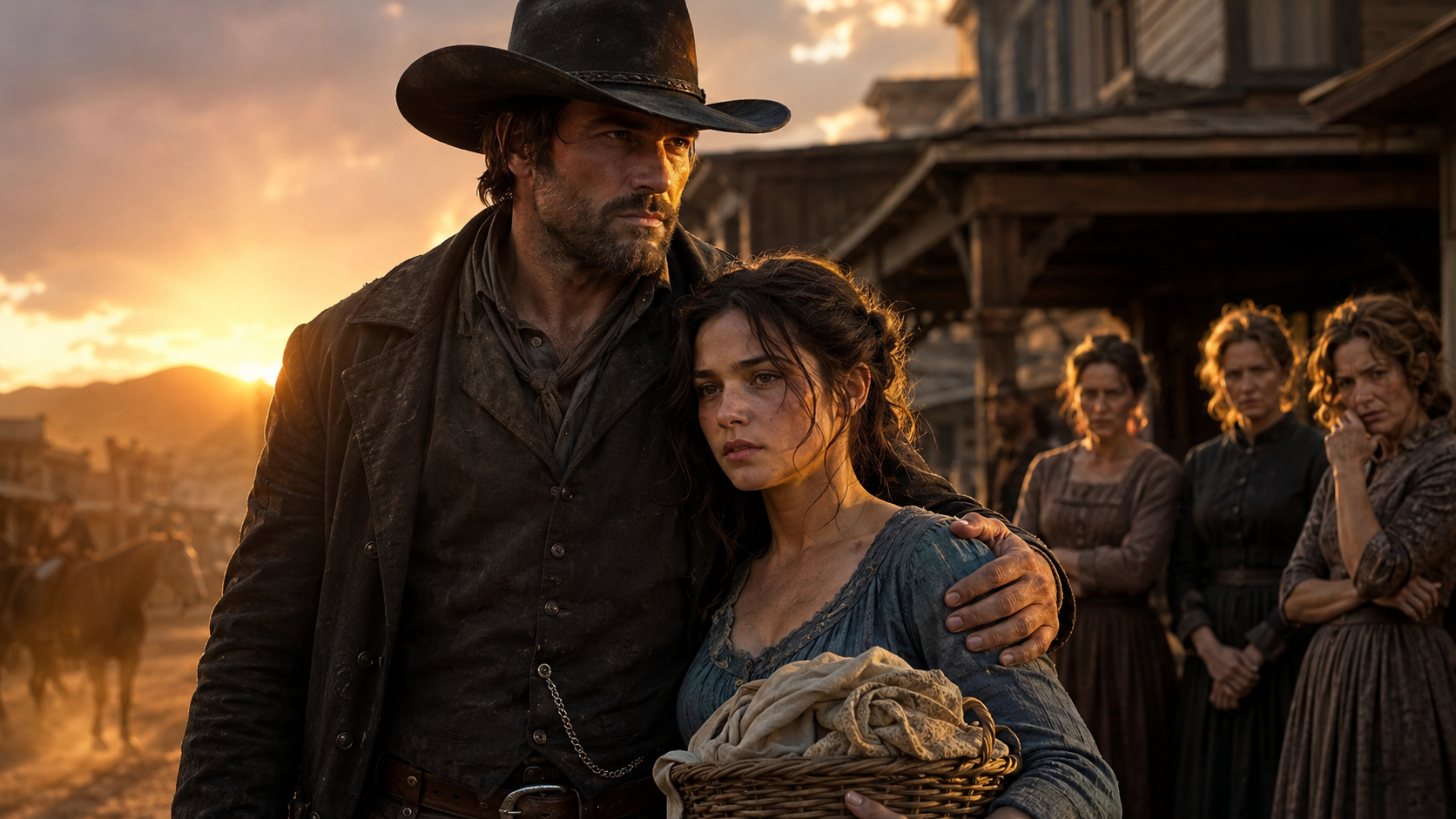
He waited until a cold rain started.
Then he sent men to cut the fence at the south pasture and drive Iron Mesa’s herd toward the ravine.
Mara heard the cattle before she understood the danger.
The sound came through the rain like thunder under the earth.
She stepped onto the porch.
The herd was moving wrong.
Too fast.
Too blind.
Ben came running from the barn. “Fence is cut!”
Mara’s heart slammed once.
Gideon was miles away.
Boone was in town.
The only people at the ranch were Mara, Ben, Clara, who had come visiting, and an old hand named Amos with a bad knee.
Mara grabbed Gideon’s rifle from inside the door.
Ben stared. “Can you shoot?”
“No,” she said. “But I can make noise.”
They ran.
Rain turned the ground slick. The cattle came wild through the gray light, pushed by fear and the pressure of the herd behind them. If they reached the ravine, dozens would die. Maybe all.
Mara saw the torn fence. Saw three riders beyond it. Saw one of them turn and flee.
Sloane’s men.
No time.
“Ben!” she shouted. “Lanterns!”
“What?”
“Every lantern in the barn! Light them and hang them along the ravine path!”
“In the rain?”
“Do it ugly!”
He ran.
Mara fired the rifle into the air.
The shot cracked across the pasture.
The cattle veered, not enough.
She fired again.
Amos limped from the barn beating a shovel against a pan. Clara came behind him with two lanterns and a face white with fear.
Together they made light, noise, movement.
Mara ran straight toward the lead cattle, waving her coat, screaming until her throat tore.
For one second, the whole world became hooves and mud.
A steer charged.
Mara slipped.
The animal came at her like a wall.
Then a horse cut between them.
Gideon leaned from the saddle, seized Mara by the back of her dress, and lifted her clean off the ground as the steer thundered past.
He set her down behind him and wheeled his horse.
“Gate!” he shouted.
Boone appeared on the ridge with three riders from Dutch Keller’s place, all of them yelling, ropes swinging.
For the next twenty minutes, the pasture became chaos.
Men rode hard. Cattle turned. Lanterns swung in rain. Mara kept shouting until the herd finally broke away from the ravine and poured toward the holding field.
When it was over, Gideon found Mara standing in the mud, shaking so badly she could barely stay upright.
He got off his horse and crossed to her.
“You could have died,” he said.
“So could your herd.”
“I don’t love the herd.”
The words hit them both at the same time.
Mara stared at him.
Rain ran down Gideon’s face.
He looked angry. Terrified. Alive in a way she had never seen him.
“I love you,” he said, as if it hurt to keep it inside. “And if you ever run in front of stampeding cattle again, I will marry you just so I can spend fifty years telling you not to.”
Mara began laughing.
Then crying.
Then she grabbed his coat and kissed him in the rain.
Behind them, Boone yelled, “Finally!”
Amos said, “Took him long enough.”
Clara covered her face and smiled through her hands.
Two days later, Sheriff Abel Crow rode to Sloane’s house with witnesses, statements, and one of Sloane’s own men tied to a confession.
Victor tried to run.
He did not get far.
Mercy Crossing watched him brought back in handcuffs, muddy, furious, and smaller than anyone remembered.
No one cheered.
That would have been too honest.
But doors opened. Curtains moved. Men who had bowed to him for years suddenly found the courage to look him in the eye.
Mara stood beside Gideon on the boardwalk.
Dorothea Pike, awaiting trial and stripped of her old power, watched from a wagon outside the jail. Her face was gray.
For a moment, Mara thought she would feel triumph.
She did not.
She felt free.
That was better.
Winter came early.
Iron Mesa survived it.
The ranch hands complained about the cold, the beans, the mud, the snow, and Boone’s singing. Mara told them complaints cost a penny each and collected enough by Christmas to buy new curtains for the kitchen.
Clara stayed through the first frost, then decided Mercy Crossing needed a respectable boardinghouse more than the east needed another widow with opinions. She bought Dorothea’s old laundry at auction and turned it into a place where no hungry woman was ever told she should be grateful for crumbs.
Gideon rebuilt the south fence stronger than before.
Mara painted the smokehouse herself.
Not to cover old cruelty.
To claim the wall.
In spring, Gideon asked her to marry him under the cottonwoods by the creek.
He had planned words. Good ones, he thought. Simple. Honest.
But when Mara came walking toward him with flour on one sleeve and sunlight in her hair, every word vanished.
So he held out a small ring made from his mother’s old gold chain and said, “Stay.”
Mara looked at the ring.