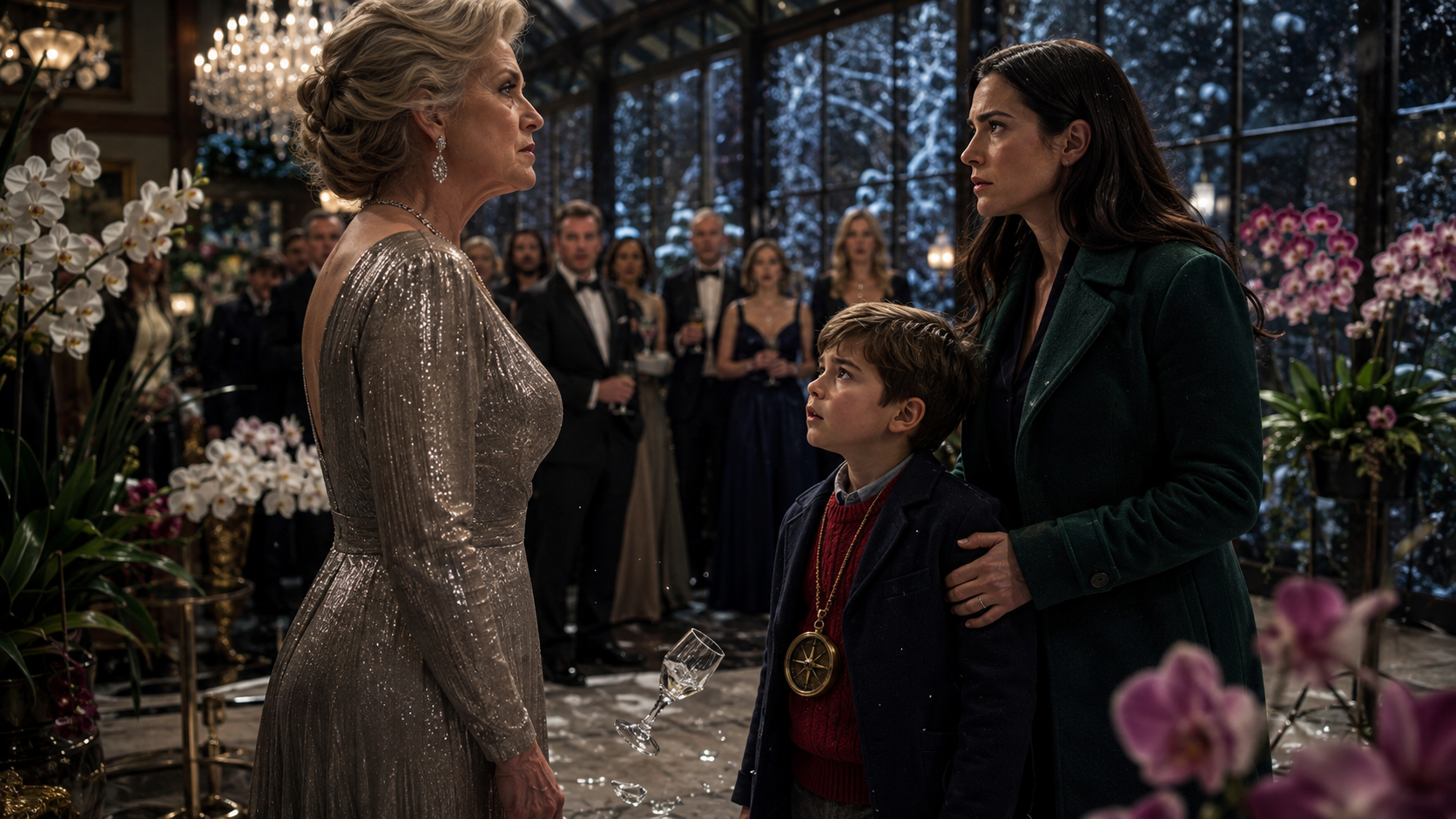
Beneath the great iron ribs of the building, two hundred guests moved through an artificial summer. White orchids climbed marble columns. Warm mist drifted above shallow pools filled with black lilies. A string quartet played beneath a suspended garden while waiters carried crystal glasses through a crowd of ministers, bankers, actors, and heirs.
At the center of it all stood Vivian Rook.
She wore silver, not because it was fashionable, but because it made everyone else look dim. At sixty-two, she had the posture of a ruler and the patient smile of someone who had never heard the word “no” without punishing the person who said it.
Behind her, the illuminated dome of the conservatory displayed the emblem of Rook Meridian, the shipping and energy empire she had controlled for nearly three decades.
“Tonight,” Vivian told the room, “we celebrate endurance.”
Applause rolled beneath the glass ceiling.
She lifted her champagne.
“Markets change. Governments fall. Reputations are tested. But institutions built on discipline survive.”
The applause grew louder.
Only one man near the stage did not clap.
Arthur Pell, the company’s oldest board member, watched Vivian with the exhausted expression of someone who had spent too many years protecting a secret. Vivian noticed him, but before she could decide whether his silence was dangerous, the rear doors opened.
A blade of winter air cut through the conservatory.
The quartet faltered.
A woman stepped inside, brushing snow from the shoulders of a dark green coat. She was neither dressed for the gala nor embarrassed by that fact. Her hair was wet from the storm. A narrow scar crossed one eyebrow. In her left hand, she carried a worn leather folder.
With her right hand, she held a little boy.
He looked seven, perhaps eight. He wore a red wool sweater under a navy jacket, and around his neck hung a brass compass on a black cord. He stared at the glass ceiling, the orchids, the chandeliers, and finally at Vivian.
Vivian’s champagne glass stopped halfway to her lips.
The woman was Lena Vale.
Eight years earlier, Lena had worked in Rook Meridian’s internal audit division. Then she had accused the company of hiding evidence connected to a fatal refinery explosion. Within a week, newspapers called her unstable. Within a month, her bank accounts were frozen by a court order. By the end of the year, she had disappeared.
Vivian had made certain of it.
A murmur traveled through the room.
Vivian lowered her glass.
“This is a private event.”
Lena looked at the stage, then at the security guards moving toward her.
“I know.”
“Then you know you are not welcome.”
The boy tightened his hand around Lena’s fingers.
Vivian pointed toward the doors.
“Remove her.”
The guards stopped when Arthur Pell stepped between them and Lena.
“No,” he said.
The single word landed harder than a shout.
Vivian turned slowly.
“Arthur.”
He did not look at her.
“Let her speak.”
A dozen phones rose from the crowd. Vivian saw them and smiled again, but the smile had become thin and dangerous.
“Put those away,” she told the guests. “This woman has a documented history of delusion.”
Lena unfastened her coat.
“I had a documented history,” she said, “because your lawyers wrote it for me.”
The boy looked up at Vivian.
“Are you Aunt Vivian?”
The room went still.
Vivian’s face did not change, but her fingers tightened around the stem of her glass.
Lena knelt beside the child.
“Theo, stay close to me.”
He touched the compass at his chest.
“But Dad said she would know this.”
Vivian’s glass slipped from her hand.
It struck the marble edge of the stage and broke. Champagne ran down the steps in a shining line.
No one moved.
Lena stood.
“The compass belonged to Julian Rook,” she said. “Your brother. Theo’s father.”
Several guests gasped. The company’s younger executives looked at one another, confused. They knew the official version: Julian Rook, cofounder of Rook Meridian, had died eight years earlier when his boat caught fire off the coast of Maine. No body had been recovered. Vivian had delivered the eulogy herself.
Vivian’s voice was quiet.
“My brother had no son.”
Theo looked at her with open, puzzled eyes.
Lena answered, “He did. Julian kept Theo hidden because he believed you would use the child to control him.”
“That is absurd.”
“Is it?”
Lena opened the leather folder and removed a sealed document.
Vivian laughed, but no one joined her.
“You arrive with a child and a piece of paper, and you expect this room to accept a fantasy?”
“No,” Lena said. “I expect the trustees to accept a blood test, a registered birth certificate, and the Founders’ Covenant you signed in 1997.”
Arthur Pell closed his eyes.
Vivian turned toward him.
“What have you done?”
“What I should have done years ago.”
He climbed the stage and faced the board members gathered near the front tables.
“The Founders’ Covenant states that if either founder dies or becomes incapacitated, that founder’s voting shares transfer to a lawful descendant through an independent trust. Julian’s shares were never Vivian’s to absorb.”
Whispers erupted.
Vivian raised her voice.
“Julian was declared dead.”
“He was declared dead because you submitted false evidence,” Lena said.
The orchids, the music, the warm mist—everything beautiful in the conservatory suddenly seemed artificial.
Vivian stepped down from the stage.
“Be careful.”
Lena did not retreat.
“You taught me that sentence,” she said. “You said it the night your security team took me from my apartment. You said nobody would believe a junior auditor over Vivian Rook.”
“I was right.”
“You were. For a while.”
Lena removed a small digital recorder from the folder.
Vivian’s expression finally cracked.
“No.”
The boy looked from one woman to the other.
Lena pressed a button.
Static filled the conservatory. Then a man’s voice emerged, weak but unmistakably clear.
“My name is Julian Rook. If this recording is being played, my sister has failed to destroy the last copy.”
A woman near the bar covered her mouth.
Vivian stared at the recorder as though it were alive.
Julian’s voice continued.
“The refinery explosion was not an accident. We knew the cooling system was unsafe. I ordered the facility closed. Vivian reversed the order because a shutdown would have ruined the merger. Twenty-three people died.”
The crowd shifted away from Vivian.
“She is lying,” Vivian said, though the voice was her brother’s.
The recording continued.
“When I threatened to go to the authorities, Vivian arranged the fire on my boat. I survived. Two fishermen found me before her men did. Lena helped hide me while I recovered.”
Lena watched Vivian, not the recorder.
“For eleven months,” Julian said, “we collected records, payment trails, internal messages, and the names of everyone involved. Then Vivian found us.”
Theo pressed against Lena’s side.
The voice paused. A faint breath could be heard.
“She could not kill me without risking another investigation. So she placed me in a private neurological clinic under a false name. She told the doctors I was violent and incompetent. I remained there for six years.”
Someone in the crowd whispered, “My God.”
Vivian’s eyes moved toward the exits.
Two uniformed officers had appeared inside the rear doors. Beside them stood a federal investigator in a dark coat.
Lena had not come to threaten Vivian.
She had come after the warrants were signed.
Julian’s recording played on.
“Arthur Pell discovered where I was. He helped Lena reach me. I saw my son for the first time three months before I died.”
Theo’s small hand closed around the compass.
“In case Vivian claims I was manipulated, my statement was witnessed by two physicians, an independent judge, and federal counsel. Theo Vale is my son and lawful heir. My voting shares belong to his trust. Lena Vale is the trustee until his twenty-fifth birthday.”
The recording ended.
For several seconds, the only sound was snow ticking against the glass.
Vivian looked at Arthur.
“You betrayed me.”
He shook his head.
“I stopped helping you betray everyone else.”
She turned to the board members.
“Do you understand what happens if I fall? The company collapses. Pension funds vanish. Thousands lose their jobs. She has no idea how to run what I built.”
Lena’s answer came without anger.
“You did not build it alone. You erased the people who built it with you.”
Vivian pointed at Theo.
“And you would place an empire in the hands of a child?”
“No. I would place it in a trust protected from people like you.”
The federal investigator approached the stage.
“Vivian Rook, we have a warrant for your arrest on charges including conspiracy, unlawful confinement, obstruction of justice, securities fraud, and destruction of evidence.”
The phones were still raised. Cameras recorded every tremor in Vivian’s face.
For the first time that evening, she looked old.
Then Theo stepped away from Lena.
He walked toward Vivian before anyone could stop him.
Lena reached for him, but Arthur gently shook his head.
Theo stopped a few feet from his aunt.
“Did my dad hate you?”
Vivian looked down at the child.
Her mouth opened, but the practiced words did not come. No denial. No command. No insult.
Only a broken breath.
Theo touched the compass.
“He said people can do terrible things and still remember when they loved someone.”
Vivian’s eyes filled.
It was the smallest sign of humanity she had shown all night, and it came too late to save her.
“He was my little brother,” she whispered.
“Then why did you hurt him?”
The question moved through the conservatory more sharply than any accusation Lena had prepared.
Vivian looked at the orchids, the guests, and the company emblem glowing above the stage. She had spent half her life turning fear into power and power into proof that she had been right.
At last, she said, “Because he was going to take everything away.”
Theo shook his head.
“No. You did.”
The investigator placed a hand on Vivian’s arm.
She did not resist as she was led across the marble floor. The crowd opened before her, not with respect, but with the instinctive distance people give a falling structure.
When the doors closed, winter air swept through the conservatory again.
The quartet remained silent.
Lena climbed the stage with Theo beside her. She looked at the board, the employees, and the guests who had spent years applauding Vivian because applause was safer than doubt.
“Rook Meridian will not close tonight,” she said. “But the company Vivian created around herself is finished.”
She announced an independent investigation, compensation for the refinery victims, protection for whistleblowers, and the immediate release of every sealed safety report. Arthur placed the Founders’ Covenant on the podium.
Theo tugged Lena’s sleeve.
“Can we go home now?”
A few people laughed softly—not because anything was funny, but because the child’s ordinary question broke the spell.
Lena knelt and zipped his jacket.
“Soon.”
Above them, the storm began to clear. Moonlight appeared through the glass roof, pale and cold, touching the orchids, the broken champagne, and the brass compass resting against Theo’s heart.
The gala had been designed to celebrate an empire that could survive anything.
Instead, it became the night a child walked through the snow and proved that survival was not the same as innocence.

