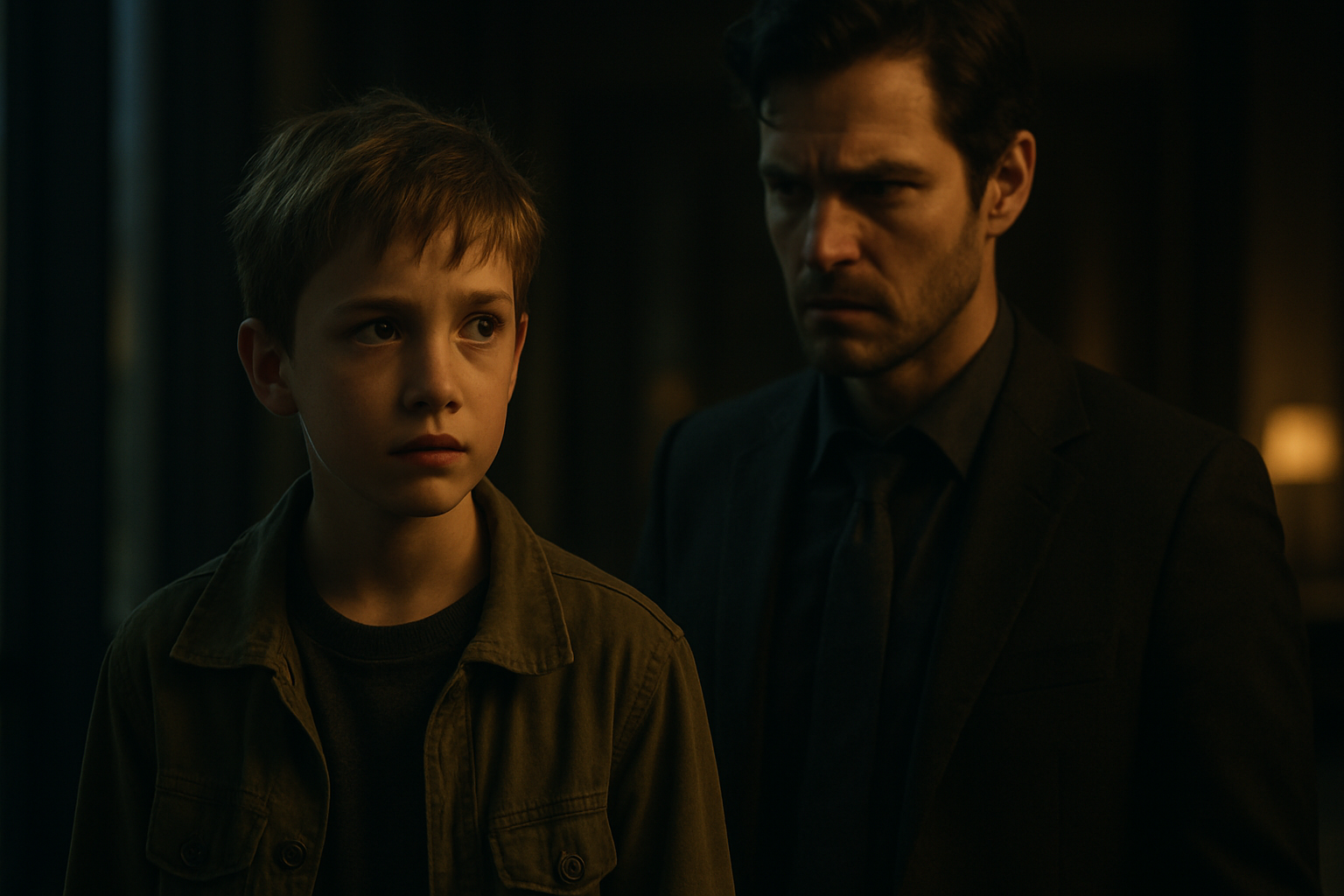
And she watched Cassian.
He remained in the wheelchair. He remained controlled, cool, difficult to read. To anyone else, his stillness might have looked like weakness, like a man reduced to waiting.
But once Mara knew to look closer, his stillness changed shape.
It became strategy.
A man pretending not to see could see everything. A man others believed broken could listen freely while they made the mistake of speaking near him. A man underestimated in his own house could turn every room into a trap without rising from his chair.
The penthouse itself began to feel less like a home and more like a stage.
Every corridor gleamed too brightly. Every vase of flowers stood too perfectly arranged. Every conversation seemed to stop a second after Mara entered and resume half a second too soon after she left.
Everyone was performing.
Everyone was pretending they were not.
Even Milo seemed to sense it in the odd, piercing way children sometimes do. He grew quiet whenever Seraphina passed the breakfast room. He no longer waved at her. Once, while Mara buttoned his sweater after lunch, he leaned close to her ear and whispered, “Pretty lady loud inside.”
Mara went cold.
Seraphina had not said a word.
The clearest proof came on a Friday afternoon.
Vanessa had learned that expensive bathrooms did not smell better than ordinary ones when fear lived in the walls.
They still gathered steam in the corners. They still collected fingerprints on polished chrome. They still required a woman on her knees with a sponge in one hand and a bottle of disinfectant in the other, wiping away evidence that someone else had been comfortable there.
The east guest bathroom was all pale stone and brushed nickel, a room designed to make even silence look curated. The mirror was wide enough to reflect a person twice over, once as she was and once as she might have been if her life had unfolded in a softer direction. Vanessa avoided looking into it. She had a habit, built over years of cleaning other people’s homes, of becoming invisible even to herself while she worked.
The window above the freestanding tub had been cracked open for ventilation. Outside, winter pressed its gray face against the glass. Below, the private garden terrace slept beneath frost-stiff shrubs and expensive stone planters. In spring, Mrs. Alvarez said, the terrace bloomed with white roses and lavender. Now it looked like a place where secrets went to freeze.
Vanessa was polishing the faucet when Vivienne’s voice drifted up through the narrow opening.
“He knows about some of it,” Vivienne said. “Not enough.”
Vanessa’s hand stopped.
The cloth remained pressed to the faucet. Water beaded along the shining curve of metal, trembling there like it too had heard something it should not have.
A man answered from below, his voice lower, blurred by distance and the cold air funneling upward. Vanessa could not make out his words, only the shape of them: controlled, displeased, familiar with power.
Then Vivienne spoke again.
“No, Martin, listen to me. The accident bought us time, but not the way we expected. He is not diminished. He is watching everything. That is what Adrian does. He sits still and lets people indict themselves.”
Vanessa lowered the cloth inch by inch.
Her heart had begun to beat in a way that felt too loud for the room. She looked toward the door, then back to the window. Every sensible part of her knew she should leave. She should turn on the tap, flush the toilet, make noise, make herself present, make herself innocent.
Instead, she lowered herself onto the closed toilet seat as carefully as if the floor might crack under her.
Vivienne’s voice sharpened with impatience.
“The maid is a complication. The kid saw something, I don’t know what, but Adrian is listening to her now. I want a performance file started. Reliability, inappropriate conduct, bringing a child into the workplace. Make it procedural, not personal.”
The maid.
Not Vanessa. Not a person with aching wrists and a sleeping child and rent due at the end of the month.
The maid.
A small, cold clarity moved through her. There was a violence to being reduced like that. It did not leave bruises, but it made every breath feel like something taken without permission.
The man murmured again.
Vivienne answered quickly. “Yes, after the board dinner. If we can push the incapacity narrative and trigger concern over leadership, the acquisition committee will move. The prenup is irrelevant if the marriage happens before he realizes how much I’ve given you.”
Vanessa pressed one hand to her mouth.
Marriage.
Acquisition.
Incapacity.
Performance file.
The words did not make a full picture. Vanessa did not know the machinery of boardrooms or the architecture of corporate betrayals. She knew bills, buses, missed shifts, childcare forms, fever charts, and the exact tone employers used before they fired a woman while pretending she had disappointed them.
But the pieces she did understand were enough.
Enough to know Vivienne was not merely cruel.