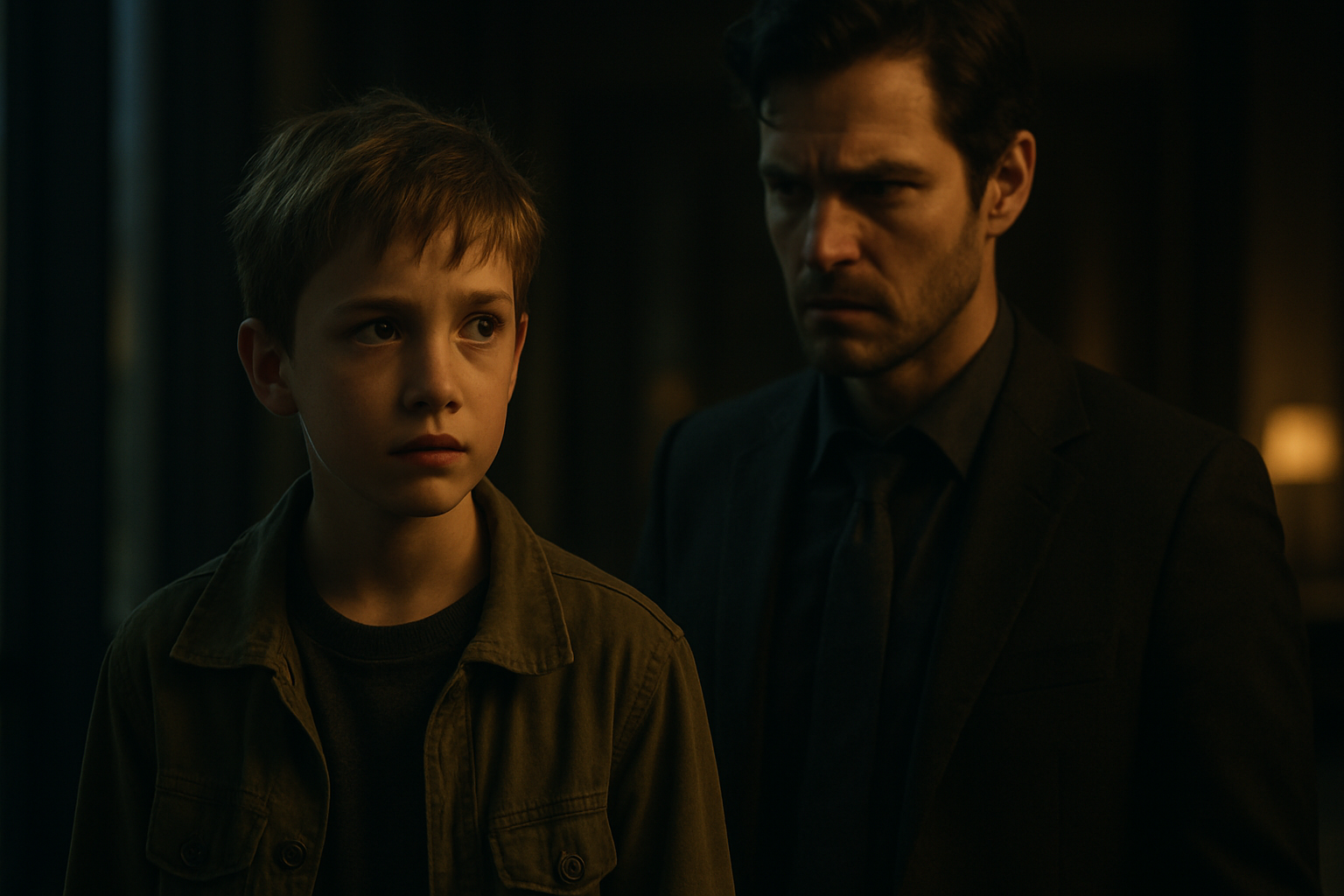
Her phone buzzed on the counter.
Unknown number.
She did not move.
It buzzed again.
Caleb watched her.
Vanessa picked it up with a hand that felt separate from her body.
The message was short.
Heard you moved up in the world. We need to talk about my son.
“I can adjust the structure,” Adrian said, his voice careful, as if he were setting glass down on marble, “so Mrs. Alvarez manages your role and compensation independently, with HR oversight through the estate office. You would not answer to me. You would not depend on my approval for hours, wages, evaluations, or housing. Or, if you prefer, I can help you transition to another position somewhere else before anything begins.”
Vanessa stared at him.
The sunroom had gone quiet around them, wrapped in late-morning light. Beyond the glass, Manhattan glittered and grumbled, traffic sliding between buildings like restless water. Inside, the air smelled faintly of coffee, polished wood, and the lemon oil Mrs. Alvarez insisted made the old tables look less lonely.
“You already thought about that?” Vanessa asked.
“Yes.”
“Of course you did.”
He lowered his eyes, not in shame exactly, but in acknowledgment. Adrian Blackwood had spent most of his adult life anticipating betrayal, boardroom traps, legal exposure, and strategic weakness. Planning came to him the way breathing came to other people. Even affection, Vanessa was beginning to understand, did not arrive in him without contingency plans.
But when she shook her head, she found herself smiling despite the weight of the conversation.
“Second rule,” she said.
Adrian looked up at once.
“Caleb is not a bridge between us,” Vanessa continued. “He is my son. His attachment matters, but it does not get used to hurry me. It does not get used to soften me. And it definitely does not get used to make something feel inevitable before I have chosen it.”
The softness left Adrian’s face, replaced by something more solemn. “Agreed.”
“I mean it.”
“I know you do.”
“No surprise visits disguised as kindness. No gifts that put me in a corner. No letting him ask questions you should be asking.”
His jaw tightened once, not in anger, but because the rule had found some hidden place in him that needed confronting.
“I won’t use him,” Adrian said. “Not as leverage. Not as proof. Not as a shield.”
Vanessa held his gaze, measuring the words and the man behind them. “All right.”
She wrapped both hands around her mug. It was still warm, though not hot enough to burn anymore. That felt fitting somehow. The conversation had started sharp and dangerous in her chest, but now it had settled into something she could hold.
“Third,” she said. “No grand gestures.”
Adrian’s brow lifted faintly.
“I’m serious,” she said. “No articles. No charity-event nonsense. No gala speech where you turn me into a story about the maid who saved the billionaire. No glossy photograph of me standing beside you while people clap and decide I’m inspiring because I was poor with dignity.”
A flicker of humor passed across his mouth. “You did save the billionaire.”
“I warned the billionaire,” Vanessa corrected. “The billionaire had lawyers, cameras, security files, and a fake wheelchair.”
“Fair.”
“And the billionaire saved himself, mostly because he was stubborn enough to sit still and let people underestimate him.”
“That is also fair.”
She took a sip of coffee to hide the smile tugging at her lips. She did not want to give him too much too quickly. There was danger in being charmed by a man who could buy buildings before breakfast and still look wounded because you would not let him buy forgiveness.
“Fourth,” she said, setting the cup down. “If this gets complicated, we tell the truth before it turns into strategy.”
That one landed differently.
Adrian went still.
The city moved behind him in bright panes of glass and silver distance. He sat with one hand resting near his coffee, the other curled against the arm of the chair. To anyone else, he might have looked composed. Vanessa had learned him better than that. She saw the small withdrawal behind his eyes, the instinctive retreat into rooms with locks, into silence, into the kind of control that had once kept him alive and nearly left him alone forever.
“That one may be the hardest for me,” he said at last.
“I know.”
His gaze returned to hers. “I have spent years letting truth arrive only when it served a purpose.”
“I know that too.”
“And you are asking me to give it before I know what it will cost.”
“Yes.”
Adrian inhaled slowly. “I agree anyway.”
Vanessa did not answer right away.
There were moments in life when happiness could be more frightening than grief. Grief was familiar. Grief had furniture. She knew how to move around inside it. She knew how to wake up tired, count money, stretch groceries, soothe Caleb through nightmares, and keep walking because there was no one else coming.
Hope was different.
Hope entered a room like an expensive guest and made you aware of every crack in the wall.