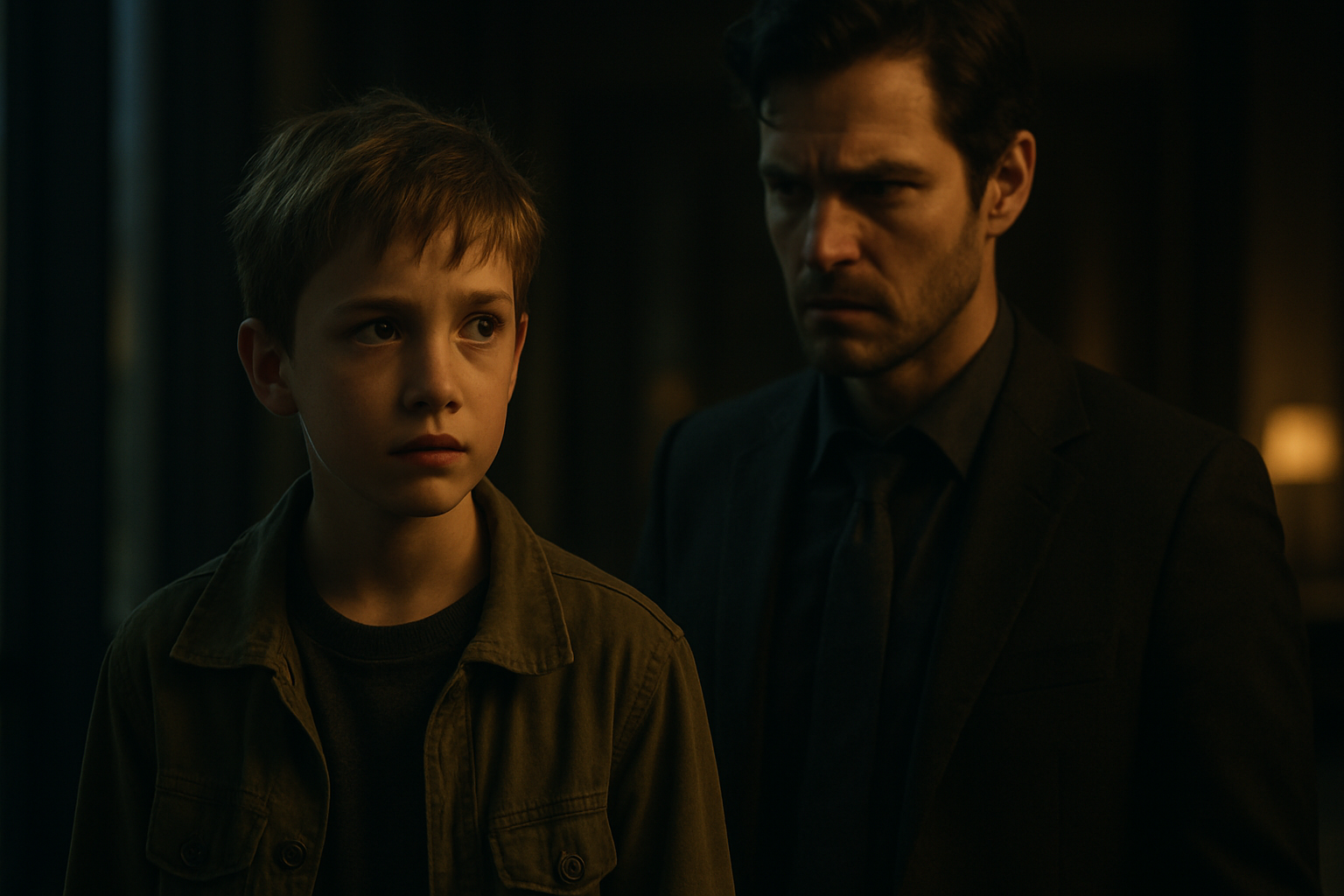
The room chilled.
“This started with you.”
Vanessa’s arms locked around her son before she could think. Caleb stared at Vivienne from the safe circle of his mother’s lap. His cheeks were still blotched from crying. One curl stuck damply to his forehead. He looked impossibly small against the dark leather sofa, his socked feet barely reaching the cushion’s edge.
But his eyes were clear.
He looked at Vivienne.
Then he lifted one small finger and pointed at Adrian.
“Keep him,” Caleb said.
The words were clumsy.
The meaning was not.
The room shifted again, but this time not with danger.
With recognition.
Adrian looked at Caleb, and something opened in his face so unexpectedly that Vanessa had no defense against it. Not softness exactly. Not relief. Something more painful. Something like a man hearing a verdict from the only judge in the room who had never learned to lie.
Security moved Vivienne toward the elevator.
This time, she did not resist.
People like Vivienne knew when power had turned away from them. They knew when a room no longer belonged to them. They knew when dignity meant pretending that the exit had been chosen, not imposed.
At the elevator doors, she looked back once.
“You’ll regret humiliating me,” she said.
Adrian’s expression did not change.
“No,” he said. “I’ll regret letting you close enough to touch a child.”
The doors slid shut.
The penthouse exhaled.
It was not silence exactly. Silence had lived there before, polished and curated. This was something else—the stunned absence that follows a storm after the windows have held.
For several seconds, no one moved.
Then Mrs. Alvarez appeared at the far end of the hallway.
She looked smaller than Vanessa had ever seen her.
The house manager’s usual severity was gone. Her shoulders were rigid, her face pale, her hands clasped in front of her as though she were standing before judgment.
“Mr. Kang,” she said. “I’m so sorry.”
Adrian turned his head.
“Apologize to Ms. Reed.”
The words struck Mrs. Alvarez harder than anger would have.
Her eyes moved to Vanessa.
For a moment, the older woman’s face held pride, fear, shame, and calculation all at once. Then something in it crumpled just enough to become human.
“Ms. Reed,” she said quietly. “I should have stopped the file. I knew it wasn’t right. I knew questions were being asked that had nothing to do with your employment. I told myself it was above my position.”
Vanessa was suddenly exhausted.
Exhausted in her bones.
Too tired for speeches. Too tired to decide whether forgiveness was mercy or another service being requested from her.
“I accept your apology,” she said automatically.
“No,” Adrian said.
Everyone looked at him.
He looked only at Vanessa.
“You don’t have to accept anything immediately because it is convenient for the rest of us.”
The sentence undid her more than the apology had.
Vanessa felt tears threaten, hot and sudden, and hated that they chose this moment—after she had stayed steady through Vivienne’s hand on Caleb, through the papers, through the revelation of Adrian rising from the chair. She swallowed hard.
“Then,” she said, voice rough, “I’ll think about it.”
Mrs. Alvarez nodded slowly.
“That’s fair.”
Caleb, who had endured betrayal, shouting, surveillance law, and corporate conspiracy with the limited patience of a toddler, rubbed both eyes with his fists.
“Snack?”
For a second, no one reacted.
Then Graham made a sound dangerously close to a laugh.
And because Caleb was two, and because the world had not ended, and because even after empires shifted and villains were escorted out under legal supervision children still needed crackers, everyone moved again.
Mrs. Alvarez went toward the kitchen. Graham stepped aside to make another call. Adrian remained near the doorway, standing with one hand braced lightly against the frame—not because he needed it, Vanessa thought, but because perhaps pretending to need nothing had become its own kind of exhaustion.
Caleb leaned against her chest.
“Snack,” he repeated, softer now.
“Yes,” Vanessa murmured. “Snack.”
Adrian heard.
Something in his mouth almost became a smile.
Three weeks later, the public story broke.
It did not break the way truth broke inside a room. Public truth was slower, colder, dressed in careful language and filtered through people whose job was to make crime sound like strategy.
Hawthorne Bridge Capital denied wrongdoing.
The denial lasted nine hours before a second report revealed that federal investigators had requested communications between Martin Vale, multiple board intermediaries, and outside advisors connected to KAIROS’s pending expansion.
Martin Vale resigned for “personal reasons” before the questions sharpened into subpoenas.
Business anchors said his name with that particular solemn delight reserved for men who had once been powerful enough to ignore everyone and were now useful as spectacle. Analysts appeared on panels to discuss insider access, market manipulation, vulnerability narratives, executive succession anxiety.