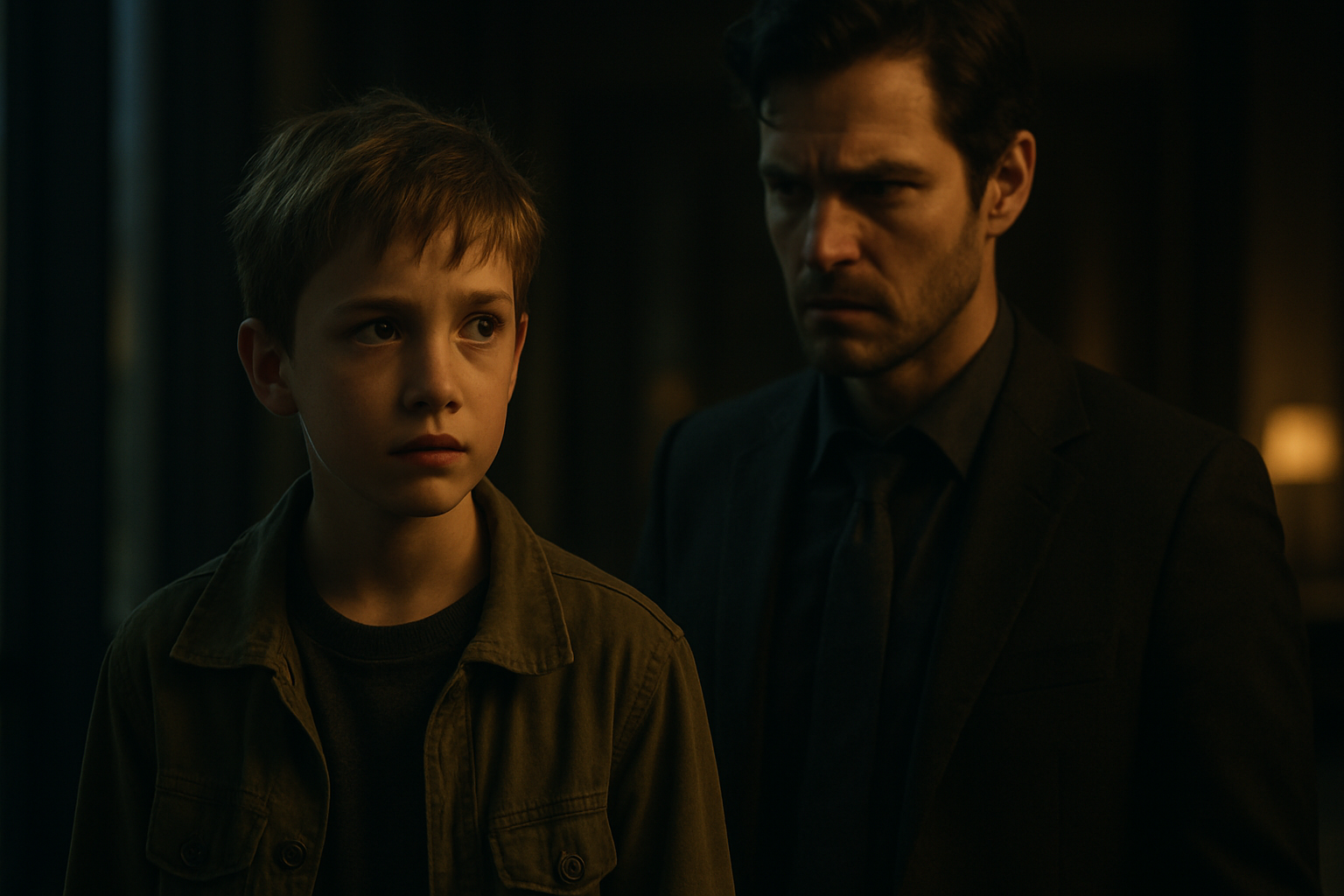
The Child Who Saw the Cracks

The Child Who Saw the Cracks

By morning, Mara Vale had almost succeeded in convincing herself that the night before had meant nothing.

Almost.

Cassian Rourke was a man built from discipline and distance. Everyone who worked in his sky-high penthouse knew that. He liked polished floors, silent doors, coffee exactly hot enough, and people who understood the value of staying invisible. He disliked disorder the way some men disliked betrayal. He did not raise his voice. He did not waste motion. He did not let emotion smear the clean lines of his world.

So when he had defended Milo the night before, Mara told herself it had not been kindness.

It had been correction.

Seraphina Voss had disrupted his charity reception. Milo had simply been the small, inconvenient spark that revealed the fire. The breakfast room had been offered because people like Cassian solved problems by assigning them space. A crying toddler in a service corridor became a liability; a toddler with a cot and crackers became order restored.

The cracker Milo had tried to give him meant nothing.

The way Cassian’s face had gone still—dangerously, painfully still—when Milo had screamed, “Don’t touch him again,” meant nothing.

The fact that Milo had not meant himself but Cassian?

That meant nothing, too.

Mara repeated all of this like a prayer she did not believe while she measured out Cassian’s coffee at six-thirty in the morning. Black. No sugar. White ceramic mug, the one with the faint gray vein running down the handle, used every day without fail. She repeated it while she balanced the tray against her hip and crossed through the silent kitchen, past the silver appliances and marble counters that never seemed to belong to anyone human.

She repeated it as she entered the sunroom, where Cassian always sat before the rest of the penthouse came alive.

The room hovered over the city like a glass lantern. Pale autumn light washed across the heated stone floor. Far below, Kingsley Green had begun turning gold at the edges, the trees catching morning as if each leaf held a small flame.

Cassian was where he always was: beside the eastern windows, seated in the chair that had become, to the household, a symbol of what had been taken from him. The wheelchair was sleek and dark, expensive enough to look less like medical equipment and more like a throne designed by someone with no mercy.

Mara set the tray down with careful hands.

Then Cassian said, “Sit down, please.”

Her fingers slipped.

The spoon struck porcelain with a sharp little cry.

“Mr. Rourke?”

“Five minutes.”

He did not look up from the window as he said it, and somehow that made the request feel less optional. Mara stood a second too long, trying to measure danger by the set of his shoulders, the angle of his head, the flat calm of his voice.

Refusing a billionaire in his own sunroom felt more reckless than obeying one.

So she sat in the armchair opposite him, perched on the edge as if the fabric might accuse her of overstepping.

Cassian lifted the mug, but he did not drink. “How old is Milo?”

Mara’s heart gave a hard little beat. “Two. He’ll be three after the new year.”

“And his father?”

She kept her face smooth, the way she had taught herself to do whenever that question came. “Not in the picture.”

Cassian nodded once.

He did not ask why.

That alone made something in Mara’s chest loosen and tighten at the same time. Most people heard single mother and leaned closer with the hungry politeness of those who believed pain was public property. They wanted the story. The abandonment. The bad choice. The mistake. They wanted to know which failure had made her life small enough to fit into their assumptions.

Cassian asked nothing.

Instead, he said, “Does Milo speak like that often?”

“Like what?”

“Clearly.” A pause. “At the exact wrong moment.”

Despite everything—despite the exhaustion, the fear, the memory of Seraphina’s hand closing around Milo’s small arm—Mara almost smiled.

“He speaks when he believes adults are missing something,” she said. “Which is often.”

Cassian’s mouth moved slightly.

It was not quite a smile. Not on a face like his, where expression seemed to require negotiation. But it was close enough to startle her.

“Last night,” he said, “when he said, ‘Don’t touch him again,’ did you understand what he meant?”

Mara felt the room sharpen around her.

She could hear the faint hum of the climate system. The distant hush of traffic far below. The tiny click of Cassian’s thumb against the handle of his mug.

“I thought he meant himself at first,” she said carefully. “Later, he told me he meant you.”

Cassian looked out over Kingsley Green.

“Yes.”

The single word settled between them like a sealed envelope.

Mara folded her hands tighter in her lap. “Did she hurt you?”

“No.”

The answer came too quickly.

Too smoothly.

A door closing before she could glimpse what lay behind it.

Mara said nothing. Silence, she had learned, could be a useful room. People often filled it with truths they had not meant to reveal.

Cassian turned his head and looked at her fully.

“Seraphina is going to make things difficult for you.”

Mara’s pulse changed. Not faster exactly—lower. Heavier. As if her blood had been warned.

“Because of Milo?”

“Because Milo spoke,” Cassian said, “and you did not apologize for the truth fast enough.”

It was a more honest answer than she expected from a man like him.

It was also far more dangerous.

“I need this job,” Mara said. Her voice came out steady, which felt like a small miracle. “That is the honest answer to anything you’re about to ask me.”

“Honest is useful.”

He picked up the coffee then, took one measured sip, and set it down.

“If anything crosses a line, you come directly to me. Not through Mrs. Bellamy. Not through Seraphina. Me.”

Mara stared at him.

“That puts me in the middle of something I don’t understand.”

“I know.”

“And you’re still asking?”

“Yes.”

She should have said no.

The sensible answer sat right there on her tongue, practical and hard-earned. No, Mr. Rourke. I’m sorry, Mr. Rourke. I can’t be involved, Mr. Rourke.

She should have protected the fragile little life she had built from spare hours and unpaid sleep: a narrow studio apartment in Eastbridge where the radiator hissed like an old cat, a daycare that fed Milo breakfast on the mornings her grocery money vanished into rent, a job cleaning rooms for people who forgot she had a name but paid on time and in full.

She should not have stepped into whatever war lived behind Cassian Rourke’s calm voice.

But Seraphina’s fingers had been on Milo’s arm.

Milo had looked at Cassian and said, with that terrifying toddler certainty, “Chair man sad.”

Cassian had heard him.

And somewhere beneath Mara’s practical fear, beneath the part of her that counted bus fare and stretched soup over three dinners, another truth stirred awake.

Something was wrong in this house.

Not untidy. Not tense. Wrong.

“I can report a line,” she said carefully. “I cannot take sides.”

Cassian’s gaze held hers.

“That may be the only side I need.”

The first retaliation came two days later.

It did not arrive as a storm. Seraphina Voss was too elegant for storms. She preferred weather no one could prove existed.

A bottle of silver polish vanished from the locked supply cabinet and reappeared in Mara’s cleaning caddy after Mrs. Bellamy discovered streaks across the dining room mirror. A guest bathroom Mara had cleaned twice was “found” with a damp towel crumpled on the heated floor. The small breakfast room that had been promised for Milo was suddenly “under review” because Seraphina had expressed concerns about “safety standards.”

Safety.

Mara had learned that rich people could make any threat sound like a concern if they wrapped it in the right words.

Mrs. Bellamy summoned Mara to the small office tucked behind the pantry, a windowless room that smelled faintly of lemon oil, paper, and old authority. The house manager sat behind a narrow desk, her silver-streaked hair pinned into its usual immaculate knot. Her lips were pressed thin. Her fingers rested atop a personnel file.

Mara’s personnel file.

“There have been complaints about your manner,” Mrs. Bellamy said.

Mara stood straight, hands clasped in front of her apron. “From Ms. Voss?”

Mrs. Bellamy did not answer.

That was answer enough.

“Has Mr. Rourke been informed directly?” Mara asked.

For the first time, Mrs. Bellamy paused.

“Not yet.”

“Then I’d like that noted before any formal action is taken. He specifically told me to come to him if an issue involved Milo.”

Mrs. Bellamy’s eyes sharpened.

Not with anger.

With calculation.

She had worked in wealthy houses for thirty years. Perhaps more. She knew the difference between a servant lying out of panic and a staff member carefully repeating words that had been given by the person who owned the walls, the floors, the air everyone breathed.

“I’ll note it,” Mrs. Bellamy said at last.

“Thank you.”

Mara left with her face arranged into the exact expression required: concerned, but not defensive; respectful, but not defeated. It was an expression she had perfected over years of swallowing replies that might cost too much.

She passed Seraphina in the hallway.

Of course she did.

Seraphina wore a dove-gray cashmere dress that skimmed her body as if it had been poured there. Her hair fell in dark, glossy waves over one shoulder. At her throat glittered a pale stone the size of a child’s fingernail and probably worth more than Mara would earn in five years.

Her smile could have been displayed in a luxury boutique under the label warmth.

“Rough morning?” Seraphina asked.

“Busy one,” Mara said.

“Cassian can be generous when people understand loyalty.”

Mara stopped.

Continuing to walk would have looked like fear.

“He’s my employer,” she said.

“For now.” Seraphina tilted her head, the smile never leaving. “I’ll be his wife soon. This house will need a certain order.”

“It already has one.”

The smile changed.

Just a fraction.

Just enough.

“You’re clever,” Seraphina said.

“I clean well.”

“Clever women who clean well sometimes forget which skill they’re being paid for.”

The insult landed neatly, like a knife placed on a linen napkin.

Mara felt it.

She simply refused to pick it up.

“I should get back to work,” she said.

Seraphina stepped closer, lowering her voice until it became something soft enough to be denied later.

“You should. Because women in your position rarely get second chances in homes like this.”

Mara looked at her.

Then past her.

To the polished black curve of a security camera half-hidden in the hallway molding.

Seraphina noticed.

For half a second, something flickered in her eyes. Not fear exactly. More like irritation at a chess piece moving in an unexpected direction.

Then her smile returned, smoother than before.

“Have a nice day, Mara.”

That evening, in the narrow glow of her apartment kitchen, Mara texted her best friend Juno while Milo sat on the floor trying to fit a wooden spoon into a toy truck.

Milo tried to feed a cracker to a billionaire and now I might get fired.

Juno replied in nine seconds.

Girl what?

Mara stared at the screen, thumbs hovering.

Then she typed more.

Something is going on here. The fiancée is dangerous. I think my boss knows. I think he’s pretending to be weaker than he is.

She read the words once.

Then again.

They looked absurd on the cracked screen of her phone. Dramatic. Paranoid. The kind of thing people said in movies before ignoring the warning signs and ending up dead in a mansion with too many staircases.

She deleted the message.

Instead, she wrote:

Long story. Pray my sitter stops canceling.

Juno sent back three prayer hands, two skulls, and a voice note Mara did not have the energy to play.

The next morning, the breakfast room was ready.

Not “under review.”

Not delayed.

Ready.

Mara stood in the doorway with Milo on her hip and felt something catch in her throat.

The room had once been a small, unused sitting area off the secondary kitchen, a place where staff sometimes set trays before formal luncheons. Now it had been transformed with quiet precision. A small blue cot stood against one wall with a folded blanket at its foot. A low shelf held board books with bright covers. A basket of wooden blocks waited beneath the window. The cabinet doors had childproof locks. The corner guards were clear and seamless. Someone had even placed a soft rug in the center of the floor, patterned with clouds and tiny moons.

Milo wriggled until Mara set him down.

He walked into the room with grave importance, surveyed the space, and declared, “Mine.”

Mara laughed.

It burst out of her before she could stop it, startling and real, the first laugh she had felt all the way through in days.

Cassian appeared in the doorway a moment later.

He did not enter.

He remained just beyond the threshold in his chair, one hand resting on the wheel, watching as if entering might disturb the verdict of the room’s smallest owner.

“Acceptable?” he asked.

Milo picked up a wooden block, toddled over, and offered it to him.

“Pay.”

Cassian looked at Mara.

“He thinks all new rooms require payment,” she explained. “Last month he paid our landlord with a sock.”

Cassian accepted the block solemnly.

“Thank you.”

“Welcome,” Milo said.

Then he turned away and began organizing the rest of the blocks according to some private system known only to himself and, possibly, the moon.

Mara met Cassian’s eyes.

“Thank you.”

“You said that already.”

“I meant it already. I’m saying it again.”

He looked away first.

That surprised her.

In men like Cassian Rourke, looking away usually meant dismissal. This did not. This looked almost like discomfort, as though gratitude was a language he understood but did not know how to answer without revealing too much.

“Mrs. Bellamy will not interfere with this room again,” he said.

“What did you tell her?”

“The truth. That I approved it.”

There it was again.

The truth.

Not used as confession.

Used as protection.

For the next four days, Mara worked with a strange double awareness.

On the surface, she was exactly what she had been hired to be. She cleaned, polished, folded, dusted, served, wiped fingerprints from glass, restored cushions to sharp angles, and disappeared before anyone important had to acknowledge her presence. She learned which guests left lipstick on crystal, which executives never said thank you, which doors should be pulled closed softly because Cassian disliked the click.

But beneath that, she watched.

Not openly. Never openly.

She watched the way Seraphina received visitors when Cassian was supposedly resting. Not friends. Not family. Men and women in tailored coats with hard eyes and expensive silence. They arrived through the private elevator and left within twenty minutes, carrying nothing visible but tension.

She watched Elias, Cassian’s assistant, take phone calls near the library in clipped tones, one hand pressed to his earpiece, his gaze flicking toward security cameras before he spoke.

She watched Mrs. Bellamy grow quieter and more watchful, her old instincts waking like guard dogs.

And she watched Cassian.

He remained in the wheelchair. He remained controlled, cool, difficult to read. To anyone else, his stillness might have looked like weakness, like a man reduced to waiting.

But once Mara knew to look closer, his stillness changed shape.

It became strategy.

A man pretending not to see could see everything. A man others believed broken could listen freely while they made the mistake of speaking near him. A man underestimated in his own house could turn every room into a trap without rising from his chair.

The penthouse itself began to feel less like a home and more like a stage.

Every corridor gleamed too brightly. Every vase of flowers stood too perfectly arranged. Every conversation seemed to stop a second after Mara entered and resume half a second too soon after she left.

Everyone was performing.

Everyone was pretending they were not.

Even Milo seemed to sense it in the odd, piercing way children sometimes do. He grew quiet whenever Seraphina passed the breakfast room. He no longer waved at her. Once, while Mara buttoned his sweater after lunch, he leaned close to her ear and whispered, “Pretty lady loud inside.”

Mara went cold.

Seraphina had not said a word.

The clearest proof came on a Friday afternoon.

Vanessa had learned that expensive bathrooms did not smell better than ordinary ones when fear lived in the walls.

They still gathered steam in the corners. They still collected fingerprints on polished chrome. They still required a woman on her knees with a sponge in one hand and a bottle of disinfectant in the other, wiping away evidence that someone else had been comfortable there.

The east guest bathroom was all pale stone and brushed nickel, a room designed to make even silence look curated. The mirror was wide enough to reflect a person twice over, once as she was and once as she might have been if her life had unfolded in a softer direction. Vanessa avoided looking into it. She had a habit, built over years of cleaning other people’s homes, of becoming invisible even to herself while she worked.

The window above the freestanding tub had been cracked open for ventilation. Outside, winter pressed its gray face against the glass. Below, the private garden terrace slept beneath frost-stiff shrubs and expensive stone planters. In spring, Mrs. Alvarez said, the terrace bloomed with white roses and lavender. Now it looked like a place where secrets went to freeze.

Vanessa was polishing the faucet when Vivienne’s voice drifted up through the narrow opening.

“He knows about some of it,” Vivienne said. “Not enough.”

Vanessa’s hand stopped.

The cloth remained pressed to the faucet. Water beaded along the shining curve of metal, trembling there like it too had heard something it should not have.

A man answered from below, his voice lower, blurred by distance and the cold air funneling upward. Vanessa could not make out his words, only the shape of them: controlled, displeased, familiar with power.

Then Vivienne spoke again.

“No, Martin, listen to me. The accident bought us time, but not the way we expected. He is not diminished. He is watching everything. That is what Adrian does. He sits still and lets people indict themselves.”

Vanessa lowered the cloth inch by inch.

Her heart had begun to beat in a way that felt too loud for the room. She looked toward the door, then back to the window. Every sensible part of her knew she should leave. She should turn on the tap, flush the toilet, make noise, make herself present, make herself innocent.

Instead, she lowered herself onto the closed toilet seat as carefully as if the floor might crack under her.

Vivienne’s voice sharpened with impatience.

“The maid is a complication. The kid saw something, I don’t know what, but Adrian is listening to her now. I want a performance file started. Reliability, inappropriate conduct, bringing a child into the workplace. Make it procedural, not personal.”

The maid.

Not Vanessa. Not a person with aching wrists and a sleeping child and rent due at the end of the month.

The maid.

A small, cold clarity moved through her. There was a violence to being reduced like that. It did not leave bruises, but it made every breath feel like something taken without permission.

The man murmured again.

Vivienne answered quickly. “Yes, after the board dinner. If we can push the incapacity narrative and trigger concern over leadership, the acquisition committee will move. The prenup is irrelevant if the marriage happens before he realizes how much I’ve given you.”

Vanessa pressed one hand to her mouth.

Marriage.

Acquisition.

Incapacity.

Performance file.

The words did not make a full picture. Vanessa did not know the machinery of boardrooms or the architecture of corporate betrayals. She knew bills, buses, missed shifts, childcare forms, fever charts, and the exact tone employers used before they fired a woman while pretending she had disappointed them.

But the pieces she did understand were enough.

Enough to know Vivienne was not merely cruel.

She was dangerous.

Below, Vivienne’s voice dropped into something hard and bright as a blade.

“I don’t care what Park promised you. I want my share in writing before the vote. Adrian Kang does not get to survive me and keep everything.”

A door opened.

A door closed.

The terrace fell silent.

Vanessa stayed seated for three full minutes.

She counted because counting was something she trusted. One breath in. One breath out. Again. Again. If she did not count, she might panic. If she panicked, she might run. If she ran, she would make mistakes, and poor women could not afford mistakes inside rich people’s homes.

At last she stood.

Her legs felt unreliable, but she forced them to obey. She rinsed the sink. She folded the towels. She checked the trash bin. She left the bathroom exactly as it was expected to be left: spotless, fragrant, without testimony.

Then she walked into the hall like a woman who had heard nothing at all.

Adrian was waiting outside the library.

The sight of him there stopped her more effectively than a hand on her arm would have. He sat in the wheelchair with one hand resting lightly near the wheel, his posture composed, his expression unreadable. The afternoon light angled across his face, turning the scar near his temple pale and distinct.

“Nadia,” he said, and then stopped.

Something flickered through him. A correction. Not embarrassment exactly, but recognition.

“Vanessa.”

The name landed softly between them.

It was such a small thing, and yet Vanessa noticed. People like Adrian Kang had entire staffs around them. Names blurred. Faces became functions. Maid. Driver. Nurse. Cook. Assistant. The wealthy lived surrounded by hands and rarely had to ask whose hands they were.

He had almost called her by another name—another woman, another employee, another person he had once placed in a category rather than fully in the world.

But he had corrected himself.

Because names mattered.

Vanessa understood that before he said anything else.

“Can you come in?” he asked.

His voice was quiet, but not casual.

She glanced down the hall. “Caleb is asleep in the breakfast room.”

“Graham is nearby,” Adrian said. “He won’t be alone.”

That should not have reassured her as much as it did. Still, she stepped past him into the library.

The library had become the strangest room in the penthouse to Vanessa. At first, it had seemed like a museum of money: dark wood shelves, leather chairs, a desk large enough to belong to a head of state, books arranged with ruthless elegance. But now she saw other things. A blanket folded over the arm of the sofa where Adrian sometimes rested when pain made his face go white. A stack of Caleb’s blocks on the edge of the carpet. A juice stain half hidden beneath the side table, which no one had mentioned because everyone in that house knew who had caused it and no one had the heart to erase it too quickly.

Vanessa closed the door.

She sat across from Adrian, hands folded in her lap because if she left them loose they might shake.

For the first time all week, she wished Caleb were awake. She wished his small blunt voice could burst through the polished adult fog and say, Bad lady. Broken chair lie. Don’t touch Mama.

Children did not know diplomacy. They did not make evil complicated. They pointed.

Adrian studied her face.

“You heard something,” he said.

Vanessa’s stomach tightened. “Yes.”

“What?”

She inhaled.

Then she told him.

Not dramatically. She did not embellish. She did not guess. She gave him only the facts because facts were all she owned in that moment. Where she had been. Which window had been open. Who had spoken. Which words she was certain of and which she had not caught. Martin. Accident. Not diminished. Watching everything. Performance file. The maid. The kid. Board dinner. Incapacity narrative. Acquisition committee. Prenup. Park. Her share in writing before the vote.

As she spoke, Adrian did not interrupt once.

But the room changed.

It was not visible at first. His expression remained controlled, his body still. Yet the air around him tightened, as if the library itself had become aware of a storm rolling in from miles away. By the time Vanessa repeated Vivienne’s phrase—“incapacity narrative”—Adrian’s right hand was still resting on the wheel of his chair, but his fingers had curled hard against the metal.

When she finished, he looked toward the shelves.

“Martin Vale,” he said.

The name sounded different in his mouth. Less like a man. More like a door opening in a place that should have been locked.

“You know him?” Vanessa asked.

“He advises Hawthorne Bridge Capital,” Adrian said. “One of our competitors.” A pause. “Vivienne introduced him to me last year as a philanthropic consultant.”

Vanessa let out a breath that did not relieve anything. “She’s helping them take your company?”

“She is helping them create enough instability to justify outside intervention.” His voice had become almost clinical, which made it worse. “A weakened CEO. A rushed marriage. A modified prenup. A board frightened by scandal. An acquisition disguised as rescue.”

His mouth hardened on the last word.

“I knew part of it,” he continued. “I did not know Martin was inside the house.”

Vanessa stared at him.

“You knew?”

“Yes.”

“The engagement?”

“Is not what she thinks it is.”

It took Vanessa a second to understand him. Then another to believe he had actually said it.

“You proposed to a woman you suspected of conspiring against you?”

“No,” Adrian said. “I allowed a woman who believed she was trapping me to believe I was trapped.”

The silence after that was thick enough to touch.

Vanessa’s eyes dropped before she could stop them.

To the wheelchair.

To his legs.

To the careful stillness she had accepted as injury because everyone in the house had accepted it. Because the world had accepted it. Because there were things decent people did not question, and a man’s body after an accident was one of them.

Adrian said nothing.

He did not rush to fill the silence. He did not soften the implication. He simply let her arrive.

“You can walk,” Vanessa whispered.

He looked at her then. Not offended. Not ashamed. Not triumphant.

“Yes.”

The word was simple. Almost bare.

For a moment, fear gave way to anger so sharp it steadied her.

“Do you understand how insane that sounds to people who don’t have nine billion dollars and a private security team?”

That almost-smile appeared and vanished. “I do.”

“Do you?”

“I understand it sounds arrogant,” he said. “It was also necessary.”

Vanessa leaned back slightly, as if distance might make him make more sense. “Necessary.”

“After the accident, everyone around me changed. Some became protective. Some became impatient. Some became careless.” His gaze moved briefly toward the closed door, beyond which the penthouse continued breathing its polished lies. “Vivienne became bold. If I recovered publicly too soon, they would retreat. If I remained underestimated, they would move.”

“And you let them move around your staff,” Vanessa said. Her voice came out harder than she intended. “Around my son.”

There it was.

The thing she had been carrying beneath everything else.

Not the company. Not the board. Not the prenup. Not Vivienne’s greed or Martin’s strategy or Park’s promises.

Caleb.

Her son with his dinosaur pajamas and cracker crumbs and solemn belief that all chairs were either “fast” or “sleepy.” Caleb, who had seen something he did not have words for. Caleb, who had touched Adrian’s injured knee like he was checking whether the world had lied to him.

Vanessa expected Adrian to defend himself. Rich men usually did, even when they apologized. They built explanations like walls and expected everyone else to stand outside them.

But Adrian nodded.

“That is why I owe you more than an explanation,” he said. “You were pulled into this without consent.”

The anger inside Vanessa faltered because she had been ready for excuses. Excuses were easier to reject. This—this calm acceptance of blame—found a more vulnerable place in her.

She looked away first.

“She’s going to come for my job.”

“She already has.”

Vanessa’s head turned back.

Adrian held her gaze. “I stopped the first file. She’ll try again.”

“Of course she will,” Vanessa said, her voice low.

Vivienne would not shout. She would not slap. Women like Vivienne did not need to. They made calls. They documented concerns. They used phrases like pattern of unreliability and boundary issues and unsuitable environment. They made destruction look like administration.

“What do you want from me?” Vanessa asked.

“Five days.”

She waited.

“Continue as you have,” Adrian said. “Tell me if Martin enters the house again. Tell me if Vivienne changes plans. Tell me if anything touches Caleb. In five days, it ends.”

Vanessa gave a short, humorless breath. “And if I say no?”

“Your job remains. Your pay increases retroactively for the extra hours you’ve worked. Caleb’s room stays available until you choose otherwise.”

She narrowed her eyes. “That sounds like you prepared the answer before asking the question.”

“I did.”

“Because you thought I’d say no?”

“Because you should be free to.”

The words struck her in a place she had not guarded because no one had aimed there in years.

Free.

In Vanessa’s life, freedom was mostly something printed on signs and said by people with savings accounts. Bills decided. Bus schedules decided. Daycare policies decided. Weather decided. Caleb’s cough at two in the morning decided. Employers decided. Landlords decided. Men who never learned her name decided.

Choice, when it came, usually arrived as a trap dressed in clean clothing.

But Adrian Kang, sitting in a wheelchair he did not need, in a library that cost more than her entire neighborhood block, had offered her something almost no one in that penthouse gave the staff.

A real way out.

No punishment disguised as disappointment. No threat hidden under kindness. No expectation that gratitude should replace consent.

A choice.

Vanessa folded her hands more tightly.

She thought of Caleb’s arm wrapped around her neck that morning. She thought of Vivienne saying the kid as if he were a spilled drink on silk. She thought of Martin Vale’s low voice from the terrace. She thought of Adrian accepting a cracker from a toddler with the grave courtesy of a man receiving a state document.

She thought of five days.

Five days was nothing.

Five days was forever.

She had survived worse stretches than that with less reason.

Danger did not disappear when poor women looked away from it. It only learned they were willing to be hunted quietly.

“Five days,” she said.

Adrian inclined his head once. “Five days.”

The first four passed like a held breath.

The penthouse continued to gleam. Flowers were replaced before they wilted. Silver was polished. Coffee appeared at the proper temperature. The staff moved in soft-soled shoes along marble floors, carrying clean towels and secrets.

But beneath the elegance, everything had sharpened.

Vanessa worked.

Vivienne watched.

Mrs. Alvarez, who had once ruled the household with the serene authority of someone who knew every stain by origin and every guest by preference, now avoided being alone with either of them. Her face had settled into careful neutrality, but Vanessa noticed how often the older woman glanced toward Caleb. Not with annoyance. With worry.

Graham moved through the penthouse with quiet urgency. He carried folders into the library and brought them out thinner. He answered calls in hallways, voice low, expression controlled. Sometimes, when he passed Vanessa, he gave the slightest nod—not enough to implicate either of them, but enough to say, I know you are standing in the storm too.

Adrian remained in the wheelchair.

He played his role flawlessly.

Some mornings he seemed distant, a man trapped in pain and silence. At dinner he allowed his hand to tremble just enough when lifting a glass. In front of Vivienne, he became slower, more withdrawn, his responses delayed by a fraction that made impatience flash across her face before she covered it.

But Vanessa no longer saw stillness as weakness.

She saw calculation.

She saw the way his eyes followed reflections in glass. The way he let people speak too long. The way silence became a net and everyone around him, believing him diminished, swam straight into it.

Caleb, mercifully unaware that adults were building a battlefield around him, developed three deep and consuming attachments: a wooden spoon from the kitchen, two blue blocks from a toy set Graham had ordered without admitting he had ordered it, and a picture book about a bear who refused to share honey.

The bear book became a moral crisis in Caleb’s small universe.

“Bear mean,” he announced the first morning.

“Yes,” Vanessa said, folding napkins. “Bear is not sharing.”

“Bear sad?”

“Maybe bear will learn.”

“Bear no learn.” Caleb frowned at the page with grave disappointment. “Bear sticky.”

Adrian, passing near the breakfast room in his chair, paused long enough to hear this verdict.

“An unforgivable flaw,” he said.

Caleb turned, saw him, and immediately toddled over with the spoon in one hand.

“Chair man.”

Vanessa closed her eyes briefly. “Caleb.”

Adrian’s mouth twitched. “It’s accurate.”

Caleb placed one small hand on Adrian’s knee.

He had begun doing that whenever Adrian stopped near him. Not roughly. Not curiously in the way adults feared children would be with injury. It was more like a check-in. A tiny palm pressing lightly against expensive fabric, confirming that the man in the chair was still there, still solid, still acceptable.

Each time, Adrian accepted the contact without flinching.

The first time, Vanessa had tensed so hard her shoulders ached.

The second, she had murmured, “Gentle.”

By the fourth, she noticed something she did not know what to do with: Adrian seemed to wait for it.

Not eagerly. Never visibly. But if Caleb was nearby, Adrian’s chair slowed. His hand remained away from the wheel. His expression softened in a way that made him look briefly less like a man orchestrating war and more like someone remembering what it meant to be trusted without condition.

On the fourth evening, Martin Vale arrived.

Vanessa saw him first in the private elevator vestibule.

The doors opened without the soft chime used for regular visitors. He stepped out as if he had been expected by the building itself: late forties, gray suit, smooth hair touched with silver at the temples, leather gloves folded in one hand. His face was pleasant in the way expensive knives were pleasant—well-made, polished, and designed for a purpose no one wanted to feel up close.

He had the soft confidence of a man who had built a career explaining ruin as strategy.

Vivienne greeted him.

No kiss.

No handshake.

Only a slight nod.

Somehow, it revealed more intimacy than either touch would have.

“Mr. Vale,” Vanessa said from the hall, because servants were expected to acknowledge arrivals without appearing to notice anything.

His gaze moved over her and dismissed her in the same motion.

“Vanessa,” Vivienne said pleasantly. “We won’t need anything.”

The lie was obvious. People like Vivienne always needed something. Silence. Obedience. Witnesses who pretended blindness.

“Of course,” Vanessa replied.

Vivienne and Martin went to the formal sitting room, a space used rarely enough that it always smelled faintly of flowers and cold upholstery. Adrian was supposed to be in the media room with Graham. The house schedule said so. The house schedule, Vanessa had learned, was sometimes less a map than bait.

She returned to the west guest suite, where fresh linens waited in a perfect folded stack. Her hands performed the work automatically: strip, smooth, tuck, fold. Hospital corners sharp enough to satisfy Mrs. Alvarez. Pillowcases aligned. Throw blanket arranged to look carelessly luxurious, which was the most labor-intensive kind of careless.

She was halfway through replacing the duvet when she thought of the bear book.

Caleb would not sleep without it now.

The blue blocks mattered until they didn’t. The wooden spoon mattered unless someone offered him a banana. But the bear book had become essential. He needed to accuse the bear of selfishness at least twice before accepting a nap.

Vanessa checked the breakfast room first.

The small blanket was there. The spoon lay abandoned under the chair. One blue block sat on the floor beside a crumb of toast.

No bear book.

No Caleb.

For one second, her mind refused to understand the room.

Then panic arrived.

Not as a scream.

As math.

He had been in the room six minutes ago.

Maybe seven.

The door had not been fully latched because Mrs. Alvarez had come through carrying towels.

He liked the hallway rug because it had circles.

He followed voices.

The sitting room had voices.

Vanessa moved.

Fast, but not loudly. Loudness cost seconds when people stopped you to ask what was wrong. She passed the breakfast room threshold, crossed the corridor, and saw the bear book lying open in the hallway, facedown on the runner as if dropped mid-journey.

Her stomach turned to ice.

She reached the sitting room just as Caleb stepped toward the glass coffee table.

Vivienne and Martin had spread documents across it.

Not casually. Not like two people reviewing charity seating arrangements. The papers were arranged in stacks, marked with colored tabs, annotated in pen. A tablet lay awake beside them, glowing with charts Vanessa did not understand. She saw names, percentages, the sharp black lines of signatures waiting to happen.

Caleb was not grabbing anything.

He was not misbehaving.

He was two years old, approaching paper because paper could be touched and moved and folded, because sometimes paper made a satisfying sound when crumpled, because once—only once—he had chewed the corner of an electric bill while Vanessa was on the phone with the clinic and had looked deeply betrayed when she took it away.

“Caleb,” Vanessa said, already crossing the room.

Martin’s head snapped up.

His eyes did not go first to the child.

They went to the papers.

Then to Vanessa.

Then back to Caleb, as if calculating which one represented the larger threat.

“Get him out,” Martin said.

The words cracked through the room.

Caleb froze.

His lower lip trembled—not because he understood the danger, but because he understood the tone. Children always understood tone. Long before vocabulary, long before manners, long before adults taught them which rooms they were allowed to exist in, children knew when a voice had turned into a hand.

Vanessa reached him in two strides and lifted him onto her hip.

“I’m sorry,” she said automatically.

The apology tasted bitter as soon as it left her mouth.

She was sorry Caleb had wandered. Sorry she had looked away. Sorry she needed the job. Sorry the world was arranged so that a toddler standing near a coffee table could be treated like a breach of security instead of a child.

Caleb clutched her collar with one hand. His other hand held something white.

Vanessa’s breath stopped.

A paper.

No—not a full page.

A torn corner.

Small. Crumpled. Damp at one edge from his fingers.

Vivienne saw it at the same moment.

Her expression did not change much. That was the frightening part. Only her eyes sharpened, and the air in the sitting room seemed to drop several degrees.

“What is that?” Vivienne asked.

Vanessa closed her hand gently over Caleb’s.

“Probably from his book,” she said.

Vivienne stood.

“Show me.”

Caleb burrowed against Vanessa’s neck.

Martin’s chair scraped back.

For an instant, Vanessa saw the entire room as a trap: the glass table, the documents, Vivienne between her and the hallway, Martin rising with that smooth corporate menace that never looked like violence until it was too late.

Then, from behind her, came the soft mechanical sound of wheels over polished floor.

“Is there a problem?” Adrian asked.

Vanessa turned.

He sat in the doorway of the formal sitting room, one hand on the wheel of his chair, Graham standing just behind him like a shadow that had learned to wear a suit.

Adrian’s gaze moved from Martin to Vivienne to Vanessa and Caleb.

It paused on Caleb’s clenched fist.

Only for a heartbeat.

Then his face became unreadable.

Vivienne recovered first.

“Caleb wandered in,” she said smoothly. “Martin was startled. There are confidential documents on the table.”

“Confidential documents,” Adrian repeated.

Martin adjusted his cuff. “Nothing relevant to household staff.”

“No,” Adrian said softly. “I imagine not.”

The words were mild.

The room heard the blade beneath them anyway.

Vivienne smiled, but the smile had effort in it. “Vanessa was just taking him out.”

“Yes,” Adrian said. “She should.”

Vanessa did not move.

Not because she meant to defy him. Because Caleb’s hand was still hidden under hers, and she could feel the paper there, fragile and damp and suddenly enormous.

Adrian looked at her.

His expression did not change.

But his eyes said, Go.

So she went.

She carried Caleb out of the room, down the corridor, past Mrs. Alvarez, who appeared at the far end of the hall with a stack of folded laundry and went pale when she saw Vanessa’s face.

“Is he hurt?” Mrs. Alvarez whispered.

“No,” Vanessa said.

Not yet.

She did not stop until she reached the small staff washroom near the laundry room. There she locked the door, sat on the closed toilet seat, and loosened her hold on Caleb’s hand.

“Baby,” she whispered, forcing her voice steady. “What do you have?”

Caleb sniffed. “Paper.”

“I know. Can Mama see?”

He opened his fingers.

The scrap was wrinkled, torn from the lower corner of a printed page. Most of it meant nothing by itself: part of a table, a line, a fragment of a name cut in half.

But at the bottom, clear enough to read, were three words.

Kang incapacity contingency.

Below them, half a signature block.

And one handwritten note in blue ink:

Proceed before recovery disclosure.

Vanessa stared at it.

The staff washroom hummed around her: pipes in the wall, fluorescent light overhead, Caleb’s breath hitching as he recovered from being frightened. The scrap of paper lay in her palm like a burning thing.

Proceed before recovery disclosure.

They knew.

Or someone suspected.

The five days had just become something else.

Something shorter.

Something closing in.

A soft knock came at the door.

Vanessa’s head snapped up.

“Vanessa?” Graham’s voice.

She stood, Caleb tight against her. “Yes?”

“Mr. Kang would like the bear book returned to Caleb,” Graham said, perfectly calm. “He thinks the bear has made several poor choices and should be confronted immediately.”

Vanessa closed her eyes.

Relief and terror collided so violently inside her that she almost laughed.

She opened the door.

Graham stood there holding the picture book.

His gaze dropped to the scrap of paper in her hand. He did not react, not visibly, but his jaw shifted once.

“May I?” he asked.

Vanessa gave it to him.

Graham folded it into his palm with the care of a man handling evidence.

Then he handed Caleb the bear book.

Caleb took it, still sniffling. “Bear mean.”

“Yes,” Graham said gravely. “Very.”

Vanessa looked toward the hall. “What happens now?”

Graham’s eyes lifted to hers.

For once, the polished assistant mask thinned.

“Now,” he said quietly, “we stop waiting.”

Vivienne rose so abruptly that the legs of her chair screamed across the polished floor.

“For God’s sake,” she snapped.

Before Vanessa could move, before the breath in her chest had even decided whether it was fear or anger, Vivienne’s hand closed around Caleb’s arm.

Not gently.

Not with annoyance softened by restraint.

Her fingers latched on as if he were a problem to be removed from the room.

Caleb cried out.

The sound cut through everything—the expensive silence, the low hum of the hidden climate system, Martin Vale’s slick half-formed sentence, Vivienne’s perfume, the shine of the marble, the years Vanessa had spent training herself to swallow humiliation before it reached her tongue.

She crossed the room before she remembered deciding to move.

“Don’t touch him again.”

The words landed cleanly.

They surprised everyone.

Most of all, Vanessa.

Because they were not small. They were not apologetic. They did not come wrapped in “please” or “ma’am” or the softening instinct of someone who knew the cost of being disliked by people with money.

They came from somewhere old and deep.

From every mother who had ever counted grocery money against bus fare. Every woman who had ever stood in a doorway while someone with cleaner hands explained what she should tolerate. Every person who had ever been told that survival meant silence and had finally discovered that there were things silence could not buy back.

Vivienne’s fingers opened.

Caleb stumbled toward Vanessa with a wet, panicked sob, and she caught him so tightly she felt his ribs move beneath her palm.

Martin Vale gathered the papers on the table with a sharp, irritated sweep, but he was not quick enough.

Vanessa saw more than he wanted her to see.

A black folder embossed with the name KAIROS.

A draft press release.

Board percentages.

Voting blocs.

A column of names arranged like pieces on a chessboard.

The phrase leadership continuity.

Another line: contingency upon medical incapacity narrative stabilization.

And then a number.

Not thousands.

Not millions in the way people like Vanessa sometimes imagined millions.

Hundreds of millions.

So many zeroes that they seemed less like money and more like weather. A storm system gathering over a man’s life.

Vivienne saw Vanessa see it.

For one suspended second, the room stopped pretending.

The silk curtains, the crystal vase, the staged tray of untouched tea, the silver-framed photographs of benefactors and galas—everything seemed to tilt, revealing the machinery behind it. Vanessa understood then that she had not walked into a private disagreement.

She had walked into a takeover.

“Get out,” Vivienne said.

Vanessa lifted Caleb onto her hip. His face pressed into her neck, hot and damp, his little fingers clutching the collar of her uniform.

“I’m taking my son.”

“You are taking yourself out of employment.”

Vanessa looked at her. “That’s not your decision.”

For the first time since Vanessa had entered the orbit of Adrian Kang’s penthouse, Vivienne Cho’s mask came off completely.

Not cracked.

Not slipped.

Gone.

The charming widow-white softness vanished from her face. The poised smile evaporated. The cultivated warmth, the elegant patience, the delicate way she held teacups and touched Adrian’s shoulder as if she were the only person in the world who understood pain—all of it dropped away, and what remained was pure contempt.

“You stupid little maid.”

Martin stood too fast. “Vivienne.”

“No.” Vivienne’s head snapped toward him. “No, I am tired of this. I am tired of a woman who scrubs floors acting like she belongs in conversations she can’t even understand.”

The insult should have struck. Maybe on another day it would have. Maybe if Caleb had not been trembling against her, if that cry had not still been ringing in Vanessa’s ears, if the papers on the table had not revealed how enormous the lie was, she might have felt the old shame rise.

But Caleb buried his face deeper against her neck, and his wet breath warmed her skin.

That anchored her.

She had not survived by winning arguments with people who wanted witnesses for her humiliation. She had not kept a roof over her son’s head by explaining herself to those who preferred her voiceless. She had stayed alive by learning which rooms were traps and which exits still led to oxygen.

So she did not answer Vivienne.

She left.

Not quickly enough to look afraid.

Not slowly enough to be stopped.

Caleb clung to her as she walked down the hallway, past the enormous abstract painting Adrian had once said was worth more than most apartments, past the antique mirror that threw her reflection back at her—a woman in a gray housekeeping uniform, hair coming loose, jaw set like stone, carrying a child who had seen too much.

She went directly to the library.

The door was closed.

She opened it without knocking.

Adrian was at his desk, seated in the wheelchair, a tablet balanced in one hand. Graham stood behind him near the windows, phone already in hand, his expression sharpened by the sight of her face.

Both men looked up.

Vanessa did not waste breath on apology.

“Martin Vale is here,” she said. “Sitting room. Acquisition papers. KAIROS. Board language. Leadership continuity. Hundreds of millions. Vivienne grabbed Caleb again.”

The effect was immediate.

Adrian Kang’s face went utterly still.

But it was not the stillness of shock.

It was the stillness of something locking into place.

A blade sliding home.

“Did Martin see you read the papers?” he asked.

“I don’t think so. Vivienne did.”

Adrian’s eyes moved to Graham.

“Now.”

Graham’s thumb was already moving over his phone. He turned away and said into the receiver, “Move.”

One word.

Flat. Controlled. Final.

Vanessa shifted Caleb higher on her hip. “Move what?”

Adrian placed the tablet on the desk.

Then he put both hands on the armrests of the wheelchair.

For a heartbeat, Vanessa thought he was only adjusting himself.

Then he stood.

No struggle.

No tremor.

No miracle accompanied by music swelling through the rooms. No moment of fragile triumph. No man dragging himself from weakness.

Adrian Kang simply rose.

Tall. Controlled. Whole.

He straightened his jacket with one smooth tug and stepped away from the chair as if it had never been anything but furniture.

Vanessa forgot how to breathe.

Caleb lifted his head from her shoulder, tears shining on his cheeks.

“Chair man?” he whispered.

Adrian looked at Vanessa, and in his expression there was apology, urgency, and something colder than both.

“Stay here with Caleb.”

Then he walked out.

Walked.

Not limped.

Not leaned.

Walked down the hallway with Graham behind him, and the sound of his shoes on marble changed the entire penthouse.

Vanessa lowered herself onto the leather sofa because her legs had become unreliable. Caleb remained frozen against her, staring at the doorway as if the laws of his small universe had just been rewritten.

“Chair man walk,” he said.

Vanessa shut her eyes for one second.

“Yes,” she whispered. “Chair man walks.”

Caleb considered this with the gravity of a child who had always suspected adults were hiding ridiculous things.

“Good.”

A laugh rose in Vanessa’s throat, broken and impossible. It nearly became a sob. It became neither. She pressed her mouth to Caleb’s hair and listened.

Down the hall, voices erupted.

Martin first—startled, too loud, the oil gone from his tone.

“Adrian, what the hell is this?”

Then Vivienne, sharp with disbelief.

“You—”

Adrian’s voice cut through both of them.

Calm.

Low.

Unhurried.

Vanessa could not make out every word, but she did not need to. There was something in the shape of his tone that made argument feel childish. Martin protested. Vivienne denied. Chairs shifted. Paper moved. Someone else entered. More footsteps. Graham’s voice followed, crisp and legal, with the clean precision of a man who had spent years waiting for someone to underestimate his employer at close range.

Then came another voice Vanessa did not recognize.

Security, perhaps.

Or a lawyer.

Or one of those people billionaires kept in invisible orbit for moments when velvet gloves had to come off and consequences needed to arrive before anyone could reach an elevator.

Caleb wriggled.

Vanessa loosened her hold, and he slid carefully from her lap to the rug. He sniffed once, wiped his nose on the back of his hand, and toddled toward the lowest shelf of the library.

Of course he did.

Because he was two, and adults could reveal conspiracies, fake paralysis, corporate fraud, and betrayal in a single afternoon, but there was still a bear book somewhere, and that mattered.

He crouched, pulled out the worn picture book with the honey-colored spine, and brought it back to her as if returning to the only sensible order in the world.

“Read.”

Vanessa stared at him.

Then she took the book.

Her fingers trembled when she opened it. The pages blurred for a moment, the cheerful watercolor bear dissolving into gold and brown smears. She blinked hard and began.

She read about the bear who found a jar of honey and decided he should keep it all, because the forest was large and winter was long and no one could be trusted to leave him enough. She read about the rabbit who knocked politely and asked for one spoonful, and the bear who said no, not because he was hungry, but because having everything made him feel safe.

At first, Vanessa’s voice shook.

By the second page, it steadied.

By the third, Caleb had crawled back into her lap, thumb in his mouth, eyes fixed solemnly on the pictures.

She read about the squirrel, and the fox, and the owl who told the bear that guarding every sweet thing in the dark did not make him strong. It only made him lonely.

When Vanessa reached the page where the bear finally opened the jar and found the honey had hardened because he had held it too tightly, Adrian appeared in the doorway.

He was still walking.

Behind him, two security officers escorted Martin Vale toward the elevator. Martin’s face had lost its practiced color. He no longer looked like a man accustomed to moving markets with a phone call. He looked like a man who had just discovered that the floor beneath him had belonged to someone else all along.

Vivienne followed a few steps behind, phone clutched in her hand. Her face had gone pale beneath her perfect makeup, but her eyes were alive with something venomous.

When she saw Vanessa sitting with Caleb and the book open between them, hatred flashed across her face so nakedly that Vanessa tightened both arms around her son.

Adrian stepped between them.

Not dramatically.

Not possessively.

Simply as if there had always been a line there, and his body had become it.

“The boy stays,” he said.

Vivienne gave a single laugh. It cracked halfway through.

“You think this makes you noble?” she asked. “Letting the maid watch your little performance?”

“No,” Adrian said. “I think it makes you careless. You built your plan on the assumption that people who serve in a house do not see the house. That was your mistake.”

Martin recovered enough to lift both hands. “Adrian, this is being blown wildly out of proportion.”

Graham raised a folder.

“Your emails disagree.”

Martin’s mouth shut.

Vivienne turned on Adrian. “You recorded me?”

“I own the home,” Adrian said. “You were informed of surveillance when you signed the guest privacy acknowledgment.”

“That was for security.”

“It worked.”

Her face twisted. There was no elegance in it now. No grace. Only rage forced to wear designer clothes.

“You used me.”

Adrian’s voice remained quiet. “You tried to convert marriage into corporate access, my recovery into board panic, and my staff into disposable cover. Do not confuse exposure with betrayal.”

For an instant, Vanessa thought Vivienne might hit him.

Her hand flexed.

Her mouth trembled with the effort of swallowing whatever she wanted to say.

Then Vivienne’s gaze slid past Adrian and found Caleb.

“You,” she said softly.

The room chilled.

“This started with you.”

Vanessa’s arms locked around her son before she could think. Caleb stared at Vivienne from the safe circle of his mother’s lap. His cheeks were still blotched from crying. One curl stuck damply to his forehead. He looked impossibly small against the dark leather sofa, his socked feet barely reaching the cushion’s edge.

But his eyes were clear.

He looked at Vivienne.

Then he lifted one small finger and pointed at Adrian.

“Keep him,” Caleb said.

The words were clumsy.

The meaning was not.

The room shifted again, but this time not with danger.

With recognition.

Adrian looked at Caleb, and something opened in his face so unexpectedly that Vanessa had no defense against it. Not softness exactly. Not relief. Something more painful. Something like a man hearing a verdict from the only judge in the room who had never learned to lie.

Security moved Vivienne toward the elevator.

This time, she did not resist.

People like Vivienne knew when power had turned away from them. They knew when a room no longer belonged to them. They knew when dignity meant pretending that the exit had been chosen, not imposed.

At the elevator doors, she looked back once.

“You’ll regret humiliating me,” she said.

Adrian’s expression did not change.

“No,” he said. “I’ll regret letting you close enough to touch a child.”

The doors slid shut.

The penthouse exhaled.

It was not silence exactly. Silence had lived there before, polished and curated. This was something else—the stunned absence that follows a storm after the windows have held.

For several seconds, no one moved.

Then Mrs. Alvarez appeared at the far end of the hallway.

She looked smaller than Vanessa had ever seen her.

The house manager’s usual severity was gone. Her shoulders were rigid, her face pale, her hands clasped in front of her as though she were standing before judgment.

“Mr. Kang,” she said. “I’m so sorry.”

Adrian turned his head.

“Apologize to Ms. Reed.”

The words struck Mrs. Alvarez harder than anger would have.

Her eyes moved to Vanessa.

For a moment, the older woman’s face held pride, fear, shame, and calculation all at once. Then something in it crumpled just enough to become human.

“Ms. Reed,” she said quietly. “I should have stopped the file. I knew it wasn’t right. I knew questions were being asked that had nothing to do with your employment. I told myself it was above my position.”

Vanessa was suddenly exhausted.

Exhausted in her bones.

Too tired for speeches. Too tired to decide whether forgiveness was mercy or another service being requested from her.

“I accept your apology,” she said automatically.

“No,” Adrian said.

Everyone looked at him.

He looked only at Vanessa.

“You don’t have to accept anything immediately because it is convenient for the rest of us.”

The sentence undid her more than the apology had.

Vanessa felt tears threaten, hot and sudden, and hated that they chose this moment—after she had stayed steady through Vivienne’s hand on Caleb, through the papers, through the revelation of Adrian rising from the chair. She swallowed hard.

“Then,” she said, voice rough, “I’ll think about it.”

Mrs. Alvarez nodded slowly.

“That’s fair.”

Caleb, who had endured betrayal, shouting, surveillance law, and corporate conspiracy with the limited patience of a toddler, rubbed both eyes with his fists.

“Snack?”

For a second, no one reacted.

Then Graham made a sound dangerously close to a laugh.

And because Caleb was two, and because the world had not ended, and because even after empires shifted and villains were escorted out under legal supervision children still needed crackers, everyone moved again.

Mrs. Alvarez went toward the kitchen. Graham stepped aside to make another call. Adrian remained near the doorway, standing with one hand braced lightly against the frame—not because he needed it, Vanessa thought, but because perhaps pretending to need nothing had become its own kind of exhaustion.

Caleb leaned against her chest.

“Snack,” he repeated, softer now.

“Yes,” Vanessa murmured. “Snack.”

Adrian heard.

Something in his mouth almost became a smile.

Three weeks later, the public story broke.

It did not break the way truth broke inside a room. Public truth was slower, colder, dressed in careful language and filtered through people whose job was to make crime sound like strategy.

Hawthorne Bridge Capital denied wrongdoing.

The denial lasted nine hours before a second report revealed that federal investigators had requested communications between Martin Vale, multiple board intermediaries, and outside advisors connected to KAIROS’s pending expansion.

Martin Vale resigned for “personal reasons” before the questions sharpened into subpoenas.

Business anchors said his name with that particular solemn delight reserved for men who had once been powerful enough to ignore everyone and were now useful as spectacle. Analysts appeared on panels to discuss insider access, market manipulation, vulnerability narratives, executive succession anxiety.

No one said: They tried to use a wounded man’s wheelchair as a lever.

No one said: A woman smiled over tea while planning how to turn intimacy into control.

No one said: A child saw the crack before the adults admitted there was a wall.

Vivienne Cho’s name surfaced more delicately.

One business outlet described her as “a socialite consultant whose proximity to Kang raised governance concerns.”

Vanessa read that sentence three times at the kitchen counter while Caleb ate banana slices from a blue plastic bowl.

“That’s one way to put it,” she muttered.

“What?” Caleb asked, mouth full.

“Nothing, baby.”

It was the coldest possible way, she thought, to say that a woman had tried to marry a man while helping his competitors break him open for parts.

Adrian gave one interview.

Only one.

Graham said he refused twenty-seven others, including two major networks, three business magazines, and a glossy profile that wanted to photograph him standing beside the wheelchair he had used as camouflage.

In the interview he did give, he wore a dark suit and sat in the KAIROS headquarters conference room with the skyline behind him. He did not mention Vanessa by name. He did not mention Caleb. He did not mention the sitting room, the bear book, or the way a toddler’s terror had forced the final hand.

He said only, “A company reveals its values not in how it protects the powerful, but in whether it listens when someone without power tells the truth.”

Vanessa watched it after Caleb fell asleep.

She sat on the edge of her bed in the small apartment she still rented because she had not yet learned to trust sudden change. The glow of the screen lit the peeling paint near the window. Outside, a siren passed and faded. Caleb breathed softly from his little bed in the corner, one arm thrown over the stuffed rabbit Adrian had sent without a note.

When Adrian said those words, Vanessa pressed pause.

She sat very still.

Someone without power.

That was what she had been, wasn’t it?

Or what they had counted on her being.

But she had carried Caleb out of that room. She had opened the library door. She had spoken.

Maybe power was not always money, or shares, or signatures on paper.

Maybe sometimes power was refusing to let go of a child when the room demanded obedience.

KAIROS stock dipped for six days, then steadied, then recovered.

Two board members resigned.

Three executives were replaced.

A compliance review became an internal restructuring. An internal restructuring became a press cycle. A press cycle became a warning in other boardrooms where men who thought themselves untouchable began deleting messages far too late.

Inside Adrian’s properties, quieter changes unfolded.

Staff salaries were reviewed.

Not performatively. Not with a memo thanking employees for their dedication while doing nothing else. Actual numbers changed.

Overtime policies were rewritten. Guest conduct rules were amended. Reporting lines shifted so that household workers could make complaints without passing through the very managers who might bury them.

Mrs. Alvarez remained.

That surprised Vanessa.

But she remained differently.

The first morning after the new policies were issued, Mrs. Alvarez gathered the entire household staff in the service kitchen. Her hair was pinned back as neatly as ever, her blouse crisp, her posture formal.

But her voice was different.

“If any guest touches you, threatens you, or asks you to perform duties outside your role, you report it,” she said. “If anyone attempts retaliation, you report it directly to Mr. Graham’s office. No exceptions.”

One of the younger housekeepers, Lina, raised a cautious hand.

“What if the guest is family?”

Mrs. Alvarez looked at Vanessa for half a second, then back to the staff.

“Especially then.”

No one clapped. That would have been too simple.

But something moved through the kitchen all the same. A loosening. A quiet recognition that rules written down were not justice, exactly, but they were something you could point to when someone tried to make you doubt what had happened.

Every household worker received written protections against retaliation by guests.

Every one of them had to sign that they had received and understood the policy.

Vanessa read hers twice.

Then a third time at home after Caleb fell asleep.

The next Friday, her paycheck arrived.

She opened the payroll app on her phone while standing in the narrow aisle of the laundromat between two humming dryers. Caleb sat in a plastic chair beside the folding table, happily peeling stickers off a sheet and pressing them onto his pants.

Vanessa saw the deposit amount and went cold.

Then hot.

Then cold again.

She checked the name.

Checked the date.

Checked the amount.

Surely some decimal had run wild.

She called payroll immediately, heart pounding with the particular panic known only to people who could not afford mistakes in either direction.

“There’s been an error,” she said when someone answered. “My deposit is wrong.”

The payroll coordinator put her on hold.

Vanessa stood beneath the fluorescent lights, listening to tinny classical music and watching Caleb place a smiling dinosaur sticker on his knee.

When the line clicked again, it was not payroll.

It was Graham.

“It’s not an error,” he said.

Vanessa closed her eyes. “Mr. Graham.”

“Ms. Reed.”

“It’s too much.”

“It includes retroactive compensation for duties outside your formal description, hazard adjustment, and a child care stipend.”

Her grip tightened around the phone.

“I didn’t ask for a child care stipend.”

“No,” Graham said. “Mr. Kang asked why the wealthiest house in Manhattan was depending on the most underpaid person in it to solve child care alone.”

Vanessa leaned back against the folding table.

A dryer thumped rhythmically behind her, metal buttons striking the drum like distant knocks. Caleb looked up from his stickers.

“Mama?”

She forced her face into something calm.

“One second, baby.”

Into the phone, she said, “I don’t know what to say to that.”

“You don’t have to say anything.”

“That seems to be a theme lately.”

Graham paused.

Then, with the faintest warmth she had ever heard from him, he said, “A necessary corrective, perhaps.”

Vanessa let out a breath that trembled at the end.

Across from her, Caleb stuck a purple star to his cheek and grinned.

For the first time in longer than she could remember, Vanessa looked at a number connected to money and did not immediately begin subtracting disasters from it.

Rent.

Food.

Shoes.

Medicine.

Emergency.

Bus fare.

Debt.

She stared at the amount and felt something unfamiliar rise in her chest.

Not joy.

Not yet.

Joy required trust, and trust was not a switch someone else could flip with a direct deposit.

But space.

Yes.

That was what it was.

Space around her lungs.

Space between one crisis and the next.

Space enough to imagine that tomorrow might not arrive already hungry.

Adrian did not answer too quickly.

That mattered.

Vanessa had learned to be afraid of men who treated boundaries as puzzles, men who heard no and immediately began looking for the side door. Adrian only sat back, fingers resting against the porcelain cup, his face thoughtful.

“Then I cannot ask you to date me while you work here,” he said.

The clean acceptance of it made her throat tighten in a way she resented.

“That’s all?” she asked.

“That is the rule you named.”

“I thought you might argue.”

“I considered it for half a second and disliked myself.”

She looked down at her coffee. “Good.”

“But I should say something else clearly.”

“Go ahead.”

“I am not asking you to leave your job so I can take you to dinner.”

Vanessa’s eyes lifted.

He continued, careful but not cold. “That would turn my interest into pressure, even if I did not intend it. Your income, Caleb’s routine, your stability—those cannot become the price of knowing me differently.”

There it was again, that maddening ability he had to walk directly into the room where her fear lived and not pretend the room was empty.

“So what are you asking?” she said.

“I am asking whether, if your life changes someday in a way that makes this no longer inappropriate, you would consider coffee with me then.”

Vanessa gave a small laugh, mostly because if she did not laugh she might say something reckless. “You’re asking me for a future hypothetical coffee.”

“Yes.”

“That is the most Adrian thing you could have done.”

“I choose to take that as praise.”

“It wasn’t entirely.”

“I will take the percentage available.”

She shook her head, smiling despite herself.

The sunlight had shifted. Outside, the city moved in its enormous indifference: taxis flashing yellow, glass towers catching October light, people living lives that did not know or care what was happening in a billionaire’s sunroom above them. Vanessa had spent so many months in this apartment thinking of it as a place where danger wore expensive shoes. Now she sat across from a man who had been raised by silence and discipline and loss, asking not for possession but permission.

A future hypothetical coffee.

It should not have undone her.

It did.

“I would consider it,” she said.

Adrian’s face changed so subtly most people would have missed it. Vanessa did not. She had learned his expressions the way people learned weather in countries where weather could kill them.

“Then I will wait,” he said.

“Don’t make that noble.”

“I won’t.”

“I mean it. I’m not a prize for patience.”

“No.” His voice was steady. “You are a person with a life. I am asking for the privilege of being considered in it.”

The words settled between them.

Vanessa looked away first.

Not because she was embarrassed.

Because she believed him, and belief was a dangerous country to enter without a map.

After that, nothing dramatic happened for three days.

That, too, mattered.

Adrian did not hover. He did not send flowers. He did not suddenly become more generous in ways that felt like persuasion wearing a tailored coat. He did not find excuses to brush past her in hallways or lower his voice when other people were near. He behaved, infuriatingly, like a man who had meant exactly what he said.

Vanessa hated how much that made her like him.

Life continued.

Caleb spilled orange juice into a basket of clean napkins and solemnly declared it an accident with “juice weather.” Mrs. Alvarez began teaching him Spanish numbers while pretending not to adore him. Graham appeared one afternoon with a box of replacement ceramic drawer pulls because Caleb had decided the old ones looked “sad.” Adrian attended meetings, missed lunch, took calls in the library, and occasionally emerged with the expression of a man who had just been asked by several adults to pretend greed was strategy.

Vanessa kept working.

But something inside her had shifted.

She began to notice the shape of her days.

Not simply the tasks, but the dependence.

Her subway route before dawn. Her keycard at the service entrance. The staff locker where her extra shoes lived. Caleb’s blanket folded in the breakfast room drawer. Her paycheck arriving because a man upstairs owned the roof over all of it.

Freedom should not depend on whether a wealthy person is in a good mood.

He had said that.

Now the sentence followed her.

At first, she was irritated. It was unfair to give a woman a sentence like that and then expect her to keep folding linens peacefully.

By November, she had updated her résumé.

By December, Mrs. Alvarez had rewritten half of it with the ruthless tenderness of a woman who had seen too many capable people underestimate themselves.

“You say cleaned private residence,” Mrs. Alvarez said, reading over the paper at the laundry room counter.

“That’s what I did.”

“You managed vendor deliveries, inventory, scheduling, child accommodations, guest turnover, emergency repairs, and the emotional weather of rich people.”

Vanessa blinked. “Can I put emotional weather on a résumé?”

“No. But we will make it sound expensive.”

Graham helped without being asked and without admitting he was helping. A list of openings appeared one morning beside the staff calendar, printed neatly, no note attached. Operations assistant. Facilities coordinator. Preschool administrative aide. Household manager for a family in Tribeca, which Vanessa crossed out so violently the pen tore the paper.

“No more private houses,” she muttered.

Mrs. Alvarez glanced over. “Good.”

Caleb was less supportive.

“You work here,” he announced one evening as Vanessa helped him into his boots.

“For now.”

“No. Here.”

“Caleb.”

“Chair Man is here.”

“Yes.”

“Bear is here.”

“Bear is actually yours.”

He hugged the stuffed bear to his chest, betrayed by facts. “But Chair Man reads better.”

“Chair Man has had more practice.”

Caleb’s face pinched with the seriousness of someone confronting labor instability before kindergarten. “If we go, he be sad.”

Vanessa crouched in front of him. The service hall hummed quietly around them. Somewhere behind the kitchen door, pans clattered. Beyond that, Adrian’s world continued with its glass and marble and expensive hush.

“People can be sad and still be okay,” she said.

Caleb studied her. “You be sad?”

She did not lie to him.

“Maybe a little.”

His lower lip moved.

“But we don’t stay places only because leaving makes someone sad. We stay when it is right to stay. We go when it is right to go.”

Caleb looked unconvinced. “I don’t like right.”

“I know.”

“Right is bossy.”

She kissed his forehead. “It really is.”

The first interview went badly.

Vanessa wore her best black pants, arrived fifteen minutes early, and sat across from a woman who said “family environment” four times in ten minutes, which Vanessa had learned usually meant low pay and no boundaries. The second interview went better until the manager asked whether she had “reliable childcare,” and Vanessa saw the question behind the question sitting there with its shoes on the table.

The third interview was at a community arts and early learning center in Queens called Juniper House.

The building was old brick with blue doors and a radiator that hissed like it had opinions. Children’s paintings lined the hallway. The director, Ms. Imani Brooks, had silver-threaded braids, calm eyes, and the kind of voice that could stop chaos without raising itself.

“We need someone who understands systems,” Ms. Brooks said. “Not just filing. Not just phones. Systems. Supplies, parent communication, staff schedules, classroom transitions, building issues. People think care work is soft because they’ve never watched what happens when the snack delivery is late.”

Vanessa sat forward.

For the first time in months, she felt something in her chest open that had nothing to do with Adrian.

“I understand that,” she said.

Ms. Brooks smiled. “I thought you might.”

The offer came two weeks later.

The pay was less than what Adrian now paid her, but more than what she had earned before him. The hours worked with Caleb’s preschool. The commute was shorter. There were health benefits after ninety days, and a small tuition discount for Caleb if she eventually enrolled him in the afternoon program.

Vanessa read the email three times in the laundromat near her apartment while Caleb fed quarters into the change machine one at a time with ceremonial concentration.

She felt joy.

Then fear.

Then grief, which offended her.

Grief had no right to sit beside opportunity like an invited guest.

But it did.

That night, after Caleb fell asleep, Vanessa stood in her tiny kitchen in Queens and called Adrian.

He answered on the second ring.

“Vanessa.”

“I got a job.”

There was a pause. Not long. But long enough to hold everything he did not say first.

“That is excellent,” he said.

She closed her eyes.

He meant it.

Damn him.

“At Juniper House,” she said. “Operations coordinator. I start in January.”

“Ms. Brooks runs a strong program.”

Vanessa opened her eyes. “You know it?”

“I know of it. KAIROS donated equipment to them two years ago through an education initiative.”

“Of course you did.”

“I had no part in your interview.”

“I know. If I thought you had, I’d be mad.”

“I assumed.”

Another silence.

This one softer.

“I’m proud of you,” he said.

The words were simple. They found a place in her that had not been praised without being evaluated in a long time.

“Thank you,” she said.

“When would you like your last day to be?”

“December twenty-third. If that works.”

“It works.”

“I’ll help train whoever comes next.”

“You don’t have to.”

“I want Mrs. Alvarez to suffer less.”

“A noble cause.”

“She’ll pretend she doesn’t miss me.”

“She will fail.”

Vanessa laughed quietly, and then the laugh faded.

Adrian did not rush to fill the space.

Finally she said, “And after that…”

“Yes?”

Her hand tightened around the phone.

“After that, you can ask me about coffee again.”

This pause was different.

This pause had warmth in it.

“Vanessa,” he said, and her name in his voice was almost too much, “would you like to have coffee with me somewhere that is not my sunroom, at a time when you are not working?”

She leaned back against the counter and stared at the ceiling, smiling like an idiot in an apartment with a leaky faucet and a child’s sock stuck to the refrigerator by static.

“Yes,” she said. “Carefully.”

“Carefully,” he agreed.

Their first coffee was not in a five-star hotel.

Vanessa made sure of that.

She picked a bakery in Queens with fogged windows, uneven tables, and almond croissants that sold out by noon. Adrian arrived in a dark coat that was probably worth more than the espresso machine but had the good sense not to look like he expected applause for entering the outer boroughs.

He stood when she approached.

“You don’t have to do that every time,” she said.

“I know.”

“And yet.”

“And yet.”

She took off her scarf. “You look nervous.”

“I am.”

That pleased her more than it should have. “Good.”

“I deserve that.”

“Yes.”

They ordered coffee. He asked what she recommended, and when she said the guava pastry, he bought one without turning it into a discussion about refined sugar or culinary history. They sat near the window. Outside, a woman wrestled a stroller through slush. A delivery truck blocked half the street. Someone shouted in Spanish at someone else who shouted back with affection.

Adrian looked around.

“What?” Vanessa asked.

“I’m trying not to look like I’m studying everything.”

“You are failing.”

“I know.”

“This is just a bakery.”

“No,” he said. “It is somewhere you chose.”

The answer was too intimate for a first date and too honest to resent.

She tore the pastry in half and slid a piece toward him. “Eat before you say anything else like that.”

He obeyed.

Careful did not mean cold.

That surprised Vanessa.

She had thought caution required distance, that the only alternative to foolishness was a locked door. But careful with Adrian became something else. It became pacing. Honesty. A hand near hers on the table but not taking it until she turned her palm. Conversations that did not avoid difficult things simply because the coffee was good.

He told her about his father, who had taught him numbers before stories and treated affection like a quarterly expense. He told her about the accident that had put him in the wheelchair for months and the strange humiliation of needing help after building a life around never needing anyone. He told her that when Caleb had first called him Chair Man, he had wanted to be irritated and had instead felt seen in a way that bypassed every defense he owned.

Vanessa told him about Caleb’s father leaving with a backpack and an apology too thin to cover the damage. She told him about the jobs she had taken because rent did not wait for dignity to catch up. She told him that she sometimes hated how tired she was, not because motherhood was a burden, but because poverty had tried to steal the parts of motherhood that should have been joy.

Adrian listened.

Not like a man collecting weaknesses.

Like a man accepting a map.

They dated through winter.

Slowly.

So slowly Mrs. Alvarez once cornered Vanessa in the pantry on her final week and said, “At this pace, I will be dead before anyone kisses anyone.”

Vanessa nearly dropped a jar of olives. “Mrs. Alvarez.”

“I am old, not blind.”

“You are not old.”

“I am old enough to know tension when it walks through a kitchen pretending to look for spoons.”

Vanessa covered her face with one hand.

Mrs. Alvarez patted her shoulder. “Good. Be embarrassed. It means you are alive.”

Caleb handled the transition with the suspicious adaptability of small children, who were capable of treating enormous emotional developments as secondary to whether there were crackers.

“Chair Man come to park?” he asked one Saturday morning in March.

“Adrian,” Vanessa corrected automatically.

“Chair Man Adrian come to park?”

She looked at Adrian, who stood in her apartment doorway holding a paper bag of bagels and looking as if he had stepped into a world where every object was both smaller and more important than he expected.

“If your mother says yes,” Adrian said.

Caleb sighed. “Mommy says maybe first.”

“Then I will wait through maybe.”

Caleb considered him with approval. “You learn.”

The park was muddy. Caleb jumped into every puddle with religious devotion. Adrian’s shoes suffered. To his credit, he did not mention it. When Caleb fell and scraped his palm, he did not panic. He crouched, offered a handkerchief, and waited while Vanessa cleaned the tiny wound with a wipe from her bag.

“Blood,” Caleb said, fascinated.

“A very small amount,” Adrian said.

“Am I brave?”

“Yes.”

“Because blood?”

“Because you fell and got up.”

Caleb thought about that, then nodded. “You brave too.”

Adrian went still.

Vanessa saw it. The flicker. The small fracture in the controlled surface.

“Why do you say that?” Adrian asked.

Caleb shrugged with the casual cruelty of innocence. “You got up.”

There were moments when the world turned transparent.

When Vanessa could see the old pain under Adrian’s composure, the child’s strange clarity, her own heart standing at the edge of something vast and asking if vast always meant dangerous.

Adrian looked at Caleb for a long moment.

Then he said, “Thank you.”

Caleb accepted this as his due and ran toward the swings.

Vanessa stood beside Adrian in the cold March light.

“He does that,” she said.

“Yes.”

“Sees the crack.”

Adrian’s mouth curved faintly. “The child who saw the cracks.”

“Don’t encourage him. He’ll start charging for wisdom.”

“He should. It’s valuable.”

By April, the press noticed.

Not all at once.

First, a blurred photo outside a museum benefit Adrian had asked Vanessa to attend—not as a secret, not as an accessory, but as herself. She had worn a navy dress she bought on sale and earrings Mrs. Alvarez insisted on lending because “rich rooms require armor that shines.” Adrian had introduced her to people without explaining her. Vanessa saw the moment some of them waited for a title they understood and did not receive one.

“This is Vanessa Morales,” he said.

That was all.

It was enough for the people who mattered.

It was not enough for the people who fed on lack.

The next morning, a society column referred to her as an “unknown companion.” By lunch, she had become a “mystery brunette.” By dinner, someone had found an old staff roster from the Harrington penthouse and turned her into “the housekeeper who captured a billionaire’s attention.”

Vanessa read the headline in Ms. Brooks’s office during her break.

Her face went hot with a kind of anger that had no clean place to go.

Ms. Brooks closed the door without being asked.

“Do you need to leave?” she asked.

“No.”

“Do you need to scream?”

“Also no.”

“Do you need me to pretend I don’t know rich people are messy?”

Vanessa laughed once, sharp and unwilling. “Maybe.”

Ms. Brooks leaned against her desk. “Your work here is yours. Whatever else is happening, that does not change.”

Vanessa swallowed.

“I know.”

“Do you?”

She looked down at the phone again. The words blurred, not because she was going to cry, but because she hated how quickly strangers could take a life and flatten it into a caption.

Housekeeper.

Mystery.

Captured.

As if she were a trick.

As if Adrian were prey.

As if Caleb did not exist except as an inconvenience to the fantasy.

Her phone buzzed.

Adrian.

I saw it. I’m sorry. I will not respond publicly unless you want me to. Graham is working on removal where possible. Your choice.

Your choice.

She stared at the words until her breathing slowed.

Then she typed back.

Do nothing for now. I don’t want to look ashamed.

His answer came quickly.

You have nothing to be ashamed of.

She held the phone against her chest for one second, then put it away and returned to work.

But the world, once invited to look, rarely looked politely.

A photographer appeared outside Juniper House two days later. Not on the property, but across the street, pretending interest in a parking meter. Ms. Brooks called him over with a smile so pleasant it should have frightened him immediately.

Vanessa watched from the office window as Ms. Brooks spoke for less than a minute.

The man left.

“What did you say?” Vanessa asked when she came back in.

“I explained that we are a childcare facility, not a red carpet, and that if he photographed one child without consent I would introduce him to administrative violence.”

Vanessa blinked. “Administrative violence?”

“Permits. Complaints. Licensing boards. People underestimate paperwork.”

“I’m learning that.”

At home, Caleb noticed nothing at first. His universe remained mercifully concerned with snacks, blocks, and whether Adrian could come to the spring classroom breakfast. Vanessa almost said no automatically. Then she caught herself.

Fear made cages and called them precautions.

“Do you want him there?” she asked Caleb.

Caleb looked offended. “He has to see my song.”

“Your song?”

“We sing about frogs.”

“Important.”

“Very.”

So Adrian came.

He sat in a too-small chair between a firefighter father and a grandmother wearing purple glasses. He accepted a paper cup of apple juice from Caleb with grave thanks. He clapped after the frog song as if the room had performed at Carnegie Hall.

For one hour, they were almost ordinary.

Almost.

Then, as they stepped outside, a woman near the curb lifted her phone too quickly.

Adrian saw first.

Vanessa felt his attention change before she saw the device. Not dramatic. Not obvious. Just a narrowing of the air.

“Keep walking,” he said quietly.

She did.

Caleb skipped between them, holding Vanessa’s hand and dragging his stuffed bear by one ear.

“Why that lady point phone?” Caleb asked.

Vanessa’s heart sank.

Adrian did not answer for her. He waited.

“Sometimes people are nosy,” Vanessa said.

Caleb turned around.

“Don’t—” Vanessa started.

But he had already planted his boots on the sidewalk and stared at the woman with the full, unfiltered judgment of childhood.

“No taking,” he shouted.

The woman froze.

Caleb lifted Bear protectively against his chest. “Ask first!”

The woman lowered the phone.

Vanessa should have been embarrassed. Instead, she wanted to cheer and cry at the same time.

Adrian crouched beside Caleb. “That was correctly stated.”

Caleb nodded, satisfied. “Rude lady.”

“Yes,” Adrian said. “But now we keep walking.”

“Okay.”

They kept walking.

That evening, after Caleb fell asleep, Vanessa stood by her apartment window while Adrian washed the mugs in her tiny sink because he had discovered domestic usefulness and treated it like a new business sector.

“You don’t have to do dishes,” she said without turning.

“I know.”

“You always say that and keep doing the thing.”

“It seems to be a pattern.”

She watched his reflection in the dark glass. Sleeves rolled, shoulders slightly bent to fit beneath the low cabinet, billionaire rinsing chipped mugs under a faucet that squealed when turned too far left.

“This can get worse,” she said.

The water shut off.

“Yes.”

“They’ll dig. They’ll make things ugly.”

“Possibly.”

“Not your kind of ugly. My kind.” She turned then. “Old landlord disputes. Debt collections. Caleb’s father. Jobs I left because the manager was a creep and I couldn’t afford to file complaints. They’ll turn survival into scandal.”

Adrian dried his hands slowly.

“I can protect some things,” he said. “Not all.”

“I know.”

“I can make calls. Quiet ones. Legal ones.”

“I know.”

“But I cannot make being seen painless.”

There. The truth again, unvarnished.

Vanessa crossed her arms, suddenly cold. “Sometimes I miss being invisible.”

Adrian’s face softened.

“I don’t miss you being invisible,” he said. “But I understand why you do.”

She wanted to step into him. She wanted to step away. Both instincts rose at once, equally honest.

He did not move first.

So she did.

She crossed the small kitchen and leaned her forehead against his chest. His arms came around her only after a breath, only after giving her that tiny space to change her mind. She hated that she noticed. She loved that she noticed.

“I’m scared,” she whispered.

“I know.”

“I hate that too.”

“I know.”

“If you say I know one more time, I’ll bite you.”

A laugh moved through him, quiet and surprised. “Understood.”

She lifted her face.

Their first kiss had happened weeks earlier outside the bakery, soft and careful and almost comically restrained. This kiss was not careless, but it was less afraid. It had winter behind it and spring pressing forward. It had boundaries and choices and all the small pieces of trust they had stacked together like Caleb’s blocks, one on top of another, hoping the structure could hold.

For a while, it did.

Summer approached.

Juniper House held a fundraiser in June, and Adrian attended not as a savior but as a donor who had been given instructions.

“No speeches unless Ms. Brooks asks,” Vanessa told him.

“I can follow instructions.”

“No surprise checks in the middle of the room.”

His brow lifted. “Define surprise.”

“Adrian.”

“I can follow instructions.”

“No buying the building.”

“That was not on my list.”

“It was in your eyes.”

He said nothing.

She pointed at him. “I knew it.”

He behaved, mostly. He spoke to parents, admired children’s artwork, and spent twenty minutes being lectured by Ms. Brooks about sustainable funding models. Vanessa watched him listen—not perform listening, not prepare to dominate, simply listen—and felt something fierce and tender move through her.

Later, while volunteers stacked chairs, Caleb ran circles around Graham, who had somehow been recruited into carrying boxes of donated books.

“You work here now,” Caleb told him.

Graham adjusted his glasses. “I have been informed.”

“You do good boxes.”

“High praise.”

Vanessa laughed from the doorway.

Adrian came to stand beside her.

“This place suits you,” he said.

She looked around at the scuffed floors, the bulletin boards, the controlled chaos, the walls full of color and need and effort.

“It does.”

“I’m glad.”

She glanced at him. “You mean that?”

“Yes.”

“No part of you wishes I still worked at the penthouse?”

Something passed over his face, honest before it became composed.

“A selfish part,” he said. “Not the part I respect.”

She took his hand.

Across the room, Caleb stopped running.

He stared.

Vanessa noticed too late.

Caleb walked toward them slowly, Bear tucked under one arm, his expression unreadable in the unnerving way children could become unreadable when they were assembling truths adults had not handed them.

“You holding,” he said.

Vanessa’s hand twitched, but Adrian did not tighten his grip or release her. He let her choose.

She kept holding.

“Yes,” she said.

Caleb looked at Adrian. “You staying?”

The room seemed to dim around the question.

There it was again.

Not “Do you like Mommy?”

Not “Are you my dad?”

Not “Will you buy me things?”

You staying?

Adrian lowered himself to one knee. His suit pants met the dusty floor without complaint.

“I would like to,” he said. “But that is something your mother decides for herself, and you get to have feelings about it too.”

Caleb frowned.

This was clearly more governance than he had expected.

“I feel yes,” he said.

Vanessa laughed through the sudden ache in her throat.

Adrian’s mouth curved. “Noted.”

Caleb stepped closer and pressed Bear into Adrian’s chest.

“Then hold him,” he ordered.

Adrian accepted the bear.

“Thank you, Caleb.”

“Welcome, Chair Man.”

“My name is Adrian.”

“Chair Man Staying.”

Graham made a sound behind a stack of boxes that might have been a cough and might have been emotional collapse.

For a brief and foolish moment, Vanessa let herself imagine the future without flinching.

Not a fairy tale.

She did not trust fairy tales.

But a life.

Messy. Negotiated. Full of logistics and hard mornings and laughter from the next room. Caleb’s shoes by a door that might one day be shared. Adrian learning that love was not a merger and not a battlefield. Vanessa learning that safety did not always arrive disguised as a trap.

Then July came.

Heat settled over the city. The sidewalks smelled of rain on concrete and food carts and garbage bags left too long at the curb. Juniper House’s air conditioners fought valiantly and lost every afternoon by three. Caleb began summer sessions and came home sticky, happy, and covered in paint.

The press quieted.

That should have comforted Vanessa.

Instead, it made her suspicious.

Quiet, she knew, was sometimes only the pause before a door opened.

The door opened on a Thursday.

Not literally.

The first sign was Caleb’s mood.

He was unusually silent when Vanessa picked him up from the classroom. His teacher said he had been fine, maybe tired, maybe overheated. He held Bear too tightly on the subway and refused his crackers.

At home, he sat on the kitchen floor and lined his blocks in a row without stacking them.

“What are you building?” Vanessa asked.

“No building.”

“What is it?”

“A wall.”

Her stomach tightened.

“A wall for what?”

He shrugged.

“Caleb.”

His little face folded inward. “A man looked.”

Vanessa went still. “What man?”

“At school fence.”

“Today?”

He nodded.

“What did he look like?”

Caleb pressed Bear against his mouth. “Like old picture.”

The room tilted.

Vanessa kept her voice calm because mothers learned to bleed internally.

“What old picture, baby?”

Caleb got up, went to the small bookshelf, and pulled out the photo album Vanessa almost never opened. It was wedged behind coloring books and a broken toy truck, a relic from the life before she understood how absence could weigh more than presence.

He turned pages with clumsy fingers.

Then he pointed.

Vanessa stared at the photograph.

A younger version of herself stood outside a Coney Island arcade, hair windblown, smile wide and unsuspecting. Beside her was Caleb’s father, one arm around her shoulders, the other holding a paper cup of lemonade. He looked charming in the cheap, easy way that had once made hunger feel like adventure.

Caleb tapped the man’s face.

“Him,” he said.

For a moment, Vanessa heard nothing. Not the refrigerator. Not the traffic below. Not her own breathing.

She had imagined this in nightmares, but nightmares had the mercy to dissolve when morning came.

Her phone buzzed on the counter.

Unknown number.

She did not move.

It buzzed again.

Caleb watched her.

Vanessa picked it up with a hand that felt separate from her body.

The message was short.

Heard you moved up in the world. We need to talk about my son.

“I can adjust the structure,” Adrian said, his voice careful, as if he were setting glass down on marble, “so Mrs. Alvarez manages your role and compensation independently, with HR oversight through the estate office. You would not answer to me. You would not depend on my approval for hours, wages, evaluations, or housing. Or, if you prefer, I can help you transition to another position somewhere else before anything begins.”

Vanessa stared at him.

The sunroom had gone quiet around them, wrapped in late-morning light. Beyond the glass, Manhattan glittered and grumbled, traffic sliding between buildings like restless water. Inside, the air smelled faintly of coffee, polished wood, and the lemon oil Mrs. Alvarez insisted made the old tables look less lonely.

“You already thought about that?” Vanessa asked.

“Yes.”

“Of course you did.”

He lowered his eyes, not in shame exactly, but in acknowledgment. Adrian Blackwood had spent most of his adult life anticipating betrayal, boardroom traps, legal exposure, and strategic weakness. Planning came to him the way breathing came to other people. Even affection, Vanessa was beginning to understand, did not arrive in him without contingency plans.

But when she shook her head, she found herself smiling despite the weight of the conversation.

“Second rule,” she said.

Adrian looked up at once.

“Caleb is not a bridge between us,” Vanessa continued. “He is my son. His attachment matters, but it does not get used to hurry me. It does not get used to soften me. And it definitely does not get used to make something feel inevitable before I have chosen it.”

The softness left Adrian’s face, replaced by something more solemn. “Agreed.”

“I mean it.”

“I know you do.”

“No surprise visits disguised as kindness. No gifts that put me in a corner. No letting him ask questions you should be asking.”

His jaw tightened once, not in anger, but because the rule had found some hidden place in him that needed confronting.

“I won’t use him,” Adrian said. “Not as leverage. Not as proof. Not as a shield.”

Vanessa held his gaze, measuring the words and the man behind them. “All right.”

She wrapped both hands around her mug. It was still warm, though not hot enough to burn anymore. That felt fitting somehow. The conversation had started sharp and dangerous in her chest, but now it had settled into something she could hold.

“Third,” she said. “No grand gestures.”

Adrian’s brow lifted faintly.

“I’m serious,” she said. “No articles. No charity-event nonsense. No gala speech where you turn me into a story about the maid who saved the billionaire. No glossy photograph of me standing beside you while people clap and decide I’m inspiring because I was poor with dignity.”

A flicker of humor passed across his mouth. “You did save the billionaire.”

“I warned the billionaire,” Vanessa corrected. “The billionaire had lawyers, cameras, security files, and a fake wheelchair.”

“Fair.”

“And the billionaire saved himself, mostly because he was stubborn enough to sit still and let people underestimate him.”

“That is also fair.”

She took a sip of coffee to hide the smile tugging at her lips. She did not want to give him too much too quickly. There was danger in being charmed by a man who could buy buildings before breakfast and still look wounded because you would not let him buy forgiveness.

“Fourth,” she said, setting the cup down. “If this gets complicated, we tell the truth before it turns into strategy.”

That one landed differently.

Adrian went still.

The city moved behind him in bright panes of glass and silver distance. He sat with one hand resting near his coffee, the other curled against the arm of the chair. To anyone else, he might have looked composed. Vanessa had learned him better than that. She saw the small withdrawal behind his eyes, the instinctive retreat into rooms with locks, into silence, into the kind of control that had once kept him alive and nearly left him alone forever.

“That one may be the hardest for me,” he said at last.

“I know.”

His gaze returned to hers. “I have spent years letting truth arrive only when it served a purpose.”

“I know that too.”

“And you are asking me to give it before I know what it will cost.”

“Yes.”

Adrian inhaled slowly. “I agree anyway.”

Vanessa did not answer right away.

There were moments in life when happiness could be more frightening than grief. Grief was familiar. Grief had furniture. She knew how to move around inside it. She knew how to wake up tired, count money, stretch groceries, soothe Caleb through nightmares, and keep walking because there was no one else coming.

Hope was different.

Hope entered a room like an expensive guest and made you aware of every crack in the wall.

She looked at Adrian across the small, ordinary space between them. A low table. Two coffee cups. A plate of pastries neither of them had touched. Morning sunlight caught in the fine threads of his dark sweater. He was still rich enough to change the weather around himself. Rich enough to make problems disappear, which meant he was also rich enough to create new ones without meaning to. She was still a woman who had counted crackers, quarters, daycare hours, bus transfers, and every possible consequence before saying anything dangerous out loud.

Nothing about that vanished because he looked at her gently.

Nothing became simple because he wanted it to.

But the best truths did not erase reality.

They entered it.

They made room.

Before Vanessa could decide what to say next, a small voice rang from the hallway with the force of a trumpet.

“Mama! Chair Man Adrian!”

Vanessa turned sharply. “I thought he was at preschool.”

A beat later, Caleb appeared at the entrance of the sunroom, cheeks flushed from the hallway, curls rumpled beneath the dinosaur hat he insisted was suitable for all weather. Behind him came Graham, looking apologetic in the way only a man trained in household logistics could look apologetic—upright, composed, and deeply aware that he was about to be blamed for a communication collapse.

“Half day,” Graham said. “Teacher conference. I told Mrs. Alvarez, who told me she told—”

“Everyone told everyone except me,” Vanessa finished.

Graham pressed his lips together. “That appears to be the unfortunate summary.”

Caleb had already lost interest in the adults’ scheduling failures. He ran into the sunroom, then stopped short when he saw the two coffee cups on the table.

His eyes narrowed.

At three years old, Caleb Reed could not read contracts, stock reports, or facial expressions with perfect accuracy, but he understood atmosphere. He could enter a room and know whether grown-ups had been laughing, fighting, pretending not to fight, or talking about something that made their voices lower.

He pointed at the cups.

“Hot?” he asked.

“Very hot,” Adrian said gravely.

Caleb nodded, accepting this as a serious safety disclosure. Then he climbed onto the chair beside Adrian with the determination of a mountain climber ascending hostile terrain. Adrian shifted automatically, ready to help, but stopped when Caleb gave him a stern look.

“I do,” Caleb said.

Adrian lifted both hands. “Of course.”

Caleb hoisted himself onto the cushion, wiggled into place, and set one small hand on Adrian’s knee as though establishing jurisdiction.

Then he looked at Vanessa.

His expression became solemn.

He pointed at Adrian with the authority of a tiny judge delivering a ruling that could not be appealed.

“Keep him,” Caleb said.

Vanessa closed her eyes briefly. “Baby, adults are having a careful conversation.”

“Keep,” Caleb repeated, firmer this time.

Graham, still standing in the doorway, made a sound suspiciously close to a cough. Vanessa glanced at him. He immediately examined the ceiling as if its architectural details had become urgent.

Adrian looked down at Caleb. Something in his face had changed—not amusement, not triumph. Something quieter. More fragile.

“You decided this a long time ago, didn’t you?” Adrian asked.

Caleb patted his knee. “Cracker day.”

Vanessa opened her eyes.

The room shifted.

For a second, the sunroom vanished, and Vanessa saw again the great cold parlor from a year before. Saw Caleb with his snack cup clutched against his chest. Saw Adrian sitting still in that wheelchair, silent and watchful while people circled him like vultures dressed in silk and wool. Saw herself standing near the edge of the room, every instinct screaming at her to stay invisible, to keep her job, to protect her child by making no waves.

Then Caleb had done what children do.

He had seen a lonely person and offered what he had.

A cracker.

Not charity. Not strategy. Not pity.

Just a small hand extended across a room full of lies.

“I remember cracker day,” Adrian said.

His voice had gone low.

Caleb nodded, pleased that the historical record remained intact. “Good.”

Then, having delivered both legal judgment and emotional context, he slid off the chair and wandered toward the large potted plant near the window. The plant had long glossy leaves that fascinated him, mostly because he believed anything larger than his hand was probably hiding either a bug or a dinosaur.

Vanessa looked at Adrian.

“He’s not always right,” she said.

“No,” Adrian replied. “But he was right when it mattered.”

The words settled between them.

Outside, Manhattan moved on beneath the penthouse, loud and bright and indifferent. Taxis leaned into traffic. Steam rose from grates. Windows flashed with reflected sun. Somewhere far below, people hurried into offices, bought coffee, argued into phones, loved badly, lied easily, and told themselves survival required silence.

Inside the sunroom, coffee cooled between two people who had met through fear, learned each other through truth, and now sat at the edge of something that did not need to become a fairy tale to be worth choosing.

Vanessa watched Caleb crouch beside the plant.

“Gentle,” she reminded him.

“I know,” Caleb said, with the deep offense of a child who had been gentle at least twice in his life and expected the reputation to last.

Adrian’s mouth twitched.

Vanessa saw it and felt something loosen in her chest.

A year earlier, she would not have imagined this room. She would not have imagined sitting across from Adrian Blackwood with sunlight on her hands and rules between them instead of fear. She would not have imagined Graham carrying Caleb’s backpack, or Mrs. Alvarez quietly rearranging the household so Vanessa could breathe, or a world in which powerful men listened when she said no.

A year earlier, Vanessa Reed had stood in a room full of powerful people with her hands shaking and told a woman in silk not to touch her child.

She had expected punishment.

She had expected dismissal.

She had expected the world to remain what it had always been: kinder to money than to mothers, quicker to protect a vase than a toddler’s arm, more offended by a servant raising her voice than by cruelty wrapped in diamonds.

Instead, a man in a wheelchair had said, “The boy stays.”

A toddler had offered a cracker.

A liar had been exposed.

And an empire built on secrets had cracked open just enough for the truth to get through.

Adrian had not been helpless. That had been the first revelation. He had been watching, testing, waiting, letting enemies reveal themselves because he knew they would grow careless around what they believed was weakness.

But Vanessa had learned something else since then.

Power could protect itself.

Truth protected everyone else.

That was why people feared it.

Not because truth was always loud, or dramatic, or clean. Most of the time, truth arrived shaking. It came from tired mouths and trembling hands. It came from women who had too much to lose. It came from children who pointed at bruises no one wanted named. It came from housekeepers, assistants, drivers, cooks, accountants, quiet sons, invisible daughters, and all the people trained by necessity to notice what others overlooked.

Blackwood Holdings had survived the conspiracy that nearly hollowed it from the inside. Not because Adrian was ruthless, though he could be. Not because he was brilliant, though he was. Not because lawyers arrived with files and security footage and signatures lined up like weapons.

It survived because one woman with no advantage had decided silence had become more dangerous than speaking.

In the months that followed, newspapers had tried to make it simple. Some called it a corporate betrayal. Some called it an attempted takeover. A few, to Vanessa’s disgust, tried to turn her into a symbol with flattering adjectives and no real understanding. Adrian had shut that down before it grew teeth. No profiles. No exploitative interviews. No smiling photographs of Vanessa and Caleb used to polish a billionaire’s reputation.

He had kept that promise before she ever knew to ask for it.

That mattered.

Not enough to erase the distance between their worlds.

But enough to make her believe he could cross some part of it honestly.

Caleb plucked something from the soil and held it up.

“Mama,” he announced, “rock.”

“That is not for eating,” Vanessa said automatically.

Caleb looked offended again. “I know.”

Adrian leaned slightly forward. “Is it a special rock?”

Caleb considered this. “Maybe.”

“Those are rare.”

“Very.”

Graham, still by the door, finally stepped in. “Mrs. Reed, I can take Caleb to the kitchen if you’d like to finish your conversation.”

Caleb spun around. “Snack?”

“That was not explicitly promised,” Graham said.

“Snack,” Caleb repeated, now correcting him.

Vanessa laughed under her breath. “He had preschool snack.”

Caleb placed one hand dramatically on his stomach. “Gone.”

Adrian looked at Graham. “I believe this is a serious matter.”

“Sir,” Graham said, “with respect, you encourage his negotiations.”

“I admire his clarity.”

“He is three.”

“Exactly. He has not yet learned to obscure his objectives.”

Vanessa shook her head, but she was smiling.

This, too, was dangerous.

Not the banter. Not the affection. The ease of it. The way Caleb moved through Adrian’s home now as if the walls did not threaten him. The way Adrian watched her son with a patience that had never felt performative. The way Graham, who had once treated Vanessa with polite professional distance, now looked at Caleb with the resigned devotion of a man who had been bested repeatedly by someone wearing Velcro sneakers.

Families, Vanessa knew, did not always announce themselves properly.

Sometimes they happened by accident.

Sometimes they formed in the aftermath of harm, in kitchens and hallways, in whispered apologies and shared breakfasts, in the long work of becoming safe.

But wanting something did not make it wise.

She turned back to Adrian. “You understand this may be slow.”

“I do.”

“I don’t mean billionaire slow, where you wait ten days and call it restraint.”

He gave a small, rueful smile. “I understand.”

“I mean slow. Months, maybe longer. I need my own work. My own money. My own decisions. Caleb needs consistency. And if at any point I feel like I’m disappearing into your life instead of building mine, I will step back.”

Adrian nodded once. “Then I’ll make room for you to do that.”

“No,” she said gently. “You’ll respect that I already have room. I’m telling you where the walls are.”

He absorbed that. Then nodded again, more slowly. “You’re right.”

Vanessa studied him.

There it was again—the thing that kept surprising her. Not that he made mistakes. He did. Not that he always knew how to respond. He didn’t. But he could stop. He could listen. He could revise himself without making her responsible for soothing the discomfort of his growth.

That was no small thing.

Caleb returned from the plant with a fallen leaf pinched between thumb and forefinger. It was brown at the edges, curled into itself, crisp with age.

He held it out to Adrian.

“Crunchy treasure,” Caleb said.

Adrian accepted it with both hands.

Not one hand. Not absently. Not with the indulgent carelessness adults often offered children when pretending to value what they had no intention of keeping.

Both hands.

As if Caleb had handed him a document of great importance.

“Thank you,” Adrian said.

Caleb nodded, satisfied. “Welcome.”

Vanessa watched Adrian turn the leaf carefully in his palm. The gesture was so simple it should not have hurt. But it did, a little. In the way tenderness sometimes hurt when you had spent years braced for impact.

Adrian looked at her then.

Not past her. Not through her. Not at the version of her the world found convenient—the struggling mother, the brave employee, the woman who had walked into danger because love made cowardice impossible.

He looked at Vanessa.

The woman who was tired. The woman who was wary. The woman who wanted, despite herself, to believe that some doors opened without becoming traps.

“Would you have dinner with me?” he asked.

Vanessa tilted her head. “We’re having coffee.”

“Dinner is traditionally later.”

“Adrian.”

“No grand gesture,” he said quickly. “No private chef arranging edible flowers. No restaurant with photographers outside. Just dinner. Somewhere you choose. Or here, with Mrs. Alvarez making too much food and Caleb negotiating dessert as if it were a hostage situation.”

Caleb perked up. “Dessert?”

“No one said dessert,” Vanessa said.

“I heard.”

“You hear everything except ‘time to put on shoes.’”

Caleb ignored this devastating accusation and climbed back onto the chair beside Adrian.

Vanessa looked from her son to the man beside him.

There was a time when she would have said no simply because yes frightened her. There was wisdom in caution, but fear could disguise itself as wisdom if you let it speak first every time. She had built her life by surviving worst-case scenarios. Maybe now she could allow herself to consider something else—not blindly, not foolishly, but with her eyes open.

“A simple dinner,” she said.

Adrian’s expression did not change much, but his stillness deepened. “Simple.”

“No promises attached.”

“None.”

“No assumptions.”

“None.”

“And Caleb’s bedtime is not negotiable.”

Caleb made a small sound of protest.

Adrian glanced at him. “That may be beyond my authority.”

“It is absolutely beyond your authority,” Vanessa said.

“Then I accept the court’s ruling.”

Caleb sighed as if surrounded by amateurs.

Graham stepped forward. “Shall I inform Mrs. Alvarez that dinner may be simple, which in her interpretation will likely involve three courses and an emotional investment?”

Vanessa laughed, and this time she did not hide it.

The sound moved through the room, soft but bright. Adrian looked at her as if it had changed something. Maybe it had. Maybe some rooms waited years for laughter honest enough to settle into the walls.

“Tell her,” Vanessa said, “two courses. And nothing with gold flakes.”

Graham nodded solemnly. “I will attempt diplomacy.”

He guided Caleb toward the hallway with the promise of apple slices, though Caleb insisted he required crackers as well because “Adrian remembers.” At the doorway, Caleb turned back.

“Mama,” he said.

“Yes, baby?”

He pointed first at Adrian, then at her, then pressed his hands together in a shape that was not quite a heart and not quite a clap.

“Careful happy,” he said.

Vanessa’s throat tightened.

Adrian went very still.

Children did that sometimes. Reached into the air and pulled down the words adults were too afraid to say plainly.

Vanessa nodded. “Yes,” she said. “Careful happy.”

Caleb accepted this and let Graham lead him away.

The sunroom quieted again, but it was not the same quiet as before. It no longer felt like a room waiting for a verdict. It felt like a room after rain, washed and uncertain, with light finding places it had not reached before.

Adrian looked down at the brittle leaf in his hand. “Crunchy treasure,” he murmured.

“You don’t have to keep it,” Vanessa said.

“I know.”

But he set it gently beside his coffee cup anyway.

That small act undid her more than any diamond bracelet could have. Wealth knew how to impress. Power knew how to command. But care—real care—revealed itself in what a person did with something fragile when no one required them to value it.

Vanessa stood and walked to the window.

The city below did not know that her life had turned on a cracker, a warning, a child’s bruised arm, a man pretending to be weaker than he was, and a truth spoken at the cost of everything familiar. The city did not know that in this high room, above all its noise, two people were trying to build something without lies.

Adrian came to stand beside her, leaving enough space that she could feel the choice in it.

For a while, neither of them spoke.

Far below, a siren rose and faded. Sunlight struck the side of a tower and scattered into white fire. Somewhere in the apartment, Caleb’s voice rang out in outrage over the number of apple slices deemed appropriate by adults with no vision.

Vanessa smiled.

“I don’t know what we become,” she said.

Adrian’s shoulder was near hers, not touching. “Neither do I.”

“That doesn’t bother you?”

“It terrifies me,” he said. “But not as much as pretending I don’t want to find out.”

She turned to him.

There was no perfect ending waiting in his face. No guarantee. No magic correction for class, grief, history, fear, or the thousand ways people could hurt each other even while trying not to.

But there was honesty.

There was patience.

There was the memory of a man saying the boy stays when it mattered, and a child offering a cracker to someone everyone else had mistaken for powerless, and a woman discovering that her voice could split open a room built to silence her.

For once, the future did not have to be solved before breakfast.

It only had to be entered honestly.

Vanessa reached for the fallen leaf beside Adrian’s cup and turned it carefully between her fingers. It crackled faintly, delicate and stubborn, a small dead thing made beautiful by the attention given to it.

“Dinner,” she said.

Adrian’s eyes warmed. “Dinner.”

“And we go slowly.”

“As slowly as you need.”

“As slowly as we need,” she corrected.

He smiled then, not the polished smile of a man who had survived boardrooms and betrayals, but something unguarded, almost boyish in its relief.

From the hallway, Caleb shouted, “I need three crackers!”

Graham replied, “Need is a complex word, Master Caleb.”

“I NEED.”

Vanessa laughed again.

Adrian looked toward the doorway, then back at her. “He drives a hard bargain.”

“He comes by it honestly.”

“I never doubted that.”

She stood beside him in the morning light, no longer invisible, no longer braced for the immediate fall of punishment. Not rescued. Not transformed into someone else. Still Vanessa Reed. Still Caleb’s mother. Still cautious. Still proud. Still learning how to accept kindness without surrendering her spine.

And Adrian Blackwood, who had once hidden his strength behind a wheelchair to expose his enemies, now stood learning a different kind of courage: the courage to be seen without armor, to wait without control, to love without turning love into strategy.

Maybe all real beginnings were like that.

Not lightning.

Not rescue.

Not a billionaire’s promise wrapped in spectacle.

But a small true thing offered.

A small true thing received.

A cracker.

A warning.

A rule.

A leaf called treasure.

And someone willing, at last, to understand its worth.