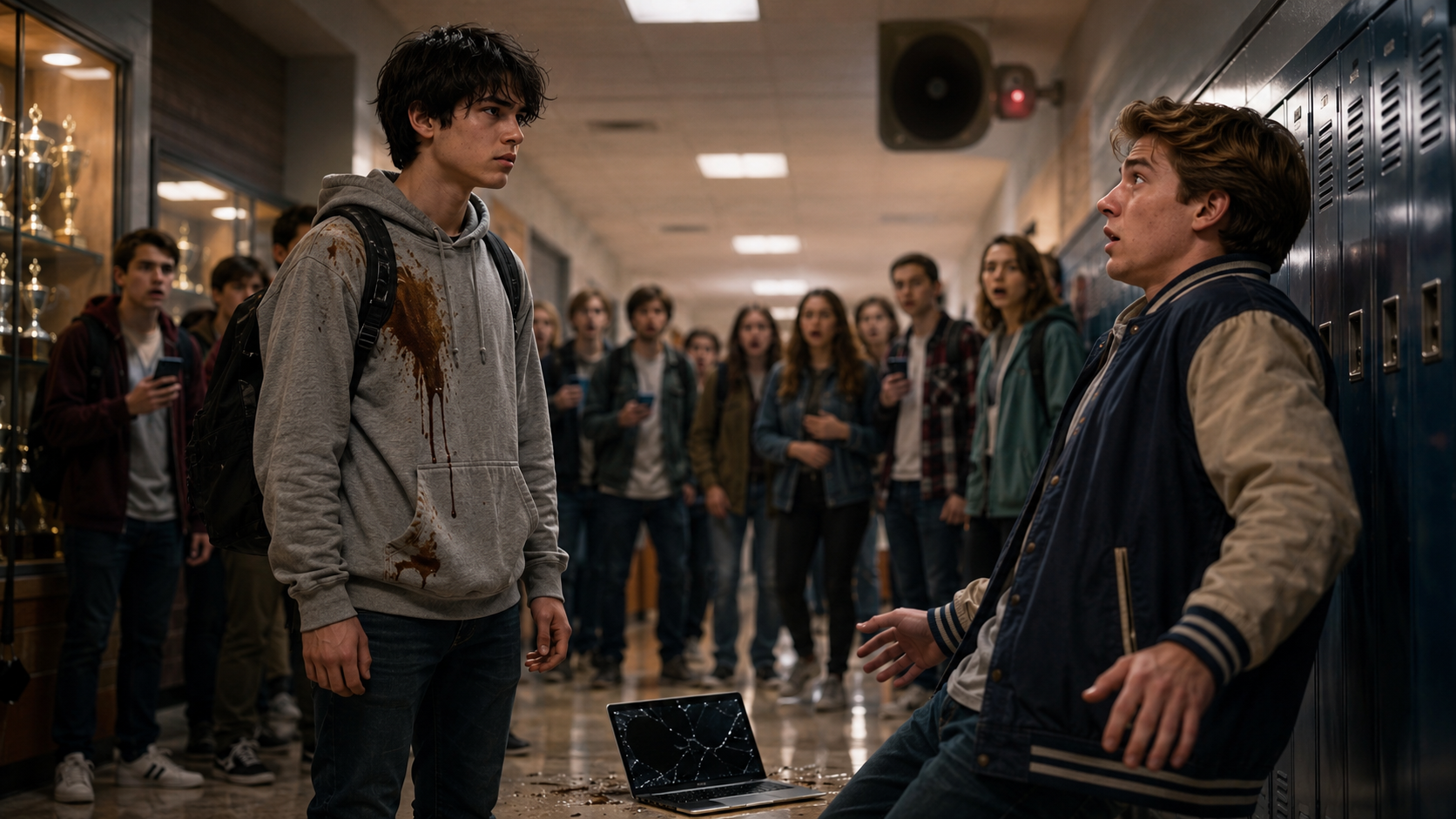
Evan’s eyes stayed on him.
“You said it yesterday behind the gym.”
Blake opened his mouth, but no words came out.
That was when Mrs. Linton pushed through the crowd.
She was Evan’s engineering teacher, a small woman with silver glasses and the kind of calm voice that made even angry students lower theirs. She took one look at Evan’s soaked hoodie, the broken laptop, and Blake’s panicked face.
Then she turned to the principal.
“What happened?”
Principal Mercer answered too quickly.
“There was a misunderstanding.”
Mrs. Linton looked at the laptop.
“A misunderstanding doesn’t destroy a computer.”
“There was an incident,” he said. “I have it under control.”
“No,” she replied. “You don’t.”
The hallway went silent again.
Mrs. Linton faced Evan, and her voice changed.
“Evan, are you hurt?”
His throat tightened.
Not because of the question.
Because she had said his name.
Not “young man.”
Not “buddy.”
Not “the quiet one.”
Evan.
Like he existed.
He shook his head.
“My laptop is dead.”
Her eyes softened.
“What was on it?”
Evan swallowed.
“My scholarship project.”
Blake’s mouth twitched.
Principal Mercer stepped in. “We can discuss that privately.”
Mrs. Linton ignored him.
“What project, Evan?”
He looked at the cracked screen.
Then at the crowd of students who had spent months walking past him while Blake shoved him into lockers, stole his notes, mocked his clothes, and called him names loud enough for teachers to hear.
“The WitnessNet system,” Evan said.
A ripple moved through the hallway.
Someone whispered, “That was him?”
Mrs. Linton nodded slowly.
“Yes,” she said. “That was him.”
WitnessNet was not just another student project.
It was an anonymous reporting platform Evan had built from scratch. A system where students could upload videos, voice recordings, screenshots, and written reports without revealing their identities. It automatically timestamped every file. It sent copies to multiple trusted adults. It prevented a single administrator from deleting a complaint before anyone else saw it.
Evan had built it because he knew exactly how schools protected their image.
He had built it because every hallway had witnesses.
But witnesses were afraid.
And fear made cowards out of good people.
Blake let out a sharp, nervous laugh.
“Of course he built a snitch machine.”
Nobody laughed with him.
That frightened him more than anger would have.
Mrs. Linton turned to the principal.
“That project was due today at noon.”
“I’m aware,” Mercer said.
“And you told the scholarship committee Blake Hargrove was the school’s strongest candidate.”
“Blake has leadership experience.”
Mrs. Linton’s voice hardened.
“Blake once asked me how to unzip a folder.”
A few students made choking sounds, trying not to laugh.
Blake’s ears turned red.
“This is inappropriate,” Principal Mercer snapped.
“No,” Mrs. Linton said. “This is overdue.”
That word moved through Evan like electricity.
Overdue.
That was what it was.
Not sudden.
Not dramatic.
Not one accident in a hallway.
Overdue.
Overdue was the freshman Blake made cry in the cafeteria.
Overdue was the girl whose science project he threw in the trash because she wouldn’t let him copy her notes.
Overdue was the boy who transferred after Blake spread a rumor about him.
Overdue was every teacher who looked away because Blake’s father funded their programs.
Overdue was every administrator who called cruelty “conflict” and fear “miscommunication.”
Then the speakers crackled again.
A third recording began.
Blake’s voice filled the hallway.
“Mercer said if Cole misses the deadline, nobody can prove anything. Just make sure the laptop doesn’t turn on again.”
This time, the hallway exploded.
Students shouted.
Someone cursed.
A few people turned their cameras toward Principal Mercer.
His face drained of color.
Blake backed into the lockers.
“No,” he said. “No, that’s not—”
The recording continued.
Then Grant Hargrove’s voice came through again.
“After the scholarship, your application looks clean. My company gets the donor spotlight, Mercer gets his board position, and that quiet kid goes back to being invisible.”
Invisible.
Evan closed his eyes.
That word should have hurt.
It had once.
But now, hearing it through the speakers while hundreds of students watched Blake and Mercer fall apart, the word felt different.
It sounded less like a sentence.
More like a mistake.
Because Evan was not invisible now.
Everyone could see him.
Coffee-soaked hoodie.
Shaking hands.
Broken laptop.
Recorder in his sleeve.
Flash drive in his pocket.
Truth in the air.
Principal Mercer stepped toward him again.
“Evan, give me the recorder now.”
Half the hallway moved.
Not far.
Not aggressively.
Just enough.