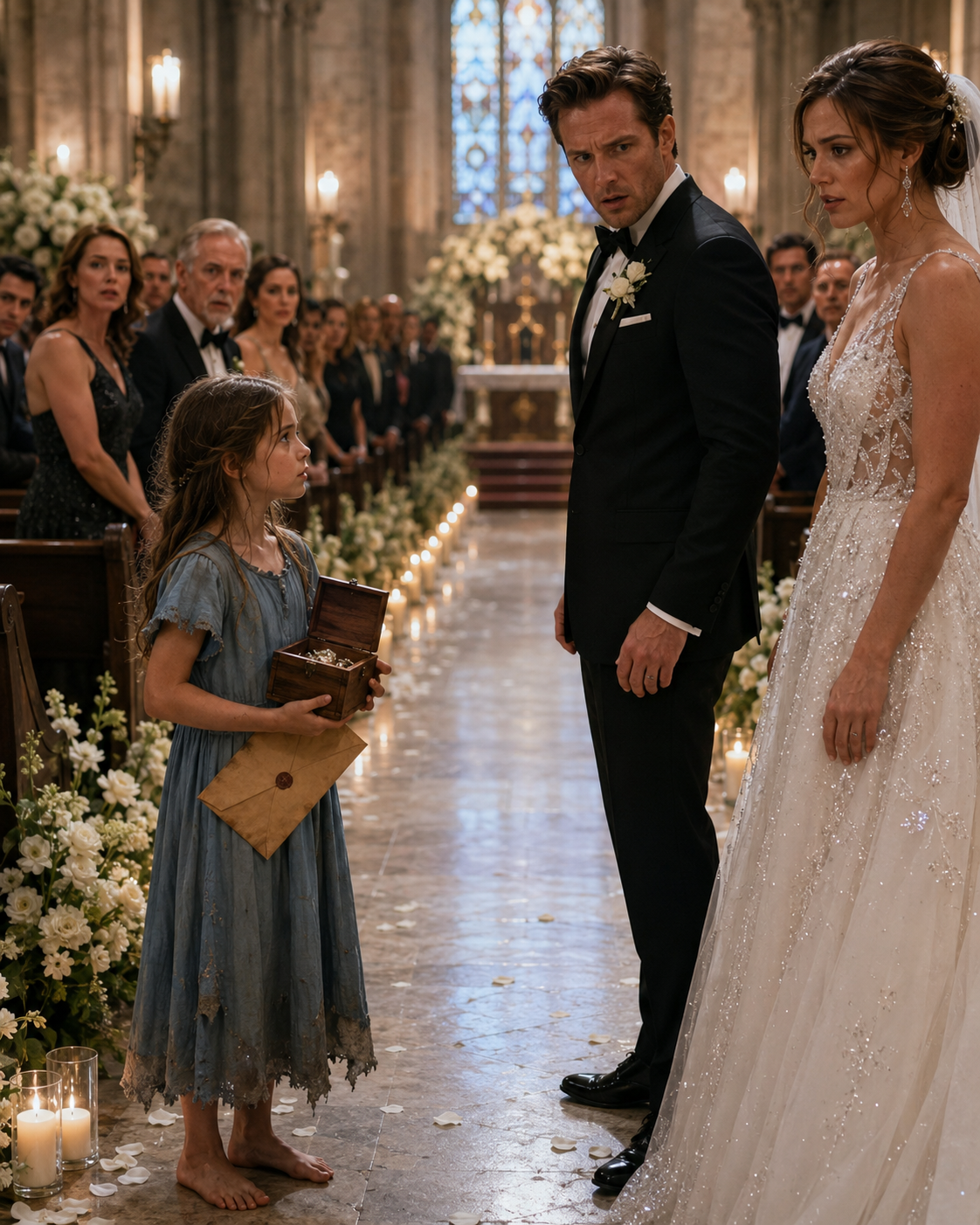
By sunset, the chapel was empty.
The roses still covered the columns. The untouched wedding cake stood in the ballroom. Hundreds of candles continued burning as though the celebration might resume at any moment.
Nathaniel sat alone in the first pew.
Margaret joined him.
“Ellie is asleep in the library,” she said. “The doctor treated her feet. She had walked almost six miles after leaving the hospital.”
Nathaniel stared toward the altar.
“Why didn’t you tell me about Hannah?”
“I was afraid.”
“So was she.”
“Yes.”
“And she still found a way to tell the truth.”
Margaret lowered her head.
“I failed her.”
Nathaniel looked at the old housekeeper who had helped raise him.
“Then help me repair what can still be repaired.”
The investigation lasted several months.
Auditors uncovered years of false invoices, offshore transfers, and hidden partnerships. Richard Whitmore had treated the charitable foundation as his private account. Celeste had helped conceal documents, intimidate witnesses, and maintain access to the Ashford family.
Her engagement to Nathaniel had been carefully planned.
Her feelings for him may eventually have become real, but the relationship had begun as another financial strategy.
Nathaniel refused every request to meet her privately.
He testified, surrendered his authority over the foundation to an independent board, and sold several properties to restore the missing funds before the courts completed the recovery process.
He also reopened every project that had been abandoned because of the stolen money.
A clinic was completed in Hannah Monroe’s neighbourhood.
A legal assistance program was established for whistleblowers and low-income employees.
Nathaniel named neither program after himself.
He named both after Hannah.
Ellie moved into Blackwood Manor under temporary guardianship while the courts searched for relatives. None were able to care for her.
At first, she barely spoke to Nathaniel.
She ate dinner with Margaret in the kitchen and slept with the broken music box on the table beside her bed. Whenever a car stopped outside unexpectedly, she hid behind the curtains.
Nathaniel did not pressure her.
He left books near her door, repaired the loose wheel on her small suitcase, and made certain no employee entered her room without knocking.
Weeks passed.
One rainy evening, he found Ellie sitting at the piano in the dark ballroom.
“I don’t know how to play,” she said.
“Neither do I.”
“You own a piano.”
“I also own three vineyards, and I know almost nothing about grapes.”
Ellie looked at him for several seconds.
Then she laughed.
It was the first time he had heard her do so.
Nathaniel sat beside her and pressed a random key.
The note echoed through the empty room.
“That sounded terrible,” Ellie said.
“It was an experimental composition.”
“It sounded like a doorbell.”
“An emotional doorbell.”
She pressed another key.
Together, they produced a disorderly collection of notes that would have horrified any trained musician.
Margaret watched from the doorway without interrupting.
A year after the wedding that never happened, Nathaniel petitioned to adopt Ellie.
The judge asked the girl whether she understood what adoption meant.
Ellie nodded.
“It means I can stay even when there isn’t a problem to solve.”
Nathaniel looked down, unable to hide his emotion.
The judge smiled.
“Yes. That is exactly what it means.”
After the adoption became official, Ellie asked to visit the chapel.
The wedding decorations had long since been removed. The marble floor was empty, and morning sunlight poured through the tall windows.
She walked to the place where she had first stood before Nathaniel.
“This is where everyone stared at me,” she said.
“They should have been staring at the people who were afraid of you.”
“I was afraid too.”
Nathaniel stood beside her.
“Courage does not mean you weren’t afraid.”
Ellie placed the repaired music box on the altar.
Nathaniel had restored the broken hinge but had left the faded stars untouched.
The melody began playing softly.
“My mother liked this song,” Ellie said.
“She gave you something more valuable than evidence.”
“What?”
“She taught you that the truth still matters, even when powerful people want it buried.”
Ellie looked at him.
“Did I destroy your wedding?”
Nathaniel thought about the question.
“No.”
He looked around the quiet chapel.
“You arrived just in time to save me from it.”
The girl slipped her hand into his.
Together, they walked toward the open doors.
A year earlier, Ellie had entered the chapel barefoot, exhausted, and alone, carrying a secret that wealthy people had spent a decade trying to hide.
She left that day without knowing what would happen next.
Now she walked out wearing new shoes, holding her father’s hand, and carrying no envelope at all.
She no longer needed to deliver the truth.
Everyone had finally heard it.