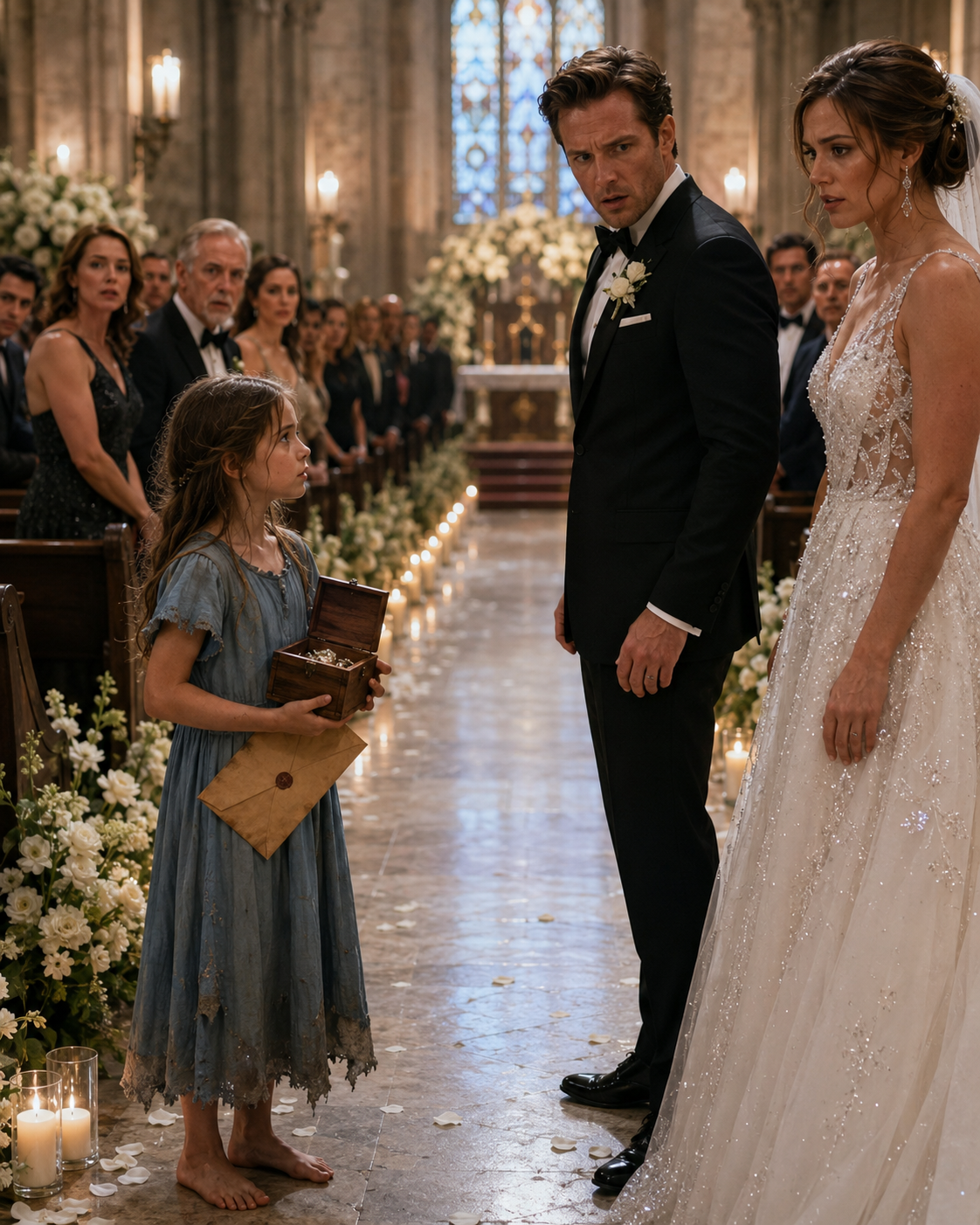
The girl continued toward him.
Celeste stepped forward.
“This is absurd. She is clearly confused.”
The girl looked directly at her.
“You know who I am.”
A wave of murmurs moved through the guests.
Celeste’s father descended from the pew.
“That is enough.”
He reached toward the girl, but Nathaniel moved between them.
“Do not touch her.”
Richard stopped.
Nathaniel’s voice was controlled, but everyone who worked with him understood that tone. It meant his patience had ended.
He crouched so that he was at the girl’s eye level.
“What is your name?”
“Ellie.”
“Ellie what?”
“Ellie Monroe.”
Nathaniel searched his memory, but the name meant nothing to him.
“Who is your mother?”
Ellie looked down at the music box.
“Her name was Hannah Monroe.”
The elderly housekeeper made a faint sound.
Nathaniel turned.
“Margaret?”
Margaret’s face had gone pale.
“Hannah worked here,” she said. “A long time ago.”
Celeste immediately shook her head.
“Hundreds of people have worked for the Ashford family. That proves nothing.”
Margaret ignored her.
“She was employed in the accounting office of the Ashford Relief Trust. She was intelligent, careful, and painfully honest.”
Nathaniel frowned.
“Why don’t I remember her?”
“Because she disappeared before you returned from London to take control of the company.”
Ellie held out the envelope.
“My mother said this belongs to you.”
Nathaniel accepted it.
The heavy cream paper was stained around the edges. His name had been written across the front in uneven handwriting.
Celeste moved closer.
“Nathaniel, please. This can wait until after the ceremony.”
He looked at her.
“Do you know what is inside?”
“No.”
Her answer came too quickly.
Ellie looked up at him.
“She does.”
The bride’s polished smile vanished.
Richard Whitmore signalled discreetly to one of the security officers.
“Take the child somewhere comfortable,” he said. “We will contact the proper services and determine who sent her.”
“No one sent me,” Ellie replied. “I came by myself.”
Nathaniel studied her muddy feet.
“From where?”
“St. Anne’s Hospital.”
The chapel became even quieter.
“My mother was there,” Ellie continued. “She died this morning.”
Nathaniel’s anger gave way to shock.
“I’m sorry.”
Ellie nodded as though she had heard the words too many times to respond to them.
“She made me promise that I would bring you the envelope and the music box. She said that once Miss Whitmore became your wife, they would move the money again and nobody would ever find it.”
Nathaniel stood.
“What money?”
Celeste turned toward him.
“She is repeating something an adult told her. You cannot seriously believe this.”
“I asked what money.”
Celeste’s father stepped beside her.
“This is neither the time nor the place for a discussion about business.”
Nathaniel looked around at the guests.
A moment earlier, their presence had seemed important. Now they were merely witnesses.
“Apparently, someone worked very hard to make certain this became the time and place.”
He broke the seal.
Inside the envelope were several bank statements, an old photograph, a small brass key, and a handwritten letter.
The photograph showed four people standing outside an Ashford Foundation office nearly ten years earlier.
Margaret was one of them.
Hannah Monroe stood beside her, younger and healthier than the woman Ellie had described. On Hannah’s other side stood Richard Whitmore.
And beside Richard was Celeste.
Nathaniel raised his eyes.
“You told me you had never met anyone named Hannah Monroe.”
Celeste stared at the photograph.
“I don’t remember every employee I met at a foundation event.”
Margaret came forward.
“That was not a foundation event.”
Her voice trembled, but not from fear.
“That photograph was taken the night Hannah discovered the missing accounts.”
Richard Whitmore’s jaw tightened.
“You are an employee, Margaret. Remember your place.”
Margaret faced him.
“I remembered my place for ten years. That was my greatest shame.”
Nathaniel unfolded the letter.
The first line was addressed to him.
Nathaniel,
You do not know me, although your signature changed my life.
He looked up sharply.
“My signature?”
Hannah’s letter explained that she had worked as a junior accountant for the Ashford Relief Trust. While preparing an annual report, she discovered payments being transferred to construction companies that existed only on paper.
The companies had received millions intended for children’s clinics, shelters, and emergency housing.
Each transfer had been approved with Nathaniel’s electronic signature.
But Nathaniel had been abroad during several of the approval dates.
Hannah concluded that someone inside the foundation had copied his authorization credentials.
She gathered evidence and tried to contact him directly.