But this time, Elena stood at the front of the room in a deep green dress, speaking into a microphone about childcare, wages, and the quiet courage of women who keep moving even when the world asks them to disappear.
Her voice shook once.
Then it steadied.
Julian watched from the side of the room.
Rosie, now seven, stood beside him with Sir Hopswell tucked under her arm.
“Mama is brave,” she whispered.
Julian smiled. “She is.”
Rosie looked up at him.
“You were sad before.”
He glanced down, surprised.
“Yes,” he said. “I was.”
“You’re not sad like that now.”
“No,” he said. “Not like that.”
Rosie nodded, satisfied.
Then she said, “You should tell Mama you love her.”
Julian nearly choked on his water.
“Rosie.”
“What? Sir Hopswell agrees.”
“Some things require timing.”
Rosie sighed with the full exhaustion of a child surrounded by foolish adults.
“That’s what grown-ups say when they’re scared.”
Julian looked toward Elena. She was laughing now as the audience applauded, one hand pressed to her heart, her face bright in a way he had never seen on the day of the ruined wedding.
Maybe Rosie had told the truth again.
Later that night, after the guests left and the last glasses were cleared, Julian found Elena on the terrace.
The gardens stretched silver beneath the moon.
“You were extraordinary tonight,” he said.
Elena smiled. “I almost fainted.”
“No one noticed.”
“I noticed.”
They laughed softly.
Then silence settled between them. Not empty silence. Not awkward silence. The kind of silence that holds every word two people are afraid to say.
Julian looked at her.
“Elena, I need to tell you something. You don’t have to answer tonight. You don’t have to answer ever, if you don’t want to.”
Her breath caught.
He continued.
“I spent a long time mistaking beauty for goodness. Charm for loyalty. Attention for love. But you showed me something different. Real love is quieter. It stays. It notices. It protects without needing applause.”
Elena’s eyes shone.
“Julian…”
“I love you,” he said. “Not because Rosie saved me. Not because you stayed. Not because I owe you anything. I love you because when I finally learned how to see clearly, you were there.”
Elena looked away toward the dark garden.
For one terrible moment, Julian thought he had ruined everything.
Then she reached for his hand.
“I’m scared,” she whispered.
“So am I.”
“I won’t let Rosie be hurt.”
“Neither will I.”
She turned back to him.
“Then we go slowly.”
Julian smiled.
“Slowly is perfect.”
A year later, they married in the garden.
Not in the ballroom.
No champagne tower. No crowd of strangers. No six-tier cake waiting under lights. Only close friends, staff who had become family, sunlight through old trees, and Rosie walking first down the aisle with Sir Hopswell wearing a tiny blue ribbon.
The cake was small.
Chocolate, because Rosie declared vanilla had “a suspicious history.”
Everyone laughed.
Elena laughed too.
This time, no one laughed at her.
Julian wrote his own vows.
He did not promise wealth.
He did not promise perfection.
He promised attention.
To notice.
To listen.
To never again let gentleness become invisible in his home.
Elena promised courage.
Not the loud kind.
The daily kind.
The kind that wakes up early, packs lunches, pays bills, tells the truth, and keeps loving even after humiliation tries to teach the heart to close.
When the ceremony ended, Rosie tugged Julian’s sleeve.
“Can I say something?”
Elena laughed nervously. “Oh no.”
Julian lifted Rosie into his arms.
“Always.”
Rosie faced the small gathering. Her curls bounced in the wind. Sir Hopswell hung proudly from one hand.
“When I was little,” she announced, “I told a secret because somebody was lying. But now I have a new secret.”
Everyone leaned closer, smiling.
Rosie grinned.
“My mama is happy.”
Elena covered her mouth.
Julian closed his eyes for one second.
Because some sentences heal places that apologies cannot reach.
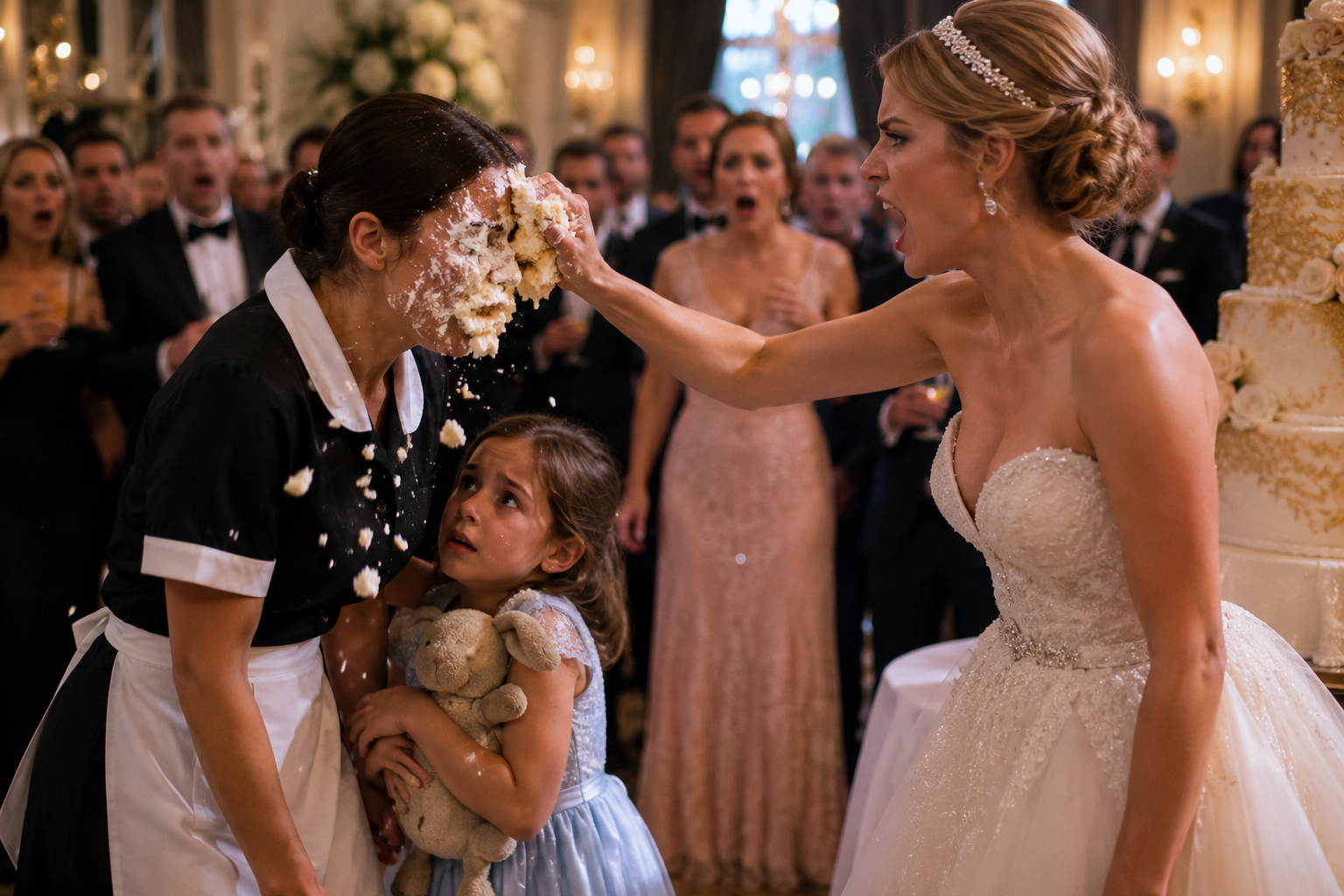
People still whispered about Julian Ashbourne’s first wedding for years afterward.
They remembered the cake.
The ruined bride.
The red car.
The little girl in pajamas.
But inside Ashbourne Manor, that was not how the story was told.
Rosie told it differently.
She said there was once a man who lived in a beautiful house but forgot how to see small things. There was a woman who worked too hard and cried too quietly. There was a false princess who lied. And there was a brave rabbit who witnessed everything.
Then, Rosie would say, the truth came out.
And after that, everybody learned.
Julian learned that love without respect is only decoration.
Elena learned that dignity can bend without breaking.
Rosie learned that even the smallest voice can shake the tallest walls when it speaks for someone it loves.
That was the real ending.
Not revenge.
Not money.
Not scandal.
The real ending was a home where no child had to whisper the truth twice.
A home where kindness was not mistaken for weakness.
A home where every spring, white roses bloomed near the terrace — not as symbols of a perfect wedding, but as proof that even after cruelty, something beautiful can still grow.