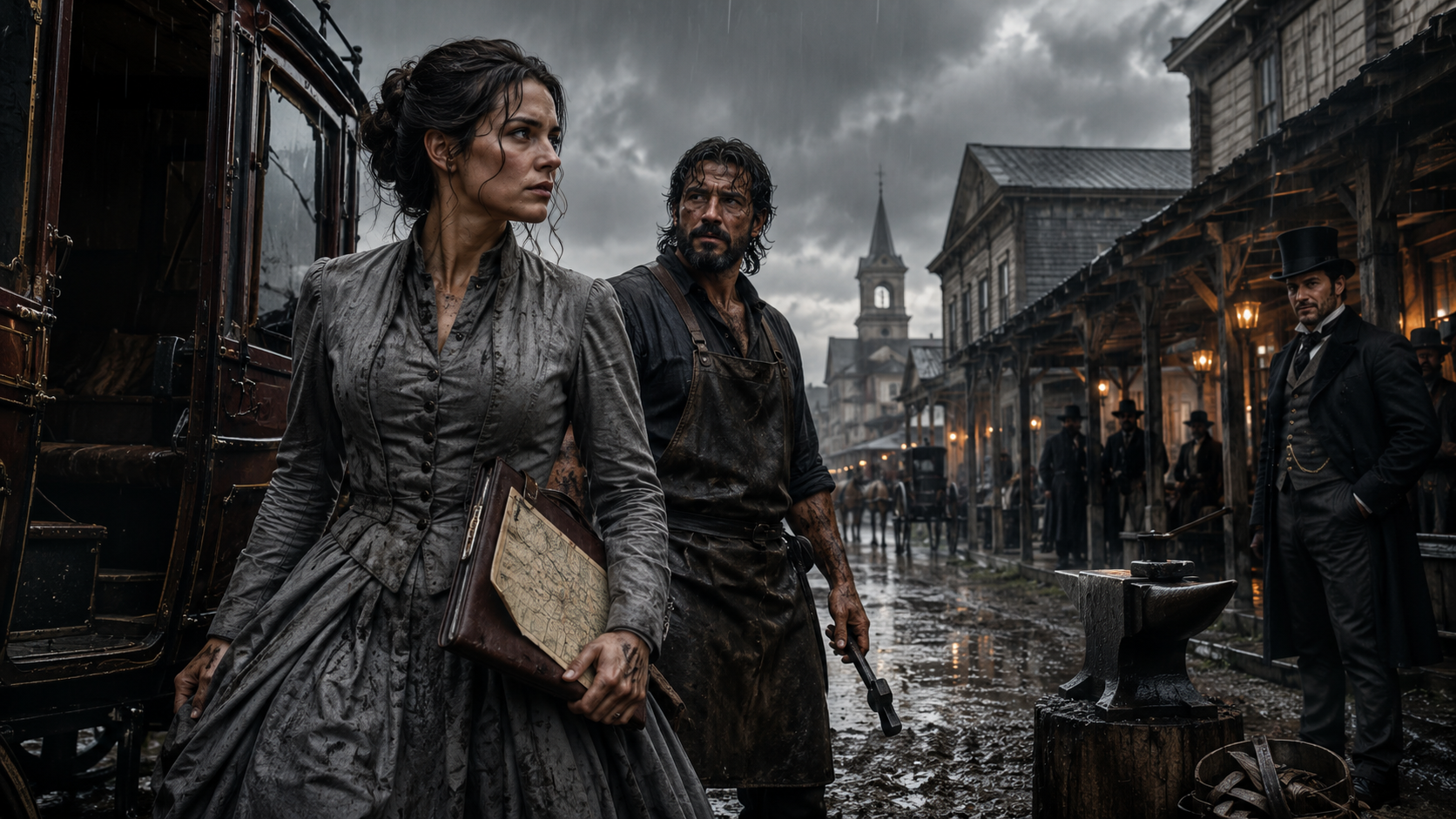
“The freight yard,” Elias said.
“Most of it.”
“And the mill road?”
“Yours.”
“And Vale knew?”
Maren answered. “He knew enough to burn the archive.”
Harrow nodded. “Which has made him careless. Careless men leave witnesses. Witnesses leave statements. Statements become doors.”
“Doors to what?” Elias asked.
“To court, Mr. Wren. And perhaps to prison.”
For a moment, Elias saw his father at the kitchen table years ago, head bowed over tax notices for land he believed he had lost fairly. He saw his mother selling the good plates. He saw himself at seventeen, carrying timber for Vale’s mill because there had been no other work. He saw the quarry explosion, the fire, the men who ran, the hand that did not pull him out until Maren’s map had, years later, pulled him from another kind of grave.
His voice came low. “I do not want only money.”
“No,” Maren said softly. “You want the truth restored.”
He looked at her.
“Yes.”
“Then we restore it loudly.”
Vale struck first.
He filed a claim accusing Elias of forging markers and conspiring with an unmarried woman of “uncertain reputation” to extort property from respectable businessmen. He produced three witnesses, all drunk enough to be useful and frightened enough to be loyal. He arranged for the town magistrate to issue a temporary order forbidding Elias from interfering with the freight yard.
Then he sent men at night to remove the remaining boundary stones.
Maren had expected that.
Elias had expected worse.
Together, they waited in the trees above the ridge with Harrow’s clerk, two hired surveyors, and a deputy from the next county who had no affection for Vale’s money because he had never tasted it.
At midnight, lanterns appeared below.
Three men crept across Elias’s land carrying shovels and pry bars. One was Benlow, the archive clerk. He complained the entire way.
“This is grave work,” he whispered.
“Stones ain’t graves,” said another.
“They are tonight,” Maren murmured.
Elias glanced at her.
She did not smile.
When the men began digging at the third marker, the deputy stepped out with his pistol raised.
“Gentlemen,” he called. “You are working late.”
Benlow screamed and dropped his shovel.
The others ran.
They did not get far. Elias moved through the dark with a surety that belonged to the ridge, not the road. He caught one by the collar and threw him into the mud. The deputy caught the second. Benlow sank to his knees before anyone touched him.
“I was ordered,” he sobbed.
Maren stepped into the lantern light. “By whom?”
Benlow looked at her and seemed to understand, too late, that the woman the town had laughed at had become the one holding the open door to his future.
“Vale,” he whispered.
“Louder,” said Maren.
“Roderick Vale ordered it.”
“Again.”
“Roderick Vale ordered it!”
The statement was written before dawn.
By noon, Ashwick Hollow knew.
By supper, Vale knew everyone knew.
That night, he stopped pretending.
He gathered twelve men from the tavern, the kind who owed him money, feared him, admired him, or could not tell the difference. They armed themselves with rifles and rode toward Elias’s farm under a moon hidden by clouds. Vale believed force could still achieve what fraud had failed to secure. Burn the house. Destroy the map. Frighten the woman. Kill Elias if necessary. By morning, witnesses would remember whatever Vale paid them to remember.
But the ridge had been prepared by people who understood both maps and violence.
Maren had studied the old quarry roads. Elias had walked the gullies since boyhood. Together, they knew every slope, ditch, loose stone, and blind turn. They did not intend to murder men. They intended to make cowards hear themselves.
The riders reached the narrow pass below the farmhouse shortly after midnight.
Vale lifted his hand.
Behind him, the men stopped.
The house above was dark.
Too dark.
“No lamp,” muttered one rider.
“He’s hiding,” Vale said.
“Or gone.”
Vale sneered. “Elias Wren does not run. He sulks.”
A voice answered from the black ridge above them.
“You never learned the difference.”
The men jerked toward the sound.
Elias stood on the rocky ledge to their left, rifle in hand, his scarred face pale in the moon’s brief break through cloud.
Vale swore. “Take him!”
No one moved.
A second voice came from the trees on the right.
“I would advise against that.”
Maren stepped into view with a lantern in one hand and Elias’s old survey map in the other. Behind her stood Deputy Cale from the next county, Mr. Harrow, two surveyors, and three farmers who had finally grown tired of renting courage from Roderick Vale.
Vale looked from one side of the pass to the other.
His men were boxed in.
Still, arrogance has a long death.
“You think a woman with a map frightens me?” Vale shouted.
“No,” Maren said. “I think the map is only paper.”