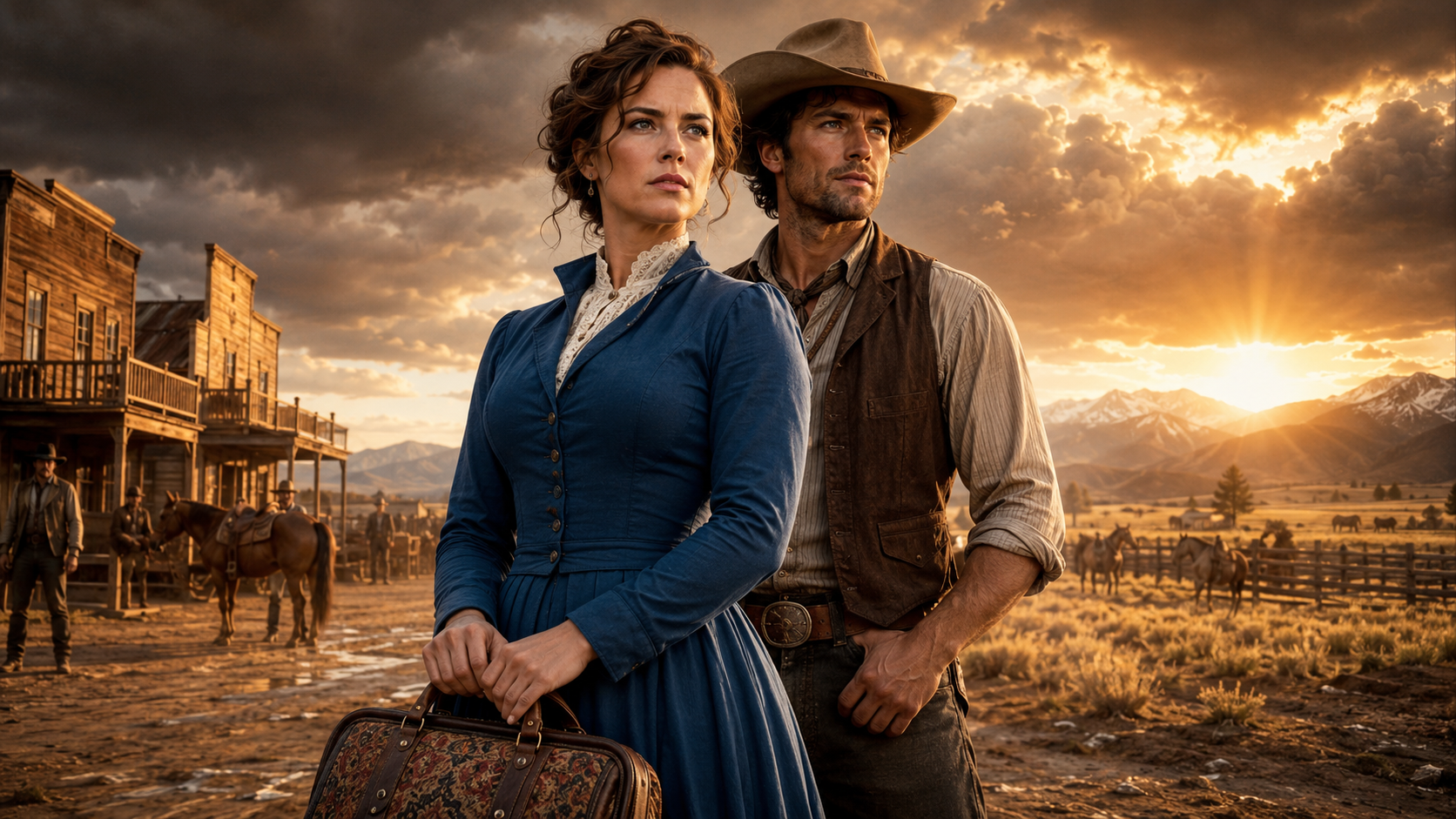
Then Caleb said, “I have another offer. This one I am asking before doing.”
“Wise.”
“I want to build a clinic near Copper Run. The valley needs one. Beatrice says you could run it.”
“Beatrice says many things.”
“She also says I am in love with you and too slow to mention it.”
Nora nearly dropped her cup.
Caleb looked at her directly, no teasing in his face now.
“I know you did not come here for me,” he said. “I know the last man who wrote you promises buried secrets inside them. I will not offer rescue. You have rescued yourself more than once. But if you ever wanted a partner, Nora Ashford, I would consider it the honor of my life to be chosen.”
The porch boards creaked in the wind.
Nora thought of Boston. Of silence. Of laughter at the station. Of Daniel’s letters. Of rain and blood and a man whispering her name as if it mattered.
She looked at Caleb Hawthorne, owner of half the valley, sitting helplessly with a broken leg and offering her not shelter, not pity, not purchase, but choice.
“I will not be chosen because I saved you,” she said.
“No.”
“And not because Mercy Bend feels guilty.”
“No.”
“And not because you think a woman who can stitch a wound can mend everything broken in you.”
His eyes lowered. “No.”
She softened. “Then ask me again when you can stand without wobbling.”
Caleb’s smile came slowly. “That may be a month.”
“I have crossed farther distances.”
He laughed then, and the sound moved through Nora like sunlight after a hard winter.
By autumn, the little white house had curtains.
Green ones.
The clinic opened with two rooms, a cabinet of medicines, a clean table, and a bell Nora rang whenever men argued with her instructions. Beatrice became its unofficial guard. Caleb donated land and money but learned quickly not to call it his clinic unless he wished to be corrected in public.
Mercy Bend changed because towns do change, though never as quickly as they claim. Some people remained foolish. Some remained cruel. But now, when a stranger stepped off the stage with hope in one hand and fear in the other, fewer people laughed.
Nora saw to that.
One bright morning, Deke Malloy came in with a nail through his palm and tears standing in his eyes.
Nora examined the wound.
“Will I lose the hand?” he asked.
“Not if you follow instructions.”
“I hate instructions.”
“I know. That is why you are here with a nail in your hand.”
Caleb, leaning in the doorway with a cane, turned his face away to hide a smile.
Later, when the clinic emptied, he walked with Nora to the porch.
He no longer wobbled.
Not much.
He stood before her, hat in his hands.
“Nora Ashford,” he said, “will you marry me?”
She pretended to consider.
“Do you promise never to make decisions about my house without telling me?”
“Yes.”
“Do you promise that if I say no, you will still fund the clinic roof repairs?”
“Yes.”
“Do you promise not to ride through a thunderstorm with broken bones again?”
He hesitated.
“Caleb.”
“I promise to make a sincere effort.”
“That is the best I will get, I suppose.”
He stepped closer. “Is that a yes?”
Nora looked down the street where she had once arrived unwanted, unclaimed, and laughed at. She looked at the house with green curtains, the clinic with its open door, the valley beyond town where water ran honestly again.
Then she looked at the man waiting for her answer.
“Yes,” she said. “But I am not marrying the owner of half the valley.”
“No?”
“No. I am marrying the man who finally learned to ask.”
Caleb laughed and drew her carefully into his arms.
Across the street, Beatrice Kane shouted, “About time!”
The whole town heard.
This time, when Mercy Bend laughed, Nora laughed with it.
And years later, when people told the story, they always began the same way:
A mail-order bride came west to marry a dead man, and fools said the groom was lucky to have escaped her.
But the fools were wrong.
Because the bride they mocked saved the richest cowboy in the valley, uncovered the crime that nearly stole the river, built a clinic where there had only been dust, and proved that a woman rejected at the station could still become the reason a whole town learned shame, courage, and grace.